

Five pillars
Complete governance is five capabilities arranged in a loop. The first two happen before an agent makes a single call; the middle two run on every call; the last one runs continuously across all of them.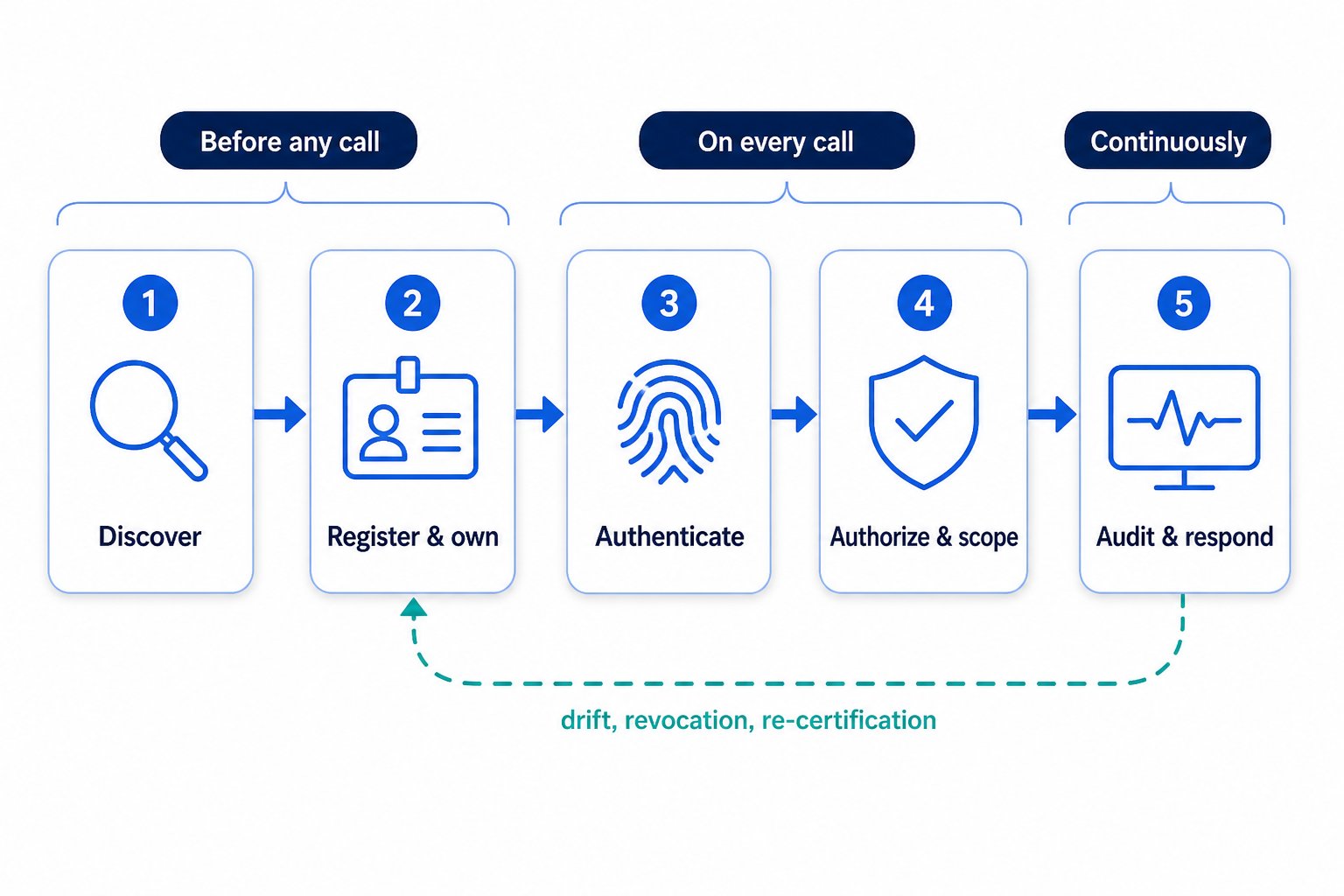
The five pillars: discover and register before any call, authenticate and authorize on every call, audit continuously — with findings feeding back into the registry
1. Discover: you can’t govern what you can’t see
Agents appear wherever teams can run code: cloud accounts, SaaS platforms with embedded copilots, developer laptops, CI pipelines. Discovery means continuously scanning those surfaces to build one inventory — including the shadow agents nobody declared — and flagging anything that is acting but not registered.
Discovery is a funnel, not a one-time census: found → triaged (owner assigned, purpose identified) → registered, and anything that skips the funnel gets denied at pillar 3.
2. Register and own: registration is the enforcement point
Every agent — however it was built, wherever it runs — gets a registry entry that carries four things:A verifiable identity
The credential the agent presents on every call. Issued by the platform, by your identity provider, or attested from the workload’s runtime (SPIFFE).
An accountable owner
A human or team that answers for the agent from creation to retirement.
A defined authority
The tools and data it may reach, the actions it may take, and whom it may act for — the boundary all behavior is measured against.
A lifecycle
Credential rotation and expiry, periodic re-certification, and a deprovisioning path.
3. Authenticate: resolve every identity on every call
At each hop, the enforcement point resolves all identities present — the user the request is for, and the agent making the call. They are different principals and both matter. Two refinements harden this in production:- Per-agent vs. per-instance. The registered identity is the stable principal you govern. Each running instance can additionally carry a short-lived attested credential (a SPIFFE SVID) bound to that identity — giving you a surgical kill switch for one rogue instance without invalidating the fleet.
- Sender-constrained tokens. A bearer token can be replayed by whoever steals it — a real risk for agents that can be prompt-injected. Where the target supports it, bind tokens to the sender with mTLS (RFC 8705) or DPoP (RFC 9449).
4. Authorize and scope: the per-hop loop
This pillar is where governance actually meets the wire, and it is a fixed five-step loop the gateway runs at every hop of the agentic call path:1
Authenticate
Resolve the user and the calling agent from the credentials on the request. No registered identity, no call.
2
Authorize
Evaluate access control before any token is minted: may this agent call this target? May it act on behalf of this user? Is this specific tool within the agent’s allowed scope? Attribute-based rules (time of day, chain depth, environment) layer on top.
3
4
Guard
Run content guardrails — pre-tool checks on the request (PII, prompt injection, unsafe arguments) and post-tool checks on the response (secrets, redaction).
5
Forward and record
Forward the scoped token to the callee — which enforces its own policy on top — and record the hop: subject, actor chain, decision, scopes.
Because every hop is an explicit, authorized exchange, three properties fall out for free: per-hop attribution (who did what, for whom, through which path), least-privilege tokens (a leaked token is good for one callee and one scope), and central control (who-can-call-what lives in one place, revocable instantly).
5. Audit and respond: close the loop
Every hop the gateway forwards, it also records — which turns governance from a policy document into an operational system:Why the gateway is the enforcement point
Each pillar could in principle live in a different tool. What makes the model coherent is placing enforcement at a gateway on the call path, because it is the only component that:- sees every hop — agents, sub-agents, and tools all pass through it, regardless of framework or cloud;
- can carry identity forward — it drives the token exchange at each hop, so the user is never lost and the actor chain always grows;
- can narrow authority at each step — it mints the scoped credential for exactly the next callee;
- is platform-neutral — Entra governs Entra agents, Okta governs Okta apps, Bedrock governs Bedrock agents; the gateway governs the path across all of them, which is where the risk actually lives.
A maturity model
Use this to locate where you are and what to build next. Each level is useful on its own; each is a prerequisite for the next.Level 1 is achievable in a day and removes the largest risk (anonymous agents). Levels 2 and 3 are incremental — nothing at a lower level has to be redone.