.png)
|
Lesedauer: 5 Minuten


Erhalten Sie sofortigen Zugriff auf eine TrueFoundry-Live-Umgebung. Stellen Sie Modelle bereit, leiten Sie den LLM-Verkehr weiter und erkunden Sie die gesamte Plattform — Ihre Sandbox ist in Sekundenschnelle einsatzbereit, ohne dass eine Kreditkarte erforderlich ist.



Published:
.png)
Unglaublich schnelle Methode zum Erstellen, Verfolgen und Bereitstellen Ihrer Modelle!
The Notion MCP server is a remote Model Context Protocol server for Notion. MCP is the open standard that lets an agent discover and call tools on an external system; Notion’s implementation exposes workspace search, page and database reads and writes, and comments as callable tools.
TrueFoundry’s docs describe the surface as search, fetch, create and update pages, databases, and comments, with tools named in the notion-* convention — notion-search, notion-fetch, notion-create-pages, notion-update-page. Grouped by capability:
That Resources tab matters: most MCP servers expose tools only, so Resources is a second retrieval path that’s easy to miss when auditing what an agent can reach.
Being a remote server, there’s no container to run and no npx process per laptop — you point a client at a URL and authenticate, the pattern now standard across remote MCP servers.
The valuable uses chain tools, and lean on search because Notion content is unstructured by nature:
The read-versus-write split is sharper here than in most tools. Reads are the point — retrieval is why you connect it. Writes are convenient but rarely load-bearing, and they’re what can overwrite a page a human spent a week on. Usefully, Notion’s tools arrive already labeled Read-only or Destructive, so the Tools tab tells you which is which without any inspection.
Notion’s risk profile differs from a code host’s. The dangerous failure isn’t an agent maliciously rewriting a page — it’s an agent legitimately reading far more than anyone intended.
Permission inheritance makes scope invisible. Notion access is page-tree shaped: grant a parent page and the grant flows down to every child, grandchild, and database beneath it. When someone shares “the Engineering wiki” with an integration, they’re picturing the landing page. What they’ve actually granted is whatever accumulated under that node over three years — including the compensation planning page a manager nested there in a hurry. Nobody sets out to hand an agent HR data. Inheritance does it for them.
Workspace-level consent is coarse. Notion’s OAuth screen asks you to pick a workspace, then shows the categories granted — page and database access, search, workspace users. It never asks you to enumerate pages. The unit of consent is far bigger than the unit of need, so the honest default is “the agent can see a lot” unless something narrows it.
Search amplifies it. An over-broad grant would be survivable if an agent had to guess page URLs. It doesn’t. notion-search is a discovery tool: point an agent at a workspace and it will find the sensitive pages, because that’s its job. Retrieval quality and blast radius scale together.
Nobody can reconstruct what was read. Notion logs API activity. It doesn’t log that your internal support agent searched for “severance” while answering a question from a Slack thread. Reads are the risk surface, and reads are the least likely thing to get noticed after the fact.
None of this is a reason to skip the Notion MCP server. It’s a reason to put a control plane in front of it — what an MCP gateway exists to do.
On TrueFoundry, Notion is a TrueFoundry Managed MCP. TrueFoundry publishes platform-verified server definitions to a managed catalogue; to provision one you supply only a Name, and the platform handles every URL, auth detail, scope, and credential — keeping them current as the upstream provider changes them.
Step 1 — Open the catalogue. Go to MCP Servers in the sidebar, click Add new MCP Server, and select Connect TrueFoundry Managed MCPs. Find notion — catalogued as “Notion is a collaboration and productivity tool” — and click + Add. TrueFoundry registers the server and opens its detail page.
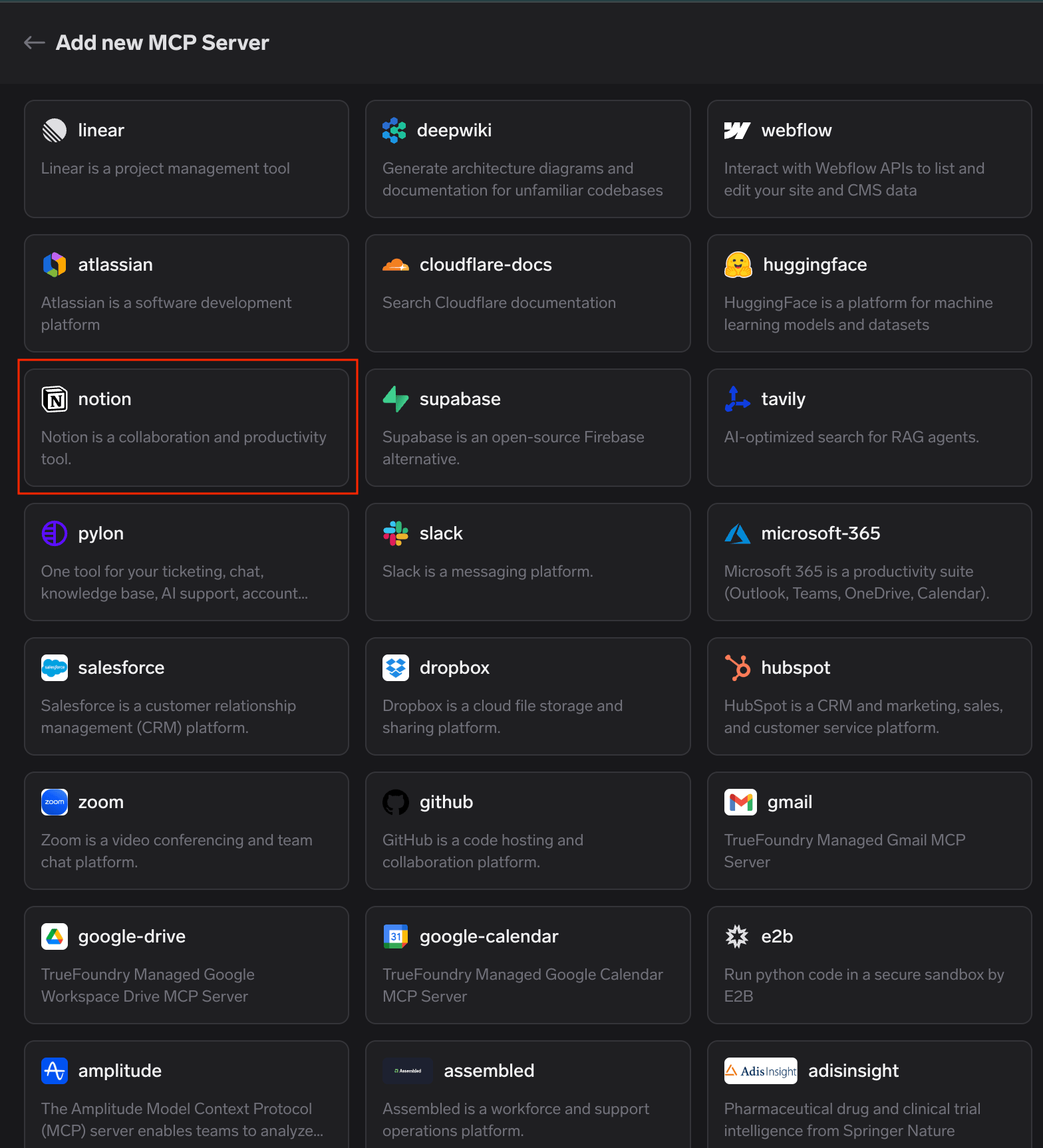
TrueFoundry managed MCP catalogue with the notion card highlighted among the available platform-verified MCP servers
That’s the entire registration — no URL to paste, no Notion integration to create, no client secret to store.
Step 2 — Start the connection. The Tools tab opens on “You’re not connected to this MCP Server.” Click Connect Now to begin OAuth2 authorization; the detail page shows the auth type before you click anything.
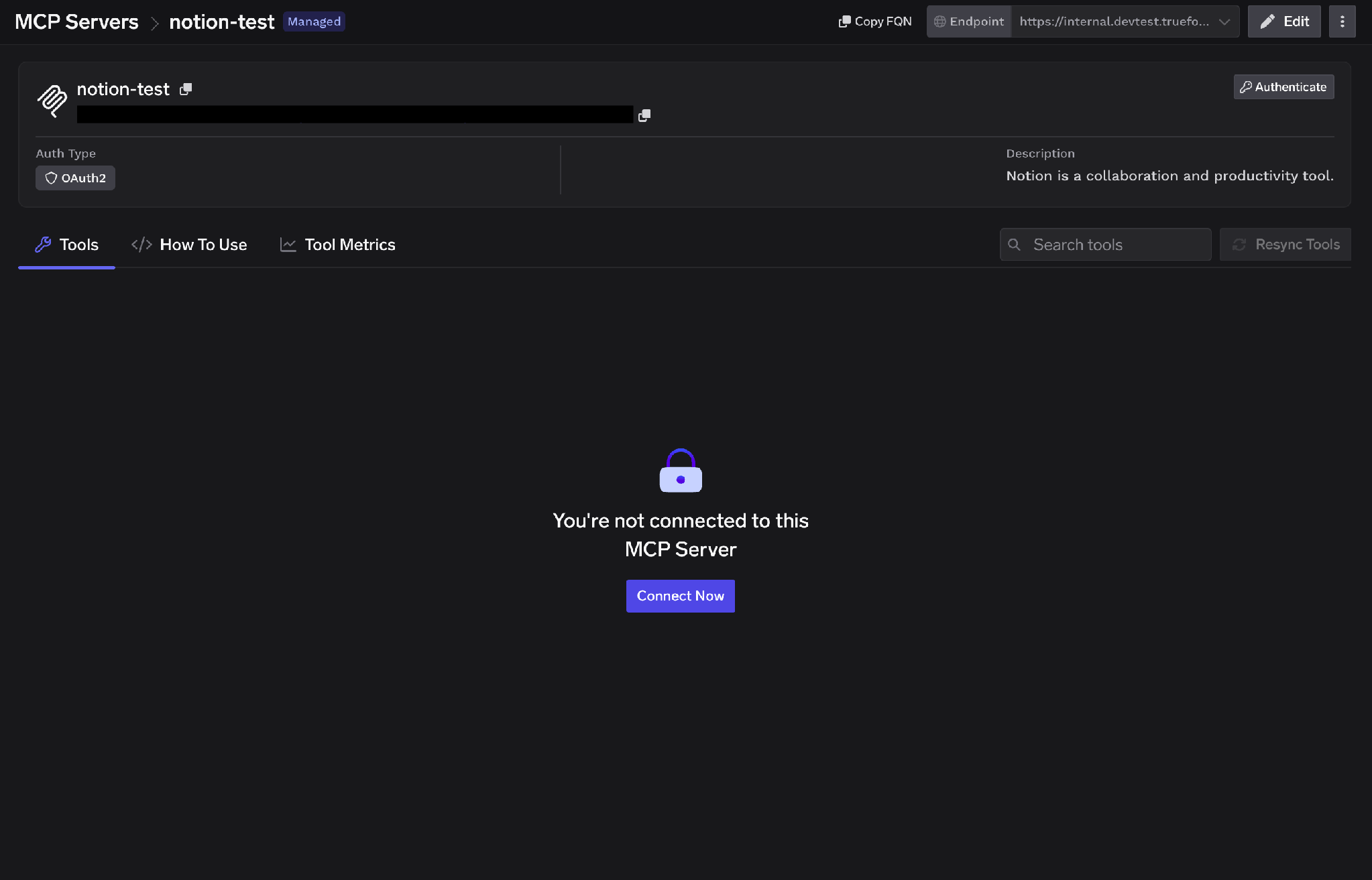
Notion MCP server detail page showing the OAuth2 auth type and the Connect Now button on the not-connected Tools tab
Step 3 — Approve at the gateway. A “Connect via TrueFoundry AI Gateway” popup shows the MCP Gateway URL, the redirect URL, and the servers to authorize. Review it and click Approve. You’re then redirected to each MCP server in sequence — worth knowing if you’re authorizing several at once, because the flow is a chain rather than one hop.
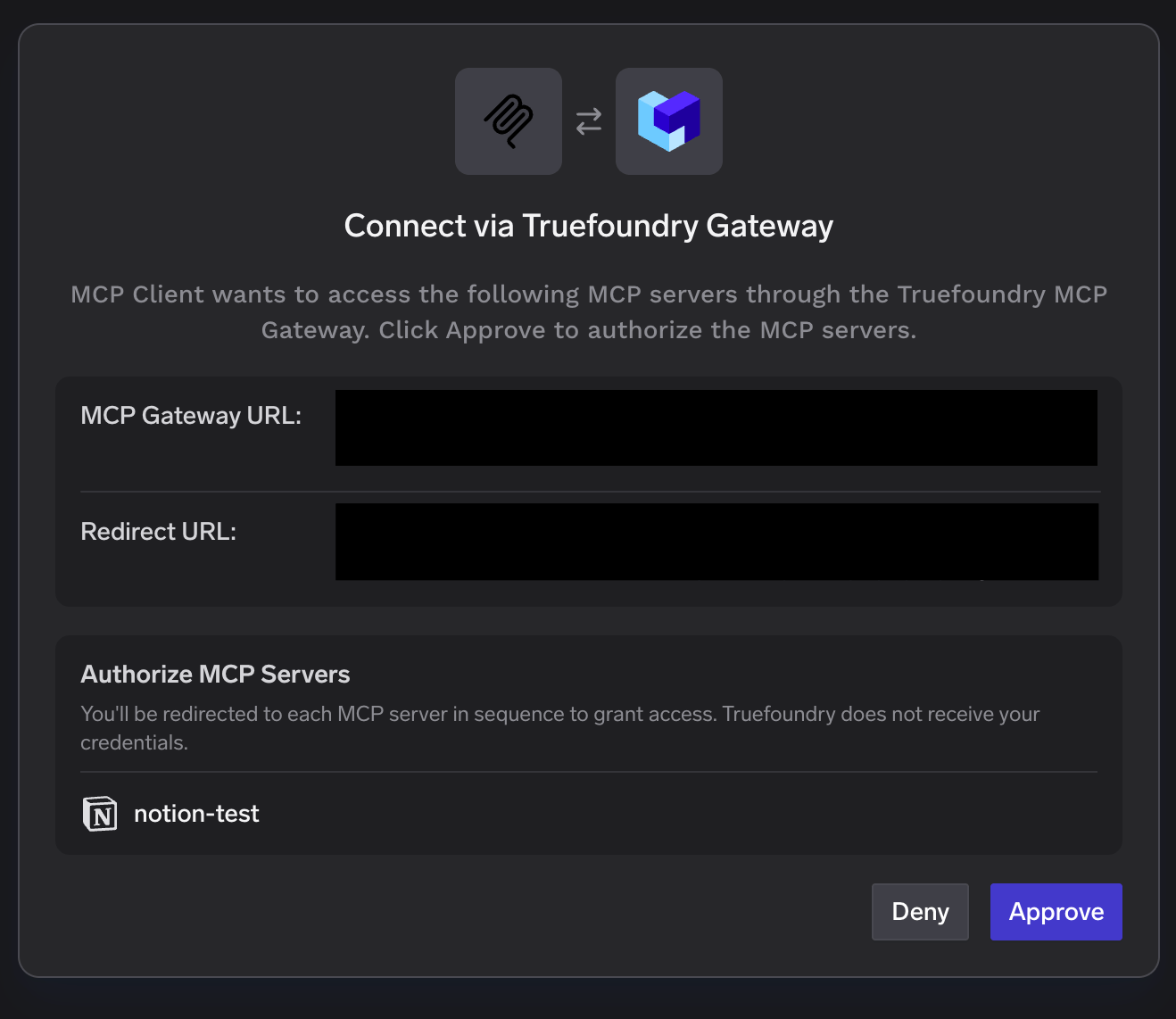
Connect via TrueFoundry AI Gateway popup listing the Notion server under Authorize MCP Servers with Deny and Approve buttons
Step 4 — Authorize your Notion workspace. Notion’s consent screen opens. Select the workspace, review the access being granted — page and database access, search, workspace users — confirm you trust the redirect URL, and click Continue.
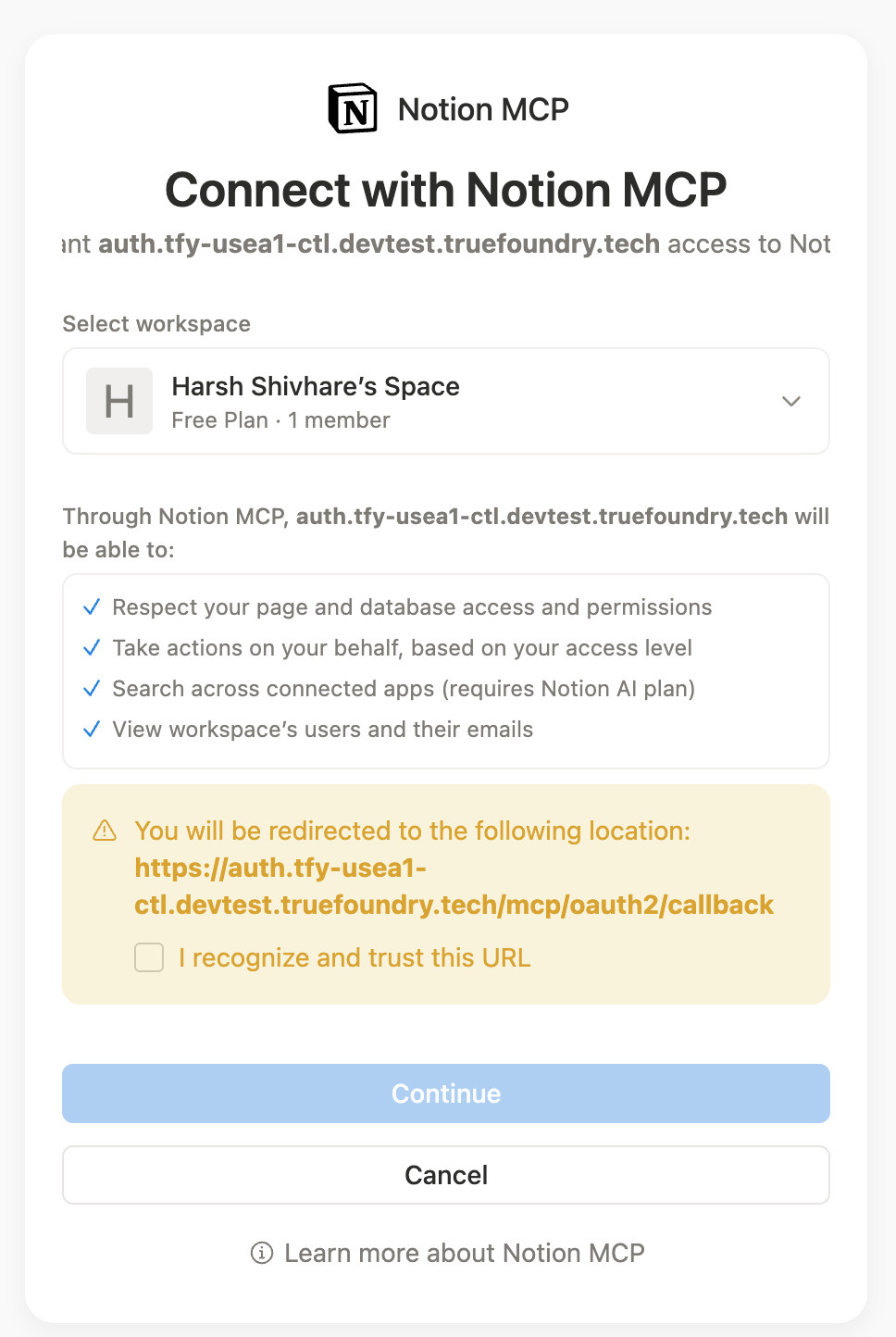
Connect with Notion MCP consent screen showing workspace selection, the list of granted permissions, and the Continue button
Read this screen slowly — it’s where the inheritance problem becomes a decision. Whoever clicks Continue is choosing how much of the workspace an agent can search.
Step 5 — Verify tools. The Tools tab populates with Notion’s tools, each with a description, a Try button, and a Read-only or Destructive label. Resources appear on their own tab.
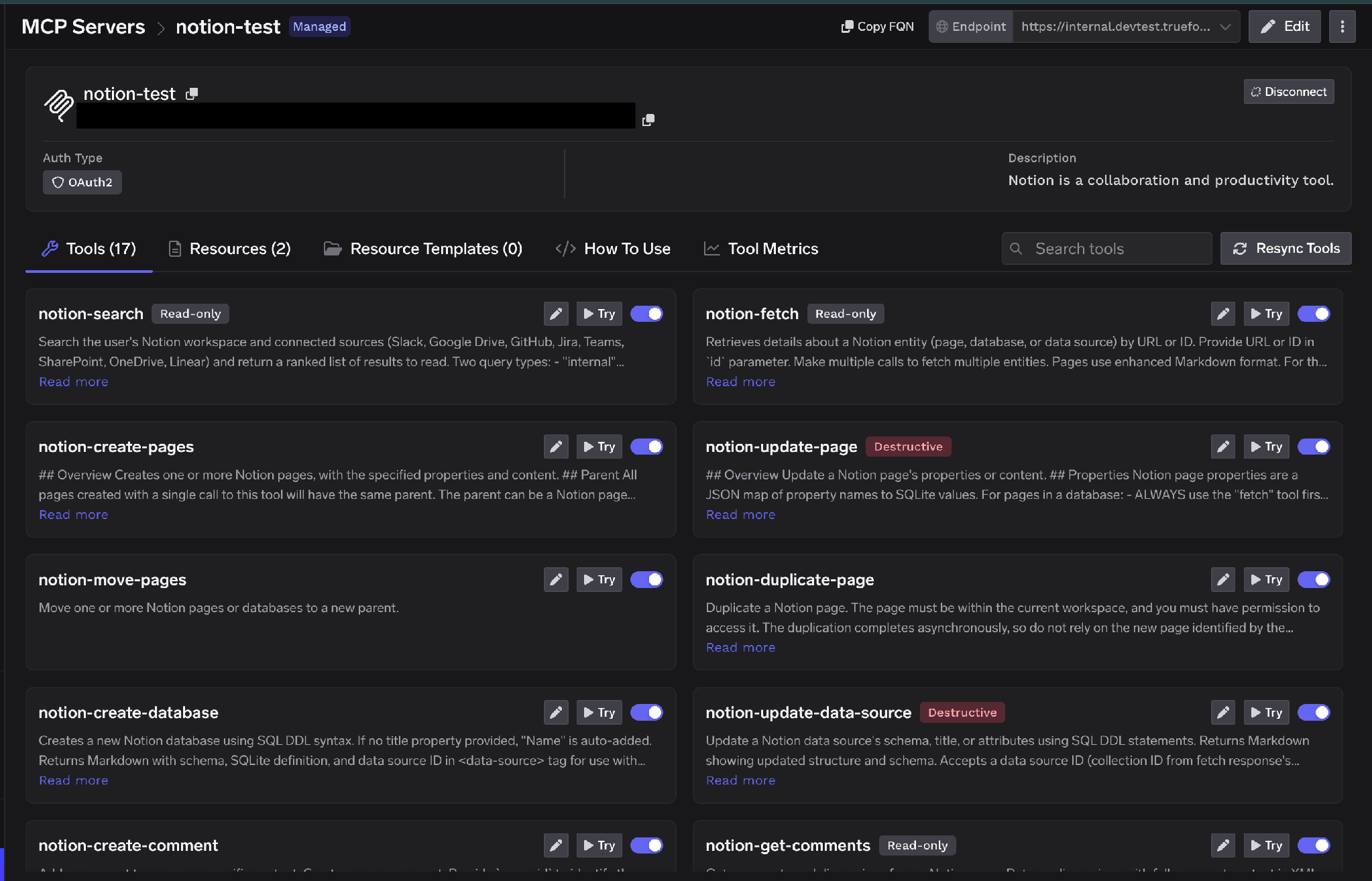
Notion Tools tab populated with tools including notion-search, notion-fetch, notion-create-pages and notion-update-page, each labeled Read-only or Destructive
TrueFoundry separates inbound authentication (how a client proves itself to the gateway) from outbound (how the gateway proves itself to Notion). The layers are independent, and that distinction is what makes per-user scoping possible.
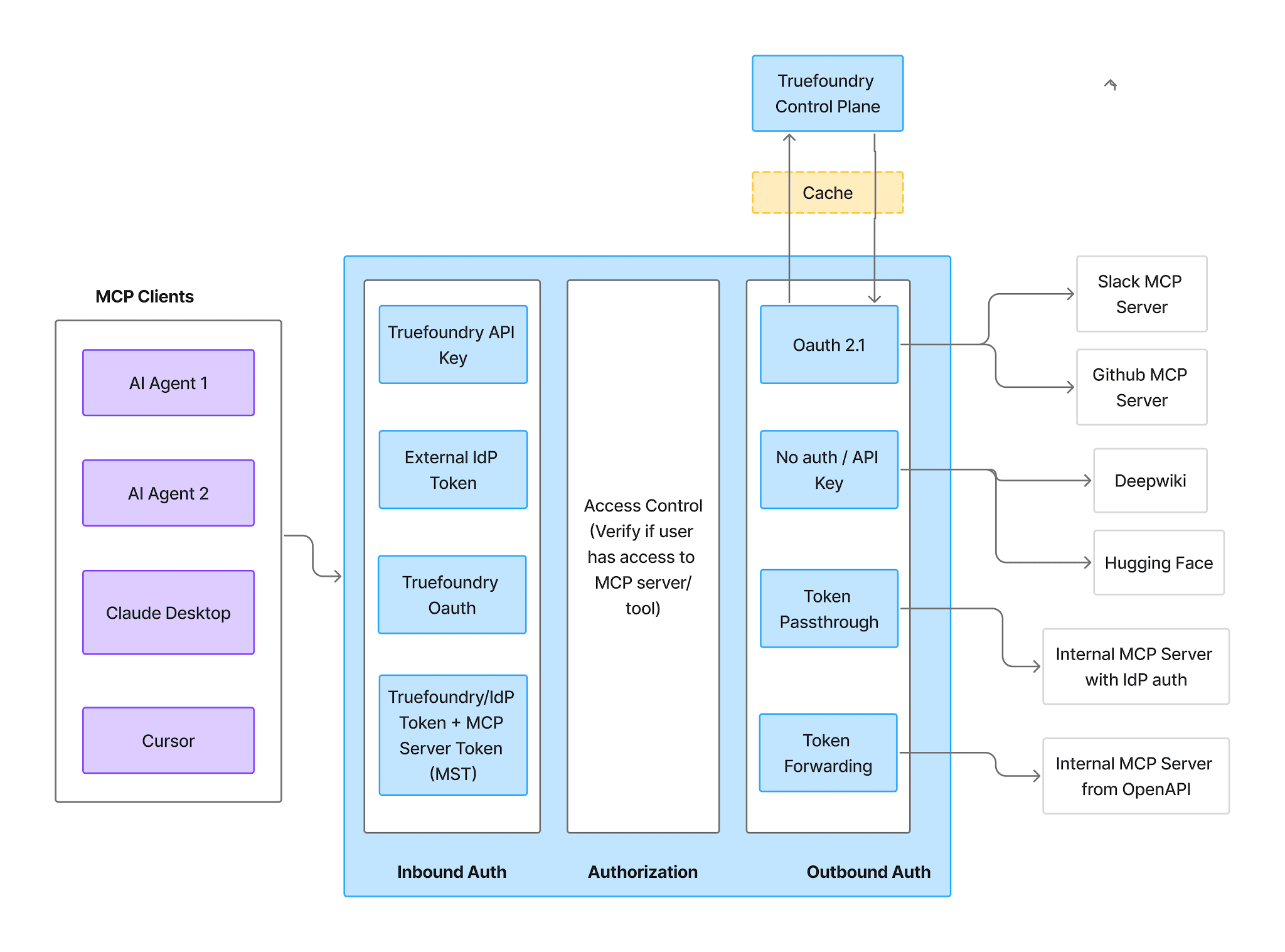
MCP Gateway authentication and authorization flow showing inbound authentication, access control, and outbound authentication as three distinct stages
Inbound — four supported methods:
TrueFoundry AI Gateway bietet eine Latenz von ~3—4 ms, verarbeitet mehr als 350 RPS auf einer vCPU, skaliert problemlos horizontal und ist produktionsbereit, während LiteLM unter einer hohen Latenz leidet, mit moderaten RPS zu kämpfen hat, keine integrierte Skalierung hat und sich am besten für leichte Workloads oder Prototyp-Workloads eignet.




A remote Model Context Protocol server for Notion that exposes a workspace as callable tools — search, fetch pages and databases, create and update pages, read and post comments. Agents connect over a URL and authorize with OAuth2 rather than running anything locally. Notion also exposes MCP Resources as a separate primitive.
Search, fetch, page creation and updates, database reads and writes, and comments — named in the notion-* convention, such as notion-search, notion-fetch, notion-create-pages, and notion-update-page. The full list appears on the Tools tab once authorized, each labeled Read-only or Destructive and individually configurable.
Yes, with scoping — and the question is read breadth, not malicious writes. Notion permissions inherit down page trees, so one grant can expose far more than intended. Run it behind a gateway that enforces per-user OAuth instead of a shared integration token, disable write tools an agent doesn’t need, gate the rest behind human approval, and trace every call with the calling user.
Yes. TrueFoundry runs in your VPC, on-prem, air-gapped, or hybrid, so prompts and responses never leave your domain even as you route across many providers.
Yes. It includes an MCP Gateway, an Agent Gateway, and an MCP & Agents Registry with tool-level access control. Agents on LangGraph, CrewAI, AutoGen, or a custom framework can all be governed centrally.
Ja. Das Gateway ist OpenTelemetry-kompatibel und lässt sich in Grafana, Datadog, Prometheus oder Ihren bevorzugten Stack integrieren. Es verfolgt jede Anfrage vom Prompt bis zur Ausführung von Tools und Modellen, sodass Sie eine einheitliche Protokollierung erhalten, ohne Ihre bestehenden Systeme entfernen zu müssen.



Die neuesten Nachrichten, Artikel und Ressourcen werden in Ihren Posteingang gesendet
.png)
.png)
.png)
.webp)
.webp)