September 14, 2026
|
Lesedauer: 5 Minuten


Erhalten Sie sofortigen Zugriff auf eine TrueFoundry-Live-Umgebung. Stellen Sie Modelle bereit, leiten Sie den LLM-Verkehr weiter und erkunden Sie die gesamte Plattform — Ihre Sandbox ist in Sekundenschnelle einsatzbereit, ohne dass eine Kreditkarte erforderlich ist.



Published: September 14, 2026
Unglaublich schnelle Methode zum Erstellen, Verfolgen und Bereitstellen Ihrer Modelle!
If you're comparing Agno vs LangChain, the first thing worth clearing up is what you're actually comparing.
LangChain isn't one thing - its ecosystem includes model integrations, LangGraph for orchestration, LangSmith for tracing, and Deep Agents for higher-level agent capabilities. So “Agno vs LangChain” often really means Agno vs LangGraph.
Agno, formerly Phidata until its January 2025 rebrand, is a Python framework and runtime for agentic software. It also leads with performance, with benchmark numbers being a major part of its appeal.
Those numbers measure something real but raw framework speed probably isn't your agent's bottleneck. To see where the difference actually matters, we need to compare their approaches to orchestration, state, memory, integrations, and production deployment.
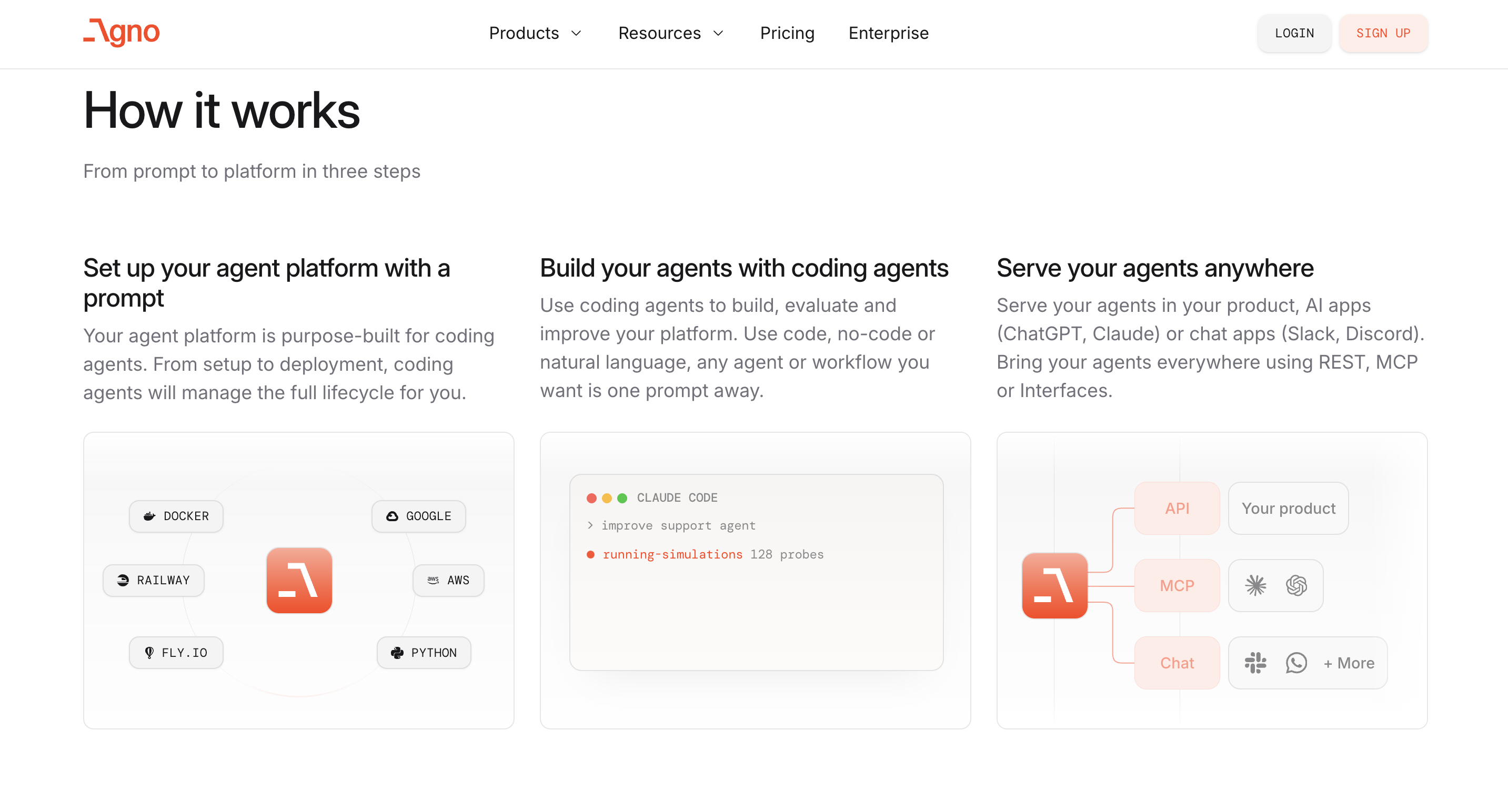
Agno is a Python framework and runtime for building multi-agent systems. The rebrand from Phidata in January 2025 came with a shift in purpose: it stopped being a data engineering tool and became a dedicated agentic runtime.
It ships AgentOS, a stateless FastAPI runtime with a control plane UI for monitoring. That's a meaningful difference from most frameworks, which hand you a library and leave deployment as an exercise. Agno gives you something you can actually run and watch.
The design priority throughout is overhead. Agents instantiate in microseconds and hold a few kilobytes of memory each, which means you can spin up thousands without the process falling over. If your architecture involves a lot of short-lived agents created per request, that's genuinely useful engineering.
LangChain is the ecosystem, and its scale is the point. Model integrations for essentially everything, LangGraph for explicit graph-based orchestration with checkpointers and interrupts, LangSmith for tracing and evaluation, deepagents as a batteries-included harness on top, and LangGraph Platform for deployment.
Nothing in this space matches it for breadth. Whatever vector store, model provider or tool you need, the integration probably exists and someone has already hit the bug you're about to hit.
The cost is weight. You adopt abstractions, and there are a lot of them. LangGraph in particular asks you to model your problem as a graph of nodes and edges with a typed state schema, which is exactly right when your workflow has a required shape and a lot of ceremony when it doesn't.
The biggest difference between Agno and LangChain is where they put the abstraction boundary.
Agno starts with the agent. You define an agent, give it a model and tools, and then compose agents into teams or workflows as the application grows.
Agent
  ↓
Tools + Model + Memory
  ↓
Team / Workflow
  ↓
AgentOS
LangChain starts with a broader set of LLM application primitives, while its current agent abstraction sits on top of LangGraph.
LangChain Agent
  ↓
LangGraph
  ↓
State + Nodes + Edges
  ↓
Persistence / HITL / Durable Execution
  ↓
LangSmith
This distinction matters most when the agent's execution logic becomes complex.
With Agno, common agent patterns can be expressed through higher-level primitives such as Teams and Workflows. With LangGraph, developers can model the execution itself as a graph, giving them more explicit control over how state moves through the application.
In short, Agno abstracts around the agent, while LangGraph abstracts around the agent's execution.
Both frameworks are easy to start with, but they differ in how much complexity they expose.
Agno keeps the experience centered around agents, teams, and workflows, making common agent patterns relatively concise.
LangChain offers a similar high-level entry point, but lets developers drop into LangGraph when they need finer control over execution.
In practice, the trade-off is simple: Agno prioritizes simplicity; LangChain offers a path to deeper control.
Agno provides Teams and Workflows as first-class primitives for coordinating agents, with support for sequential, parallel, conditional, and looping execution.
LangChain uses LangGraph for orchestration, where developers define nodes, edges, and state explicitly.
So the distinction is straightforward: Agno makes common multi-agent patterns easier to express, while LangGraph gives you more control over complex execution paths.
Both frameworks support persistent, stateful agents, but they approach state differently.
Agno provides sessions, storage, memory, and knowledge capabilities directly around its agent abstraction.
LangGraph makes state a core part of the execution model, with checkpointing that allows workflows to persist, pause, and resume.
For simple conversational agents, either approach works. For long-running workflows, LangGraph's explicit state model becomes more valuable.
LangChain has the larger integration ecosystem, spanning models, databases, retrievers, document loaders, and tools. Agno also offers a broad and growing set of integrations.
The bigger difference is observability. Agno provides operational capabilities through AgentOS, while LangChain has LangSmith for tracing, evaluation, and production monitoring.
If your application depends heavily on third-party integrations or detailed agent tracing, LangChain's ecosystem is a strong advantage.
Agno's marketing leads with instantiation speed, and the numbers get repeated everywhere. They deserve a closer look, because they're real and they're widely misread.
The headline claim is roughly 5,000x faster agent instantiation and 50x less memory than LangGraph, with agent creation around 2 to 3 microseconds and about 3.75 KiB of memory each. Some write-ups cite 10,000x instead of 5,000x. An independent measurement puts it closer to 529x faster and 24x less memory.
That spread should tell you something. These are single-source numbers that third parties have struggled to reproduce consistently, and the multiplier moves by an order of magnitude depending on who ran it.
But here's the more important point, and it holds even if every number is accurate.
Instantiation cost is not where your money goes. These benchmarks measure how long the framework takes to set itself up. In production, the LLM API call dominates response time by several orders of magnitude. Saving 3 milliseconds of setup on a request that spends 4 seconds waiting for a model is not a win anyone will notice.
There is a case where it genuinely matters: if you're creating thousands of agents per second, memory per agent becomes a real constraint on how much you can fit on one box. That's a legitimate architecture and Agno serves it well. But most teams asking "Agno vs LangChain" are not in that situation, and choosing a framework on a benchmark that doesn't describe their workload is a bad way to decide.
What should you measure instead? Tokens per completed task. That's the number that arrives on the invoice, and the spread between tools is far larger than the spread in setup time. We measured three agent runtimes on identical tasks with an identical model and found one used 3.8M tokens where another used 16.5M for the same answers. Nobody's microsecond benchmark predicted that.
You're creating a lot of agents. Per-request instantiation at scale is the case Agno was built for, and memory per agent becomes a real ceiling there.
You want a runtime, not just a library. AgentOS plus the control plane gives you something deployable and observable without assembling it yourself.
You're Python-only and want to move fast. The learning curve is much gentler than LangGraph's, and you'll have something working sooner.
The framework's footprint matters to your infrastructure. Fewer resources per agent means more agents per node, which is a real cost line if you're running many.
Your workflow has a required shape. If the sequence matters for correctness, LangGraph's explicit graph is the strongest tool here and Agno doesn't try to match it.
You need durable execution. Checkpointers let a crashed run resume from the last saved step instead of starting over, which on long runs is the difference between seconds and a full re-run.
Ecosystem breadth is load-bearing. If you're integrating a long tail of providers, stores and tools, LangChain's coverage will save you more time than Agno's overhead saves you.
You're already using LangSmith. That integration is tight, and rebuilding tracing and evaluation is real work.
Worth naming a third option, because a decent number of teams comparing these two want something neither is.
Both Agno and LangGraph are frameworks. They give you primitives and expect you to assemble the agent, which is right when your workflow has a shape you need to express. If your agent's path is discovered rather than designed, if the next step depends on what the last step found, then you're building a loop by hand that already exists as a finished product.
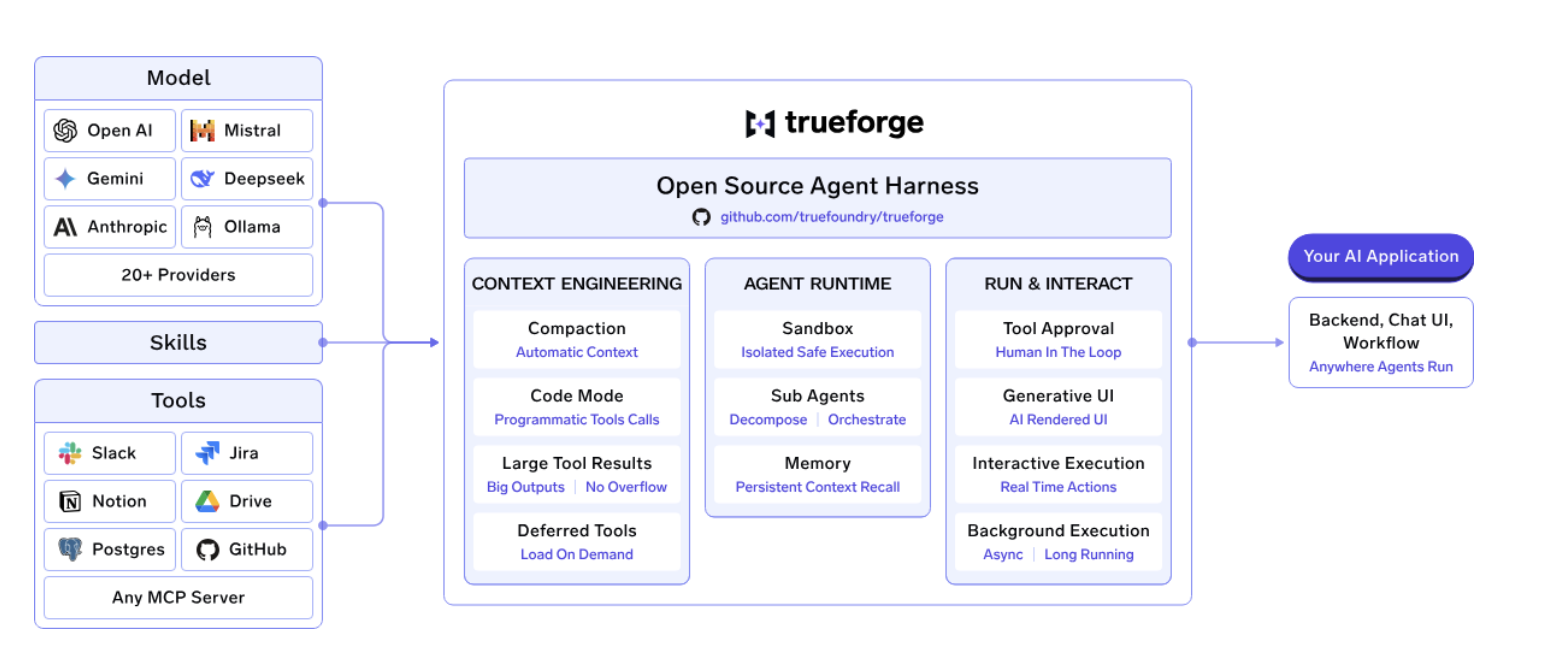
TrueForge is the MIT-licensed harness we open-sourced in August 2026, and the same runtime behind our own AskTFY agent. We built it because we wanted managed-agent ergonomics without handing the model decision to a vendor, and nothing open source covered the whole surface.
It ships as three pieces rather than one. A core server runs the loop: streaming, approval gates on sensitive actions, subagent delegation, compaction, and sessions that survive reconnects. An HTTP API with a TypeScript SDK (@truefoundry/trueforge-sdk) gives your code everything the UI can do. And a chat UI with its own SDK (@truefoundry/trueforge-ui) is there to use as-is, theme, or embed. That third piece is what separates it from most of this list, which stops at the terminal.
The design choice that moves your bill most: TrueForge treats the sandbox as a tool. It spins one up only when the agent actually needs to run code, instead of wrapping the whole session in a container. One server handles many agents at once, and turns that never touch code stay cheap.
What it adds on top of the loop is the context work, because that's what decides whether long runs stay affordable. Deferred tool loading means MCP tool schemas load on demand rather than filling the window upfront. Code Mode lets the agent chain several tool calls inside one sandbox script so only the printed summary enters context. Oversized tool responses get written to a sandbox file and replaced with a path and a preview. Compaction triggers at 80% of the model's context length and replaces old history with a structured summary. Subagents run with their own clean context and return only the result.
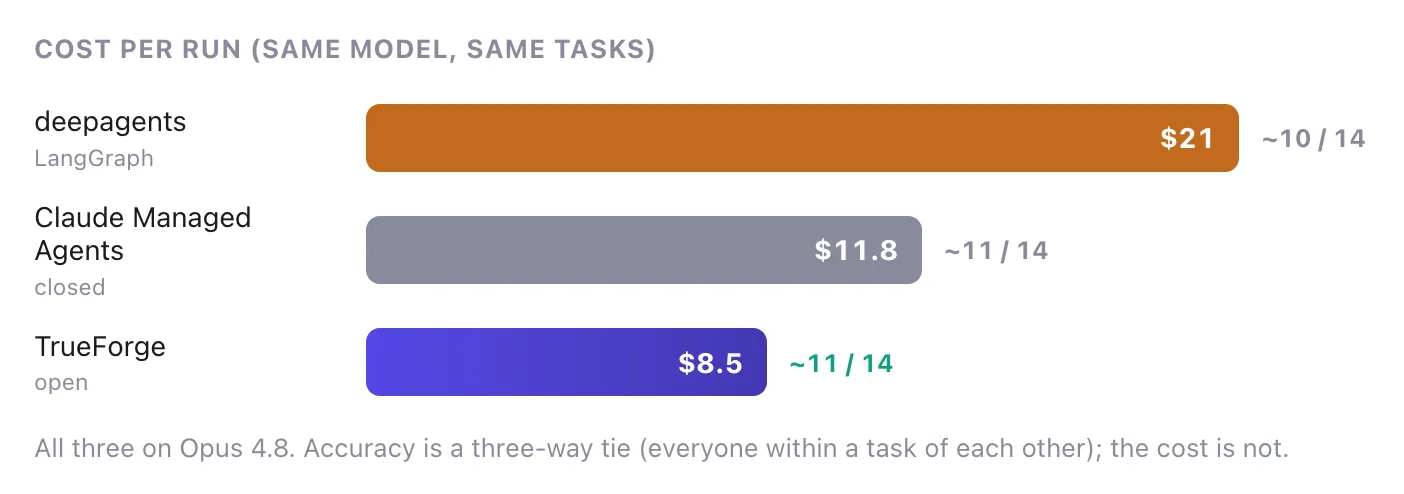
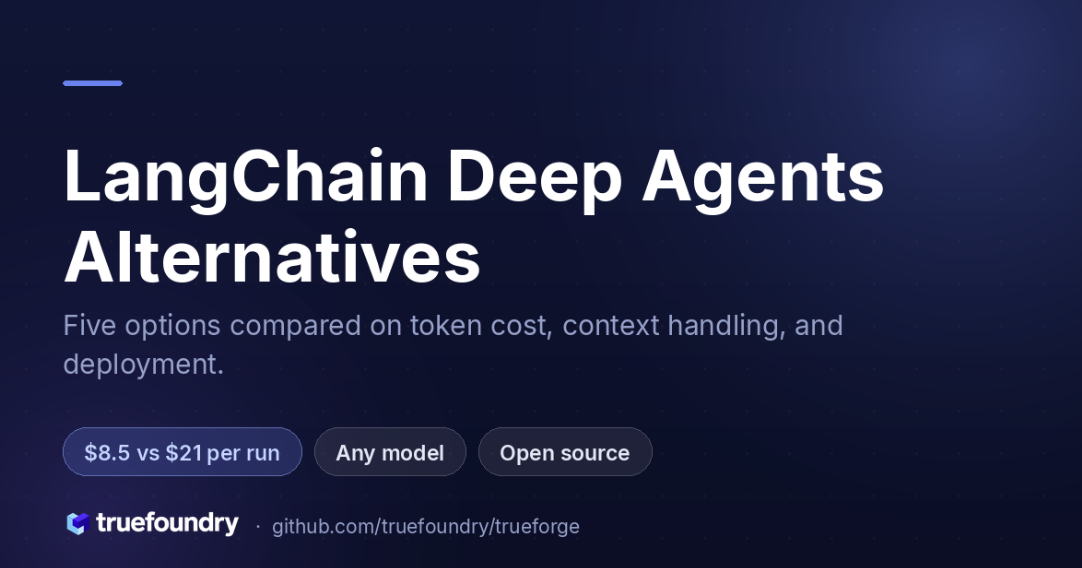
On DevRev's Enterprise-Bench, which is 14 cross-system tasks over three MCP servers with a fresh session each time and a blind LLM judge, TrueForge on Opus 4.8 solved the same tasks as Claude Managed Agents at $8.5 per run against $11.8, on 3.8M tokens against 10M. Swapping to GLM-5.2 took it to $2.9 per run. Against deepagents on the same model it used under a quarter of the tokens.
It's MIT-licensed, maintained by us, and developed in the open. The strengths are those three surfaces, on-demand sandboxing, a documented path from npx all the way to Helm with Postgres, Redis, replicas and OIDC, and published benchmark numbers you can check. The obvious weakness is age. It's the youngest project here, so the third-party extension ecosystem is thin compared to what opencode has.
Try it in 60 seconds: npx @truefoundry/trueforge or star it on GitHub.
Q: What is the difference between Agno and LangChain?
A: Agno is a single high-performance Python runtime for building and running agents, optimized for low instantiation overhead and memory per agent. LangChain is a broad ecosystem covering model integrations, orchestration through LangGraph, tracing through LangSmith and deployment through LangGraph Platform. Agno is leaner and faster to learn; LangChain gives you more control and far more integrations.
Q: Is Agno really faster than LangGraph?
A: At creating agents, yes, and by a wide margin. Reported figures range from about 529x to 5,000x faster with roughly 24x to 50x less memory, depending on the source. What those benchmarks measure is framework setup cost, not response time. In production the LLM API call dominates latency by orders of magnitude, so the difference only matters if you're instantiating agents at very high volume.
Q: Is Agno the same as Phidata?
A: Yes. Agno is the rebranded Phidata, renamed in January 2025 alongside a shift in focus from data engineering tooling to an agentic runtime. Older tutorials and posts referencing Phidata describe the same project.
Q: Should I use Agno or LangGraph for a complex workflow?
A: LangGraph, if the workflow has a required shape. Its explicit graph, checkpointers and node-level interrupts give you precision Agno isn't trying to match. Agno is the better pick when you want a lean runtime and a gentle learning curve rather than fine-grained control over the sequence.
Q: Can I run an agent framework or harness in my own VPC or on-prem?
A: Yes, with any self-hosted option here. TrueForge runs from a single npx command locally, or via Docker Compose and Helm for team deployments with Postgres, Redis, replicas and OIDC login. TrueFoundry's managed version also runs self-hosted, on-prem, air-gapped or hybrid, so no data leaves your domain.
Q: How do I govern models and MCP servers across many agents?
A: Through a gateway layer. TrueFoundry's AI Gateway puts 1,000+ LLMs behind one OpenAI-compatible API at roughly ~3–4 ms of added latency and 350+ RPS on a single vCPU, with RBAC, budgets, guardrails and credential rotation, plus OpenTelemetry traces into Grafana, Datadog or Prometheus. Agents built on Agno, LangGraph or anything else can be governed centrally.
Agno vs LangChain comes down to lean runtime versus deep ecosystem. Agno is faster to learn, cheaper to run per agent, and ships a deployable runtime in AgentOS. LangChain and LangGraph give you more control, more integrations and durable execution, at the cost of a much steeper curve.
Just don't let the microsecond benchmarks decide it for you. They measure something real that almost certainly isn't your bottleneck. The number that will show up on your bill is tokens per completed task, and that's worth measuring on your own workload before you commit to anything.
If it turns out you didn't want a framework at all, TrueForge is on GitHub and takes about a minute to try.
TrueFoundry AI Gateway bietet eine Latenz von ~3—4 ms, verarbeitet mehr als 350 RPS auf einer vCPU, skaliert problemlos horizontal und ist produktionsbereit, während LiteLM unter einer hohen Latenz leidet, mit moderaten RPS zu kämpfen hat, keine integrierte Skalierung hat und sich am besten für leichte Workloads oder Prototyp-Workloads eignet.





Die neuesten Nachrichten, Artikel und Ressourcen werden in Ihren Posteingang gesendet
.webp)
.webp)
.webp)
.webp)
.webp)