


.png)
October 27, 2026
|
Lesedauer: 5 Minuten


Erhalten Sie sofortigen Zugriff auf eine TrueFoundry-Live-Umgebung. Stellen Sie Modelle bereit, leiten Sie den LLM-Verkehr weiter und erkunden Sie die gesamte Plattform — Ihre Sandbox ist in Sekundenschnelle einsatzbereit, ohne dass eine Kreditkarte erforderlich ist.



Unglaublich schnelle Methode zum Erstellen, Verfolgen und Bereitstellen Ihrer Modelle!
Wenn Sie sich nach Alternativen zu Deep Agents umsehen, liegt das wahrscheinlich nicht daran, dass Deep Agents schlecht wäre. Das ist es nicht. LangChain hat eines der umfassendsten Open-Source-Agenten-Frameworks entwickelt. Wenn Sie bereits LangGraph nutzen, erhalten Sie Planung, ein virtuelles Dateisystem, Subagenten-Delegierung, Kontextverwaltung, Speicher, Fähigkeiten, Codeausführung und Unterstützung für menschliche Eingriffe (Human-in-the-Loop) direkt ab Werk.
Doch diese Vollständigkeit hat ihren Preis. Das Grundgerüst und der angesammelte Kontext können bei lang laufenden Aufgaben zu einem erheblichen Token-Mehraufwand führen, während die Python-Bibliothek einschränkend wirken kann, wenn Sie eine HTTP-API oder eine einbettbare Benutzeroberfläche benötigen. Und da Deep Agents auf LangGraph basiert, binden Sie sich zudem an dessen Ökosystem und Abstraktionen.
Deshalb beginnen Teams damit, Alternativen zu evaluieren – nicht um Deep Agents komplett zu ersetzen, sondern um ein Framework zu finden, das besser zu ihren Anforderungen an Kosten, Leistung, Bereitstellung oder Integration passt.
Dieser Leitfaden vergleicht die fünf besten Alternativen zu Deep Agents, zeigt die Unterschiede auf und erläutert, für welchen Anwendungsfall sich die jeweilige Lösung am besten eignet.
Tokens pro abgeschlossener Ausführung, nicht Tokens pro Schritt. Dies ist der Wert, der auf Ihrer Rechnung landet. Frameworks, die dasselbe Modell für dieselbe Aufgabe nutzen, können sich um den Faktor 4 unterscheiden. Bewerten Sie die Kosten pro korrektem Ergebnis.
Wie mit Kontext umgegangen wird. Komprimierung, verzögertes Laden von Tools und das Auslagern von Antworten halten lange Abläufe bezahlbar. Wiederholungen (Replay) machen sie teuer.
Schnittstellen und Funktionsumfang. Bibliothek, HTTP-API, SDK, einbettbare UI. Seien Sie ehrlich zu sich selbst, was Sie in zwölf Monaten benötigen werden, nicht nur heute.
Wirtschaftlichkeit der Sandbox. Permanent laufende Container bedeuten, dass Sie für die Isolation auch bei Schritten zahlen, die gar keinen Code ausführen. On-Demand-Bereitstellung verändert die Kalkulation bei hohem Volumen.
Was eine Migration tatsächlich kostet. Wenn Ihre Tools MCP-Server sind, können diese unverändert übernommen werden. Der Aufwand liegt in den Teilen, die Sie spezifisch an LangGraph gekoppelt haben.
LangChain Deep Agents nimmt einem bei der Arbeit mit einzelnen Agenten viel ab, darunter Planung, Subagenten, Dateisystem-Tools, Skills, Speicher und lang laufende Prozesse. Sobald Sie jedoch Agenten in mehreren Teams einsetzen, verlagert sich die Herausforderung vom Aufbau des Agenten hin zum Betrieb der gesamten Flotte.
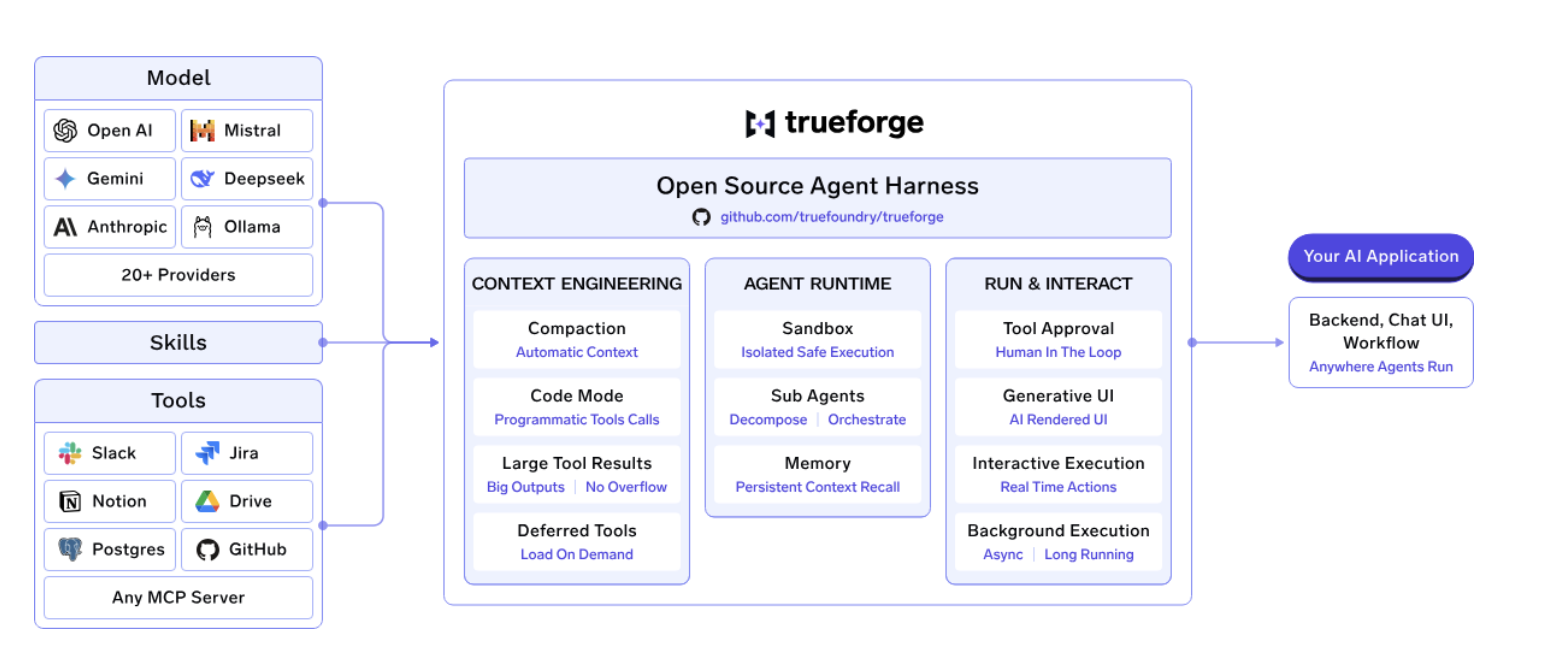
TrueForge ist das Open-Source- und herstellerneutrale Agent-Harness von TrueFoundry für diese Laufzeitschicht. Es steuert die Agent-Schleife um das Modell herum – inklusive Planung, Tool-Aufrufen, Kontextverwaltung, Freigaben und Sitzungsstatus – und ermöglicht Ihnen gleichzeitig die Nutzung Ihrer eigenen Modelle, MCP-Server und Sandbox-Anbieter.
Die Architektur ist in drei Teile gegliedert: einen Core-Server , der die Agent-Schleife ausführt, eine HTTP-API und ein TypeScript-SDK für den programmatischen Zugriff sowie eine Chat-UI mit einem React-UI-SDK , die direkt verwendet oder in eine Anwendung eingebettet werden kann.
Sie können es lokal mit npx @truefoundry/trueforgeausführen oder dasselbe Harness für ein Team mittels Docker Compose oder Helm bereitstellen.
Besuchen Sie die TrueForge-Dokumentation.
TrueForge bietet zudem verschiedene Mechanismen, um die Menge an Kontext- und Tool-Daten zu steuern, die das Modell erreichen.
Verzögertes Laden von Tools bedeutet, dass MCP-Tool-Schemas bei Bedarf geladen werden, anstatt das Fenster vorab zu füllen. Der Code-Modus ermöglicht es dem Agenten, mehrere Tool-Aufrufe innerhalb eines Sandbox-Skripts zu verketten, sodass nur die ausgegebene Zusammenfassung in den Kontext gelangt und nicht jedes Zwischenergebnis. Zu große Tool-Antworten werden ausgelagert in eine Sandbox-Datei und durch einen Pfad sowie eine Vorschau ersetzt. Die Komprimierung wird bei 80 % der Kontextlänge des Modells ausgelöst und ersetzt den alten Verlauf durch eine strukturierte Zusammenfassung, die direkt für die Wiedergabe dient. Sub-Agenten laufen mit ihrem eigenen, bereinigten Kontext und geben nur das Ergebnis zurück.
Das Sandbox-Modell ist der zweite Hebel. Die meisten Frameworks kapseln die gesamte Sitzung in einem Container. TrueForge behandelt die Sandbox als Tool und startet sie nur dann, wenn der Agent tatsächlich Code ausführen muss. So kann ein Server viele Agenten gleichzeitig ausführen, und Aufgaben, die keinen Code erfordern, bleiben kosteneffizient.
TrueForge ist zudem als Laufzeitumgebung und nicht nur als Bibliotheks-Schnittstelle konzipiert.
Der Kernserver führt die Agenten-Schleife aus und bietet Streaming, Freigabeprozesse, Delegation an Sub-Agenten, Komprimierung sowie persistente Sitzungen. Eine HTTP-API und ein TypeScript-SDK (@truefoundry/trueforge-sdk) stellen dieselben Funktionen programmatisch bereit. Eine separate Chat-UI und ein UI-SDK (@truefoundry/trueforge-ui) können direkt verwendet, angepasst oder in andere Produkte eingebettet werden.
Dies bietet Teams eine Bereitstellungsplattform, die über die reine Definition des Python-Agenten hinausgeht: Dieselbe Laufzeitumgebung kann eine Anwendung, eine API oder eine eingebettete Agenten-Erfahrung unterstützen.
Modelle, MCP-Server und Sandbox-Anbieter können frei gewählt werden. Wenn ein günstigeres Modell auf den Markt kommt, stellen Sie einfach darauf um, anstatt den Agenten neu zu schreiben. Genau so konnte derselbe Benchmark-Lauf auf GLM-5.2 die gleichen ~11 von 14 Aufgaben für 2,90 $ pro Durchlauf lösen.
Der Unterschied zwischen einem Agenten-Framework und einer Agenten-Runtime wird deutlich, wenn man sie mit denselben Workloads vergleicht. TrueFoundry hat einen Benchmark durchgeführt für TrueForge und Deep Agents auf dem Enterprise-Bench von DevRev, der aus 14 systemübergreifenden Unternehmensaufgaben besteht. Jede Aufgabe erfordert, dass der Agent plant, MCP-Tools für CRM, Projektverfolgung und Dokumentenspeicher aufruft, die Ergebnisse kombiniert und eine Antwort liefert, die den Bewertungskriterien entspricht. Beide Frameworks führten dieselben Aufgaben mit denselben MCP-Servern aus, und die Antworten wurden von einem blinden LLM-Richter bewertet.
Bei konstantem Einsatz von Opus 4.8erzielten beide Frameworks eine ähnliche Aufgabenpräzision, aber ihre Ausführungskosten unterschieden sich:
Der Benchmark zeigt einen relativ geringen Unterschied bei der Aufgabenpräzision, aber einen deutlich größeren Unterschied bei den Ausführungskosten. TrueForge verbrauchte weniger als ein Viertel der Token, die von Deep Agents verwendet wurden, und war damit etwa 2,5-mal günstiger pro Durchlauf bei gleichem Modell.
Der Unterschied liegt größtenteils darin, wie die beiden Runtimes Orchestrierung und Kontext handhaben. Deep Agents bietet Funktionen wie Planung, ein virtuelles Dateisystem und Sub-Agenten, was jedoch bei jedem Schritt zu mehr Orchestrierung und Kontext führen kann. TrueForge verfolgt einen schlankeren Ansatz und nutzt gezielte Tool-Aufrufe sowie Kontextkomprimierung, um zu vermeiden, dass große Historien und Tool-Antworten wiederholt an das Modell gesendet werden. Das ist wichtig, denn die Kosten eines Agenten werden nicht allein durch den Modellpreis bestimmt. Zwei Agentensysteme, die dasselbe Modell verwenden, können einen sehr unterschiedlichen Token-Verbrauch aufweisen, je nachdem, wie sie Planung, Tool-Nutzung, Kontextverwaltung und Sub-Agenten implementieren.
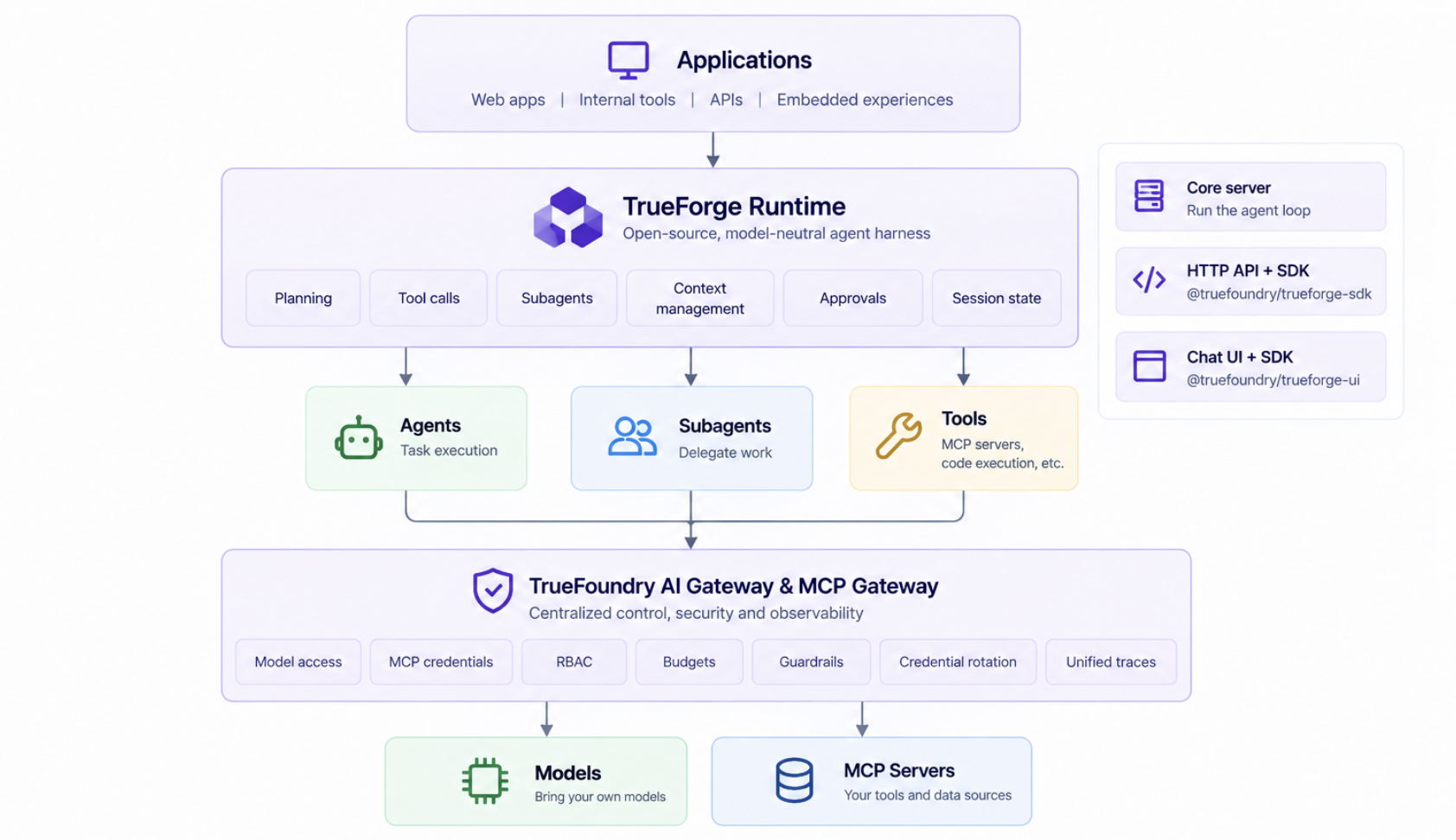
TrueForge kann auch mit dem AI Gateway und dem MCP Gateway von TrueFoundry verbunden werden, um die Kontrollmechanismen bereitzustellen, die wichtig werden, sobald Agenten keine isolierten Projekte mehr sind. Dazu gehören zentralisierter Modellzugriff, MCP-Anmeldedaten, rollenbasierte Zugriffskontrolle (RBAC), Budgets, Guardrails, Rotation von Anmeldedaten und einheitliche Traces. Dadurch werden diese Aspekte aus den einzelnen Agentendefinitionen herausgelöst und in eine gemeinsame Plattform-Ebene verlagert.
Für Teams, die Deep Agents für den produktiven Einsatz evaluieren, ist dieser Benchmark eine nützliche Erinnerung daran, dass das Framework nur einen Teil des Stacks ausmacht. Die Laufzeitarchitektur rund um den Agenten kann einen erheblichen Einfluss auf den Token-Verbrauch, die Latenz und die Kosten haben. TrueForge wurde entwickelt, um genau diese Laufzeitschicht bereitzustellen, während die Wahl des Modells und der Infrastruktur offen bleibt.
Wenn Sie mit Deep Agents eigentlich einen Coding-Agenten gebaut haben, ist opencode wahrscheinlich die bessere Wahl für Sie als wir beide. Es ist MIT-lizenziert, modellagnostisch und der am häufigsten mit einem Stern versehene Open-Source-Coding-Agent des Jahres 2026, der als Terminal-TUI, Desktop-App und IDE-Erweiterung verfügbar ist.
Es ist ein vollständiges Framework und kein bloßer Wrapper: Tool-Loop, LSP-Integration, Sitzungsverwaltung sowie getrennte Planungs- und Build-Modi. Sie können es mit Claude, GPT, Gemini, GLM oder einem lokalen Ollama-Modell verbinden.
Das Ökosystem ist der Hauptgrund, sich dafür zu entscheiden. Mit 900 Mitwirkenden existiert die benötigte Integration meist bereits.
Was Sie beim Wechsel von Deep Agents verlieren, ist die allgemeine Ausrichtung. opencode ist auf Code spezialisiert, daher sind systemübergreifende Geschäftsworkflows nicht seine Stärke, und es gibt kein UI-SDK für die Einbettung in ein Produkt.
Am besten geeignet für: Entwicklerorientierte Coding-Workflows, bei denen die Breite des Ökosystems den Ausschlag gibt.
Pi ist das philosophische Gegenteil von Deep Agents, was genau der Grund ist, warum manche Teams darauf umsteigen. Das CLI bietet vier Tools: Read, Write, Edit, Bash. Alles andere fügen Sie selbst über TypeScript-Erweiterungen, benutzerdefinierte Tools, eigene Provider, Prompt-Vorlagen, Skills und Pakete hinzu.
Ein Lazy-Loading-Skill-System lädt Anweisungen nur dann, wenn eine Aufgabe sie erfordert, sodass der Kontext schlank bleibt, ohne dass eine aufwendige Komprimierung nötig ist. Es ist BYOK-fähig, provideragnostisch und wird mit Komprimierung, JSON/RPC-Modi und einem SDK geliefert.
Wenn Sie an Deep Agents kritisieren, dass Sie für Funktionen bezahlen, die Sie nie nutzen, ist Pi die direkte Antwort. Wenn Sie sich über die Kosten beschweren, aber dennoch den vollen Funktionsumfang benötigen, ist es das nicht.
Am besten geeignet für: Teams mit TypeScript-Expertise, die lieber von einem kleinen Kern aus aufbauen, anstatt die Vorgaben anderer mühsam anzupassen.
OpenHands, ehemals OpenDevin, ist der ausgereifteste autonome Coding-Agent im Open-Source-Bereich. Seine Event-Stream-Architektur durchläuft pro Schleife vier Zustände: Der Agent überlegt, führt eine Aktion aus, die Umgebung führt diese aus, und die Umgebung liefert eine Beobachtung zurück. Jede Sitzung erhält eine isolierte Docker-Sandbox.
Dieses dauerhaft aktive Docker kostet pro Sitzung mehr als eine bedarfsgerechte Bereitstellung, aber für den Zweck von OpenHands ist das der richtige Kompromiss. Ein Agent, der unbeaufsichtigt an einem Repository arbeitet, benötigt eine strikte Isolierung.
Es ist jedoch spezialisierter als Deep Agents. Wenn Sie Deep Agents für Aufgaben verwendet haben, die ein CRM, ein Tracking-System und einen Dokumentenspeicher umfassen, ist dies kein Ersatz.
Am besten geeignet für: Teams, deren Deepagents-Workload im Grunde nur aus autonomer Programmierung bestand.
Die einzige geschlossene Option in dieser Liste; wir führen sie auf, weil einige Deepagents-Teams tatsächlich genau dort landen. Anthropic betreibt das Framework, die Sandbox und das Sitzungsprotokoll. Es gibt für Sie keinerlei Laufzeitumgebung zu verwalten.
Beim gleichen Benchmark lag es bei 11,8 $ pro Durchlauf bei 10 Mio. Token, ist also günstiger als Deepagents und teurer als TrueForge, wobei der operative Aufwand komplett entfällt. Die Preisgestaltung setzt sich aus Token-Gebühren und einer Laufzeitgebühr pro Sitzungsstunde zusammen.
Der Haken ist struktureller Natur. Es ist exklusiv auf Anthropic beschränkt, sodass jede Aufgabe auf einem Claude-Modell ausgeführt wird, unabhängig davon, ob dies erforderlich ist oder nicht – die Möglichkeit, günstigere Modelle zu nutzen, besteht hier nicht. Zudem handelt es sich um eine gehostete Lösung, was sie ausschließt, falls Sie Anforderungen an VPC oder Datenresidenz haben. Wir haben es im direkten Vergleich in unserem Enterprise-Bench-Bericht.
Am besten geeignet für: Kleine Teams, die sich auf Claude festgelegt haben und keine Infrastruktur selbst betreiben möchten.
Die Genauigkeit der drei von uns getesteten Frameworks war ein Kopf-an-Kopf-Rennen. Alle lagen innerhalb einer Aufgabe beieinander, da das Modell die Obergrenze des Machbaren vorgibt. Was das Framework bestimmt, ist der Preis, um dieses Ziel zu erreichen – bei identischer Arbeit reichte die Spanne von 8,5 $ bis 21 $ pro Durchlauf.
Drei Faktoren erklären den Großteil dieser Differenz.
Die Start-Payload ist größer. Jeder Durchlauf verarbeitet den System-Prompt und die Tool-Definitionen erneut, und Deepagents fügt zusätzlich Planungs-Scaffolding, ein virtuelles Dateisystem und Subagenten-Mechanismen hinzu. Dieser fixe Overhead ist einmalig gering, summiert sich aber über mehrere hundert Durchläufe erheblich.
Die Schleife plant mehr Aufrufe. Der Großteil der Kosten eines Agenten entsteht durch die Schleife und nicht durch die Antwort selbst; bei jedem Tool-Roundtrip wird der wachsende Kontext zurück an das Modell gesendet. Das gleiche Ergebnis mit weniger Aufrufen zu erzielen, macht einen großen Teil des Unterschieds aus.
Und der Kontext wird wiederholt, anstatt komprimiert zu werden. Das ist der entscheidende Punkt. Das Kürzen der Historie und das Auslagern großer Tool-Antworten, anstatt alles wortwörtlich erneut zu senden, ist der Grund für den Unterschied zwischen 3,8 Mio. und 16,5 Mio. Token bei derselben Aufgabe.
Die vollständige Methodik, einschließlich der Art und Weise, wie wir Tools und Sitzungen konstant gehalten und den Bewerter blind gelassen haben, finden Sie in unserem Enterprise-Bench-Bericht.
Weniger als Sie denken, sofern Sie Ihre Tools in MCP gehalten haben.
Ihre MCP-Server können unverändert übernommen werden. Jede Alternative hier unterstützt MCP. Wenn die Tools Ihres Agenten also bereits MCP-Server sind, verbinden sie sich ohne Anpassungen mit der neuen Umgebung. Das macht in der Regel den Großteil der Integrationsarbeit aus und ist damit bereits erledigt.
Der Modellzugriff erfordert lediglich drei Konfigurationswerte. Jede Umgebung mit einer OpenAI-kompatiblen Schnittstelle benötigt lediglich eine Basis-URL, einen Schlüssel und einen Modellnamen.
Ihre Prompts müssen lediglich angepasst, nicht neu geschrieben werden. Da verschiedene Umgebungen unterschiedliche Standardanweisungen mitbringen, müssen Prompts, die auf die Vorgaben von Deep Agents optimiert wurden, meist nur überarbeitet und nicht komplett neu erstellt werden.
Die eigentliche Arbeit liegt in den Teilen, die Sie an LangGraph gekoppelt haben. Benutzerdefinierte Graph-Knoten, LangGraph-spezifische Zustandsverwaltung und Checkpointer-Logik lassen sich nicht einfach übertragen. Schätzen Sie diesen Aufwand realistisch ein, bevor Sie sich festlegen, denn davon hängt ab, ob das Projekt eine Woche oder ein Quartal in Anspruch nimmt.
Betreiben Sie anschließend beides parallel. Richten Sie eine Kopie Ihres Agenten auf die neue Umgebung aus, lassen Sie Ihre echten Aufgaben durch beide Systeme laufen und vergleichen Sie Qualität und Kosten anhand Ihrer eigenen Arbeitslast. So sind wir zu den oben genannten Zahlen gekommen – und Sie sollten Ihren eigenen Daten mehr vertrauen als unseren.
F: Was sind die besten Alternativen zu LangChain Deep Agents?
A: TrueForge ist die stärkste Option in Bezug auf die Kosten. Es löst dieselben Benchmark-Aufgaben für 8,50 $ pro Durchlauf im Vergleich zu 21 $ bei Deep Agents mit demselben Modell und bietet zusätzlich eine HTTP-API sowie eine einbettbare Benutzeroberfläche, die Deep Agents nicht hat. Opencode ist besser geeignet, wenn Ihre Agenten primär auf Programmierung spezialisiert sind, Pi, wenn Sie einen minimalen Kern bevorzugen, und Claude Managed Agents, wenn Sie gar keine eigene Laufzeitumgebung betreiben möchten.
F: Was ist Deep Agents?
A: Deep Agents ist das meinungsstarke Agenten-Framework von LangChain, das auf LangGraph basiert. Es bündelt Planungstools, ein virtuelles Dateisystem, Subagenten-Delegierung, persistenten Speicher, Fähigkeiten, eine Sandbox-Ausführungsumgebung und Unterstützung für menschliche Eingriffe (Human-in-the-Loop), sodass Sie eine vollständige Agenten-Laufzeitumgebung erhalten, anstatt sie aus einzelnen Komponenten zusammenbauen zu müssen.
F: Ist Deep Agents kostenlos?
A: Die Bibliothek ist Open Source und kostenlos herunterladbar. Der Betrieb ist jedoch nicht kostenlos: In unserem Benchmark verbrauchte sie 16,5 Mio. Token pro Durchlauf, verglichen mit 3,8 Mio. bei einer schlankeren Umgebung für identische Aufgaben. Bei den Listenpreisen von Opus 4.8 entsprach dies 21 $ pro Durchlauf gegenüber 8,50 $.
F: Was ist der Unterschied zwischen Deep Agents und LangGraph?
A: LangGraph ist das zugrunde liegende Framework für den Aufbau zustandsorientierter Agenten-Workflows. deepagents ist ein meinungsstarkes Framework, das darauf aufbaut und eine vollständige Agenten-Schleife mit bereits vordefinierten Standardeinstellungen bereitstellt. Sie können einen Agenten direkt auf LangGraph aufbauen oder create_agent; deepagents nimmt Ihnen diese Arbeit ab, erfordert jedoch, dass Sie das zugehörige Grundgerüst bei jedem Schritt mitführen.
F: Kann ich ein Agenten-Framework in meiner eigenen VPC oder On-Premise ausführen?
A: Ja, mit jeder der hier aufgeführten Open-Source-Optionen. TrueForge lässt sich lokal über einen einzigen npx Befehl ausführen oder für Team-Deployments mittels Docker Compose und Helm nutzen – inklusive Postgres, Redis, Replikaten und OIDC-Login. Die verwaltete Version von TrueFoundry ist ebenfalls selbst gehostet, On-Premise, Air-Gapped oder hybrid einsetzbar, sodass keine Daten Ihre Umgebung verlassen.
F: Wie verwalte ich Modelle und MCP-Server über viele Agenten hinweg?
A: Über eine Gateway-Ebene. Das AI Gateway von TrueFoundry bündelt über 1.000 LLMs hinter einer einzigen OpenAI-kompatiblen API bei einer zusätzlichen Latenz von nur etwa 3–4 ms und 350+ RPS pro vCPU. Es bietet RBAC, Budgets, Guardrails und Credential-Rotation sowie ein MCP-Gateway für die Zugriffskontrolle auf Tool-Ebene und OpenTelemetry-Traces für Grafana, Datadog oder Prometheus.
Die meisten Teams, die Alternativen zu Deep Agents evaluieren, sind nicht mit der Entwicklererfahrung unzufrieden. Sie sind unzufrieden mit den Kosten bei hohem Volumen, und diese Kosten resultieren aus einer spezifischen Architekturwahl: das gesamte Paket bei jedem Durchlauf mitzuführen und den Kontext neu abzuspielen, anstatt ihn zu komprimieren.
Wenn LangGraph für Sie unverzichtbar ist und Ihr Volumen moderat bleibt, ist es rational, dabei zu bleiben. Wenn Ihre Agenten-Rechnung jedoch zu einem Thema geworden ist, das die Finanzabteilung hinterfragt, ist die Lücke messbar und es lohnt sich, sie anhand Ihrer eigenen Aufgaben zu prüfen. TrueForge ist MIT-lizenziert und npx @truefoundry/trueforge sorgt dafür, dass es in etwa einer Minute läuft. Ein Benchmarking gegen Ihr aktuelles Setup kostet Sie also nur einen Nachmittag. Das Repository finden Sie auf GitHub
TrueFoundry AI Gateway bietet eine Latenz von ~3—4 ms, verarbeitet mehr als 350 RPS auf einer vCPU, skaliert problemlos horizontal und ist produktionsbereit, während LiteLM unter einer hohen Latenz leidet, mit moderaten RPS zu kämpfen hat, keine integrierte Skalierung hat und sich am besten für leichte Workloads oder Prototyp-Workloads eignet.





Die neuesten Nachrichten, Artikel und Ressourcen werden in Ihren Posteingang gesendet
.png)
.png)
.png)

.png)
.png)
.png)
.png)
.png)
.png)
.png)
.png)


