
Introducing TrueForge: the open-source agent harness we run in production
The model is the easy part of a production agent. The frontier models are close enough now that switching is a configuration change. The difference is what surrounds the model: the loop, the sandbox, the context that doesn't decay over time, the approval that prevents the agent from doing something destructive.
That layer is the harness, and most teams rent it from a vendor who also picks their model and marks up the bill.
So today we're open-sourcing TrueForge, the harness we run in production. It's MIT-licensed, and just one command will have you up and running locally: npx @truefoundry/trueforge
We benchmarked it against Claude Managed Agents on identical tasks. TrueForge matched it in quality and was much cheaper: an open model responded equally well to Opus for ~75% less, and even when using the same model TrueForge was 30% cheaper. See how we measured it.
How the harness works
The model reasons but doesn't act. Give it a task to perform, and you'll get a plan back, and nothing else. It won't be able to open a file, make an API request, execute the code it just generated, and remember what it said three turns ago.
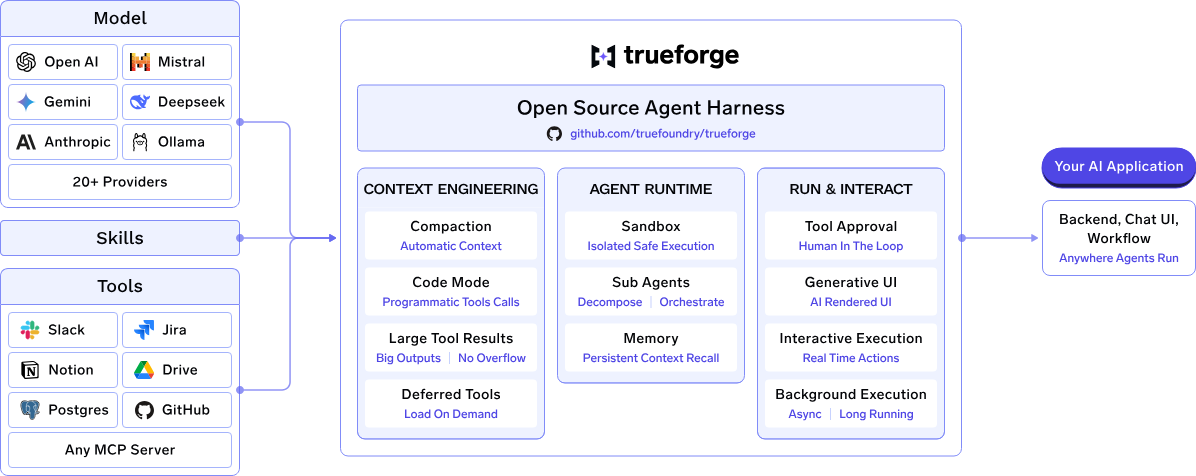
The harness is the runtime that bridges that gap. It runs the loop around the model (plan, call, execute tools, feed results back, repeat) while managing context on long tasks, enforcing boundaries like sandboxes and human approval, and persisting session state so it's preserved during reconnects and restarts.
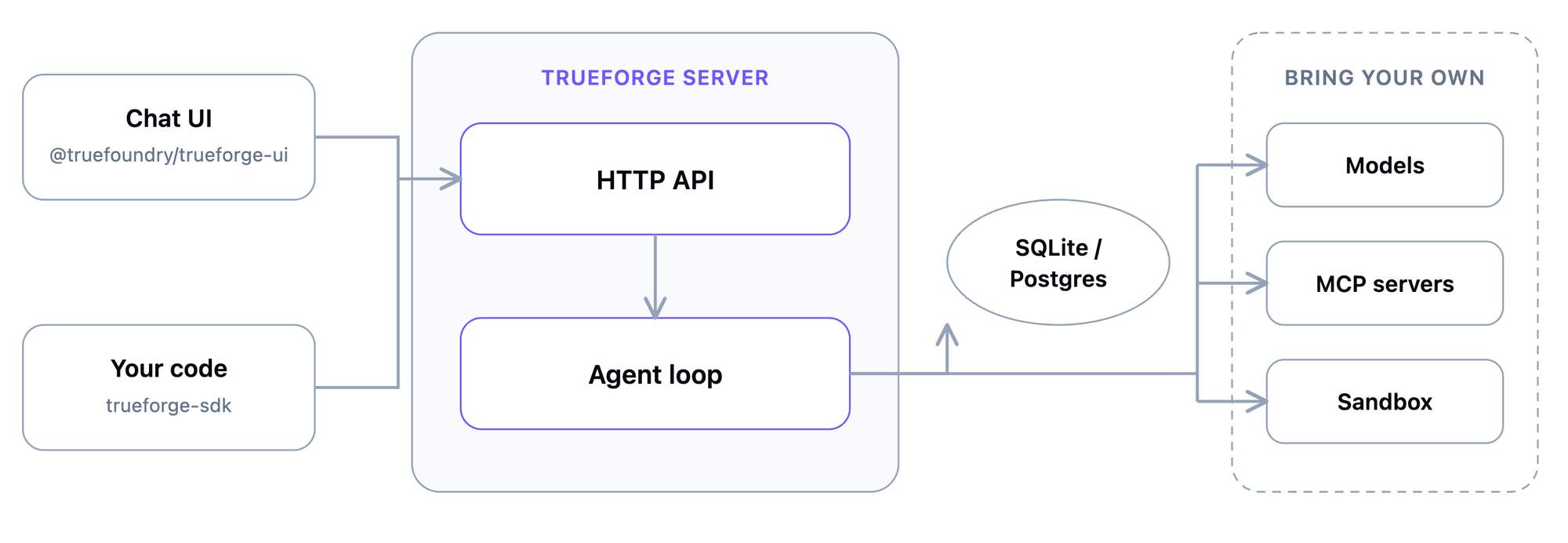
TrueForge is that runtime, split into three components:
- A core server that runs the agent loop: streaming every step, pausing for approval on sensitive actions, keeping context lean with subagents and compaction, and persisting sessions across reconnects.
- An HTTP API with a TypeScript SDK (
@truefoundry/trueforge-sdk). Whatever your user interface can do, you can do from your code. - A chat UI with a UI SDK (
@truefoundry/trueforge-ui). A complete interface you can leverage as is, theme or embed in your application.
Most harnesses run the agent inside a sandbox the whole time. TrueForge treats the sandbox as a tool and only spins one up when the agent needs to run code, so one server runs many agents at once and non-code turns stay cheap. Model providers, MCP servers, and sandbox are all bring-your-own: when a cheaper model ships, you can simply point at it instead of rewriting the agent.
Build on it, ship it to your team
The chat UI is the fastest way in: you just point it at a model and MCP server and get to chat with the agent in minutes. But everything runs through the API and SDK, so you can build agents into your own product or theme the UI into a branded interface backed by your server.
Run it locally with one npx command for personal use, or host it for the team with Docker Compose or Helm (Postgres, Redis, replicas behind a load balancer, OIDC login). Same harness, testing to production.
Governance when you need it
Self-hosted, you bring your own model and MCP keys and manage them yourself. That works until you're running a lot of agents. Then the keys are everywhere, team spend is impossible to cap, PII needs masking, and you're stitching together logs from every agent to answer an audit question.
When you get there, TrueFoundry's AI Gateway adds RBAC, budgets, guardrails, credential rotation, and unified traces,
Built with partners across the stack
Vendor neutrality can only be meaningful if the ecosystem is present right from the start. Here are our launch partners, but it's far from the closed list. TrueForge runs any model and any MCP server via open, OpenAI-compatible interfaces, thus whatever isn't listed here is also supported, and we will keep adding more.
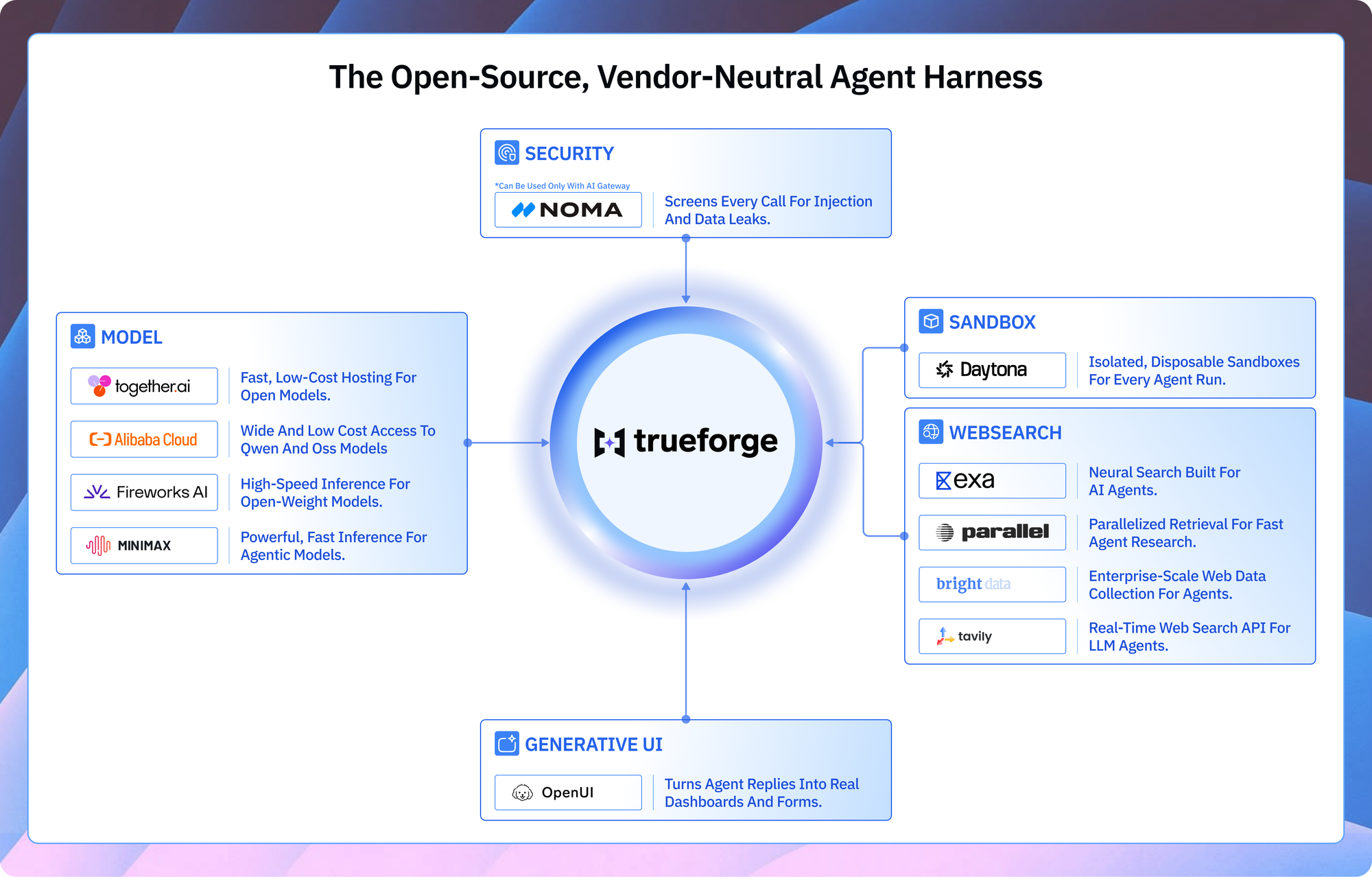
- Sandbox: Daytona. Your agents run their code in a disposable sandbox, so no code they generate ever touches your host machine.
- Search & retrieval: Exa, Tavily, Parallel Web, Bright Data. Choose the web provider that best fits the task and your budget.
- Model inference: Together AI, Fireworks AI, Alibaba. Together and Fireworks provide open models such as GLM, Kimi, and MiniMax in fast and inexpensive ways, and we are Qwen's official inference partner via Alibaba. Anything else you get through an OpenAI-compatible interface.
- Generative UI: OpenUI. Your agents produce real dashboards, forms, and tables rendered while generating text.
Join us in building this
We're shipping this early and in the open on purpose. Clone it, build something valuable, and shape its future.
Get it up and running in the next 60 seconds: npx @truefoundry/trueforge