September 13, 2026
|
Lesedauer: 5 Minuten


Erhalten Sie sofortigen Zugriff auf eine TrueFoundry-Live-Umgebung. Stellen Sie Modelle bereit, leiten Sie den LLM-Verkehr weiter und erkunden Sie die gesamte Plattform — Ihre Sandbox ist in Sekundenschnelle einsatzbereit, ohne dass eine Kreditkarte erforderlich ist.



Published: August 3, 2026
Unglaublich schnelle Methode zum Erstellen, Verfolgen und Bereitstellen Ihrer Modelle!
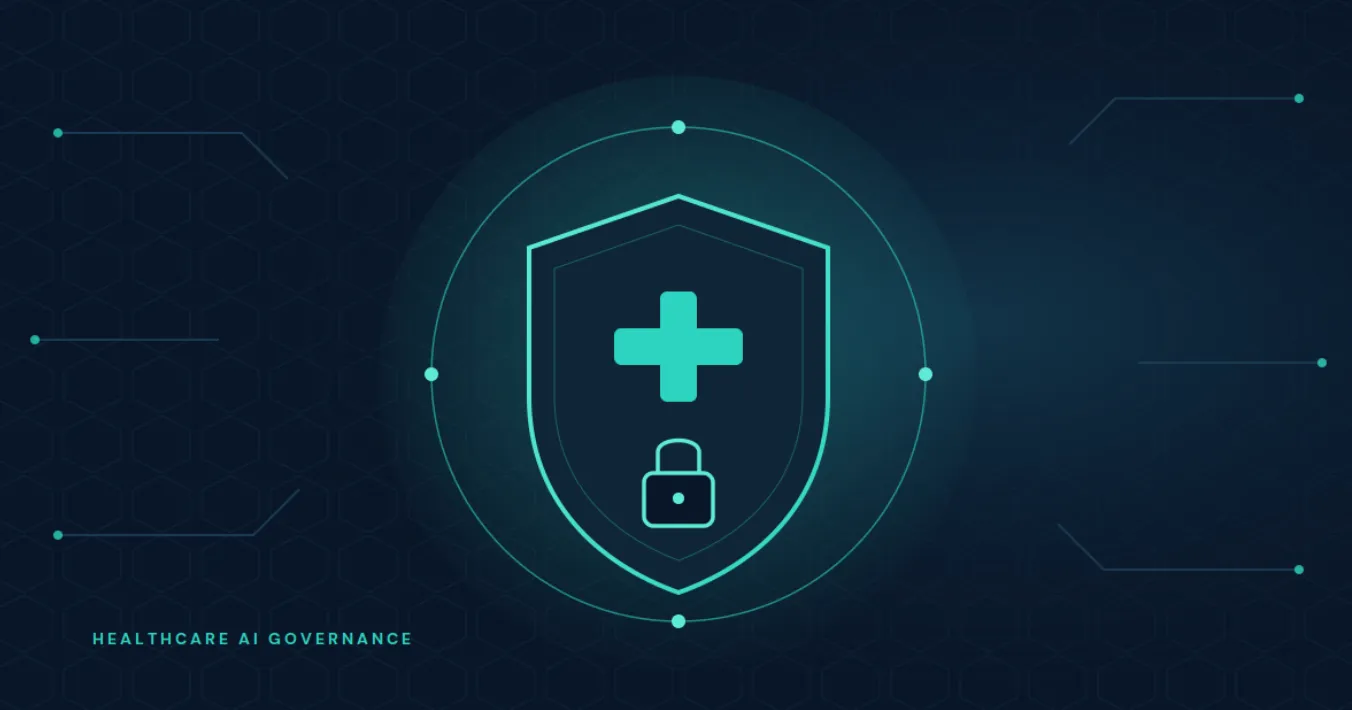
After having spent decades in healthcare, the lack of preparedness for AI was astonishing. Even today, governance remains one of the biggest unanswered questions in healthcare AI adoption.
What surprised me most about AI entering healthcare was not the models themselves, but the compliance fallout surrounding them.
On paper, using LLMs in clinical workflows sounds straightforward. In reality, it is far more complicated. Yes, part of the challenge comes from the deeply siloed nature of healthcare data. But even if organizations solved that problem tomorrow, most existing security and compliance frameworks were never designed for probabilistic AI systems.
Every model inference that processes patient context, every API call touching Protected Health Information (PHI), every vector embedding, and every log entry capturing a clinical query creates potential compliance exposure. This is exactly why Gen AI HIPAA compliance has become one of the most important priorities for healthcare organizations adopting generative AI systems.
Healthcare organizations understand the regulatory landscape extremely well. But generative AI is still new territory for many teams. The concern is no longer just whether AI works, it is whether AI systems can be operated safely, audited properly, and governed consistently at scale.
And the stakes are extremely high. HIPAA violations create financial penalties, legal exposure, reputational damage, and loss of patient trust. Organizations are effectively forced into a difficult position: either slow AI adoption entirely or move forward while managing infrastructure and governance risks that traditional healthcare systems were never designed to handle.
The organizations successfully deploying compliant generative AI systems are not solving this through policy documents alone. They are building dedicated infrastructure designed specifically for secure, scalable, and operationally mature gen AI HIPAA compliance.
HIPAA has always required organizations handling PHI to maintain strong controls around privacy, security, access management, and auditability. But generative AI changes how those principles must be implemented technically.
Protected Health Information now flows through entirely new infrastructure layers. PHI may appear inside prompts, inference requests, embeddings, model outputs, cached responses, vector databases, observability pipelines, and debugging systems. Even routine engineering workflows can unintentionally expose patient data if organizations lack proper safeguards.
This is where many healthcare AI projects run into problems. A vendor signing a Business Associate Agreement (BAA) or advertising HIPAA eligibility does not automatically make an AI system compliant. Organizations still need technical safeguards, operational controls, governance workflows, and secure architectural patterns to achieve true gen AI HIPAA compliance.
Most teams only discover this gap after development has already begun, usually when they realize their infrastructure lacks the controls HIPAA actually requires.
“A HIPAA-eligible vendor does not automatically make your AI system HIPAA compliant.”
That distinction remains one of the most misunderstood aspects of healthcare AI adoption.
.webp)
Building HIPAA-compliant generative AI systems requires much more than securing databases or encrypting storage. Organizations pursuing gen AI HIPAA compliance need infrastructure-level controls specifically designed for AI workloads.
One of the biggest security risks in healthcare AI systems is logging.
Consider a clinical documentation assistant helping physicians draft patient notes. The prompts contain PHI. The responses likely contain PHI. The conversation history definitely contains PHI.
Now add observability systems, debugging tools, telemetry pipelines, and support workflows into the mix. Without proper controls, organizations can unintentionally expose patient data through infrastructure layers rather than the application itself.
Most application performance monitoring systems were never designed for healthcare AI workloads. Standard observability tooling assumes developers can freely inspect raw requests, complete traces, and debugging payloads. That assumption breaks immediately in regulated healthcare environments.
Retrieval-Augmented Generation creates additional compliance challenges. Healthcare organizations increasingly store clinical documents inside vector databases to support semantic retrieval during inference. That introduces difficult questions around whether embeddings themselves should be treated as PHI.
In many cases, the answer is yes.
Even numerical vector representations may create compliance exposure if they can be reconstructed or linked back to patient information. Most vector databases were optimized for retrieval performance, not healthcare-grade governance. Organizations therefore need encryption, retention policies, strict access controls, and deletion workflows specifically designed for regulated AI systems and long-term gen AI HIPAA compliance.
Governance complexity also grows rapidly as organizations scale AI adoption internally. Traditional software access controls operate relatively simply, users either have access or they do not. AI systems are much more nuanced. A cardiology-specific model may need to remain inaccessible to dermatology teams, despite both groups operating within the same health system.
Enforcing those policies through APIs and AI workflows requires a completely different governance model.
Truefoundry approaches healthcare AI compliance as an infrastructure problem rather than a post-deployment checklist. Instead of adding governance later, the platform embeds compliance controls directly into the operational layer powering AI systems.
The platform’s HIPAA and SOC 2-compliant infrastructure gives healthcare organizations a foundation for securely deploying and scaling AI workloads while maintaining strong governance controls required for enterprise-grade gen AI HIPAA compliance.
.webp)
Some of the core architectural capabilities include:
Many healthcare AI projects become non-compliant not because of the models themselves, but because of operational shortcuts and infrastructure assumptions.
Organizations successfully deploying compliant healthcare AI systems typically follow several consistent architectural patterns that strengthen gen AI HIPAA compliance over time.
Achieving initial compliance is difficult. Maintaining compliance over time is even harder.
AI systems evolve continuously. Models change, prompts evolve, workflows expand, regulations shift, and teams grow. Healthcare organizations therefore need continuous governance and monitoring rather than one-time compliance exercises.
Truefoundry’s observability features help organizations monitor abnormal access patterns, failed authentication attempts, unusual traffic spikes, policy violations, and operational anomalies before they become larger compliance incidents.
Regular compliance reviews remain essential for maintaining long-term gen AI HIPAA compliance. Organizations should continuously verify user permissions, retention policies, audit completeness, governance controls, and observability configurations as systems evolve.
Documentation must evolve alongside the architecture itself. As new workflows, models, or governance rules are introduced, organizations need updated records showing how those changes impact regulatory requirements and PHI exposure.
Healthcare organizations no longer need to decide whether generative AI will influence clinical operations.
That future is already here.
The real question is whether AI systems will be deployed using infrastructure capable of protecting patient data safely at scale.
The future of healthcare AI will not belong to organizations using the most models. It will belong to organizations capable of operating AI safely under healthcare-grade compliance requirements and scalable gen AI HIPAA compliance frameworks.
Generative AI HIPAA compliance is no longer just a legal requirement.
It is rapidly becoming the operational foundation required for trustworthy healthcare AI systems.
See how TrueFoundry AI Gateway helps teams safely scale AI across models, apps, and clinical workflows. Book a demo.
TrueFoundry AI Gateway bietet eine Latenz von ~3—4 ms, verarbeitet mehr als 350 RPS auf einer vCPU, skaliert problemlos horizontal und ist produktionsbereit, während LiteLM unter einer hohen Latenz leidet, mit moderaten RPS zu kämpfen hat, keine integrierte Skalierung hat und sich am besten für leichte Workloads oder Prototyp-Workloads eignet.





Die neuesten Nachrichten, Artikel und Ressourcen werden in Ihren Posteingang gesendet
.webp)
.webp)
.webp)
.webp)
.webp)