November 6, 2026
|
5 min read



Blazingly fast way to build, track and deploy your models!
Most teams secure the model and ignore everything around it. They evaluate a provider's safety record, tune guardrails, and lock down the API endpoint, while the code path that actually reaches that endpoint runs through a stack of third-party packages, SDKs, and tool servers that nobody reviewed with the same rigor. That stack is the AI supply chain, and in 2026 it is where the real compromises happened.
A supply-chain attack does not break your model. It breaks something your model's code depends on, before your security controls ever see a request. A malicious package version runs during pip install. A compromised SDK reads your environment variables at import time. An impersonated MCP server hands your agent a poisoned tool description. In each case the attacker inherits the privileges of your application, which usually means the provider keys, cloud credentials, and internal network access the application was granted to do its job.
This article maps the AI supply chain surface by surface, uses the well-documented public incidents of 2026 as the anchor case, and lays out the mitigations that actually reduce blast radius, chief among them concentrating provider secrets behind one governed layer instead of spraying them across every service that installs a package.
Want your provider secrets behind one audited gateway instead of in every package install? Book a demo.
"Supply chain" means every external thing your application trusts in order to produce an inference. There are five surfaces, and they fail in different ways.
Model weights. The weights you download or fine-tune from. Risk: a tampered or backdoored checkpoint, or one whose provenance you cannot verify, pulled from an open repository. You are trusting that the artifact is what its name claims and that it was not modified in transit or at rest.
Providers and their APIs. The hosted model endpoints you call. Risk: a compromised provider account, a leaked provider key, or a dependency the provider itself ships. Your exposure here is largely your credentials and how widely they are distributed.
SDKs and packages. The client libraries and their transitive dependencies you install to call models. Risk: a malicious version published to a public registry, typosquatting, or a hijacked maintainer account. This code runs with your privileges, often at install or import time, before any of your own logic executes.
MCP servers and tools. The Model Context Protocol servers that expose tools to your agents. Risk: a malicious or impersonated server, a poisoned tool description, or a server that over-collects on connection. The agent trusts the tool catalog it is handed, and by default nothing authenticates where that catalog came from.
Prompts and prompt templates. Shared system prompts, templates, and prompt libraries. Risk: an injected instruction committed into a shared template, or a prompt pulled from an untrusted source at runtime. This is supply-chain compromise of the instruction layer rather than the code layer.

| Surface | Primary threat | Mitigation |
|---|---|---|
| Model weights | Tampered or unverifiable checkpoint | Verify checksums and provenance; pull from trusted registries |
| Providers / APIs | Leaked or over-distributed provider key | Hold keys behind one gateway; scope and rotate |
| SDKs / packages | Malicious published version, hijacked maintainer | Pin exact versions; verify provenance; minimize what has secrets |
| MCP servers / tools | Impersonated server, poisoned tool description | Authenticate servers; govern tool access through a gateway |
| Prompts / templates | Injected instruction in a shared template | Review templates as code; treat runtime-fetched prompts as untrusted |
The clearest demonstration of why the package layer matters is the series of publicly reported incidents affecting LiteLLM, a widely used open-source LLM SDK, during 2026. These are stated here factually, as reported in public advisories, to illustrate the mechanics of a package supply-chain attack. The point is not the project; any widely depended-on package is a target, and LiteLLM's popularity is precisely what made it a useful one for attackers.
March 2026: malicious versions on PyPI. Two malicious releases, versions 1.82.7 and 1.82.8, were published to the Python Package Index. The root cause reported was a compromise of the project's continuous-integration pipeline, specifically a vulnerability in the Trivy scanning step, which was used to steal the maintainer's PyPI publishing credentials. With those credentials the attacker published tampered packages under the legitimate project name. The malware in those versions harvested environment variables, SSH keys, and cloud credentials from any machine that installed them, and installed a backdoor. Notably, the project's official Docker image was reported unaffected, because it was built and distributed through a path the attacker did not control. The split outcome, poisoned on PyPI, clean in the official container, is itself the lesson: the compromise was specific to one distribution channel's credentials.
October 2026: a malicious release via stolen tokens. A later incident involved a malicious release, version 1.107.0, pushed using stolen GitHub tokens. This one reached both PyPI and the Docker distribution, including the latest and main-latest tags, so teams that pulled the newest container were exposed as well as those installing from PyPI. The vector was different, stolen source-control and publishing tokens rather than a CI-scanner compromise, but the pattern was the same: legitimate credentials used to publish an illegitimate artifact under a trusted name.
Associated CVEs. Separate from the package-poisoning events, the project had multiple reported vulnerabilities in the same period. At least one was serious enough to be added to the US CISA Known Exploited Vulnerabilities (KEV) catalog, reported as a remote-code-execution issue exploitable by holders of an API key. Another reported issue allowed establishing an MCP session with any bearer token, weakening the authentication boundary on the tool path.
Taken together these incidents show the full anatomy of the package surface: the code you install can be poisoned through a compromised build or publish credential, it runs with your privileges and goes straight for your secrets, and separate code-level vulnerabilities can hand an attacker execution or a bypassed auth check even when the package itself is genuine.

The reason a poisoned package is worse than most application bugs is timing and privilege. Package install and import hooks run before your application logic and with whatever the installing environment holds. In a typical AI service that environment contains exactly the things an attacker wants: the provider API keys, cloud credentials from the instance role, SSH keys, and often tokens for internal services. The malicious code does not need to find a vulnerability in your app. It runs as your app, at the moment your app is being built or started, and reads the secrets your app was trusted with.
This is why "where your secrets live" is the single most important architectural decision for limiting damage.
See how TrueFoundry shrinks your AI supply-chain blast radius with centralized secrets and audit. Book a demo.
The package layer is the familiar surface. The MCP layer is the new one, and it has the same shape: your agent trusts an external component, and that trust is largely unverified by default.
When an agent connects to an MCP server, the server advertises a set of tools, each with a name and a natural-language description that tells the model when and how to use it. That description is instruction data the model acts on. A malicious server can poison it: embed hidden instructions in a tool description that tell the agent to exfiltrate context, call another tool, or ignore a safety rule. The agent never sees anything suspicious, because reading and trusting tool descriptions is how MCP is supposed to work. This is tool poisoning, and it is a supply-chain attack on the agent's instruction layer. We cover the mechanism in detail in MCP tool poisoning and gateway defense.
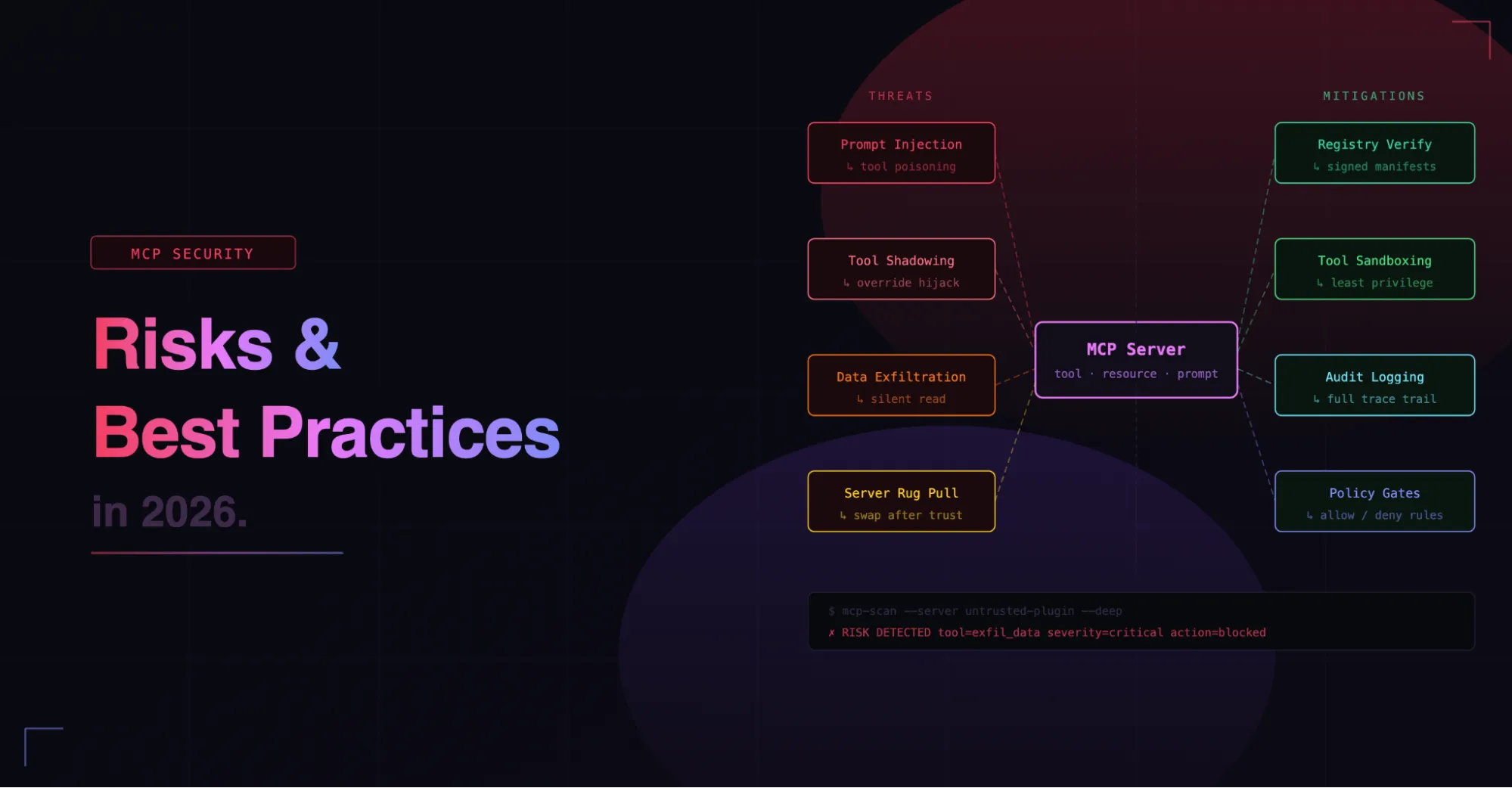
Impersonation compounds it. There is no inherent trust anchor that proves an MCP server is the one you intended to connect to. A server that squats a well-known name, or one reached through a misconfigured endpoint, can impersonate a legitimate tool provider and collect whatever the agent sends it. The broader catalog of these risks, unverified servers, over-broad tool permissions, and data over-collection, is laid out in MCP security: risks and best practices and MCP server security best practices.
The mitigation mirrors the package case: do not let every agent connect directly to arbitrary tool servers. Route tool access through an MCP gateway that authenticates servers, governs which tools are reachable, controls egress, and audits every tool call. Enterprise MCP governance makes the tool supply chain something you approve and monitor rather than something each agent discovers on its own.
The incidents above all point to the same short list. None is exotic; the failures come from skipping them.
1. Pin exact versions. Depend on litellm==1.82.6, not litellm>=1.82 or litellm unpinned. A floating range means the next install can silently pull a version published five minutes ago by whoever controls the publishing credential. Pinning plus a lockfile means a malicious new release does not enter your build until a human reviews the bump. In the March 2026 case, teams pinned below the poisoned versions were not pulled into them automatically.
2. Verify provenance. Check that the artifact is what it claims: verify checksums, prefer signed artifacts and build-provenance attestations where the ecosystem provides them, and prefer distribution channels with tighter controls. The LiteLLM split outcome, PyPI poisoned, official Docker image clean, is a concrete argument for choosing the hardened distribution path and verifying what you pull from it.
3. Rotate secrets on any suspicion. If a package you installed is implicated, assume every secret that was readable in that environment is compromised: provider keys, cloud credentials, SSH keys, service tokens. Rotate them. The speed of rotation is bounded by how many places each secret lives, which leads directly to the next two points.
4. Minimize blast radius. Give each component only the secrets and permissions it needs, and keep the set of components that hold high-value secrets as small as possible. A build runner that installs packages should not also hold your production provider key. The fewer environments that can read a secret, the fewer an attacker reaches through any one poisoned dependency.
5. Concentrate provider secrets behind one governed gateway. This is the highest-leverage structural change. Instead of distributing provider API keys into every service that installs a client SDK, hold the keys in one gateway and have applications call the gateway with their own scoped credentials. The provider keys then live in exactly one audited layer. A poisoned SDK in an application environment finds application-scoped credentials to the gateway, not the raw provider keys, and the gateway's audit trail shows exactly what was called. This is the model TrueFoundry uses: provider secrets sit behind the AI gateway, access is governed by RBAC, SSO, and SCIM, and every request is tagged by user, team, and model in a full audit trail.
The clearest way to see the benefit is to compare the two architectures directly on the dimensions that matter during an incident.
| Dimension | Secrets in every service's install | Secrets behind one governed gateway |
|---|---|---|
| Blast radius of a poisoned package | Provider keys exposed in every environment that installed it | Application sees only gateway-scoped credentials; raw provider keys not present |
| Rotation effort | Rotate the key in every service that holds it; easy to miss one | Rotate in one place; applications unaffected |
| Audit of provider usage | Scattered across each service's logs, formats differ | One trail, tagged by user, team, and model |
| Adding a new app | New copy of the secret, new exposure point | New scoped credential to the gateway, no new copy of the provider key |
| Detecting misuse | Per-service, inconsistent | Central observability on every request |
The table is not an argument that a gateway makes package compromise impossible. It makes the point that follows the compromise: when, not if, a dependency is poisoned, the amount you have to rotate and the amount an attacker gets are both determined by how many places your secrets live. One place is the goal.
Securing the model, ignoring the dependency tree. Teams spend weeks on guardrails and model selection and run an unpinned, unreviewed dependency graph underneath it. The attacker does not need to beat your guardrails if a package reads your keys at install time.
Treating the official container and the package registry as equally trusted. The 2026 incidents showed these are separate channels with separate credentials and separate outcomes. In March the PyPI releases were poisoned and the official Docker image was not; in October a release reached both. Know which channel you pull from and verify each independently.
Distributing provider keys into every service. The convenient pattern, drop the API key in each app's environment, is also the one that maximizes blast radius and rotation pain. Every copy is a place a poisoned dependency can read it and a place you must remember to rotate.
Trusting MCP servers because they responded. A server answering on an endpoint is not proof it is the server you meant to use, and a tool description is instruction data the model will act on. Unauthenticated, ungoverned tool connections are a supply-chain surface, not a convenience.
Rotating slowly, or partially. After a suspected compromise, a secret rotated in four of five places is not rotated. The time-to-rotate and the completeness of rotation are functions of your architecture; design for them before the incident, not during it.
The AI supply chain is larger than the model, and in 2026 it is where attackers succeeded. A poisoned package runs with your privileges before your controls engage; an impersonated MCP server poisons the tools your agent trusts; a leaked provider key in one of fifty services is fifty rotations and fifty exposure points. None of these touch the model's quality, and all of them touch your credentials.
The durable defenses are unglamorous: pin versions, verify provenance, rotate completely, minimize what holds secrets, and concentrate provider credentials behind one audited gateway so that the blast radius of the next poisoned dependency is bounded by design. Treat every external component your AI stack trusts as part of your attack surface, because that is exactly what the public incidents proved it is.
Secure your models, packages, and MCP tools behind one control plane. Book a demo.
TrueFoundry AI Gateway delivers ~3–4 ms latency, handles 350+ RPS on 1 vCPU, scales horizontally with ease, and is production-ready, while LiteLLM suffers from high latency, struggles beyond moderate RPS, lacks built-in scaling, and is best for light or prototype workloads.



AI supply chain security is the practice of protecting every external component an AI application trusts to run, model weights, provider APIs, SDKs and packages, MCP servers and tools, and shared prompts, from compromise. It covers verifying provenance, pinning versions, controlling where secrets live, and governing tool access so that a compromised dependency cannot read credentials or take unauthorized actions.
It is an attack that compromises a dependency of an LLM application rather than the model itself, for example a malicious package version that runs on install and steals environment variables and cloud credentials, or a poisoned MCP tool description that redirects an agent. Public incidents in 2026 affecting a popular LLM SDK demonstrated the package vector operationally.
Pin exact versions and use a lockfile so new releases do not enter your build automatically, verify artifact provenance and checksums, prefer hardened distribution channels, and minimize the secrets present in any environment that installs packages. Concentrating provider keys behind one gateway means a poisoned install finds scoped gateway credentials rather than raw provider keys.
Yes. An agent trusts the tool descriptions an MCP server advertises, and those descriptions are instruction data the model acts on. A malicious or impersonated server can poison them or over-collect data on connection. Routing tool access through an MCP gateway that authenticates servers and audits every call turns the tool chain into something you govern rather than something agents discover.
Because the number of places a secret lives determines both your blast radius if a dependency is poisoned and how long rotation takes. Keys spread across every service mean every service is a compromise point and a rotation chore. Held behind one governed gateway, they are one place to audit, one place to rotate, and absent from the application environments most exposed to poisoned packages.



The latest news, articles, and resources sent to your inbox