November 11, 2026
|
5 min read


Blazingly fast way to build, track and deploy your models!
The question "which model is best?" is the wrong question, and it quietly costs teams money. The honest answer is that a frontier model is a tool with a price tag, and the right tool depends on what you are asking it to do. Sending a product-review classification job to a top-tier reasoning model is like renting a crane to hang a picture frame. It works. It also costs 40 times more than it needs to, and it is slower.
By late 2026 the frontier has widened into tiers. Every major vendor ships at least three models: a flagship tuned for hard reasoning, a mid-tier workhorse tuned for price and throughput, and a small model tuned to be fast and nearly free. The interesting decisions are no longer "OpenAI or Anthropic." They are "which tier, for which request, at what cost, with what fallback." That is a routing problem, and routing problems are solved with policy, not with allegiance to a brand.
This post does two things. First, a tour by vendor organized around what each model is actually good at. Second, a decision framework that maps your task types to a model tier and a cost posture, and shows how an AI gateway lets you act on that framework without rewriting your app every time a provider ships a new version.
Want to route each request to the right model by task and cost? Book a demo.
Benchmarks measure a model on a fixed test. Your production traffic is not a fixed test. It is a mix: a flood of cheap, repetitive calls (extract the invoice number, classify the ticket, decide which downstream prompt to run) and a thin stream of genuinely hard requests (debug a race condition across five files, reason over a 200-page contract). A single "best" model has to be priced and sized for the hard stream, so you overpay on the flood.
Three forces make single-model thinking expensive:
The way out is to treat model selection as configuration. Decide the policy once ("extraction goes to the cheap tier, coding goes to the mid tier, hard reasoning escalates to a flagship, and everything falls back to a second provider on error"), express it at a gateway, and change it without shipping code. For the mechanics of that, see what is an LLM router and cost- and quality-aware model selection.
The only numbers below that are first-party confirmed are Claude's. Everything else is aggregated from third-party reporting as of November 2026 and should be verified against the provider's own pricing and model pages before you rely on it. Model specs change frequently.
Claude's late-2026 lineup runs on a 1M-token context window with 128K output and a June 2026 training cutoff. The tiers are clean:
The useful pattern here is the three-way split: a near-free small model, a balanced workhorse, and a premium agentic model. You can build almost any routing policy from those three roles.
OpenAI's GPT-6 generation is reported to follow the same tiering shape. GPT-6 Astra is reported at $10 / $50 and positioned for top-tier reasoning. GPT-6.1 Sol is reported at $2 / $10 and described as the strongest coding and research model in the family, with a reported Coding Index around 54. GPT-6.1 Terra, reported at $1 / $5 and released around October 26, 2026, is described with roughly 1.05M context and a reported Coding Index near 48, which lands it at about half Sol's price for a large share of Sol's coding ability. GPT-6 Luna, reported at $0.10 / $0.50, is the high-volume classify-and-route model, with a reported Coding Index around 31.
Read those Coding Index numbers as directional, not precise. They come from third-party aggregation and will shift.
Google's lineup is the hardest to pin down because reporting conflicts. Gemini 3.1 Pro is reported at $2 / $12 and aimed at the hardest reasoning. Gemini 3.6 Flash is reported at $1.50 / $7.50, released around July 2026, with a 1M context window, an Intelligence Index reported near 50, SWE-Bench Pro reported around 58.7%, and throughput reported near 280 tokens per second, which positions it as a high-capability but cheap coding workhorse. Gemini 3.1 Flash-Lite is reported near $0.25 / $1.50 for the bottom tier. If you cannot confirm 3.6 Flash in your account, the safe fallback is the generally available Gemini 3.5 Flash.
Grok's versioning is unsettled. Grok 4.3 at roughly $1.25 / $2.50 is the most-cited configuration, and its low output price is notable. Newer Grok 4.6 and Grok 5 versions are reported but not settled. Treat the version as unsettled and verify directly with xAI before you route production traffic to it.
For teams that want to self-host or push cost to the floor: Meta Llama 4 Maverick is reported around $0.20 / $0.60 and Scout around $0.11 / $0.34, both open-weight and self-hostable. DeepSeek V4 is reported in a roughly $0.22 to $0.66 range and positioned for cost-efficient reasoning and coding. Mistral Large 3 is reported around $0.50 / $1.50. These matter most when data residency or raw unit economics dominate the decision.
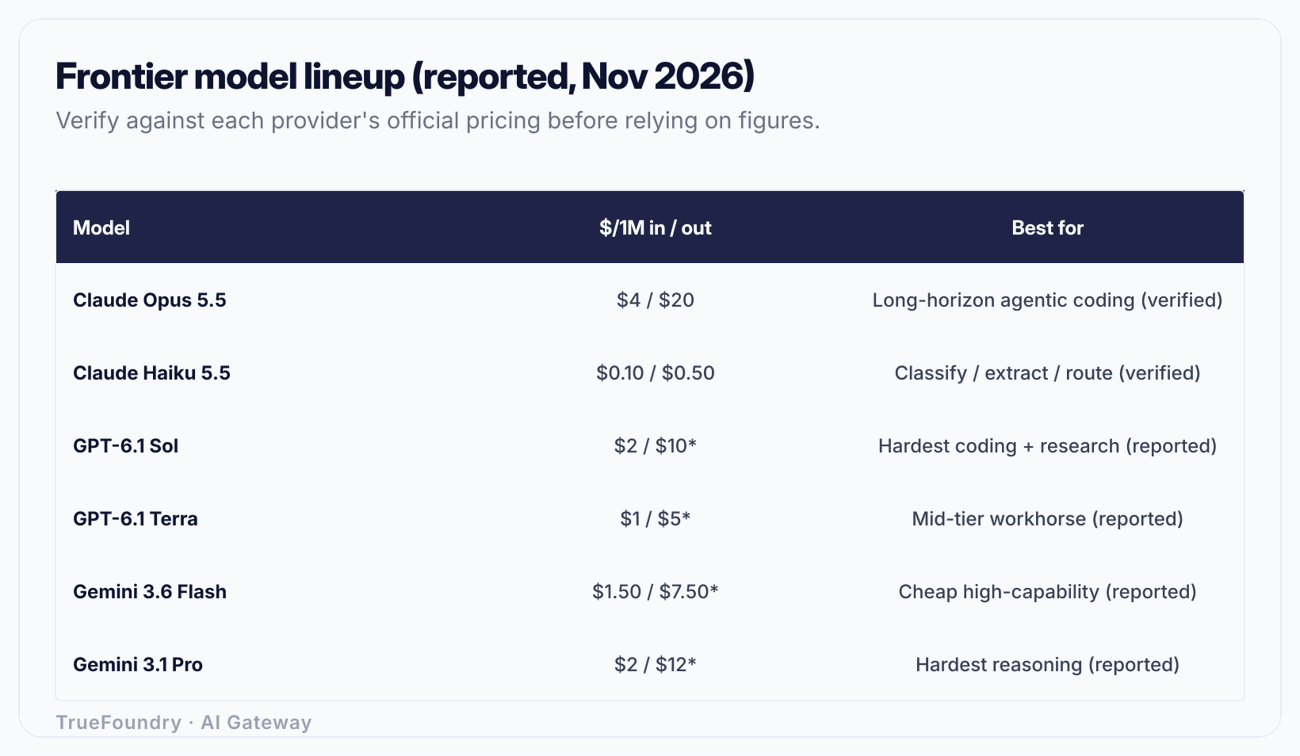
| Vendor | Model | Reported $/1M in | Reported $/1M out | Context | Best for |
|---|---|---|---|---|---|
| Anthropic | Opus 5.5 | $4 | $20 | 1M | Long-horizon agentic coding (confirmed) |
| Anthropic | Sonnet 5.5 | $2 | $10 | 1M | Balanced everyday coding and chat (confirmed) |
| Anthropic | Haiku 5.5 | $0.10 | $0.50 | 1M | Classify, extract, route (confirmed) |
| OpenAI | GPT-6 Astra | $10 | $50 | reported | Top-tier reasoning |
| OpenAI | GPT-6.1 Sol | $2 | $10 | reported | Strongest coding/research (CI ~54) |
| OpenAI | GPT-6.1 Terra | $1 | $5 | ~1.05M | Mid-tier coding workhorse (CI ~48) |
| OpenAI | GPT-6 Luna | $0.10 | $0.50 | reported | High-volume classify/route (CI ~31) |
| Gemini 3.1 Pro | $2 | $12 | reported | Hardest reasoning | |
| Gemini 3.6 Flash | $1.50 | $7.50 | 1M | Cheap coding/speed workhorse | |
| Gemini 3.1 Flash-Lite | $0.25 | $1.50 | reported | Bottom-tier volume | |
| xAI | Grok 4.3 | $1.25 | $2.50 | reported | Low output cost (version unsettled) |
| Meta | Llama 4 Maverick | $0.20 | $0.60 | reported | Open-weight / self-host |
| DeepSeek | V4 | $0.22–$0.66 | (range) | reported | Cost-efficient reasoning |
| Mistral | Large 3 | $0.50 | $1.50 | reported | Cost-efficient general |
Pricing/benchmarks as reported as of November 2026; verify against each provider's official pricing page before relying on them — model specs change frequently.
Stop choosing a model. Start classifying your traffic, then attach each class to a tier and a cost posture. Four categories cover almost everything.
These are high-volume, low-ambiguity jobs: label a ticket, pull a date from a document, decide which prompt branch to run. They do not need a flagship. A small model (Haiku 5.5, GPT-6 Luna, Gemini 3.1 Flash-Lite) at roughly $0.10 to $0.25 per million input tokens handles them, and because the output is short, the per-request cost is tiny. Cost posture: minimize. This is where routing to the cheap tier pays for itself.
User-facing chat needs decent quality and low latency, but rarely the deepest reasoning. A mid-tier model (Sonnet 5.5, GPT-6.1 Terra, Gemini 3.6 Flash) is the sweet spot. Cost posture: balance. Watch output price especially, because chat generates a lot of tokens.
Multi-step coding, where the model plans, calls tools, reads files, and keeps a goal in mind across turns, is where capability gaps show. For the hardest agentic work, Opus 5.5 is the confirmed strong default; GPT-6.1 Sol is reported as a strong peer. For everyday coding that does not need a long horizon, a mid-tier model (Terra, Gemini 3.6 Flash, Sonnet 5.5) is usually 90% as good at a fraction of the cost. Cost posture: tier by difficulty. Route routine edits to mid-tier, escalate the hard agentic runs.
Legal analysis, research synthesis, reasoning over large documents. This is the one place to pay for a flagship (Astra, Gemini 3.1 Pro, Opus 5.5 or Fable 5.1 for the heaviest). Cost posture: pay for quality, but gate it. Only a thin slice of traffic should reach this tier; the gate is the routing rule.
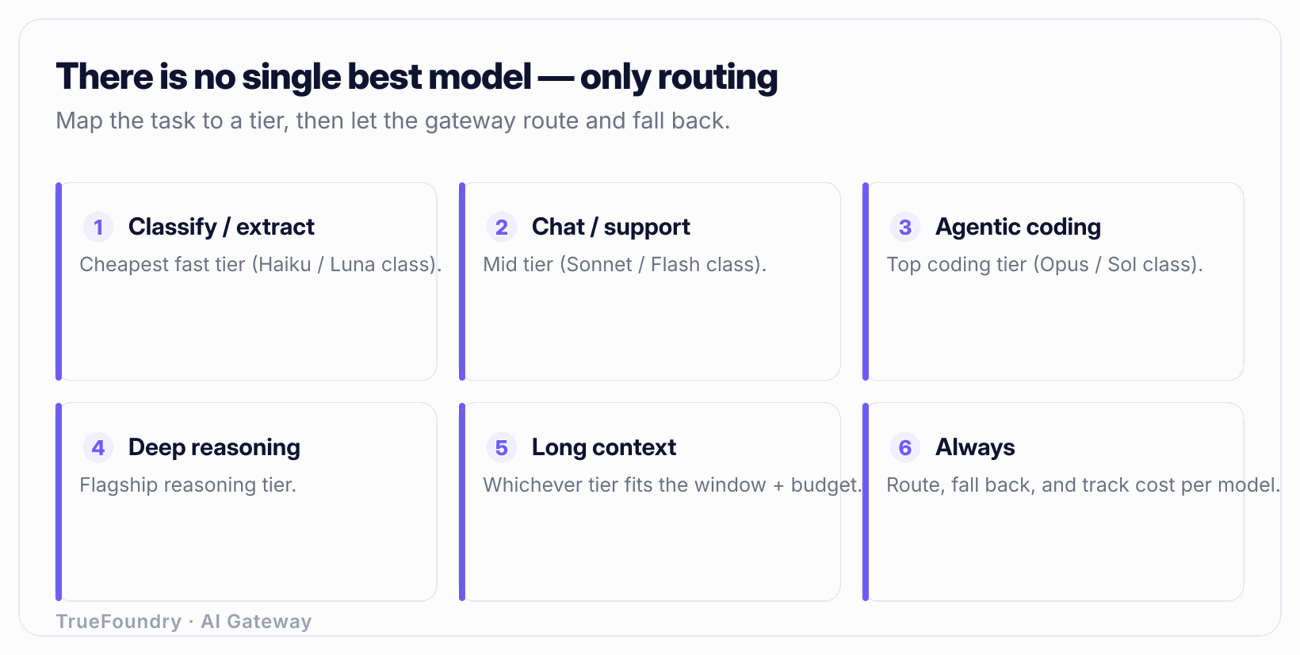
| Task type | Model tier | Example (reported) | Cost posture |
|---|---|---|---|
| Classify / extract / route | Small | Haiku 5.5, Luna, Flash-Lite | Minimize |
| Chat / general assist | Mid | Sonnet 5.5, Terra, 3.6 Flash | Balance (watch output price) |
| Everyday coding | Mid | Terra, 3.6 Flash, Sonnet 5.5 | Balance |
| Agentic / long-horizon coding | Flagship | Opus 5.5, Sol | Pay for quality |
| Deep reasoning / long context | Flagship | Astra, 3.1 Pro, Fable 5.1 | Pay, but gate traffic |
Pricing/benchmarks as reported as of November 2026; verify against each provider's official pricing page before relying on them — model specs change frequently.
See how TrueFoundry routes, falls back, and tracks cost across every model. Book a demo.
Suppose a product sends 10 million model requests a month. Assume an 80/15/5 split: 80% simple (classification, extraction, routing), 15% chat and everyday coding, 5% hard reasoning and agentic coding. Assume an average of 500 input and 200 output tokens per request for the simple and chat tiers, and more for the hard tier.
Route everything to a single flagship at $4 / $20 and you pay the flagship rate on all 10M requests, including the 8M that a $0.10 model would have handled identically. Route by task instead:
The simple tier, which is the bulk of volume, now costs roughly 1/40th per input token of the flagship. In most real workloads this cuts the total bill by well over half while leaving the hard requests on exactly the model they need. The exact figure depends on your token mix, which is the point: you measure it per tier, which requires per-model cost visibility. See LLM cost attribution and team budgets for how to hold teams to that.
The framework above is only useful if you can act on it without a deploy every time. That is what an AI gateway is for. A gateway exposes one unified, OpenAI-compatible API to your application. Behind that single endpoint, you configure which real model each request goes to. The application sends the same request shape every time; the gateway decides the target.
That decoupling buys four things that map directly onto the framework:
The single-API point matters more than it looks. When a new model ships (Terra appeared in late October; something will appear in December), you add it as a target and shift traffic with a config change. The app never knows. For the architecture underneath, see what is an LLM proxy and how to choose an AI gateway.
The frontier in late 2026 is not a single peak with a clear winner. It is a set of tiers, and the teams that spend well are the ones that match each slice of their traffic to the right tier instead of paying flagship rates for classification. The vendor names will keep changing, the prices will keep moving, and the leaderboards will keep reshuffling. The framework survives all of it: classify your traffic, map each class to a tier and a cost posture, and gate the expensive tier so only hard requests reach it.
Make that framework a routing policy at a gateway, and "which model" stops being a standing debate and becomes a line of configuration you change in minutes. You route by task and cost, fall back when a provider stumbles, cache the repeats, and see exactly what each model costs per request. That is how you stay on the frontier without being locked to any one point on it.
Stop locking into one model — route between them. Book a demo.
TrueFoundry AI Gateway delivers ~3–4 ms latency, handles 350+ RPS on 1 vCPU, scales horizontally with ease, and is production-ready, while LiteLLM suffers from high latency, struggles beyond moderate RPS, lacks built-in scaling, and is best for light or prototype workloads.





There is no single best LLM. For long-horizon agentic coding, Opus 5.5 is a confirmed strong default and GPT-6.1 Sol is reported as a strong peer. For high-volume classification, a small model like Haiku 5.5 or the reported GPT-6 Luna is better because it is far cheaper and faster. The best model is the one that matches the task and budget, which is why routing beats choosing.
Claude Opus 5.5 is first-party confirmed as strong for long-horizon agentic coding. GPT-6.1 Sol is reported with a Coding Index around 54 and GPT-6.1 Terra around 48, both from third-party aggregation as of November 2026. Verify against OpenAI's official pages, and evaluate both on your own codebase before committing, because benchmark scores do not transfer cleanly to your tasks.
It depends on the tier. Gemini 3.6 Flash is reported at $1.50 / $7.50, close to Claude Sonnet 5.5 at a confirmed $2 / $10 on input but higher on output ratio in some workloads. At the bottom tier, Claude Haiku 5.5 is confirmed from $0.10 / $0.50. Compare at the tier you will actually use, and price it against your own input/output ratio.
Several, routed by task. Using one model means overpaying on simple traffic and carrying single-provider outage risk. A gateway lets you use several behind one API, so the complexity stays in configuration, not in your application.
Frequently. New model versions and price cuts land roughly monthly across vendors. Every non-Claude number in this post is reported as of November 2026 and should be verified against the provider before you depend on it. Build for change: put model selection behind a gateway so a price shift is a config edit, not a redeploy.



The latest news, articles, and resources sent to your inbox