



October 5, 2023
|
5 min read


Obtenha acesso instantâneo a um ambiente TrueFoundry ao vivo. Implante modelos, direcione o tráfego de LLM e explore a plataforma completa — seu sandbox estará pronto em segundos, sem necessidade de cartão de crédito.



Published: June 11, 2026

Blazingly fast way to build, track and deploy your models!
The Model Context Protocol (MCP) has revolutionized how AI applications connect to external data sources and tools. As organizations scale their AI implementations, they're discovering that direct server connections aren't always the optimal approach. Enter MCP Proxy—a powerful intermediary layer that enhances security, scalability, and manageability of MCP deployments. Let's explore how MCP Proxy transforms enterprise AI architectures and why it's becoming essential for production deployments.
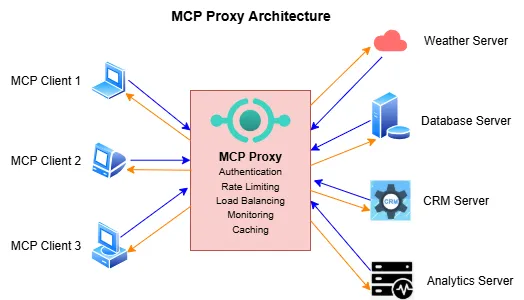
An MCP Proxy serves as an intelligent intermediary layer that sits between MCP clients (AI applications) and MCP servers (data sources and tools). Rather than establishing direct connections, the proxy acts as a centralized gateway that manages, routes, and enhances communication between these components.
Think of MCP Proxy as the "API Gateway for AI"—similar to how traditional API gateways manage REST endpoints, MCP Proxy manages MCP server connections with enterprise-grade features like authentication, rate limiting, observability, and security controls. The proxy architecture follows the standard MCP protocol, appearing as a regular MCP server to clients while acting as an MCP client to backend servers. This transparency ensures seamless integration with existing MCP-enabled applications.
At its core, an MCP Proxy provides unified access control and authentication mechanisms, enables protocol translation between different transport types (stdio, SSE, HTTP), implements enterprise security policies and governance, and offers centralized monitoring and observability. Most importantly, it aggregates multiple MCP servers behind a single endpoint, dramatically simplifying enterprise deployments.
MCP Proxy operates on a straightforward yet powerful architecture that leverages the JSON-RPC foundation of the Model Context Protocol. The proxy functions as both an MCP server (facing clients) and an MCP client (facing backend servers), creating a transparent bridge that adds value without disrupting existing workflows.
Modern proxies support multiple transport protocols simultaneously. This includes stdio transport for local server connections and development environments, Server-Sent Events (SSE) for real-time streaming capabilities, streamable HTTP for stateless, scalable deployments, and WebSocket for persistent, low-latency connections. This transport flexibility allows organizations to deploy MCP servers using their preferred protocols while providing clients with a consistent interface.
When a client makes a request to the proxy, the system follows a well-defined workflow. First, the proxy receives the JSON-RPC request from the client, then security policies are evaluated during authentication and authorization. Next, route resolution determines which backend server(s) to query, followed by protocol-specific formatting during request translation. The proxy then forwards requests to appropriate servers, aggregates multiple server responses if needed, and returns a unified response to the client.
Enterprise MCP Proxy implementations maintain session state to optimize performance and enable advanced features including connection pooling where persistent connections to backend servers reduce latency, context preservation to maintain user context and conversation state, load balancing to distribute requests across multiple server instances, and circuit breaking to automatically bypass failed servers.
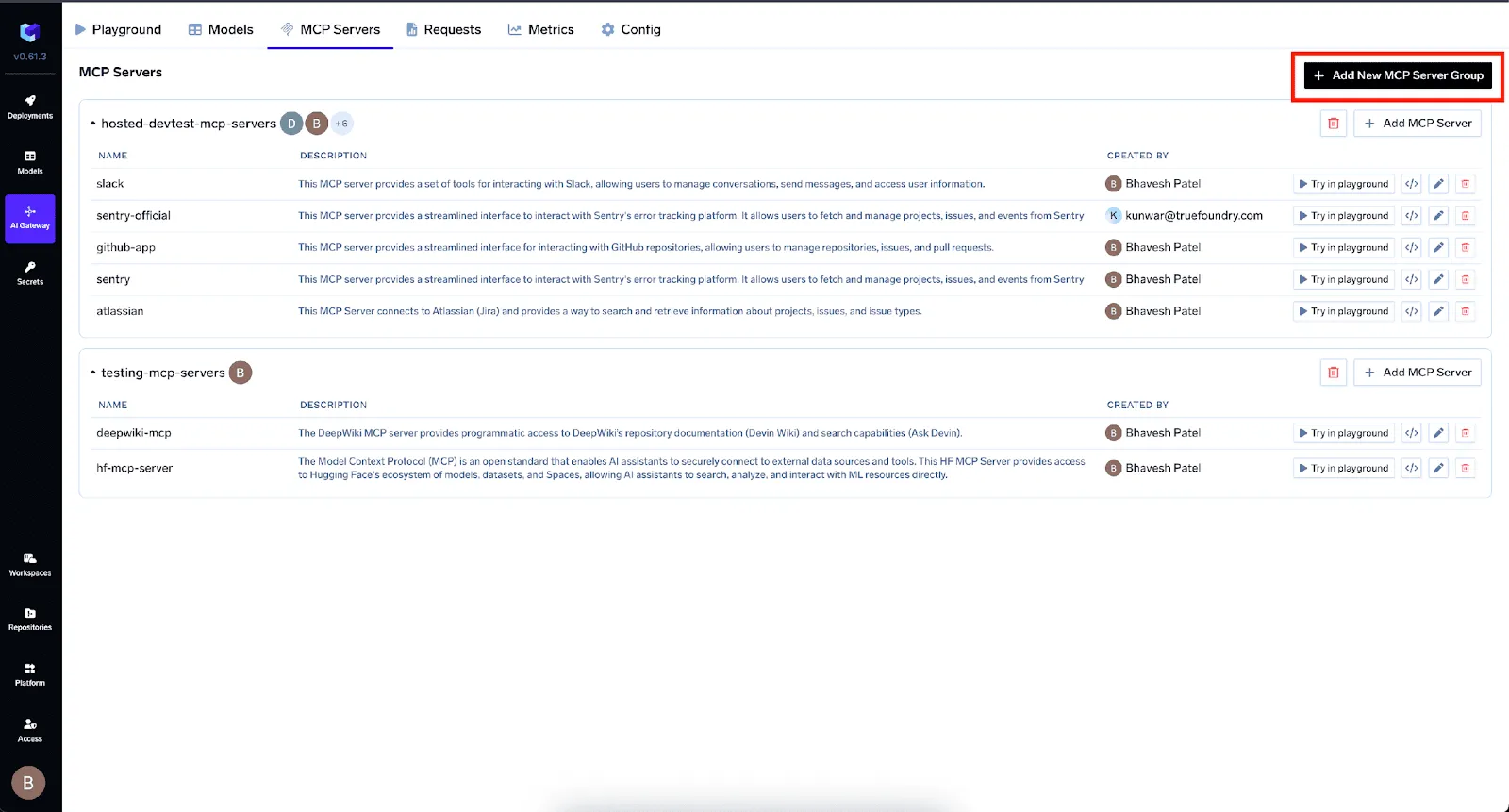
The foundation of any enterprise MCP deployment is a comprehensive registry that catalogs and manages available servers. A robust MCP registry provides a centralized catalog where administrators can register both public and privately hosted MCP servers, maintaining detailed metadata about each server's capabilities, authentication requirements, and access controls.
TrueFoundry's MCP Gateway exemplifies this approach with its centralized MCP registry that maintains a complete inventory of available servers and their authentication mechanisms. The registry handles user-specific OAuth2 flows, securely storing and refreshing access tokens while ensuring users can only access resources they're authorized for. This eliminates the chaos of distributed credential management and provides enterprise IT teams with the visibility and control they need.
The registry also enables dynamic tool discovery, allowing autonomous agents to discover and invoke tools at runtime rather than requiring hardcoded configurations. This flexibility is crucial for building adaptive AI systems that can respond to changing business requirements without manual intervention.
Security is paramount in enterprise MCP deployments, and authentication represents the first line of defense. Traditional direct server connections require managing separate credentials for each MCP server, creating a complex web of authentication flows that becomes unwieldy at scale.
MCP Proxy centralizes authentication through several mechanisms. OAuth 2.0 integration supports both 2-legged and 3-legged OAuth flows for enterprise applications, while Personal Access Tokens (PATs) allow users to generate a single token for accessing all authorized MCP servers. For applications, Virtual Account Tokens (VATs) provide scoped access to specific server sets, and role-based access control (RBAC) ensures fine-grained permissions management.
The authentication layer also implements sophisticated token management, including automatic token refresh, secure credential storage, and session management across multiple server connections. This approach significantly reduces the security burden on individual developers while providing IT teams with comprehensive audit trails and access controls.
The core value of MCP Proxy lies in its ability to orchestrate complex tool invocations across multiple servers. Unlike direct connections where each server operates in isolation, the proxy enables sophisticated workflows that span multiple data sources and capabilities.
Tool namespace management prevents naming conflicts by automatically prefixing tools with server identifiers. For example, a get_weather tool from a "weather-api" server becomes weather-api_get_weather, ensuring no collisions even when multiple servers expose similar functionality. This enables unified tool discovery where clients can discover all available tools through a single list_tools call rather than managing connections to multiple servers.
The proxy also enables cross-server workflows where complex AI agent behaviors can leverage tools from multiple servers seamlessly. This orchestration capability is what transforms simple tool calling into sophisticated enterprise automation, allowing organizations to build AI systems that integrate naturally with their existing technology stack.
Enterprise deployments demand comprehensive observability into MCP operations. Traditional direct connections scatter monitoring across multiple endpoints, making it difficult to gain holistic insights into system performance and usage patterns.
MCP Proxy consolidates observability through centralized monitoring that provides end-to-end visibility into request flows, comprehensive metrics collection including latency, throughput, and error rates, detailed audit logging for compliance and security analysis, and real-time health monitoring of backend server availability.
Advanced observability features include request tracing that follows individual requests through the entire system, performance analytics that identify bottlenecks and optimization opportunities, usage analytics that track tool utilization patterns, and security monitoring that detects anomalous access patterns or potential security threats.
The observability layer also integrates with enterprise monitoring solutions like Grafana, Datadog, and custom dashboards, ensuring that MCP metrics flow seamlessly into existing operational workflows. This integration is crucial for maintaining enterprise-grade service level agreements and operational excellence.

The security benefits of MCP Proxy extend far beyond simple access control. By consolidating multiple server connections through a single, hardened gateway, organizations can implement consistent security policies across their entire MCP ecosystem. This approach dramatically reduces the attack surface compared to exposing multiple server endpoints directly to client applications.
Centralized authentication means clients authenticate once with the proxy rather than managing separate credentials for each server. The proxy handles backend authentication using service accounts or sophisticated token exchange mechanisms, ensuring that sensitive credentials never leave the secure gateway environment. Policy enforcement becomes consistent across all MCP interactions, with capabilities like sensitive data filtering, request sanitization, and response redaction implemented at the proxy layer rather than requiring individual server modifications.
Attack surface reduction is achieved by deploying backend servers in private networks, accessible only through the proxy. This network isolation significantly reduces exposure to external threats while maintaining the flexibility needed for complex enterprise integrations.
MCP Proxy transforms operational complexity from a distributed challenge into a centralized management opportunity. Instead of configuring monitoring, scaling, and network policies for each individual server, operations teams can focus on a single, well-understood gateway component.
The unified deployment model allows proxies to be deployed using standard cloud-native patterns including containers, load balancers, and auto-scaling while backend servers focus purely on business logic. This separation of concerns enables different teams to optimize their components independently while maintaining overall system coherence.
Simplified client integration means applications need only integrate with a single proxy endpoint rather than managing connections to multiple servers. This dramatically reduces the complexity of client applications and makes it easier to add new MCP servers without requiring client-side changes.
The proxy architecture enables sophisticated scalability patterns that would be difficult to implement with direct connections. Horizontal scaling through multiple proxy instances deployed behind load balancers provides linear scalability as demand grows. Backend server pooling allows multiple instances of the same server to be pooled behind the proxy for load distribution, improving both performance and reliability.
Geographic distribution becomes possible with proxies deployed in multiple regions and intelligent routing to the nearest backend servers. This approach minimizes latency for global deployments while maintaining consistent functionality across all regions.
Performance optimization features include intelligent caching where frequently requested data is cached with configurable time-to-live settings, request deduplication that collapses identical concurrent requests, connection pooling that maintains efficient connections to backend servers, and response compression that reduces network overhead.
MCP Proxy deployments often result in significant cost savings through several mechanisms. Resource consolidation reduces per-server operational overhead by sharing infrastructure components like monitoring, logging, and security systems. Efficient resource utilization through connection pooling and request batching improves overall system efficiency.
Reduced development overhead allows teams to focus on building MCP servers that implement business logic rather than solving repeated infrastructure challenges like authentication, monitoring, and scaling. This acceleration in development velocity often represents the largest cost savings for organizations adopting MCP Proxy architectures.
Understanding when to use MCP Proxy versus direct connections requires careful consideration of both technical and organizational factors. The choice between these approaches significantly impacts security, scalability, and operational complexity.
Direct connections offer minimal latency, typically adding only 1-2ms to request processing times. However, this performance advantage comes at the cost of limited scalability, with throughput constrained by individual server capacity. Resource usage follows a pattern of one connection per client-server pair, which can become inefficient as the number of clients and servers grows.
MCP Proxy introduces slightly higher latency, typically 3-5ms with proper optimization, but provides scalable throughput through connection pooling and load balancing. The resource efficiency of pooled connections often results in better overall system performance despite the small latency increase. Additionally, intelligent caching can significantly reduce backend load for frequently accessed data.
Direct connections require per-server credential management, distributed security controls, and multiple exposed endpoints that each represent potential attack vectors. Audit trails are scattered across servers, making comprehensive security analysis difficult.
MCP Proxy provides centralized authentication, fine-grained role-based access control, centralized audit logging, and a single hardened endpoint that reduces overall attack surface. This consolidation dramatically improves security posture while simplifying compliance and governance requirements.
For simple deployments with few servers, direct connections offer straightforward setup and minimal operational overhead. However, as systems scale, the operational complexity grows significantly. Each server requires individual monitoring, manual scaling procedures, and distributed configuration management.
MCP Proxy requires more complex initial setup but dramatically simplifies operations at scale. Unified observability provides comprehensive system visibility, automated scaling capabilities handle demand fluctuations, and centralized configuration management reduces operational burden as the system grows.
Choose direct connections for development and testing environments where simplicity is paramount, applications requiring sub-millisecond response times, single server scenarios, and basic use cases involving simple tool calling without complex workflows.
Choose MCP Proxy for production deployments requiring enterprise-grade security and monitoring, multi-server architectures that aggregate multiple MCP servers, scalability requirements involving horizontal scaling and load distribution, governance and compliance needs requiring centralized control and audit capabilities, and complex workflows involving cross-server tool orchestration.
Implementing MCP Proxy introduces several technical challenges that require careful architectural consideration. State management represents a primary concern since, unlike stateless HTTP proxies, MCP Proxy often needs to maintain session state to provide optimal user experience. This includes conversation context, user preferences, and server connection state. Designing stateful proxies requires careful consideration of state persistence, replication, and recovery mechanisms.
Protocol compatibility presents another challenge as different MCP servers may implement slightly different protocol versions or extensions. The proxy must handle these variations gracefully while presenting a consistent interface to clients. Version negotiation and feature detection become critical components for ensuring seamless operation across diverse server implementations.
Error handling and circuit breaking require sophisticated logic when aggregating multiple servers. If one server in a multi-server request fails, the proxy needs intelligent decision-making to determine whether to return partial results, retry with alternative servers, or fail the entire request. This complexity multiplies when dealing with dependencies between different server responses.
Connection pool management requires balancing resource usage with performance characteristics. Too few connections create bottlenecks that limit throughput, while too many connections consume excessive system resources. The optimal configuration depends on usage patterns, server characteristics, and infrastructure constraints.
Caching strategy implementation requires deep understanding of MCP tool semantics. Some tools return dynamic data that shouldn't be cached, while others return relatively static information suitable for extended caching periods. Implementing effective caching policies requires careful analysis of each tool's behavior and data characteristics.
Request batching presents opportunities for efficiency improvements but must be implemented carefully to avoid introducing unacceptable latency for individual requests. The challenge lies in identifying optimal batching windows that balance efficiency gains with response time requirements.
Token management becomes complex when securely managing authentication tokens for backend servers while providing seamless authentication for clients. This requires sophisticated token exchange mechanisms, secure credential storage, and proper token lifecycle management.
Data privacy concerns arise because the proxy potentially has access to all data flowing between clients and servers. Implementing proper data handling, encryption at rest and in transit, and privacy controls becomes crucial for maintaining enterprise security standards.
Rate limiting implementation must balance protecting backend servers from overload while providing good user experience. This requires careful tuning based on server capabilities, user behavior patterns, and business requirements.
Monitoring and alerting complexity increases as the proxy becomes a critical component requiring comprehensive observability. Teams need to implement health checks, performance monitoring, and alerting for both the proxy itself and its connections to backend servers. This monitoring must integrate seamlessly with existing enterprise monitoring infrastructure.
Deployment coordination becomes necessary as updates to the proxy must be coordinated with backend server deployments to ensure compatibility and avoid service disruptions. This coordination requires sophisticated deployment pipelines and testing procedures.
Backup and recovery planning must account for the proxy's configuration and state. Critical system components need comprehensive backup strategies and tested recovery procedures to ensure business continuity during outages or disasters.
Successful MCP Proxy implementation begins with comprehensive architecture planning that addresses both immediate needs and future growth requirements. Server discovery strategy determines how the proxy will identify and connect to backend MCP servers. Options include static configuration files suitable for stable environments, service discovery mechanisms that automatically detect new servers, and dynamic registration APIs that allow servers to self-register with the proxy.
Deployment topology decisions involve choosing between single proxy instances for simple deployments or multiple instances for high availability and load distribution. Geographic distribution requirements must consider network latency, data residency requirements, and disaster recovery needs.
Integration planning identifies how the proxy will connect with existing enterprise infrastructure including load balancers for traffic distribution, API gateways for external access control, identity providers for authentication integration, and monitoring systems for comprehensive observability. These integration points are critical for ensuring the proxy fits seamlessly into existing operational workflows.
A fundamental MCP Proxy implementation requires several core components working in harmony. The proxy server itself handles client connections and implements the MCP protocol, while backend connection managers maintain connections to MCP servers and handle protocol translation. Authentication and authorization modules integrate with enterprise identity systems and enforce access policies.
Here's a simplified example demonstrating the basic structure of an MCP Proxy implementation using Node.js:
const express = require('express');
const { MCPClient } = require('@modelcontextprotocol/client');
const { StdioTransport } = require('@modelcontextprotocol/transport-stdio');


class MCPProxy {
  constructor() {
    this.servers = new Map();
    this.app = express();
    this.setupRoutes();
  }


  async addServer(name, config) {
    const transport = new StdioTransport(config.command, config.args);
    const client = new MCPClient(transport);

    await client.connect();
    this.servers.set(name, {
      client,
      config,
      lastHealthCheck: Date.now()
    });

    console.log(`Added MCP server: ${name}`);
  }


  async listTools() {
    const allTools = [];

    for (const [serverName, server] of this.servers) {
      try {
        const tools = await server.client.listTools();
        const prefixedTools = tools.map(tool => ({
          ...tool,
          name: `${serverName}_${tool.name}`,
          serverName
        }));
        allTools.push(...prefixedTools);
      } catch (error) {
        console.error(`Failed to list tools from ${serverName}:`, error);
      }
    }

    return allTools;
  }


  async callTool(toolName, args) {
    const [serverName, actualToolName] = toolName.split('_', 2);
    const server = this.servers.get(serverName);

    if (!server) {
      throw new Error(`Server ${serverName} not found`);
    }

    try {
      return await server.client.callTool(actualToolName, args);
    } catch (error) {
      console.error(`Tool call failed for ${toolName}:`, error);
      throw error;
    }
  }


  setupRoutes() {
    this.app.use(express.json());

    this.app.get('/health', (req, res) => {
      res.json({ status: 'healthy', servers: Array.from(this.servers.keys()) });
    });

    this.app.get('/tools', async (req, res) => {
      try {
        const tools = await this.listTools();
        res.json({ tools });
      } catch (error) {
        res.status(500).json({ error: error.message });
      }
    });

    this.app.post('/tools/:toolName', async (req, res) => {
      try {
        const result = await this.callTool(req.params.toolName, req.body);
        res.json(result);
      } catch (error) {
        res.status(500).json({ error: error.message });
      }
    });
  }


  start(port = 3000) {
    this.app.listen(port, () => {
      console.log(`MCP Proxy listening on port ${port}`);
    });
  }
}
TrueFoundry's AI Gateway provides a production-ready MCP Proxy implementation that addresses the complex requirements of enterprise deployments. The platform offers a comprehensive MCP Registry and Gateway that simplifies server management while providing enterprise-grade features for security, monitoring, and scalability.
The TrueFoundry approach centers on a centralized MCP registry that maintains a complete inventory of available servers and their authentication mechanisms. This registry handles user-specific OAuth2 flows, securely storing and refreshing access tokens while ensuring users can only access resources they're authorized for. The system eliminates the chaos of distributed credential management and provides enterprise IT teams with comprehensive visibility and control.
Key architectural components include the centralized control plane that maintains the registry of all MCP servers and handles authentication mechanisms, unified access control through Personal Access Tokens (PATs) and Virtual Account Tokens (VATs), an integrated agent playground for testing and development, and comprehensive observability with real-time monitoring and audit trails.
To get started with TrueFoundry's MCP implementation, follow the Getting Started guide que orienta na criação de Grupos de Servidores MCP e na configuração dos seus primeiros servidores. A plataforma suporta tanto servidores MCP públicos da comunidade quanto servidores hospedados privadamente, com controles de acesso sofisticados que determinam quais usuários e equipes podem acessar servidores específicos.
A TrueFoundry também suporta servidores MCP baseados em stdio através das suas capacidades de conversão de proxy, permitindo que as organizações implementem servidores legados como endpoints HTTP modernos. Para integrações empresariais, servidores pré-construídos como o Atlassian MCP Server fornecem integração perfeita com Jira e Confluence.
As implementações de Proxy MCP em produção exigem atenção cuidadosa à alta disponibilidade, segurança, monitoramento e procedimentos operacionais. A alta disponibilidade geralmente envolve a implantação de múltiplas instâncias de proxy atrás de balanceadores de carga com verificações de saúde abrangentes e capacidades de failover automático.
As estratégias de escalonamento devem implementar o autoscaling horizontal de pods com base na utilização da CPU, consumo de memória e métricas de volume de requisições. As políticas de escalonamento devem considerar tanto picos de tráfego súbitos quanto padrões de crescimento gradual, mantendo os acordos de nível de serviço de desempenho.
A implementação de segurança requer políticas de rede que restrinjam o acesso entre os componentes do sistema, gerenciamento abrangente de segredos para todas as credenciais e tokens, criptografia para dados em trânsito e em repouso, e auditorias de segurança regulares para identificar potenciais vulnerabilidades.
A integração de monitoramento deve se conectar com soluções de monitoramento empresarial para fornecer observabilidade abrangente, incluindo métricas de desempenho, rastreamento de erros, monitoramento de segurança e dados de planejamento de capacidade. Essa integração garante que as operações do Proxy MCP estejam alinhadas com os procedimentos e padrões operacionais empresariais existentes.
O Proxy MCP representa uma evolução fundamental na arquitetura de IA empresarial, transformando a forma como as organizações implementam, gerenciam e escalam suas implementações do Protocolo de Contexto de Modelo. À medida que as aplicações de IA se tornam cada vez mais sofisticadas e se integram com sistemas empresariais complexos, o padrão de proxy oferece capacidades essenciais de governança, segurança e operacionais que as implementações em produção exigem.
Os benefícios se estendem muito além do simples gerenciamento de conexão. Através de autenticação centralizada, roteamento inteligente, monitoramento abrangente e controles de segurança de nível empresarial, o Proxy MCP permite que as organizações construam sistemas de IA robustos e escaláveis que atendem a padrões rigorosos de confiabilidade e conformidade. O padrão de arquitetura aborda desafios críticos relacionados à segurança, observabilidade e complexidade operacional que surgem à medida que as organizações passam de implementações de prova de conceito para implantações em escala de produção.
Para organizações que iniciam sua jornada com MCP, as conexões diretas fornecem funcionalidade adequada para desenvolvimento e experimentação inicial. No entanto, à medida que os sistemas amadurecem e os requisitos de negócios crescem, a adoção do Proxy MCP torna-se essencial para o sucesso a longo prazo. A transição de conexões diretas para uma arquitetura mediada por proxy representa uma evolução natural que espelha padrões semelhantes em serviços web, microsserviços e computação em nuvem.
O AI Gateway da TrueFoundry exemplifica a implementação pronta para produção de padrões de Proxy MCP, oferecendo às empresas uma plataforma abrangente para escalar implementações de IA, mantendo os padrões de segurança e governança. A abordagem integrada da plataforma para gerenciamento de servidores MCP, autenticação e observabilidade a torna uma escolha ideal para organizações comprometidas com a implantação de IA em escala empresarial.
À medida que o ecossistema do Protocolo de Contexto de Modelo continua a evoluir, o padrão de proxy desempenhará um papel cada vez mais crítico na habilitação de aplicações sofisticadas alimentadas por IA. O futuro da IA empresarial depende não apenas da construção de modelos inteligentes, mas da criação de arquiteturas inteligentes que possam adaptar, escalar e proteger essas capacidades para implantação no mundo real. O Proxy MCP serve como um componente fundamental dessa arquitetura inteligente, permitindo que as organizações desbloqueiem todo o potencial do Protocolo de Contexto de Modelo, ao mesmo tempo em que atendem aos exigentes requisitos dos ambientes de produção empresariais.
Um proxy MCP é um intermediário inteligente que gerencia a comunicação entre aplicações de IA e ferramentas externas ou fontes de dados. Ele traduz protocolos e centraliza o controle de acesso para simplificar a forma como os modelos interagem com múltiplos serviços. Essa camada garante um fluxo de dados seguro e eficiente, sem a necessidade de conexões diretas e complexas entre os componentes.
Um proxy MCP facilita conexões diretas ou traduções de protocolo para servidores individuais. Em contraste, um gateway MCP atua como um plano de controle centralizado para todo um ecossistema. Ele oferece recursos avançados como RBAC, descoberta unificada de ferramentas e observabilidade profunda que proxies simples e individuais não conseguem fornecer nativamente.
O proxy inspetor MCP é um proxy especializado usado para monitorar e depurar a interação entre clientes de IA e servidores MCP. Ele permite que os desenvolvedores visualizem o tráfego JSON-RPC em tempo real para garantir que as definições de ferramentas e as solicitações estejam formatadas corretamente. O uso de uma ferramenta como essa ajuda a manter integrações de alta qualidade e acelera a resolução de problemas.
O TrueFoundry oferece uma solução de proxy MCP de alto desempenho com latência inferior a 3ms e governança integrada para todas as suas conexões de ferramentas. Ele unifica o gerenciamento de servidores em um único registro, permitindo a descoberta segura de ferramentas e controle de acesso granular. Ao hospedar essa infraestrutura em sua própria VPC, você mantém total residência de dados e segurança.
Os riscos de usar um proxy MCP incluem potenciais vulnerabilidades de segurança, interceptação de dados e preocupações com a privacidade se informações sensíveis passarem pelo proxy. Proxies mal configurados também podem introduzir latência, criar pontos únicos de falha ou permitir acesso não autorizado se a autenticação e a criptografia não forem implementadas corretamente.
O principal objetivo de um proxy MCP é atuar como um mediador entre clientes e servidores MCP. Ele ajuda a gerenciar a comunicação roteando solicitações, registrando interações, aplicando controles de segurança e permitindo depuração ou monitoramento. Isso melhora a confiabilidade, a observabilidade e o controle sobre como os sistemas de IA baseados em MCP trocam dados.
TrueFoundry AI Gateway delivers ~3–4 ms latency, handles 350+ RPS on 1 vCPU, scales horizontally with ease, and is production-ready, while LiteLLM suffers from high latency, struggles beyond moderate RPS, lacks built-in scaling, and is best for light or prototype workloads.





As últimas notícias, artigos e recursos enviados para sua caixa de entrada



.png)
.png)
.png)
.png)

.png)
.png)
.png)
.png)
.png)
.png)
.png)


