


October 1, 2026
|
5 min read


Published: July 4, 2026
.webp)
Blazingly fast way to build, track and deploy your models!
As more enterprises roll out multiple AI agents, a new challenge is surfacing, getting them to actually work together. Too often, one agent’s output doesn’t quite fit as another’s input, leading to broken workflows and inconsistent results. So the question isn’t just ‘can you build an agent?’ anymore, it’s ‘can your agents collaborate?’
That’s where two emerging standards come in: the Agent-to-Agent Protocol (A2A) and the Model Context Protocol (MCP). They may sound similar, but MCP and A2A play different role. A2A gives agents a common language to communicate, while MCP keeps them anchored in the same context. The real choice for enterprises is deciding which one to trust first.
The Agent-to-Agent (A2A) Protocol, announced by Google Cloud in April 2025 with support from over 50 leading technology and consulting partners, is an open standard for agent interoperability. Its goal is straightforward yet transformative: to enable AI agents, regardless of vendor, framework, or modality, to communicate, collaborate, and coordinate tasks seamlessly across enterprise systems.
Unlike brittle, one-off integrations, A2A provides a formalized protocol layer built on standards like HTTP, SSE, and JSON-RPC, making it highly compatible with existing IT stacks.
The result is a universal framework where agents become interoperable components of a scalable, multi-agent ecosystem, capable of automating complex enterprise workflows with reliability and reduced integration costs.
.webp)
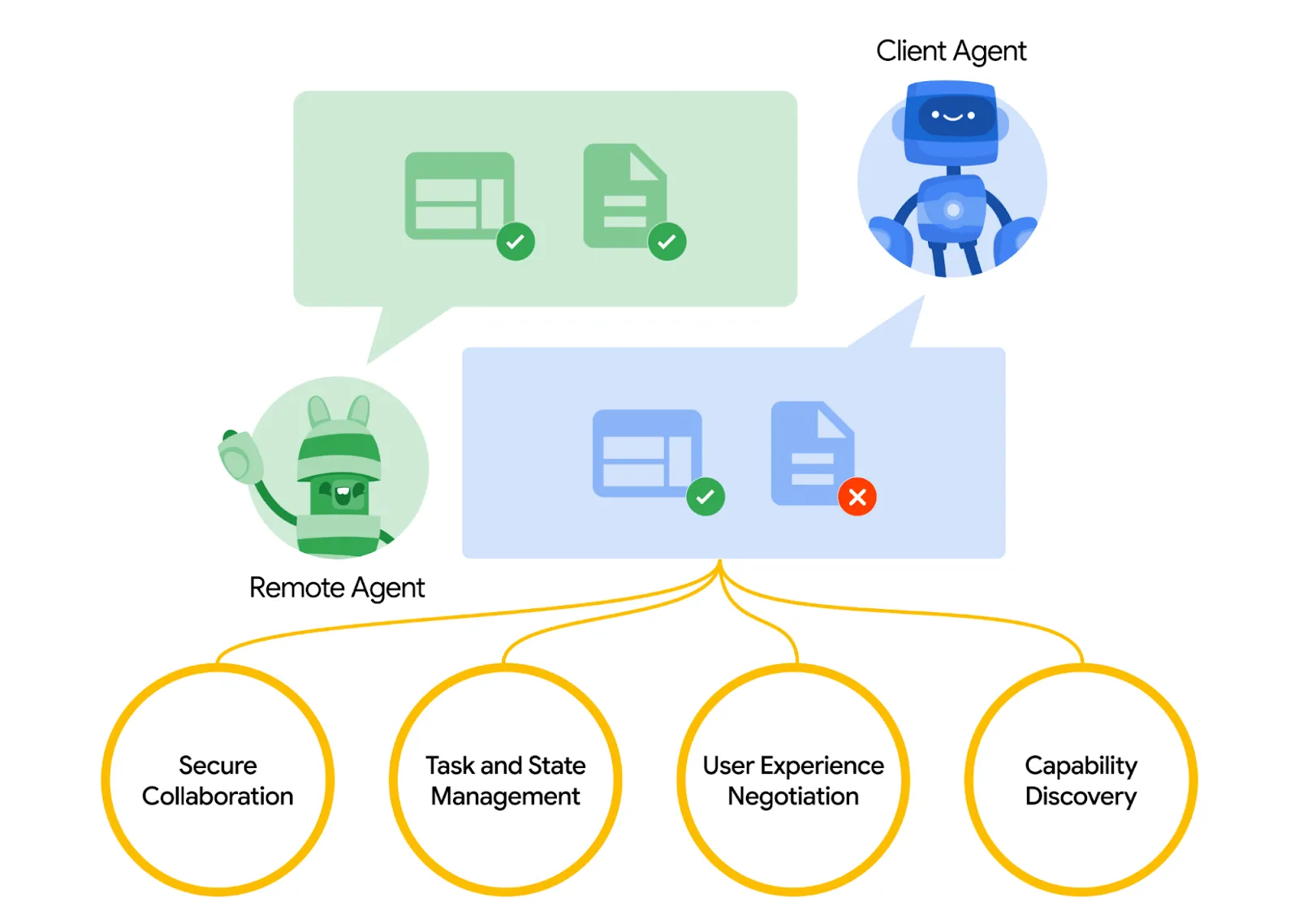
Agent-to-Agent (A2A) enables seamless collaboration between a “client” agent and a “remote” agent. The client agent defines tasks and communicates what needs to be done, while the remote agent executes those tasks to deliver the desired outcomes.
Agents share their capabilities through “Agent Cards” in JSON format, allowing the client to identify the most suitable agent for each task. Once a task is assigned, both agents coordinate throughout its lifecycle, keeping each other updated on progress and exchanging results, or “artifacts.”
Beyond task execution, agents communicate context, instructions, and responses to stay aligned. Each message consists of distinct “parts” with specified content types, enabling agents to negotiate the correct format for the user interface, whether images, video, interactive forms, or other elements, so the end user receives the information exactly as needed.
Also Read: 6 Best LLM Gateways in 2026
The Model Context Protocol (MCP), introduced by Anthropic in 2024, is an open standard for connecting AI applications with external tools, databases, and services. Acting as a universal integration layer, MCP eliminates the brittle, ad hoc connectors that often plague multi-agent systems.
Instead, it provides a standardized communication channel that makes agents context-aware, scalable, and more reliable in production environments.
Just like how USB-C standardized hardware connectivity, MCP standardizes how agents interface with heterogeneous tools and data sources.
The Model Context Protocol (MCP) empowers a single AI agent to leverage external tools and resources efficiently. Here, have a look at the features of MCP.
Unlike orchestration frameworks such as LangChain or CrewAI, MCP does not decide when a tool should be invoked.
Instead, it establishes the standard wiring layer that ensures tools, prompts, and resources are seamlessly available to agents. This transforms multi-agent systems from brittle prototypes into enterprise-grade, interoperable AI ecosystems.
.webp)
The Model Context Protocol lets an LLM complete tasks by using external tools that go beyond its native capabilities. For example, if you ask an AI assistant to “Check the inventory for the latest smartphone models and create a summary report,” MCP coordinates the process.
The LLM recognizes it cannot directly access the inventory database or generate a report on its own, so it queries the MCP system to discover relevant tools. It finds an inventory lookup tool to retrieve product data and a report generator tool to create the summary.
The LLM then sends structured requests to these tools: the inventory tool fetches the latest product information, and the report generator formats this data into a readable summary. Once both steps are completed, the LLM presents the final report to the user. By orchestrating tool discovery, invocation, and response handling, MCP enables LLMs to safely and efficiently extend their capabilities for real-world tasks.
Also Read: What is MCP Proxy?
When scaling AI, choosing the right protocol determines how agents share context, access tools, and collaborate. Both MCP and A2A are complementary but focus on different layers: MCP standardizes model-tool interactions, while A2A enables agents to coordinate tasks and communicate across systems.
Both protocols serve distinct but complementary purposes. MCP powers agents internally with context and tools, while A2A connects agents externally for collaboration and task execution. Together, they form a robust framework for scalable, multi-agent AI systems.
Here’s a concise comparison of MCP vs A2A.
The Agent2Agent (A2A) Protocol is a transformative standard that enables AI agents to collaborate seamlessly across various platforms and frameworks. By facilitating secure, context-aware communication, A2A empowers enterprises to build scalable, interoperable multi-agent ecosystems.
Seamless Interoperability: A2A allows agents from different vendors and frameworks to communicate effortlessly, eliminating integration barriers and promoting a unified AI ecosystem.
Enhanced Task Orchestration: The protocol supports complex task management, enabling agents to delegate responsibilities, track progress, and manage long-running workflows efficiently.
Modality-Agnostic Communication: A2A accommodates various communication modalities, including text, audio, and video, allowing agents to interact in diverse formats suited to specific tasks.
Enterprise-Grade Security: Built with robust authentication and authorization mechanisms, A2A ensures secure agent interactions, safeguarding sensitive enterprise data.
Scalability and Flexibility: The protocol's design supports the dynamic addition of new agents and capabilities, facilitating the growth of AI ecosystems without significant reconfiguration.
Standardized Communication Protocol: A2A utilizes widely adopted standards such as HTTP, SSE, and JSON-RPC, simplifying integration with existing IT infrastructures.
Context-Aware Collaboration: Agents can share and understand each other's context, leading to more informed decision-making and efficient task execution.
Accelerated Development Cycles: By providing a common communication framework, A2A reduces development time for multi-agent systems, enabling faster deployment of AI solutions.
Several enterprises have already seen tangible benefits from implementing A2A. For example, Comparus, which uses IBM watsonx.ai solutions, reported that integrating the protocol significantly streamlined their AI operations.
Their agents are now able to collaborate more effectively across different workflows, resulting in faster task completion and improved service delivery for clients. This real-world adoption underscores the protocol’s potential to transform multi-agent AI ecosystems.
Also Read: Top 5 LiteLLM Alternatives for Enterprises in 2026
The Model Context Protocol (MCP) is revolutionizing the way AI agents interact with external tools and data sources. By providing a standardized framework, MCP enables seamless integration, enhancing the capabilities and efficiency of AI systems. Here are the key advantages:
Standardized Integration: MCP offers a universal interface for connecting AI agents to various tools and data sources, reducing the complexity of custom integrations.
Enhanced Interoperability: AI agents can access a diverse ecosystem of resources, including APIs, databases, and files, ensuring consistent performance across different platforms.
Reduced Development Time: Developers can leverage MCP to quickly integrate new tools and data sources, accelerating the development cycle and time-to-market for AI applications.
Improved Security: MCP incorporates robust security measures, such as controlled access to resources and secure communication protocols, safeguarding sensitive data during interactions.
Dynamic Context Management: The protocol allows AI agents to maintain context across different tools and interactions, enabling more coherent and context-aware responses.
Scalability: MCP's modular architecture supports the addition of new tools and data sources without significant reconfiguration, facilitating scalable AI solutions.
Ecosystem Growth: By providing a common standard, MCP encourages the development of a wide range of compatible tools and services, fostering a vibrant AI ecosystem.
Future-Proofing: As an open-source protocol, MCP is continuously evolving, ensuring that AI systems remain adaptable to emerging technologies and requirements.
Several enterprises have reported measurable improvements after adopting MCP. Tech Innovators Inc., for example, found that integrating the protocol streamlined their development process, allowing their AI agents to connect seamlessly with multiple tools and data sources.
As a result, the agents capabilities expanded, workflows became more efficient, and overall system performance improved significantly.
Scaling AI in the enterprise isn’t just about building powerful agents; it’s about making them work together effectively. Two protocols are leading this effort: MCP and A2A.
While both enhance AI systems, they operate at different layers. MCP focuses on providing context and connecting tools, whereas A2A enables agents to communicate and collaborate seamlessly. The question isn’t which is better, but which fits your use case or how you can combine them to maximize results.
MCPは、AIエージェントが外部リソースへの構造化された信頼性の高いアクセスを必要とする場合に真価を発揮します。その最大の強みは標準化であり、エージェントがAPI、データベース、テンプレートと一貫してやり取りできるようにします。
企業がMCPの導入を検討すべきなのは、次のような場合です。
例えば、MCPを使用するカスタマーサービスエージェントは、カスタムスクリプトなしで複数のナレッジベースをシームレスに照会し、事前に構築されたテンプレートを使用してユーザーに応答できます。
A2Aは、複数のエージェントがリアルタイムで連携し、通信する必要がある場合に不可欠です。これは、エージェント間のタスクオーケストレーションのための、安全でモダリティに依存しないフレームワークを提供します。
A2Aの導入を検討すべきなのは、次のような場合です。
例えば、サプライチェーンのシナリオでは、調達、ロジスティクス、顧客通知のエージェントがA2Aを使用してタスクを同期し、更新を自動的に共有できます。
こちらもご覧ください: Claude CodeにおけるMCPサーバー
AIが進化し続けるにつれて、MCPやA2Aのようなエージェントプロトコルは、インテリジェントな協調システムの基盤となるでしょう。
実際には、多くの企業が両方のプロトコルを併用しています。MCPは各エージェントが適切なコンテキストとツールを持つことを保証し、A2Aはそれらのエージェントが複雑なワークフロー全体で効果的に連携できるようにします。この組み合わせにより、効率性、スケーラビリティ、セキュリティが最大化されます。
適切なプロトコルを選択するか、両方を組み合わせるかは戦略的な決定です。MCPとA2Aの強みを理解することで、企業は強力であるだけでなく、結束力があり、コンテキストを認識し、協調的なAIエコシステムを設計できます。
その強力さにもかかわらず、MCPとA2Aプロトコルはしばしば誤解されています。いくつかの一般的な誤解は次のとおりです。
こちらもご覧ください: AWS MCPゲートウェイの代替となる5つの選択肢
企業がAIをスケールさせるにつれて、MCPやA2Aのようなプロトコルはもはやオプションではなく、不可欠なものとなっています。MCPは、エージェントが効率的に動作するために適切なコンテキストとツールを備えていることを保証し、A2Aは、ワークフローやプラットフォームを横断する複数のエージェント間のシームレスな連携を可能にします。
これらを組み合わせることで、強力で相互運用可能なAIエコシステムが構築され、複雑なタスクの処理、プロセスの自動化、生産性の向上を可能にします。適切なプロトコルを選択するか、両方を戦略的に組み合わせることで、断片化されサイロ化したAIと、まとまりのある高性能なエージェントネットワークとの間に大きな違いが生まれます。AI時代をリードしようとする企業にとって、これらのプロトコルを理解し導入することは、将来にわたって利用可能でスケーラブルなインテリジェンスを実現するための第一歩となります。
どちらの標準もAIの相互運用性を向上させますが、MCPは異なるアーキテクチャ上の課題を解決するため、A2Aを完全に置き換えることはできません。MCPは単一のエージェントをツールやデータに接続するように設計されているのに対し、A2Aは複数の独立したエージェント間のコミュニケーションとタスクの引き渡しを調整することに焦点を当てています。これらを併用することで、よりスケーラブルなAIエコシステムが構築されます。
MCPとA2Aの主な違いは、その機能範囲とアーキテクチャにあります。MCPはクライアントサーバーモデルを使用して、エージェントに外部コンテキストとツールアクセスを提供する一方、A2Aはエージェント間の連携のためにピアツーピアモデルを利用します。MCPがエージェントをデータに結びつけるのに対し、A2Aはエージェントが異なるシステム間でタスクを交渉し、共有することを可能にします。
はい、MCPとA2Aを組み合わせることは、エンタープライズのエージェントワークフローにとって理想的な戦略となることがよくあります。このハイブリッドな設定では、MCPは各エージェントが必要なツールへの標準化されたアクセスを保証し、A2Aはそれらのエージェント間の高レベルなオーケストレーションとコミュニケーションを管理します。この階層化により、エージェントの内部インテリジェンスと外部連携の効率性の両方が最大化されます。
MCPとA2Aは、重要な通信基盤として機能します。MCPはモデルがデータベースやAPIと連携するための普遍的なコネクタとして機能し、A2Aはエージェントが複雑な目標を達成するために協力するための共通言語を提供します。TrueFoundryはこれらのプロトコルを単一のゲートウェイに統合し、プロダクションレベルのエージェント展開に必要なガバナンスとセキュリティを提供します。
いいえ、A2AはMCPの一部ではありません。MCPが単一エージェントのツールアクセスとタスク実行を標準化するのに対し、A2Aは複数のエージェント間の通信と連携を可能にすることに重点を置いています。これらは補完的な目的を果たします。MCPは個々のエージェントの能力を強化し、A2Aはコラボレーションと共有タスクの完了のためにマルチエージェントワークフローを調整します。
MCPは単一エージェントのワークフロー向けに設計されており、複数のエージェント間でタスクを調整する能力が制限されます。A2Aは、エージェントが通信し、コンテキストを共有し、成果物を交換し、出力を交渉できるようにすることで、この問題を解決します。このマルチエージェントオーケストレーションにより、MCP単独では管理できない複雑で適応性の高いワークフローが可能になり、AIシステムにおける柔軟性とコラボレーションが向上します。
TrueFoundry AI Gateway delivers ~3–4 ms latency, handles 350+ RPS on 1 vCPU, scales horizontally with ease, and is production-ready, while LiteLLM suffers from high latency, struggles beyond moderate RPS, lacks built-in scaling, and is best for light or prototype workloads.



.png)
.png)
.png)
.png)
.png)
.png)
.png)
.png)
.png)
.png)
.png)





