


October 1, 2026
|
5 min read


Published: July 4, 2026
.webp)
Blazingly fast way to build, track and deploy your models!
Claude Code is no longer experimental. It reads entire codebases, edits files, runs terminal commands, executes tests, and iterates on solutions — all from natural language instructions. Engineering teams are rolling it out fast because the productivity gains are real.
But every Claude Code session is also an unmonitored pipeline between your developers, your proprietary codebase, and Anthropic's API. Without centralized governance, that pipeline carries serious security, cost, and compliance risk.
This guide breaks down the specific risks of ungoverned Claude Code rollouts and shows how TrueFoundry's AI Gateway gives platform teams the control plane they need to govern Claude Code traffic at enterprise scale — without slowing developers down.
Claude Code is Anthropic's agentic coding tool. Unlike traditional code-completion assistants that suggest the next line in an editor, Claude Code operates as an autonomous agent. It can:
It runs in the terminal, in IDEs like VS Code and JetBrains, through a desktop app, and in the browser. It works with models across the Claude family — Opus 4.6, Sonnet 4.6, and Haiku 4.5. Enterprise customers can also access it through Amazon Bedrock or Google Cloud Vertex AI.
The adoption numbers reflect the impact. Stack Overflow's 2025 Developer Survey found that 85% of developers already use or plan to use AI coding tools. Gartner predicts that 75% of hiring processes will include AI proficiency testing by 2027. AI-assisted coding is becoming standard development infrastructure.
For a detailed look at how Claude Code actually processes tasks from context ingestion to iteration, see our Claude Code workflows guide.
Enterprise-wide adoption of Claude Code doesn't just produce productivity gains. It also produces a new category of LLM traffic — high-volume, high-context, and deeply tied to proprietary source code. Without governance, five risks compound fast.
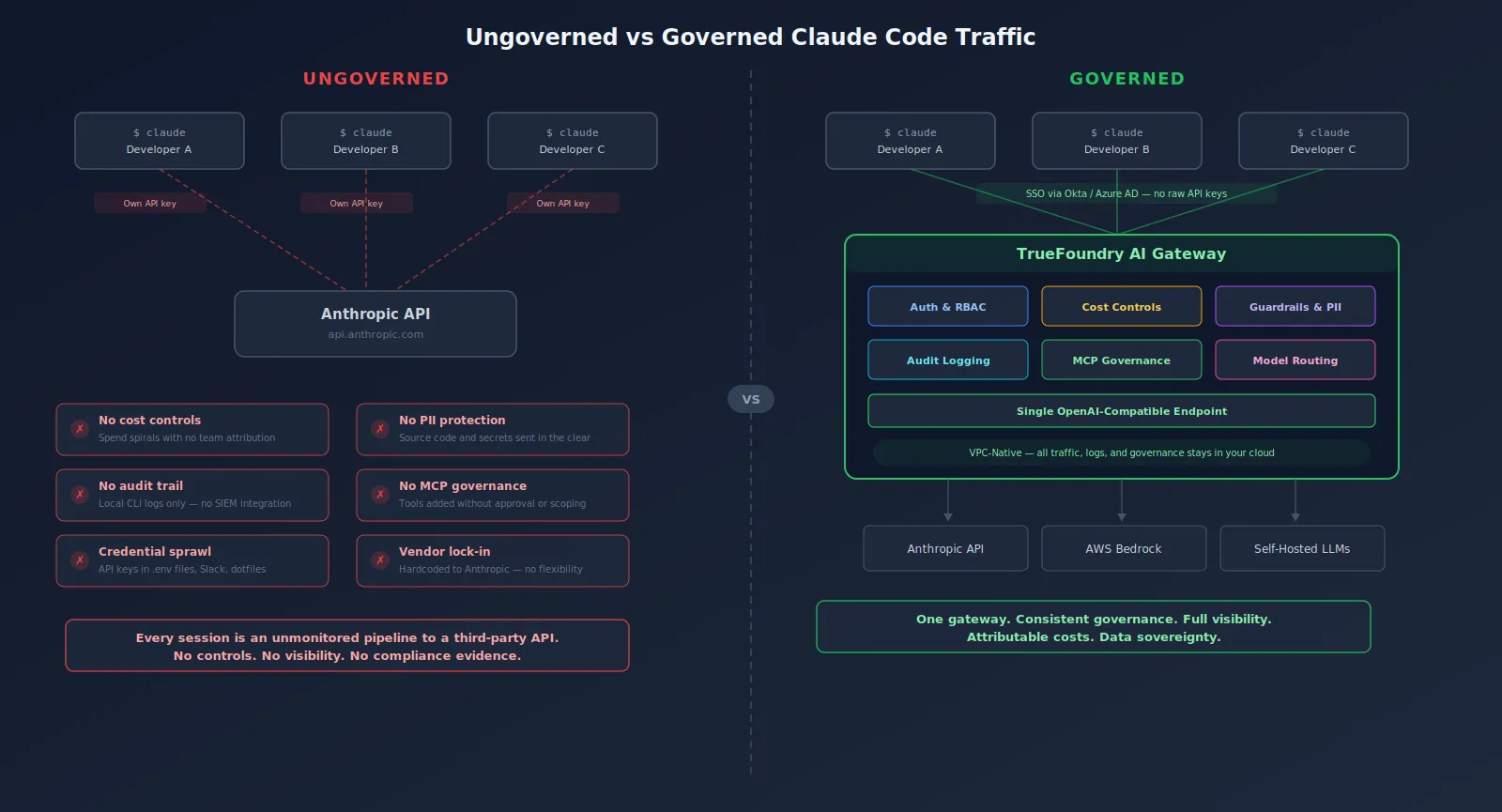
Claude Code sessions consume tokens aggressively. Referencing five medium-sized files in a single session can burn through 30,000+ tokens. Developers iterating on complex refactors may generate hundreds of API calls per day. Claude Code itself has no organizational budget controls — that responsibility falls to whatever sits between the developer and the API. Without centralized enforcement, costs spiral before finance even sees the invoice.
Claude Code sends code context to Anthropic's servers for processing. Proprietary source code, environment variables, API keys, configuration files, and potentially customer data all travel over the network. Security researchers have already identified real vulnerabilities — CVE-2025-54794 (path restriction bypass) and CVE-2025-54795 (command injection) were patched, but they demonstrate the attack surface. Without a governance layer inspecting outbound traffic, organizations have limited ability to enforce data loss prevention.
Regulated industries need clear records of AI usage: what was sent, what was returned, which models were used, by whom, and when. Claude Code out of the box does not produce the centralized, structured audit logs that compliance teams require. Every ungoverned session is a blind spot. When an auditor asks, "what did your AI coding tool access last quarter?" — you need a better answer than "we don't know."
Without governance, developers find their own paths. Different teams configure Claude Code differently. They use different models, apply different security practices, or bypass organizational controls entirely. Shadow AI fragmentation makes it impossible to enforce consistent security policies, accurately forecast costs, or demonstrate compliance across the org.
Without an abstraction layer, organizations hardcode workflows directly to Anthropic's API. If pricing changes, models are deprecated, or the team wants to evaluate alternatives — migration gets expensive and disruptive. An enterprise that ties every developer's tooling to a single provider has surrendered negotiating leverage and architectural flexibility.
CRO Banner Title: Your Developers Are Already Using Claude Code — Who's Governing the Traffic?
Subtext: TrueFoundry's AI Gateway gives platform teams centralized auth, cost controls, guardrails, and audit logging for every Claude Code session
CTA: Book a Demo
The AI gateway pattern addresses these risks by inserting a centralized control plane between all AI-consuming applications (including Claude Code) and the models they call. It is the same architectural principle that API gateways brought to REST and gRPC traffic — now extended to handle the specific requirements of LLM workloads.
An AI gateway sits in the request path and enforces governance at the infrastructure layer:
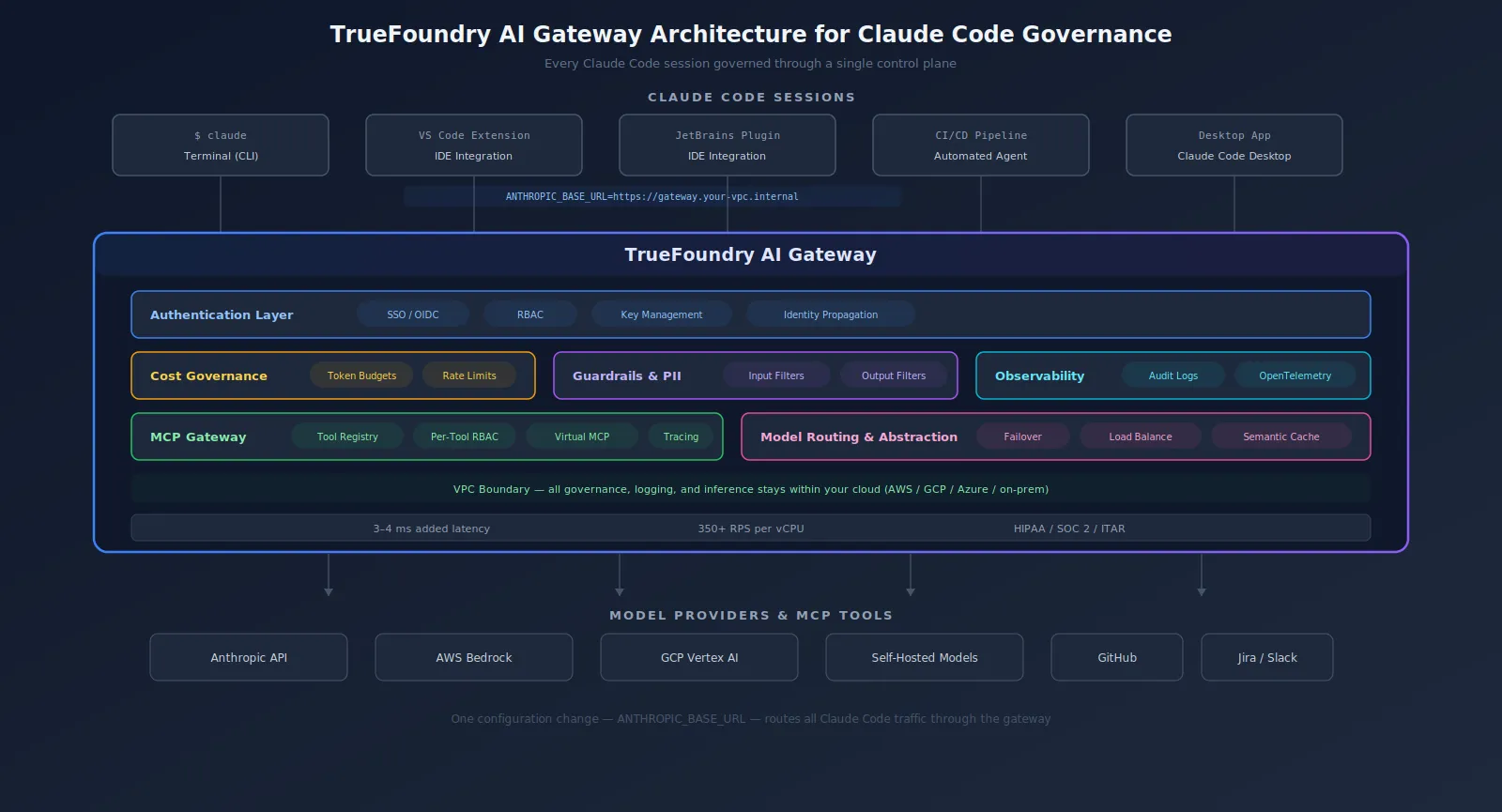
For Claude Code specifically, the AI gateway pattern is a natural fit. Claude Code communicates with Anthropic's API over standard HTTP. Routing that traffic through a gateway requires no changes to the developer's workflow — just a configuration change that points Claude Code to the gateway endpoint instead of directly to Anthropic.
The architectural pattern is now the industry consensus. Gartner's Hype Cycle for Generative AI 2025 identifies AI gateways as critical infrastructure for scaling AI responsibly. TrueFoundry was recognized in Gartner's 2025 Market Guide for AI Gateways as an emerging solution provider in this category.
TrueFoundry's AI Gateway provides enterprise-grade governance, security, and observability for LLM traffic — including traffic from Claude Code sessions. It goes beyond traditional API gateway capabilities with AI-native controls built specifically for LLM and agentic workloads.
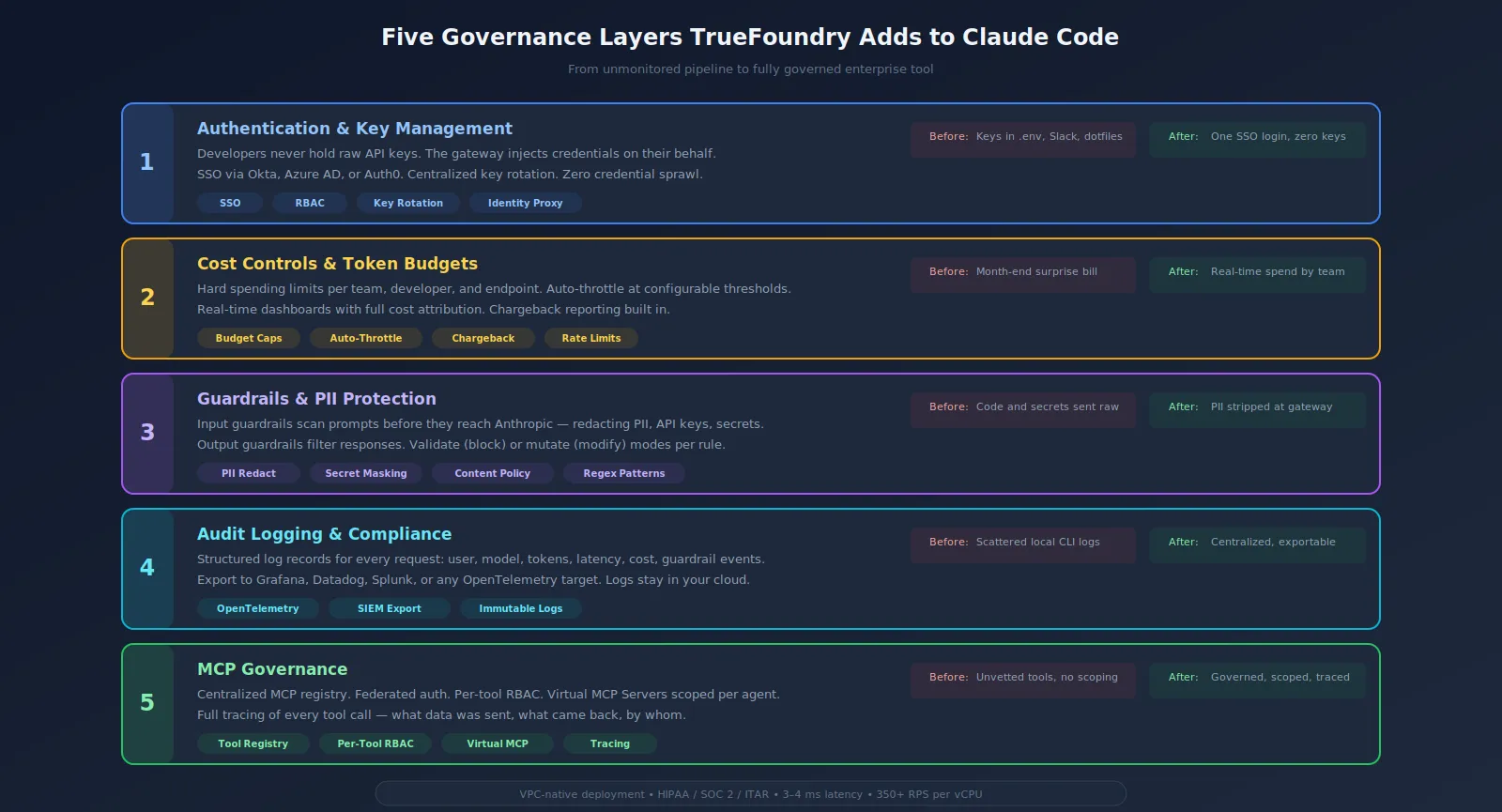
With TrueFoundry's gateway in the path, individual developers never hold or manage Anthropic API keys. The gateway injects authentication headers on behalf of the developer, using credentials managed centrally by the platform team. Developers authenticate once through your existing identity provider (Okta, Azure AD, Auth0) via SSO, and the gateway handles all downstream provider auth.
The result: no credential sprawl, simplified key rotation, and no API key leakage through developer workstations, .env files, or Slack messages.
TrueFoundry enforces hard spending limits per team, per developer, and per endpoint. The gateway tracks token consumption — prompt tokens, completion tokens, total cost — for every request in real time.
Platform teams can:
For more on building cost governance into the AI layer, see our FinOps for AI guide.
TrueFoundry's guardrails engine operates on both inputs and outputs at the gateway layer. For Claude Code traffic specifically, this means:
Each rule operates in validate (block) or mutate (modify) mode. Platform teams configure guardrails centrally. Every Claude Code session inherits them automatically — no per-developer configuration needed.
Every Claude Code request routed through the gateway produces structured log records: user identity, model used, token counts, latency metrics, guardrail firing events, and cost attribution. Logs stay within your infrastructure and export to your existing observability stack — Grafana, Datadog, Splunk, or any OpenTelemetry-compatible target.
When compliance asks, "who used Claude Code to modify production configs last Tuesday?" — the gateway has the answer.
As Claude Code's MCP integration deepens — connecting to tools like GitHub, Jira, Slack, Confluence, and Datadog — TrueFoundry's MCP Gateway extends governance to tool traffic:
MCPガバナンスがなければ、開発者が追加する新しいツール接続はすべて攻撃対象領域を拡大します。私たちの 企業向けMCPアクセス制御ガイド は、完全な実装パターンを網羅しています。
ここがTrueFoundryがSaaSファーストのゲートウェイと異なる点です。TrueFoundryは、お客様のAWS、GCP、またはAzureアカウント内にデプロイされます。また、オンプレミスおよびエアギャップ環境へのデプロイもサポートしています。
すべての推論トラフィック、ガバナンスロジック、監査ログ、および可観測性データは、お客様のクラウド境界内に留まります。プロンプト、コードコンテキスト、使用状況データがお客様のインフラストラクチャから出ることはありません。医療、防衛、金融サービス、または厳格なデータレジデンシー要件を持つ規制対象業界の企業にとって、これは「Claude Codeを使える」と「使えない」の決定的な違いとなります。
TrueFoundryは、HIPAA、SOC 2、およびITARの要件に標準で対応しています。ゲートウェイはリクエストあたり約3~4ミリ秒のレイテンシーを追加し、各プロキシインスタンスは単一のvCPUで毎秒350以上のリクエストを処理します。
TrueFoundryのゲートウェイは、250以上のモデルに対応するユニバーサルLLM APIを提供します。今日はAnthropicのAPIでClaude Codeから始めましょう。明日はBedrockホスト型またはVertexホスト型のClaudeモデルにトラフィックをルーティングできます。特定のユースケースに合わせてGPT-4やセルフホスト型のLlamaモデルに切り替えることも可能です。開発者のワークフロー変更は不要で、ゲートウェイの設定を更新するだけです。
CROバナー タイトル: Claude Codeは強力なエージェントです — あなたのゲートウェイはそれを適切に管理すべきです
サブテキスト: すべてのClaude CodeトラフィックをTrueFoundryのAIゲートウェイ経由でルーティングし、一元的なコスト管理、ガードレール、監査ログ、MCPガバナンスを実現します
CTA: 無料で始める
開発者はすでにClaude Codeを使用しています。問題は、そのトラフィックが管理されているかどうかです。それとも、すべてのセッションが監視されていないサードパーティAPIへのパイプラインになっているか、です。
TrueFoundryのAIゲートウェイは、一元化された認証、チームごとのコスト制限、構成可能なガードレール、構造化された監査ログ、MCPガバナンス、完全なデータ主権など、すべてのClaude Codeトラフィックに対する単一のコントロールプレーンをプラットフォームチームに提供します。VPCネイティブ。SOC 2およびHIPAA対応。
デモを予約する TrueFoundryがエンタープライズ規模でClaude Codeをどのように管理しているかをご確認ください。または 無料で始める ライブサンドボックスで — クレジットカードは不要です。
TrueFoundry AI Gateway delivers ~3–4 ms latency, handles 350+ RPS on 1 vCPU, scales horizontally with ease, and is production-ready, while LiteLLM suffers from high latency, struggles beyond moderate RPS, lacks built-in scaling, and is best for light or prototype workloads.



環境変数 ANTHROPIC_BASE_URL に TrueFoundry ゲートウェイのエンドポイントを設定してください。ゲートウェイが Anthropic API との認証を代行します。Claude Code CLI や開発ワークフローに変更を加える必要はなく、設定を更新するだけで完了します。
はい。ガードレールエンジンがゲートウェイ層で送信されるすべてのリクエストをスキャンします。APIキー、顧客の個人情報(PII)、社内プロジェクト名、あるいは任意の正規表現パターンを検出し、マスキングするルールを設定可能です。これにより、リクエストがインフラストラクチャから送信される前に保護されます。
TrueFoundryによるオーバーヘッドは、リクエストあたり約3〜4ミリ秒です。LLMの推論時間(多くの場合数秒)と比較すれば無視できるレベルです。セマンティックキャッシュを活用すれば、繰り返し行われるクエリの合計往復時間を短縮することも可能です。
ゲートウェイは、ユーザーID、モデル、トークン数、レイテンシ、コスト、ガードレールイベントなど、すべてのリクエストに関する構造化されたログレコードをキャプチャします。ログは貴社のインフラストラクチャ内に保持され、Grafana、Datadog、Splunk、または任意のOpenTelemetryターゲットへエクスポート可能です。開発者のマシンにログが散在することはありません。
VPCネイティブなデプロイメント。TrueFoundryはお客様のAWS、GCP、またはAzureアカウント内で実行されます。すべてのトラフィック、ログ、ガバナンスデータはクラウド境界内に留まるため、SaaS型ゲートウェイでは対応できないHIPAA、SOC 2、ITARの要件を満たすことが可能です。さらに、ネイティブなMCPゲートウェイサポート、チームごとのFinOps管理、構成可能なガードレールを組み合わせることで、TrueFoundryはエンタープライズ規模のClaude Code運用に必要な包括的なガバナンススタックを提供します。
.png)
.png)
.png)
.png)
.png)
.png)
.png)
.png)
.png)
.png)
.png)





