Blank white background with no objects or features visible.

TrueFoundryはSeldon AIの買収を発表し、エンタープライズAI向けコントロールプレーンを拡張します。プレスリリース全文はこちら→

2026年のベストAIセキュリティツール:保護対象と課題

By アシシュ・ドゥベイ

Published: July 4, 2026

TrueFoundry AI gateway secures enterprise AI workloads

Most evaluations of AI security tools combine two categories that solve different problems. One category uses machine learning and artificial intelligence to strengthen existing cybersecurity workflows across endpoints, networks, identities, and cloud workloads. The other category governs AI systems themselves, including models, prompts, agents, data flows, and tool execution.

This distinction matters for security leaders making buying decisions. A SOC platform with an AI assistant cannot stop an agent from calling a tool it should never touch. A model scanning service cannot cap inference spend, enforce tool-level permissions, or govern model access across production AI applications.

The threat model, deployment pattern, and working definition of secure differ across both categories. Traditional cybersecurity tools improve detection, investigation, and response across IT environments. AI security platforms control the new AI attack surface created by LLMs, agents, MCP servers, prompts, and enterprise data.

This guide separates the market clearly. It compares leading AI security tools, explains where AI security software helps, and shows what both categories miss once autonomous AI agents reach production. You should finish with a buying framework, not a simple vendor ranking.

Securing AI Infrastructure Requires More Than a Traditional Security Tool

TrueFoundry governs every model call, agent action, and tool execution inside your own private cloud environment.

Two AI Security Categories Every Buyer Must Distinguish

Getting the category distinction right matters because both tool types protect different risk surfaces. AI-powered security tools strengthen the cybersecurity stack that enterprises already use. They apply machine learning to endpoint detection, network detection, identity monitoring, threat detection, and SOC triage automation.

These tools are usually owned by security operations, security operations centers, and incident response teams. Their threat model covers malware, phishing, identity compromise, network intrusion, suspicious user behavior, and cloud misconfiguration. They help reduce alert fatigue and allow SOC teams to manage repetitive tasks with stronger context.

AI security platforms solve a different problem. They govern AI workloads themselves, including models, prompts, agents, data flows, and tool execution. They control which users, teams, and agents can call specific models, access sensitive data, or execute MCP tool calls inside production workflows.

Buying one category when the other is required creates serious gaps. A traditional SOC tool cannot fully govern LLM inference, prompt injection, or MCP tool calls. An AI gateway does not replace endpoint protection. Large enterprises running production AI usually need both categories working together.

Category What It Protects What It Misses
AI-powered security tools Endpoints, networks, identities, cloud workloads Prompt semantics and agent tool calls
AI security platforms Models, agents, prompts, MCP tools, data flows Traditional endpoint and network threats

The common mistake appears in quarterly security reviews. A SOC team chooses a familiar endpoint or XDR platform to “cover AI.” Platform engineering then ships agents into production without runtime governance. Six months later, an incident exposes the gap, and both teams retrofit controls under audit pressure.

AI-powered security tools versus AI security platforms comparison across coverage and blind spots

The Best AI-Powered Security Tools in 2026

These AI security tools strengthen traditional security operations with machine learning, behavioral analytics, and automated response. They protect endpoints, networks, cloud workloads, and identities, not LLM prompts or agent tool calls.

CrowdStrike Falcon

CrowdStrike Falcon protects endpoints identities and cloud workloads

CrowdStrike Falcon is a cloud-native endpoint and threat intelligence platform for enterprise security teams. It protects endpoints, cloud workloads, identities, and data from one platform. Charlotte AI helps analysts query threats, investigate incidents, and accelerate security operations workflows.

What are the key features of CrowdStrike Falcon

  • AI-powered endpoint protection, detection, and response across enterprise environments.
  • Threat intelligence supports faster investigation of advanced adversary behavior.
  • Charlotte AI helps analysts investigate threats through natural language workflows.
  • Cloud, identity, endpoint, and data protection work through one platform.

What are the Pros and Cons of CrowdStrike Falcon

Pros Cons
Strong endpoint detection coverage Limited LLM governance scope
Mature threat intelligence depth No agent tool control

Who is CrowdStrike Falcon Best For?

CrowdStrike Falcon is best for security operations teams that need AI-assisted endpoint, identity, and cloud threat response across large enterprise environments.

Darktrace

Darktrace detects behavioral anomalies across enterprise environments

Darktrace uses Self-Learning AI to understand normal enterprise activity and identify high-risk anomalous behavior. It supports threat detection across networks, cloud, email, and critical environments. Its strength is real time behavioral analysis across traditional security surfaces.

What are the key features of Darktrace

  • Self-Learning AI builds behavioral baselines across enterprise environments.
  • Real-time anomaly detection across network, cloud, and email.
  • Behavioral analytics reduce manual correlation work for analysts.

What are the Pros and Cons of Darktrace

Pros Cons
Strong behavioral analytics capability Limited prompt-level inspection
Useful autonomous threat response No MCP tool governance

Who is Darktrace Best For?

Darktrace is best for organizations that need AI-driven anomaly detection and real-time visibility across networks, email, cloud, and operational environments.
SentinelOne Singularity

SentinelOne Singularity unifies endpoint cloud and identity security

SentinelOne Singularity unifies endpoint security, identity protection, cloud security, and AI-assisted security workflows. Purple AI helps teams investigate threats, translate data across the security stack, and support analyst decision-making. It is built for autonomous incident response and modern SOC operations.

What are the key features of SentinelOne Singularity

  • Unified endpoint, cloud, identity, and data security operations.
  • Purple AI supports natural language threat hunting and triage.
  • Automated response workflows reduce repetitive security tasks.
  • Static and behavioral AI models detect suspicious activity.

What are the Pros and Cons of SentinelOne Singularity

Pros Cons
Strong autonomous endpoint protection Limited AI workload governance
Useful Purple AI workflows No LLM access controls

Who is SentinelOne Singularity Best For?

SentinelOne Singularity is best for SOC teams that need endpoint-to-cloud coverage, AI-assisted investigation, and automated incident response across enterprise environments.
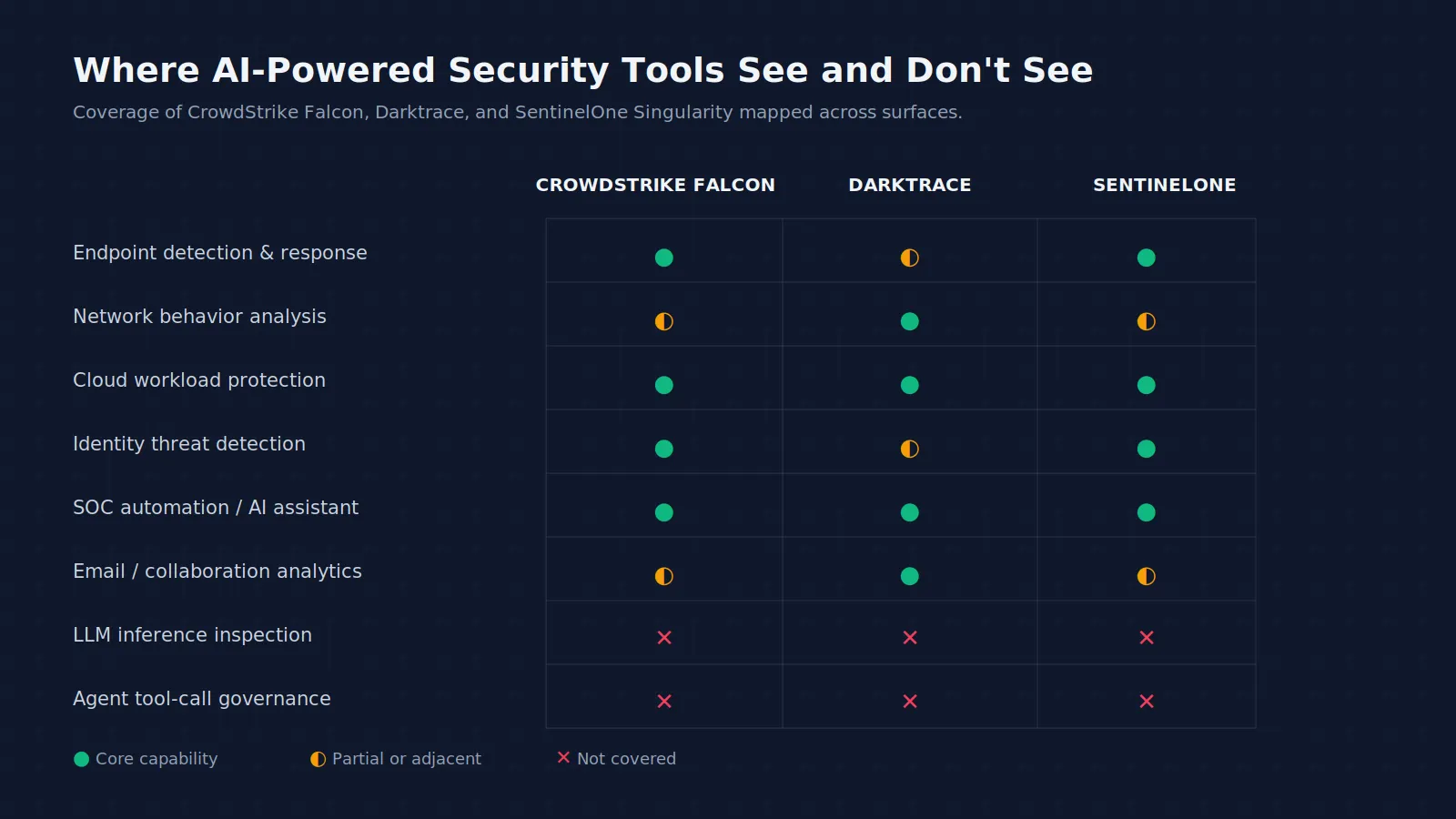
Coverage map of CrowdStrike Falcon, Darktrace, and SentinelOne across eight security surfaces

The Best AI Security Platforms in 2026

These platforms protect AI systems themselves. The category is younger than traditional cybersecurity, and vendors differ sharply by deployment model, runtime depth, and governance scope. The right choice depends on whether teams are securing models, governing agents, or controlling full inference traffic.

TrueFoundry

TrueFoundry AI gateway governs models agents and tools

TrueFoundry is an infrastructure-first AI security platform for enterprise AI systems. Its AI gateway centralizes model access, observability, governance, guardrails, and cost controls across enterprise AI workloads. The platform also includes MCP Gateway and Agent Gateway for governing tool-connected and agentic workflows.

What are the key features of TrueFoundry

  • Infrastructure-first AI security: TrueFoundry secures AI systems at the gateway layer. It governs model calls, agent actions, and MCP tool execution before risk reaches production. This gives teams runtime control instead of after-the-fact monitoring.
  • Identity-aware model access: Every model request maps to a verified user, team, or agent through OAuth 2.0 identity injection. This prevents over-privileged service accounts from becoming the default pattern. Access decisions happen before requests execute.
  • MCP Gateway for tool governance: Approved MCP servers, OAuth controls, observability, and policy checks govern every tool call. Teams can define which agents access which tools. Each invocation can be logged with identity and context.
  • Agent Gateway for autonomous workflows: Multi-step agents need controls that go beyond model selection. TrueFoundry governs tool execution, runtime limits, cost controls, and policy enforcement. This becomes critical when agents act on live enterprise systems.

VPC-native deployment and audit control: AWS, GCP, Azure, on-premise, and air-gapped deployments are supported for enterprise environments. Prompts, responses, logs, and governance data stay inside the customer’s environment. This supports security and compliance needs.

How Much Does TrueFoundry Cost?

TrueFoundry offers four pricing tiers. Developer is free for early experimentation, while Pro starts at $499 per month for small teams shipping AI features. Pro Plus starts at $2,999 per month for stricter data controls and priority SLAs. Enterprise pricing is custom for organizations needing advanced governance, security, custom deployment, and mission-critical reliability.

Who is TrueFoundry Best For?

TrueFoundry is best for enterprise security, platform engineering, AI infrastructure, and compliance teams that need governance across models, agents, MCP tools, and sensitive data workflows. It is especially relevant for organizations running production AI agents, regulated workloads, multi-provider model access, and private-cloud or air-gapped deployments.
HiddenLayer

HiddenLayer secures models through AI threat detection

HiddenLayer focuses on securing AI models across the AI lifecycle. Its platform supports model scanning, red teaming, AI detection and response, and security posture management. It is strongest when teams need model-layer protection and adversarial AI testing.

What are the key features of HiddenLayer

  • Scans proprietary and third-party models for hidden risks.
  • Supports adversarial red teaming and model robustness testing.
  • Detects threats against predictive, generative, and agentic AI.
  • Covers AI supply chain risks across the MLOps pipeline.

What are the Pros and Cons of HiddenLayer

Pros Cons
Strong model scanning depth Limited agent workflow governance
Useful adversarial AI testing No full gateway control

Who is HiddenLayer Best For?

HiddenLayer is best for organizations with mature ML development teams that need model-layer protection, scanning, and adversarial robustness testing.

Lasso Security

Lasso Security protects LLMs and MCP workflows

Lasso Security focuses on LLM security, agentic cybersecurity, and MCP protection. Its open-source MCP Gateway acts as a proxy and orchestrator for MCP interactions, adding governance, monitoring, and security controls. It is useful for teams already focused on LLM runtime protection.

What are the key features of Lasso Security

  • Monitors LLM interactions for security and governance risks.
  • Detects prompt injection and unsafe model behavior.
  • Adds MCP Gateway coverage for tool interactions.
  • Supports shadow AI and LLM threat visibility.

What are the Pros and Cons of Lasso Security

Pros Cons
Strong LLM runtime focus Narrower infrastructure control
Useful MCP visibility layer Limited enterprise deployment depth

Who is Lasso Security Best For?

Lasso Security is best for organizations prioritizing LLM interaction monitoring, prompt security, and MCP visibility across agentic workloads.

Palo Alto Networks Prisma AIRS

Prisma AIRS secures enterprise AI applications and agents

Palo Alto Networks Prisma AIRS is designed to secure enterprise AI applications across the lifecycle. Its capabilities cover AI agents, runtime governance, AI app development, and security assurance. It is most relevant for teams already invested in Palo Alto Networks security architecture.

What are the key features of Prisma AIRS

  • Protects AI applications from development through runtime.
  • Supports agent security, visibility, and runtime governance.
  • Provides AI red teaming and risk assessment workflows.
  • Integrates with broader Palo Alto cloud security stack.

What are the Pros and Cons of Prisma AIRS

Pros Cons
Broad AI lifecycle coverage Higher vendor ecosystem dependency
Strong red teaming capabilities Integration effort can increase

Prisma AIRSはどのような企業に最適ですか?

Prisma AIRSは、すでにPalo Alto Networksを利用しており、そのエコシステム内でAIライフサイクルセキュリティを求めている大規模企業に最適です。

Comparing TrueFoundry, HiddenLayer, Lasso Security, and Prisma AIRS

両カテゴリがエージェントAIに関して未対応のままにしている点

どちらのカテゴリも、単独では、本番環境のエージェントAIが必要とする保証を提供できません。AIを活用したセキュリティツールは、従来の攻撃対象領域全体で既知の攻撃パターンを検出します。プロンプトの意図を解析したり、AIワークフロー内のデータフローを検査したり、エージェントのツール呼び出しがビジネスロジックに違反しているかどうかを判断したりすることはできません。

AIモデルセキュリティ プラットフォームは、開発時および実行時にモデルを保護します。モデルスキャン、レッドチーム、脅威検出に役立ちます。しかし、チームごとのアクセス制御、推論予算、ツールレベルのゲーティング、およびランタイム権限には、より広範なコントロールプレーンが必要となることがよくあります。

データレジデンシーは、別のギャップを生み出します。推論トラフィックが分析やガバナンスのためにSaaSプラットフォームを経由する場合、独自のプロンプトや出力が組織の境界を越えてしまう可能性があります。これは、機密データ、顧客記録、医療データ、または機密性の高い企業ワークフローを扱う規制対象チームにとって重要です。

エージェントAI は、モデル、ツール、認証情報、およびアクションに対して、単一の強制ポイントが必要です。そのコントロールプレーンは、実行をユーザーIDに紐付け、組織の環境内にログを保持し、実行前にポリシーを適用する必要があります。エージェントがツールへのアクセスを獲得するにつれて、ランタイム調停の重要性が増します。

医療分野のRAGエージェントが、このギャップを明確にします。エンドポイントセキュリティツールは、MCPツールを介した患者情報の取得を認識できない場合があります。モデル層のスキャナーは、要求元のユーザーがアクセス権を持っていたかどうかを知らない可能性があります。ゲートウェイがIDを検証し、スコープを取得し、顧客のVPC内でアクションをログに記録することで、このギャップは解消されます。

Runtime agentic AI risks mapped across security categories

Your AI Agents Are Acting on Live Systems. Govern Them From the Start. One

Get started with TrueFoundry and enforce identity-aware execution, RBAC, and VPC-native audit logging.

TrueFoundryがAIセキュリティツールの見落としにどう対処するか

TrueFoundryは、本番環境のAIワークロード向けに、インフラストラクチャファーストのAIセキュリティプラットフォームとして構築されました。AIゲートウェイは、顧客のAWS、GCP、Azure、オンプレミス、またはエアギャップ環境内にデプロイされます。モデル呼び出し、エージェントアクション、ツールリクエストが実行されるレイヤーでAIシステムを管理します。

  • ID認識型実行: OAuth 2.0のIDインジェクションにより、すべてのエージェントアクションが特定のユーザーの権限に紐付けられます。要求元のユーザーがシステムにアクセスできない場合、エージェントもアクセスできません。これにより、過剰な権限を持つサービスアカウントが減少し、最小特権実行が強化されます。
  • モデルごと、ツールごとのRBAC: アクセスポリシーは、リクエストがモデルまたはMCPツールに到達する前に、ゲートウェイ層で適用されます。異なるチーム、エージェント、環境、ユースケースは、アプリケーションごとのグルーコードなしに、個別のスコープで実行できます。
  • PIIの匿名化とプロンプトフィルタリング: ゲートウェイは、機密情報が組織のネットワークから出る前に検出してマスクできます。これにより、プロンプト、取得されたドキュメント、AI出力が偶発的なデータ漏洩や悪意のあるプロンプトインジェクションから保護されます。TrueFoundryのAIガードレールコンテンツは、ガードレールをセキュリティ、コンプライアンス、AIガバナンスと連携させます。
  • コンプライアンス対応の監査ロギング: すべてのリクエストは、ユーザーID、モデル、ツール、タイムスタンプ、プロンプト、応答、およびポリシーの結果をログに記録できます。これらのログは顧客環境内に保持され、SOC 2、HIPAA、および社内コンプライアンスプログラム向けの既存の可観測性ワークフローと統合されます。
  • 設計上、データは外部に出ません: 推論、ガバナンス、ロギングは、お客様のVPC内に留まります。これにより、規制対象企業や高感度ワークロードにおいて、SaaS経由の代替手段では満たせない可能性のあるデータレジデンシー要件を満たすことができます。

このモデルでは、コンプライアンス要件は強制可能な制御にマッピングされます。ID認識型実行は最小特権をサポートし、プロンプトフィルタリングはデータ処理をサポートします。VPCスコープの監査ロギングはガバナンスの証拠をサポートします。ゲートウェイレベルの制御により、AIガバナンスはドキュメントからランタイムでの強制へと移行します。

TrueFoundry AI Gateway architecture for VPC-native control

AIセキュリティツールを評価するチームは、中核となる要件を認識する前に、多くの場合2、3のカテゴリをテストします。本番環境のエージェント型AIには、モデル、エージェント、MCPサーバー、ガードレール、監査証跡に対応する単一のコントロールプレーンが必要です。

もしお客様のワークロードに、すでにライブシステムを呼び出す自律型エージェントが含まれている場合は、本番環境を拡張する前に、弊社と一緒にアーキテクチャをご確認ください。 TrueFoundryのデモを予約する お客様のAIセキュリティ要件をゲートウェイベースのリファレンス設計と照らし合わせてマッピングするために。

The fastest way to build, govern and scale your AI

Sign Up
Table of Contents

One Gateway for Every LLM, Agent and MCP Server

Book a 30-min with our AI expert

Book a Demo

The fastest way to build, govern and scale your AI

Book Demo
Summarize with
ChatGPT logo by OpenAI
Perplexity AI logo
Blurry red snowflake on white background, symmetrical frosty design with soft edges and abstract shape.

Discover More

No items found.
OpenRouter vs AI Gateway
July 4, 2026
|
5 min read

OpenRouter 対 AIゲートウェイ:どちらがあなたに最適ですか?

comparison
July 4, 2026
|
5 min read

プロンプトエンジニアリング:LLMとの対話方法を学ぶ

Thought Leadership
LLMs & GenAI
July 4, 2026
|
5 min read

True ML Talks #12 - Llama-Index共同創設者

True ML Talks
July 4, 2026
|
5 min read

AIワークロードがクラウド料金を膨らませていませんか?

Thought Leadership
No items found.

Recent Blogs

Black left pointing arrow symbol on white background, directional indicator.

Frequently asked questions

What are AI security tools?

AI security tools cover two product categories. The first applies machine learning to conventional cybersecurity problems across endpoints, networks, identities, and cloud workloads. The second governs AI systems themselves, including models, agents, prompts, MCP tools, and sensitive data flows. Enterprise teams usually need both categories for complete security coverage.

What are the different types of AI security tools?

The market splits into AI-powered security tools and AI security platforms. AI-powered tools help SOC teams detect endpoint, identity, and cloud threats. AI security platforms govern model access, prompt security, agent actions, MCP tool calls, guardrails, and runtime policies. The right category depends on whether the risk sits in IT infrastructure or AI workloads.

What is the most secure AI security tool?

The best AI security tool depends on the threat surface. CrowdStrike Falcon and SentinelOne Singularity are strong for endpoint, identity, and cloud security. TrueFoundry is stronger for LLM inference, AI agents, MCP tools, and VPC-native governance. It enforces identity-aware execution, RBAC, guardrails, and audit logs from one enterprise control plane.

What are the top AI security platforms?

TrueFoundry, HiddenLayer, Lasso Security, and Palo Alto Prisma AIRS are major AI security platforms for 2026. TrueFoundry focuses on infrastructure-layer governance. HiddenLayer specializes in model security. Lasso focuses on LLM and MCP security. Prisma AIRS covers AI lifecycle security inside the Palo Alto ecosystem.

What are the types of AI security software?

AI security software includes endpoint and network detection, model-layer protection, LLM runtime security, MCP governance, and infrastructure-layer AI gateways. Traditional tools protect users, devices, and networks. AI-native platforms govern prompts, model access, agents, and tools. Enterprises running autonomous agents usually combine endpoint security with gateway-level AI governance.
Take a quick product tour
Start Product Tour
Product Tour