


.webp)
October 24, 2026
|
5 min de lecture


Accédez instantanément à un environnement TrueFoundry en direct. Déployez des modèles, acheminez le trafic LLM et explorez la plateforme complète : votre sandbox est prête en quelques secondes, aucune carte de crédit n'est requise.



.webp)
Une méthode incroyablement rapide pour créer, suivre et déployer vos modèles !
Les équipes d'ingénierie comparent LiteLLM et Vercel AI lorsque les intégrations directes avec les fournisseurs deviennent difficiles à gérer. Les deux solutions simplifient l'accès à plusieurs fournisseurs de LLM et réduisent le travail d'intégration spécifique aux modèles. Elles offrent également une interface standardisée permettant aux applications d'IA de changer de modèle sans avoir à modifier le code à répétition.
La différence clé réside dans la gestion opérationnelle des deux plateformes. LiteLLM est une passerelle d'IA et un serveur proxy open source auto-hébergé. Vercel AI Gateway est un service géré et hébergé axé sur l'expérience développeur. LiteLLM s'exécute sur votre propre infrastructure, tandis que Vercel exploite la passerelle.
TrueFoundry devient pertinent lorsque les entreprises ont besoin d'une gouvernance plus large sur les modèles, les outils, les agents et les budgets.
Le moyen le plus efficace de comparer LiteLLM et Vercel AI est de se pencher sur la propriété. LiteLLM fournit aux équipes un proxy qu'elles peuvent exécuter et personnaliser. Les équipes plateforme contrôlent le routage, les limites de débit, les budgets, les identifiants des fournisseurs et le déploiement. Le serveur proxy LiteLLM prend également en charge un SDK Python. Les appels API peuvent transmettre des métadonnées via des en-têtes HTTP.
Vercel AI Gateway adopte une approche hébergée. Les équipes produit bénéficient d'une clé API unique, du BYOK (Bring Your Own Key), de jetons OIDC, du routage et de l'observabilité. Les intégrations compatibles avec OpenAI peuvent être migrées en remplaçant simplement l'URL de base. Le SDK Vercel AI se connecte également sans maintenance de passerelle.
La propriété entraîne des coûts d'exploitation différents. LiteLLM utilise Postgres pour la gestion des équipes, les clés virtuelles, les budgets et le contrôle d'accès. Vercel exploite le service tandis que les équipes configurent le routage et les fournisseurs.
.webp)
LiteLLM convient aux équipes souhaitant un routage auto-hébergé et un contrôle des coûts. Son cœur sous licence MIT prend en charge plus de 140 fournisseurs via une interface unifiée. Les équipes peuvent connecter des modèles internes, Google Vertex, Amazon Bedrock, AWS Bedrock et d'autres fournisseurs en amont.
L'offre gratuite inclut des clés virtuelles, des budgets, la limitation de débit, des mécanismes de secours et des métriques Prometheus. LiteLLM prend en charge l'équilibrage de charge entre les fournisseurs, les régions et les clés. Les fonctions de routage automatique et de recherche du coût le plus bas permettent de choisir les fournisseurs de modèles en fonction du prix ou de la complexité. Le guide de TrueFoundry sur l'équilibrage de charge LLM explique ces itinéraires de trafic pour les charges de travail en production.
LiteLLM va désormais au-delà d'un simple proxy grâce à ses fonctionnalités LLM, MCP et agents. L'utilisation permet de suivre les clés, les utilisateurs, les équipes, les outils, les agents et les serveurs MCP dans des cas d'usage plus larges.
Le compromis reste la charge opérationnelle incombant aux équipes d'ingénierie. Les équipes gèrent le déploiement, les mises à jour, le stockage, la sécurité et la fiabilité. L'offre Entreprise ajoute le SSO, le SCIM, les journaux d'audit, la gestion des secrets, les contrôles multi-régions et le support. La tarification est basée sur devis et dépend de la capacité annuelle de la passerelle et des exigences de déploiement.
Choisissez LiteLLM si :
Vercel AI Gateway est la solution idéale pour les petites équipes qui développent déjà sur Vercel. Un point de terminaison unique dessert de nombreux modèles avec une seule identification et sans majoration sur les jetons. Les équipes peuvent utiliser les identifiants système ou leurs propres clés, tandis que les intégrations OpenAI existantes peuvent migrer simplement en modifiant l'URL de base.
L'avantage pratique réside dans une configuration plus rapide et une charge opérationnelle réduite. Les développeurs peuvent changer de fournisseur, consulter les analyses d'utilisation et définir des budgets sans avoir à gérer une passerelle. La documentation de Vercel AI Gateway couvre l'AI SDK, les complétions de chat OpenAI, les réponses et les messages Anthropic via une interface unifiée.
Vercel assure un basculement automatique entre les fournisseurs proposant le même modèle d'IA. Les équipes peuvent effectuer des tests A/B sur les prompts grâce à un routage contrôlé. Il est possible de classer chaque fournisseur pris en charge selon le coût, le temps jusqu'au premier jeton ou le débit. Le BYOK permet d'utiliser les délais d'attente des fournisseurs, tandis que la logique de secours redirige le trafic en cas d'échec.
La politique de non-rétention des données à l'échelle de l'équipe limite les requêtes aux fournisseurs couverts par les accords Vercel. Les listes d'autorisation des fournisseurs restreignent le trafic de l'équipe. La rétention des données au niveau du fournisseur doit toutefois être examinée pour les charges de travail réglementées.
Choisissez Vercel AI Gateway lorsque :
Le choix entre Vercel AI et LiteLLM devient plus clair lorsqu'on examine le routage et la surveillance. LiteLLM contrôle la limitation de débit, les solutions de secours, le routage des fournisseurs et la journalisation. Le proxy expose une API unique pour tous les déploiements.
Vercel fournit une surveillance intégrée via son tableau de bord. Les équipes peuvent examiner les requêtes, les coûts, la latence, l'utilisation des jetons et le comportement des fournisseurs. Le routage peut privilégier le coût, le débit ou une faible latence sans avoir à gérer le plan de données. La latence de queue dépend toujours des fournisseurs en amont et des modèles sélectionnés.
Pour les entreprises, l'observabilité de la passerelle IA doit lier le routage aux échecs, aux coûts et à l'activité liée aux politiques. Une passerelle LLM dédiée permet de centraliser l'accès aux fournisseurs pour l'ensemble du trafic de production.
LiteLLM couvre désormais le MCP et les agents de manière plus approfondie que ne le suggèrent les anciennes comparaisons. Les acheteurs doivent toujours distinguer l'accès aux outils des limites de workflow. La gouvernance d'un appel d'outil diffère du contrôle d'une séquence complète d'appels d'agents.
.webp)
La tarification doit refléter le coût total de possession requis par chaque modèle opérationnel. La passerelle open source de LiteLLM ne comporte aucuns frais de licence, tandis que la tarification Entreprise est personnalisée. L'offre Entreprise est dimensionnée en fonction de la capacité de requêtes annuelle, de l'architecture de déploiement et des besoins en support. Les équipes continuent de financer elles-mêmes l'infrastructure de support et les opérations courantes.
L'offre Entreprise ajoute le SSO, le SCIM, les journaux d'audit, la gestion des secrets, les capacités multi-régions et le support. Cela remplace l'ancienne hypothèse de prix public figurant dans le brouillon. TrueFoundry’s l'analyse de la tarification entreprise de LiteLLM fournit des informations détaillées sur les facteurs de coûts opérationnels.
Vercel utilise des crédits prépayés et facture le prix catalogue du fournisseur sans majoration sur les jetons. Son offre gratuite inclut 5 $ tous les 30 jours jusqu'au début de la facturation. Les achats par carte peuvent entraîner des frais de traitement de paiement, tandis que la facturation est disponible sans ces frais.
Certains contrôles de gouvernance comportent également des compteurs basés sur l'utilisation pour les équipes. Le ZDR à l'échelle de l'équipe coûte 0,10 $ pour 1 000 requêtes. Le reporting personnalisé facture 0,075 $ pour 1 000 valeurs écrites et 5 $ pour 1 000 requêtes. Ces coûts supplémentaires deviennent significatifs à mesure que le trafic de production augmente au sein des équipes.
Les entreprises doivent comparer simultanément les logiciels, l'infrastructure, les opérations et le contrôle des coûts dès lors que le déploiement privé et une gouvernance plus large deviennent des exigences.
La comparaison entre LiteLLM et Vercel AI ne se résume plus à un simple choix entre proxy et solution hébergée. LiteLLM couvre les modèles, le MCP, les agents et la gouvernance. Vercel dispose de meilleurs outils de gestion budgétaire et de contrôle des fournisseurs. Les lacunes restantes concernent les workflows d'agents complets.
L'IA en production peut commencer par un appel LLM, se poursuivre via les outils du Model Context Protocol et déclencher d'autres actions. Les entreprises peuvent avoir besoin d'identité, de budgets et de preuves d'audit tout au long de cette chaîne. TrueFoundry’s MCP Gateway régit l'accès aux outils, tandis que la Agent Gateway régit l'exécution des agents.
Les domaines courants à évaluer incluent :
Le choix entre Vercel AI et LiteLLM doit refléter les exigences actuelles en matière de gouvernance. Les équipes comparant une autre option gérée, telle que Kong AI Gateway, devraient appliquer le même test de propriété.
TrueFoundry est une solution adaptée lorsque les entreprises souhaitent une couche de gouvernance unique pour leurs modèles, outils et agents. Son AI Gateway centralise le routage, les budgets, les garde-fous, l'observabilité et l'accès aux fournisseurs, aussi bien pour les déploiements SaaS que privés.
LiteLLM offre aux équipes une passerelle qu'elles gèrent elles-mêmes, tandis que Vercel propose une passerelle de modèles hébergée. TrueFoundry regroupe la gouvernance des modèles, du MCP et des agents avec des options de déploiement privé.
L'application des règles est déclarative et intégrée au contrôle de version. Les règles sont évaluées dans l'ordre et la première correspondance l'emporte :
name: ratelimiting-config
type: gateway-rate-limiting-config
rules:
  # Cap one contractor account on a specific model
  - id: "contractor-gpt4-daily"
    when:
      subjects: ["user:contractor@example.com"]
      models: ["openai-main/gpt4"]
    limit_to: 1000
    unit: requests_per_day

  # Give every user an independent daily token budget
  - id: "user-daily-limit"
    when: {}
    limit_to: 1000000
    unit: tokens_per_day
    rate_limit_applies_per: ['user']
Le champ `rate_limit_applies_per` crée un compteur distinct par entité, permettant à une seule règle de couvrir tous les utilisateurs sans avoir à générer une règle par identité. Une requête dépassant sa limite renvoie une erreur HTTP 429, en indiquant la règle déclenchée, accompagnée d'un en-tête `x-tfy-applied-rules` :
{
  "status": "failure",
  "message": "Rate limit exceeded for model: openai-main/gpt4 with rule: contractor-gpt4-daily",
  "error": {
    "type": "RateLimitError",
    "code": "429"
  },
  "error_origin_level": "rate_limit_budget"
}
TrueFoundry est particulièrement pertinent lorsque :
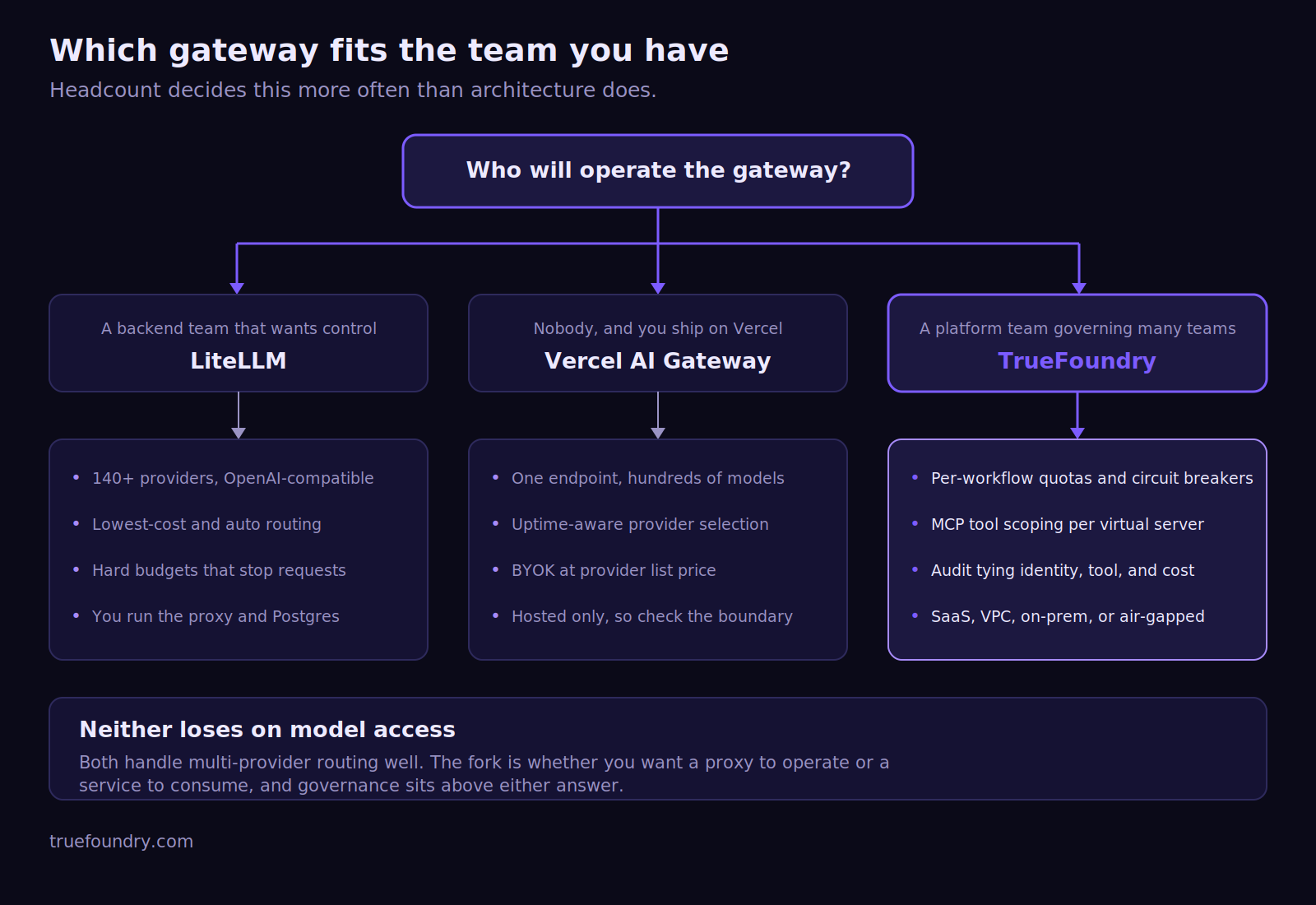
Optez pour LiteLLM si votre équipe a besoin d'un contrôle auto-hébergé, de la flexibilité de l'open source, de clés virtuelles, de gestion budgétaire et d'opérations personnalisées. Sa plateforme couvre désormais les modèles, le protocole MCP et les agents, ce qui en fait la solution idéale lorsque les équipes techniques souhaitent maîtriser leurs opérations.
Optez pour Vercel AI Gateway si votre équipe utilise déjà Vercel et recherche un accès rapide aux modèles, la gestion de ses propres clés (BYOK) et la fiabilité d'un service hébergé. C'est la solution idéale lorsque la rapidité de mise en production prime sur la possession d'une passerelle privée.
Optez pour TrueFoundry lorsque l'exécution gouvernée doit englober les modèles, les outils MCP, les agents et les budgets. Elle est également adaptée aux environnements de production privés ou gérés nécessitant des preuves d'audit.
Le choix entre LiteLLM et Vercel AI Gateway dépend avant tout de la question de la propriété. LiteLLM offre un contrôle total sur l'infrastructure, tandis que Vercel propose un service hébergé. TrueFoundry est la solution adaptée lorsque la gouvernance globale de l'IA devient la priorité.
Réserver une démo avec TrueFoundry pour évaluer vos besoins en matière de passerelle, de protocole MCP, d'agents, de déploiement et de gouvernance.
TrueFoundry AI Gateway offre une latence d'environ 3 à 4 ms, gère plus de 350 RPS sur 1 processeur virtuel, évolue horizontalement facilement et est prête pour la production, tandis que LiteLM souffre d'une latence élevée, peine à dépasser un RPS modéré, ne dispose pas d'une mise à l'échelle intégrée et convient parfaitement aux charges de travail légères ou aux prototypes.





Les dernières nouvelles, articles et ressources envoyés dans votre boîte de réception


.png)
.png)
.png)
.png)
.png)
.png)
.png)
.png)
.png)
.png)
.png)


