October 29, 2026
|
5 min de lecture


Accédez instantanément à un environnement TrueFoundry en direct. Déployez des modèles, acheminez le trafic LLM et explorez la plateforme complète : votre sandbox est prête en quelques secondes, aucune carte de crédit n'est requise.



Une méthode incroyablement rapide pour créer, suivre et déployer vos modèles !
We're releasing three major product updates to strengthen agent governance on TrueFoundry, giving teams control over which agents run, what they can reach, and on whose behalf they act.
Agent Identity is the first major launch in this series.
In a hospital, every doctor and nurse carries an ID badge. They tap it on the medication cabinet before they can dispense a drug, and the cabinet logs who took what, for which patient, and when. Now imagine a busy ward where a few people share one badge to save time. The log still says "Dr. Smith dispensed 10 mg of morphine at 2:14 a.m.", but nobody can say who actually opened the drawer. The record of the last credential used exists, but there’s no traceability beyond that.
That is how most AI agents work today. Agents call models, MCP servers, and other agents using shared API keys, static service accounts, or whatever credentials the developer had at hand. When an agent issues a refund or updates a customer record, the logs show a key, not an agent, and not the person the agent was acting for. This was an inconvenience when agents operated at a small scale, mostly on internal workflows. But as the size of each enterprise’s agent fleet increases and teams begin deploying multi-agent systems that can touch sensitive records and take destructive actions, untraceability becomes a huge compliance and security risk.
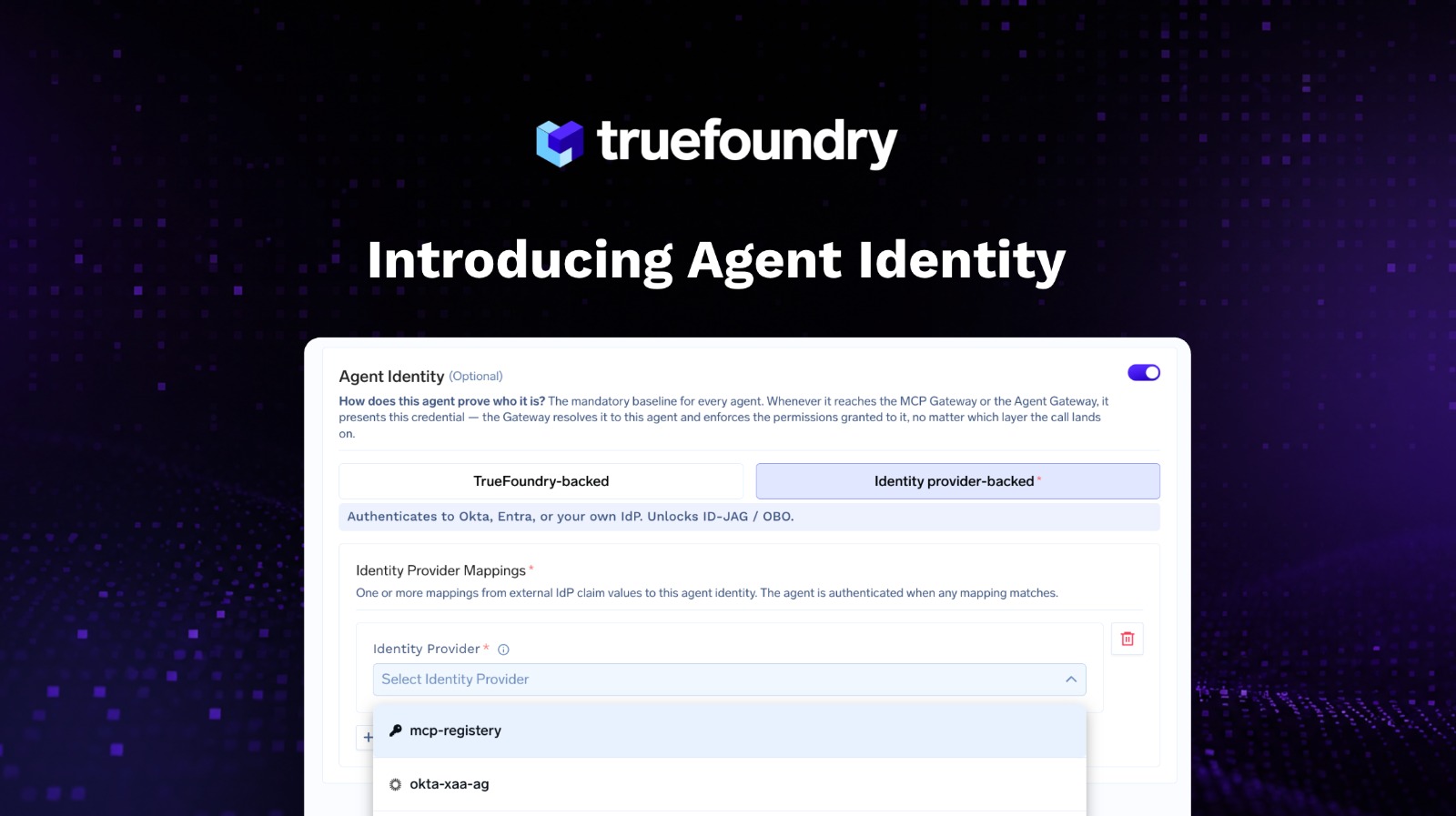
That’s why we're launching Agent Identity in TrueFoundry's Agent Gateway.
We kept hearing the same story from platform and security teams. Take a support portal: a support engineer, acting for a customer, asks the portal to process a payment. The portal calls a support orchestrator agent. The orchestrator hands the task to a payments agent. The payments agent calls a payments MCP server that actually writes the record.
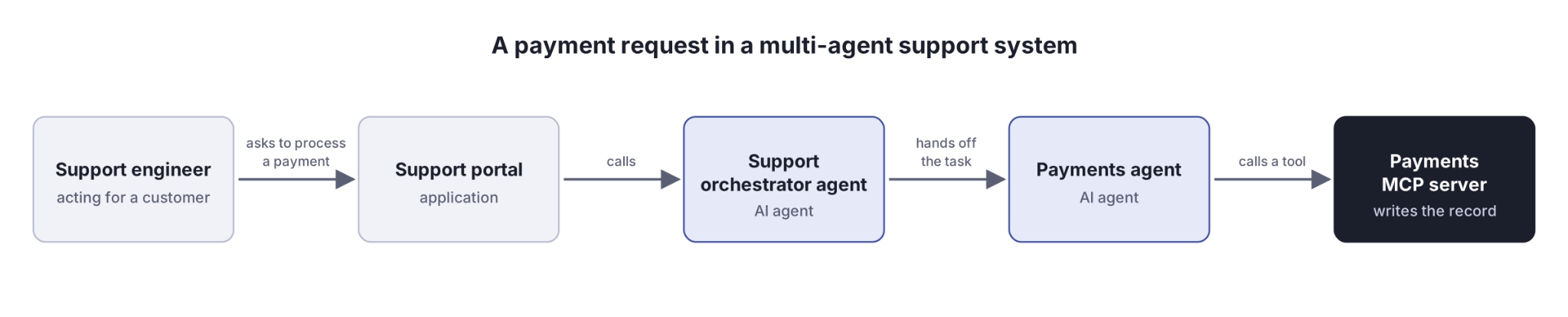
Four hops later, the MCP server has to decide whether to act. Is this request coming from the portal? From the engineer? From the customer the engineer is helping? In most setups, it only sees the last agent in the chain, so it either trusts everything or trusts nothing.
Teams that tried to fix this ran into three problems:
Agent Identity moves all of this out of agent code and into the gateway.
Every agent registered in TrueFoundry's AI agent registry gets exactly one identity. You choose who backs it:
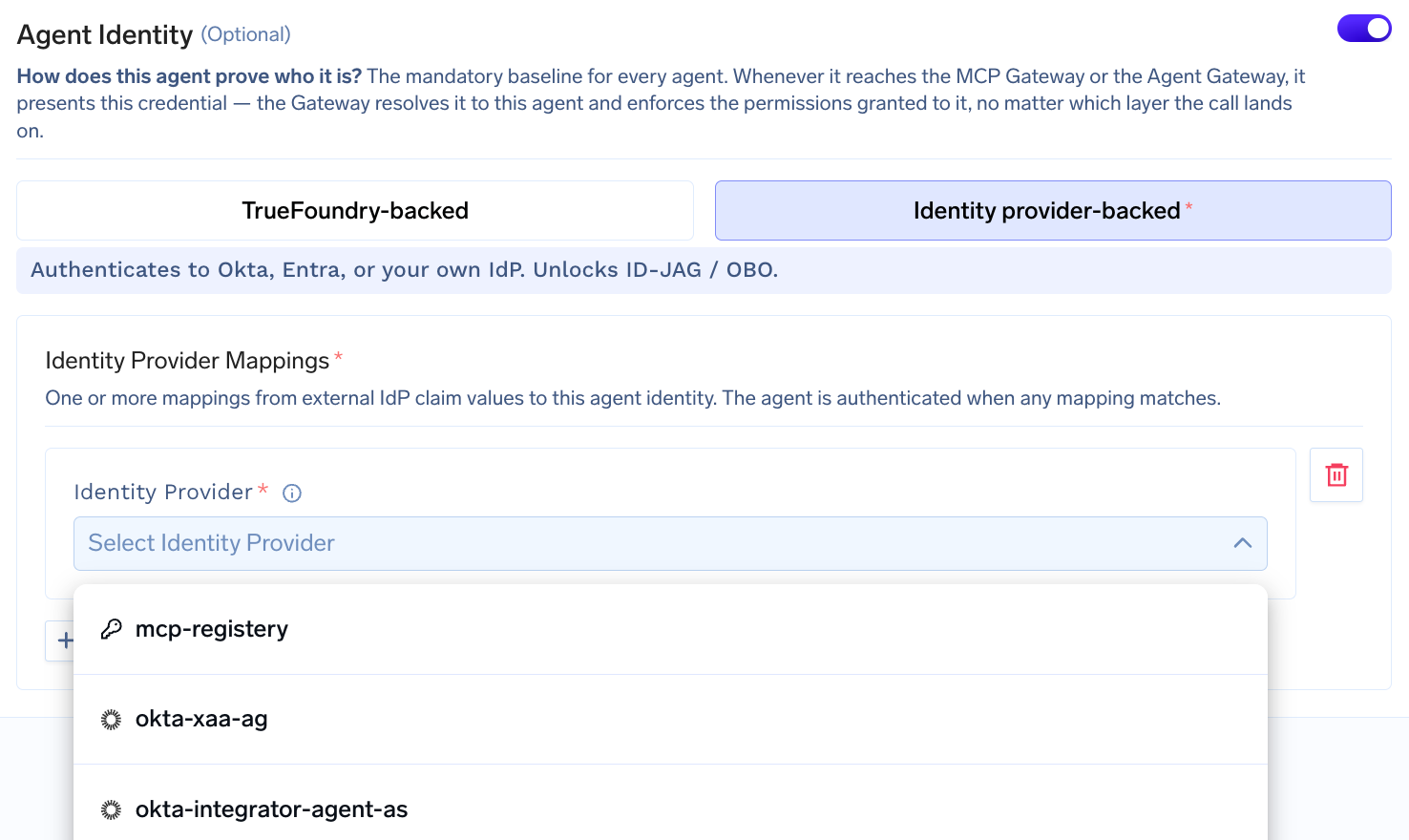
Agents don't need to move to get an identity. You can register agents running on AWS Bedrock AgentCore, Vertex AI, LangGraph, custom HTTP services, A2A agents, or TrueForge without rewriting them. Agents you route through the gateway get full policy enforcement on inbound calls. Embedded agents that can't be proxied still get an identity, and their outbound calls to models and MCP servers are still governed.
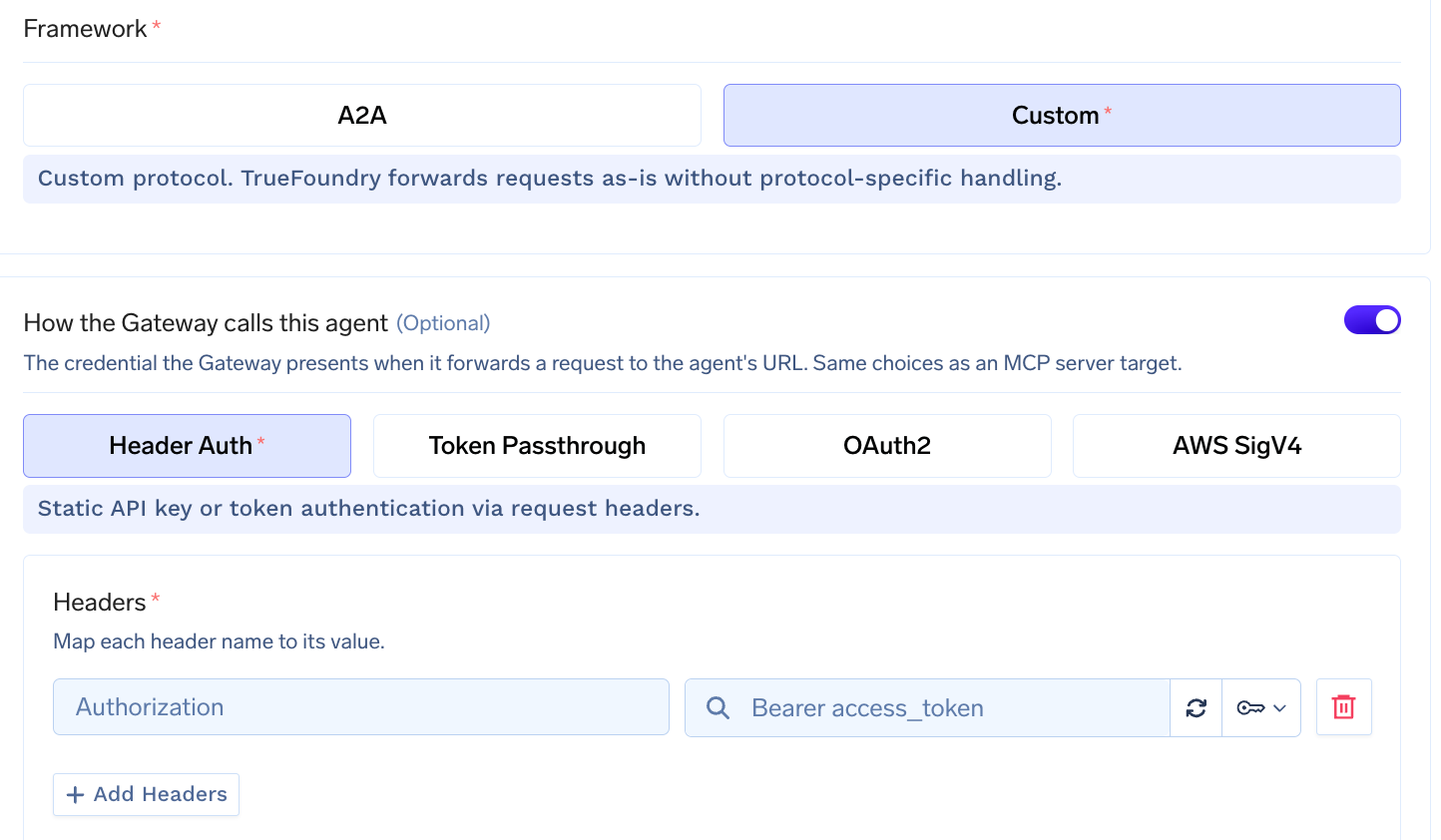
Authentication answers "who are you?" In a multi-agent chain, however, the harder question is "on whose behalf are you acting?" Agent Identity lets you decide, for each hop, how identity is presented to the next system:
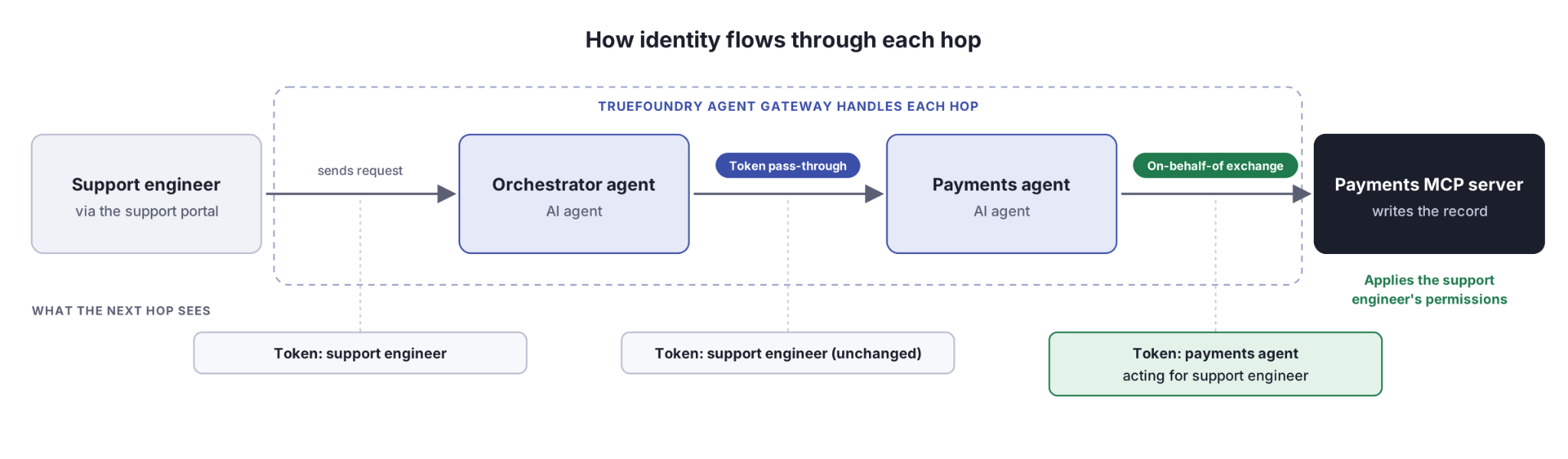
How does this work in real life? Let’s go back to the support agent scenario from earlier. You might pass the token straight through between the orchestrator and the payments agent, then use on-behalf-of on the final call to the payments MCP. The MCP server now sees that the payments agent is acting for the support engineer, and can apply that person's permissions. In practice, the system of record at the end of the chain usually decides which identity it needs, and Agent Identity lets you meet that requirement without touching agent code. The gateway runs the exchange, caches and refreshes tokens, and rejects calls that don't carry the identity the next hop requires.
Identity is only useful if you can act on it. Every agent has two sets of controls:
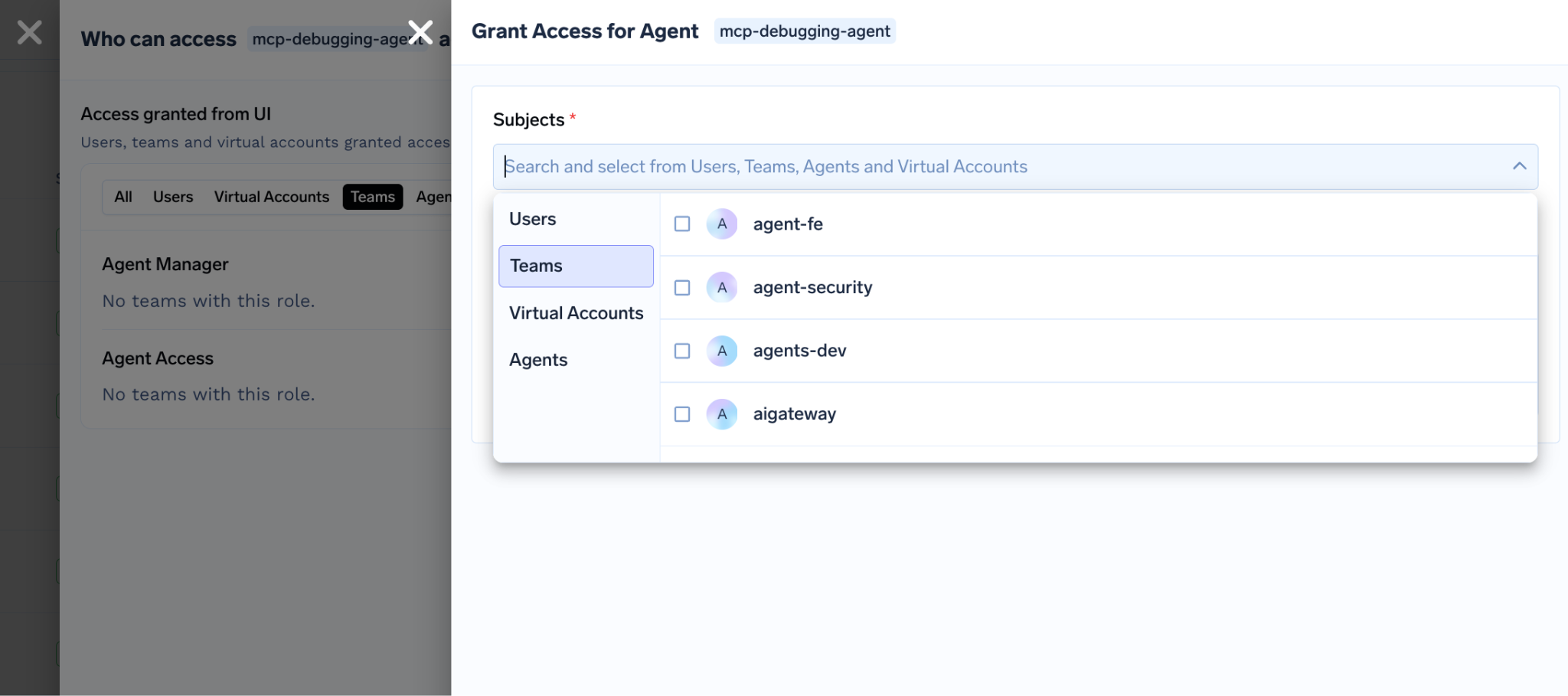
Agents can have an owner team and collaborators with Agent Manager or Agent Access roles. Access is allow-list based: remove a grant, and the gateway returns a 403 on the next call. These policies use the same RBAC model as every other TrueFoundry resource, so there's no separate permission system to learn.
Registering an agent takes four steps in the Agent Registry: Metadata, Agent Identity, Config, and Access Control. You can also apply the same configuration as YAML. Head to the Agent Registry documentation for a full walkthrough, including setup guides for Okta and Microsoft Entra.
Like to learn more about how Agent Identity in the TrueFoundry AI Gateway would work in your current set up?
TrueFoundry AI Gateway offre une latence d'environ 3 à 4 ms, gère plus de 350 RPS sur 1 processeur virtuel, évolue horizontalement facilement et est prête pour la production, tandis que LiteLM souffre d'une latence élevée, peine à dépasser un RPS modéré, ne dispose pas d'une mise à l'échelle intégrée et convient parfaitement aux charges de travail légères ou aux prototypes.


Agent identity is a verifiable credential that uniquely identifies an AI agent when it calls models, tools, or other agents. In TrueFoundry, each registered agent gets exactly one identity, issued by TrueFoundry or backed by your identity provider, and the gateway uses it to enforce access and record what the agent did.
Pass-through forwards the caller's original token unchanged to the next system. On-behalf-of exchanges that token with your identity provider for a new one that names both the agent and the user it's acting for. Use on-behalf-of when the downstream system needs to apply per-user permissions.
Yes. Agents can use identities backed by Okta, Microsoft Entra, any OIDC provider, or SPIFFE/SPIRE. On-behalf-of token exchange is supported for both Entra and Okta.
Oui. TrueFoundry s'exécute dans votre VPC, on-premise, en environnement air-gapped ou en hybride, de sorte que les prompts et les réponses ne quittent jamais votre domaine, même lorsque vous routez vers de nombreux fournisseurs.
Oui. La passerelle est compatible OpenTelemetry et s'intègre à Grafana, Datadog, Prometheus, ou à votre pile technologique préférée. Elle trace chaque requête, du prompt à l'exécution de l'outil et du modèle, vous offrant ainsi une journalisation unifiée sans avoir à remplacer ce que vous utilisez déjà.



Les dernières nouvelles, articles et ressources envoyés dans votre boîte de réception