


October 6, 2026
|
5 min de lecture


Accédez instantanément à un environnement TrueFoundry en direct. Déployez des modèles, acheminez le trafic LLM et explorez la plateforme complète : votre sandbox est prête en quelques secondes, aucune carte de crédit n'est requise.



Published: October 6, 2026
Une méthode incroyablement rapide pour créer, suivre et déployer vos modèles !
Enterprises are moving AI applications into production faster than ever and the operational reality on the other side looks very different from a prototype. Application teams need to ship and iterate quickly. Platform and security teams need to know that every prompt and every completion was checked against the organization's AI policy and that PII and secrets did not leak through model calls. The harder question is this: how do you enforce AI security policy on hundreds of model calls across multiple providers and multiple agent frameworks without scattering policy decisions through application code and without depending on every team to integrate the same SDK?
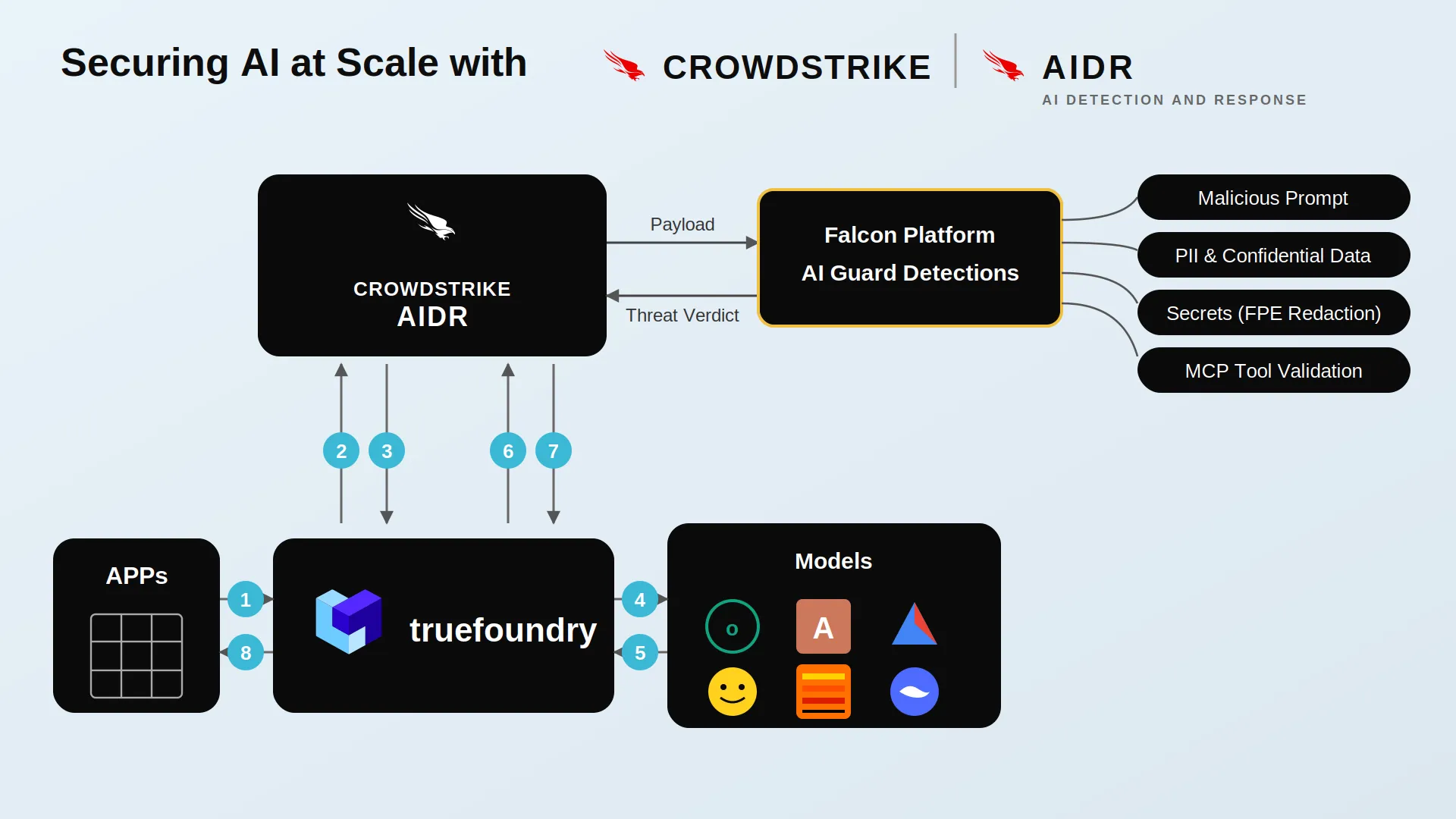
At TrueFoundry, our approach is to keep the execution layer uniform and let teams plug in the security system they already use. That is why we are announcing a native integration between the TrueFoundry AI Gateway and CrowdStrike AI Detection and Response (AIDR). The gateway becomes the single execution boundary that every model call and every agent step passes through and AIDR provides the security inspection and enforcement layer, analyzing prompts and completions for AI-specific threats, sensitive data exposure, and policy violations.
The TrueFoundry AI Gateway establishes a single governed entry point for all model and agent requests. Applications and agents no longer talk directly to model providers. They talk to the gateway proxy. This architectural decision matters because it creates a consistent surface for policy enforcement, routing decisions and telemetry generation. The gateway determines which model is used, under what constraints, in which environment and with what safeguards. It also becomes the one place where security policy can be applied to every model call without depending on every application team.
For platform leaders, this is the point where AI systems stop being a collection of python scripts and start behaving like infrastructure.
While the gateway governs where and how requests execute CrowdStrike AIDR is the place every prompt and completion is analysed against your AI security policy. In AIDR's terminology a request flows through a collector which has an input policy and an output policy. Each policy runs a set of detectors over the content. Detectors cover prompt injection, jailbreaks and confidential or PII entities and secrets and malicious tool descriptions and conflicting MCP tool names and configurable language and topic policies. Detector signals feed into the policy verdict which returns whether the request should be blocked, allowed, or transformed.
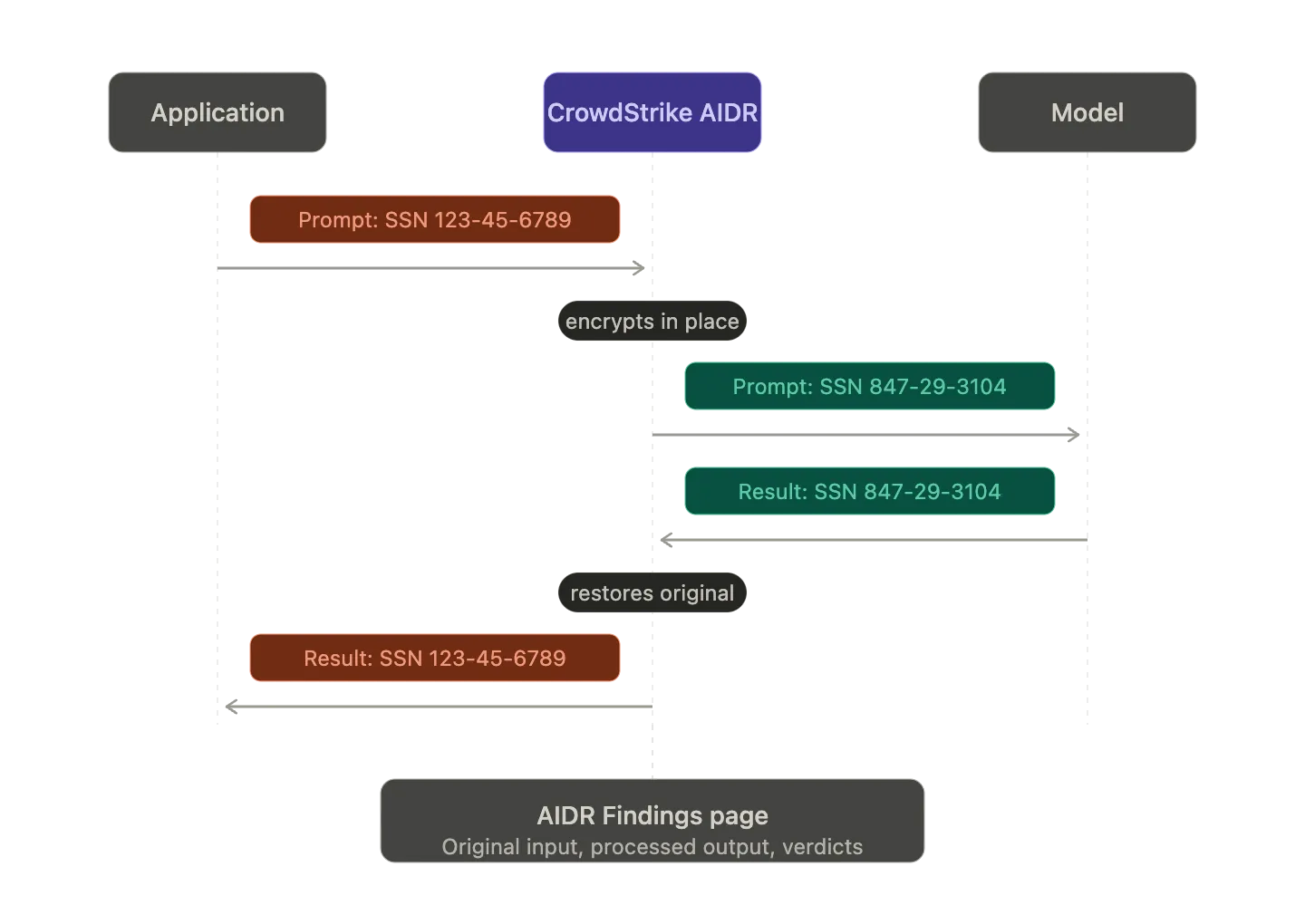
AIDR treats content transformation as a first class concept alongside blocking. A flagged value can be redacted in place rather than blocking the entire request. The redaction uses format-preserving encryption so a prompt containing an SSN can have just the SSN replaced with an encrypted token before reaching the model and the original value can be restored on the way back. Every analyzed request is logged on the AIDR Findings page with the original input and the processed output and the detector verdicts.
Most enterprises already operate a centralized security stack that anchors their data loss prevention, threat detection and compliance posture. The challenge with LLM systems is that the threats they introduce (prompt injection and jailbreaks and PII in completions and indirect injection through tool outputs and unauthorized model behaviour) do not map cleanly onto the WAF, DLP and IDS tools those teams already run. Teams typically end up choosing between two unsatisfactory options:
On the TrueFoundry side, you can add CrowdStrike AIDR as a first-class guardrail from the registry. The gateway remains responsible for routing and rate limiting and the guardrail is configured through the same form as any other built-in guardrail. There is no adapter service to host. You bind the guardrail to models with a rule and inline enforcement happens automatically on every request that matches.
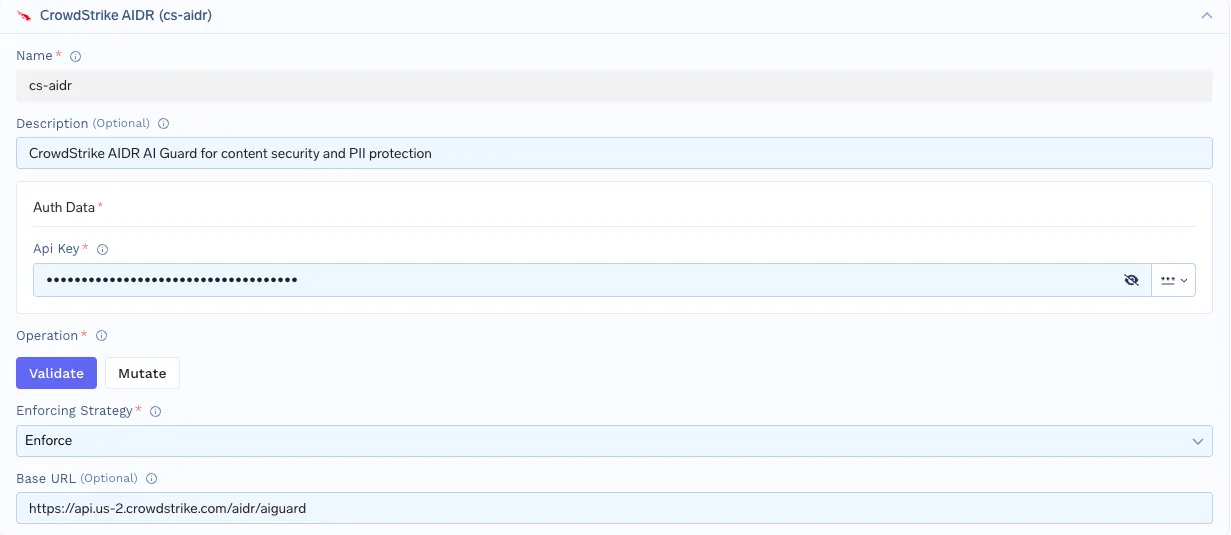
On the AIDR side, you provision an Application collector and configure the Input Policy and Output Policy that should run for your traffic. You generate a bearer token from the collector's Tokens page and paste it into the TrueFoundry guardrail form. The same collector handles both directions because the gateway sets event_type to input or output per leg and AIDR selects the matching policy. Docs: CrowdStrike AIDR APIs.
For AI leaders the TrueFoundry and CrowdStrike AIDR integration provides a shared foundation where execution and security policy stays aligned as systems scale. Every model call that crosses the gateway is subject to the same policy whether it comes from a python script or an autonomous agent or a copilot embedded in an IDE. Application teams keep their velocity and security teams keep their enforcement posture because production AI needs production grade security infrastructure.
The partnership is intentionally composable. TrueFoundry governs and routes execution, AIDR analyses and enforces policy and the AIDR API connects them. Together, they provide centralized AI execution with integrated security inspection and enforcement for production AI workloads.
TrueFoundry AI Gateway offre une latence d'environ 3 à 4 ms, gère plus de 350 RPS sur 1 processeur virtuel, évolue horizontalement facilement et est prête pour la production, tandis que LiteLM souffre d'une latence élevée, peine à dépasser un RPS modéré, ne dispose pas d'une mise à l'échelle intégrée et convient parfaitement aux charges de travail légères ou aux prototypes.





Les dernières nouvelles, articles et ressources envoyés dans votre boîte de réception
.webp)
.png)
.png)
.png)
.png)
.png)
.png)
.png)
.png)
.png)
.png)
.png)


