


October 1, 2026
|
5 min de lecture


Accédez instantanément à un environnement TrueFoundry en direct. Déployez des modèles, acheminez le trafic LLM et explorez la plateforme complète : votre sandbox est prête en quelques secondes, aucune carte de crédit n'est requise.



Published: July 6, 2026
.webp)
Une méthode incroyablement rapide pour créer, suivre et déployer vos modèles !
RunLayer positions itself as AI enablement and control in one platform, built around the Model Context Protocol. Its connectors expose org-approved tools through one MCP gateway, and the Runlayer Plugin gives Cursor and Claude Code users a single entry point to those tools, skills, and agents.
What sets RunLayer apart is its approach to discovery and runtime security. Its Shadow AI product, called AI Watch, installs as a package on employee machines through Jamf, Intune, Kandji, Mosyle, or another MDM. Once deployed, it finds unsanctioned MCP servers and skills, enforces policy on tool calls in real time, and records agent sessions. On top of that, RunLayer runs ToolGuard, a set of security models for MCP ecosystems, and AgentGuard, which watches an agent's full trajectory to catch attempts at manipulation. Incident management, approvals, audit logs, and Slack alerts round out the security workflow.
There is a trade-off in scope. RunLayer is built to secure and govern how agents use tools. It is not an LLM gateway that routes a thousand models behind one API, and it does not serve or deploy your own models. Teams that need model routing, load balancing, or self-hosted inference will run RunLayer alongside another system rather than in place of one.
Best for: security teams that need to find and control shadow MCP and agent usage across employee devices.
TrueFoundry is a broader platform that puts models, MCP servers, and agents behind one governed gateway. The AI gateway gives developers a single OpenAI-compatible API to more than 1,600 LLMs, so switching providers is as simple as changing the model name. We designed the gateway to sit in the hot path without becoming the bottleneck, adding only about 3 to 4 ms of overhead while serving 350+ RPS on a single vCPU.
Pointing an app at the gateway is a one-line change. You keep the OpenAI SDK and swap the base URL:
from openai import OpenAI

# Point the OpenAI SDK at the TrueFoundry gateway
client = OpenAI(
    api_key="your_truefoundry_api_key",
    base_url="{GATEWAY_BASE_URL}",
)

response = client.chat.completions.create(
    model="openai-main/gpt-4o-mini",   # switch providers by changing this name
    messages=[{"role": "user", "content": "Summarize our Q3 roadmap"}],
)
print(response.choices[0].message.content)
The gateway does much more than route models. It includes load balancing and fallbacks, semantic caching, guardrails for PII and prompt injection, per-team rate limits and budgets, and OpenTelemetry-based observability. On the agentic side, our MCP Gateway centralizes authentication so one key reaches every registered MCP server, with tool-level RBAC and virtual MCP servers that expose a curated subset of tools. The MCP Registry, Agent Registry, and Skills Registry let platform teams publish governed catalogs that agent builders draw from without ever handling raw credentials.
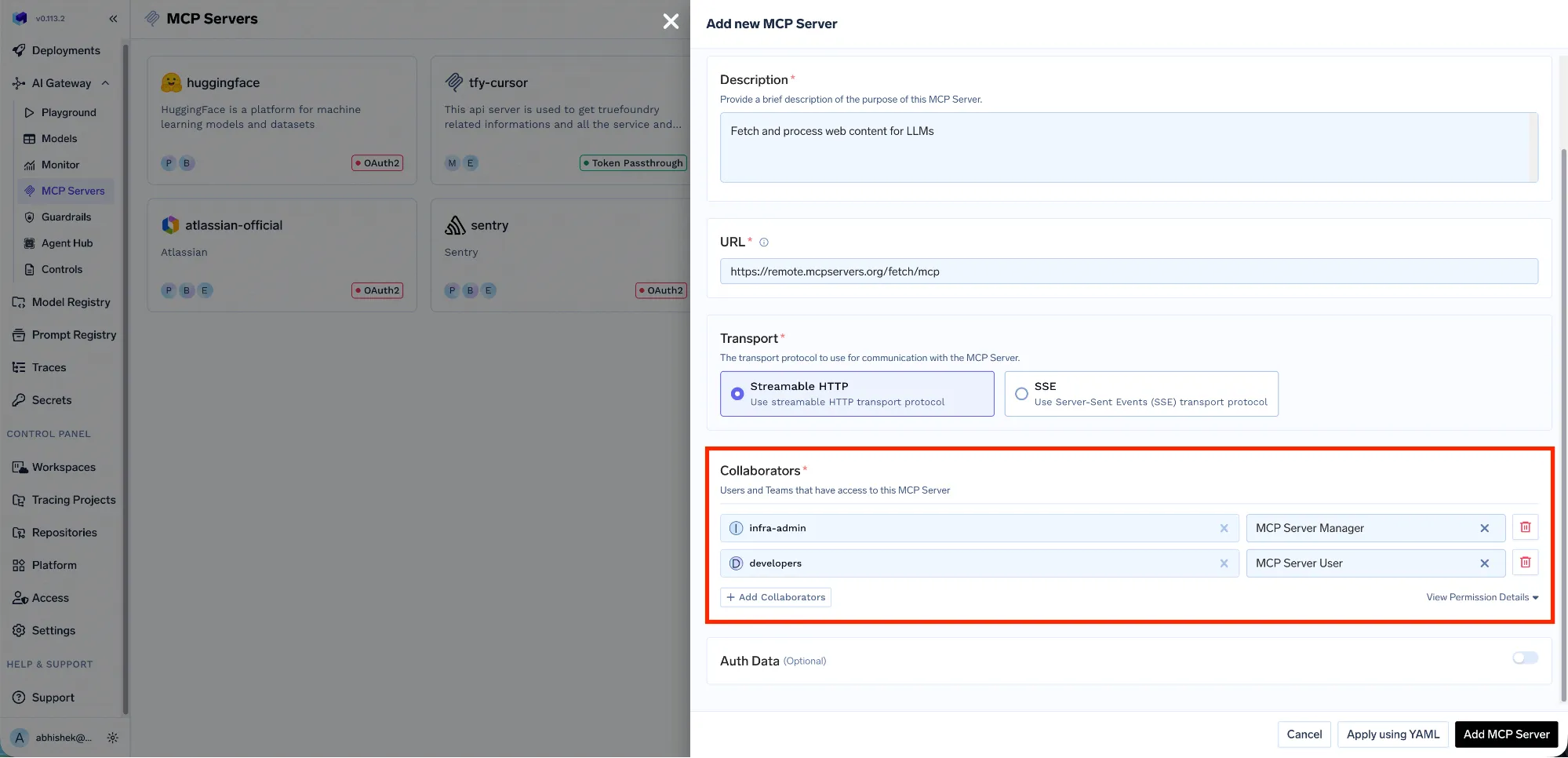
Best for: platform and engineering teams that want models, MCP, and agents governed in one control plane, deployed in their own infrastructure.
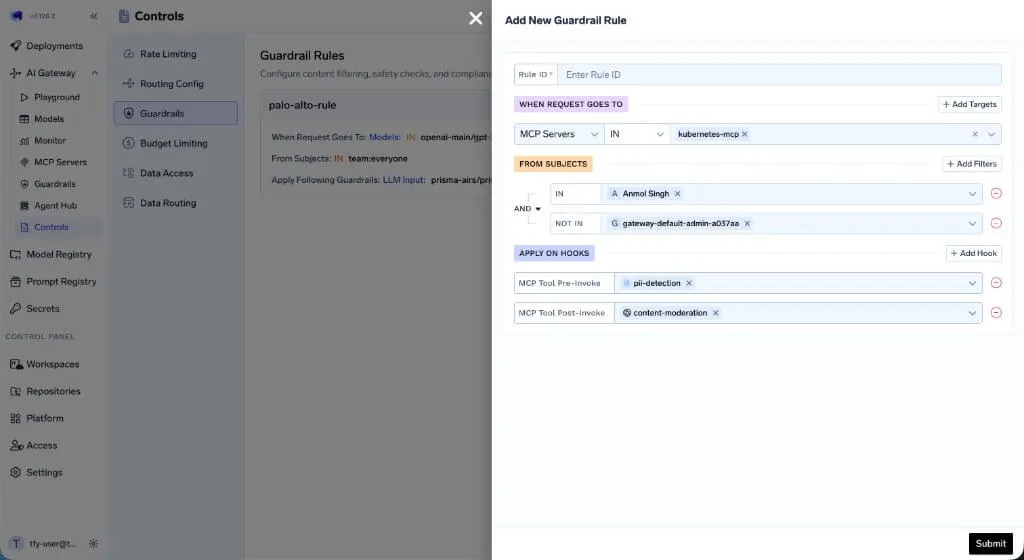
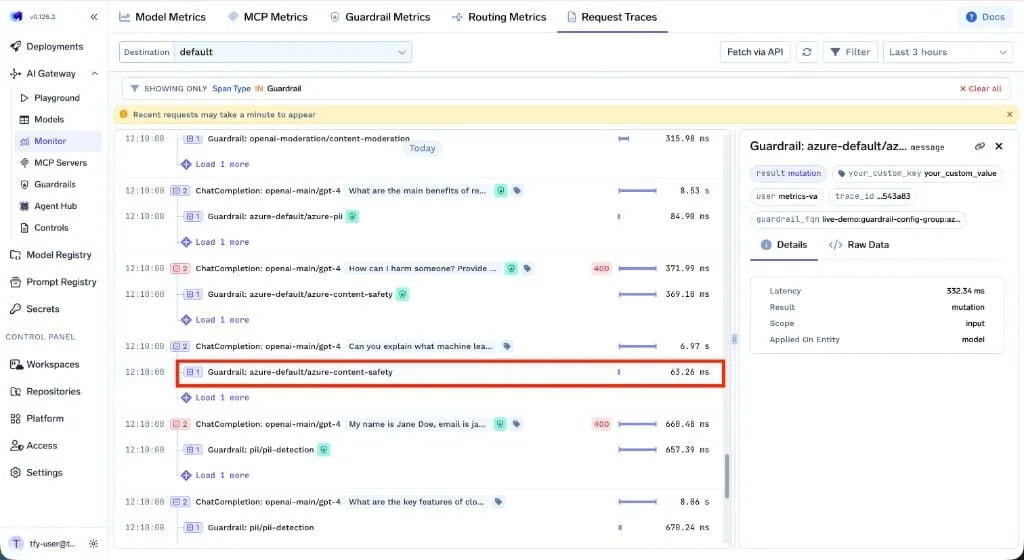
Yes, and this is worth spelling out because it is where the two products overlap most. On MCP security, the TrueFoundry gateway authenticates every call with OIDC, JWT, or API keys, then checks tool-level permissions before a tool runs. You can attach guardrails on four hooks: LLM input, LLM output, MCP pre-tool invoke, and MCP post-tool invoke. Policies can be written in Cedar or OPA, destructive tools can require human approval, and every call is traced with a unified audit trail and a per-agent kill switch.
{
  "llm_input_guardrails": ["global/pii-redaction"],
  "llm_output_guardrails": ["global/openai-moderation"]
}
On shadow AI, TrueFoundry takes a traffic-first approach. It puts one control point in front of every model call and covers both the AI your teams build and the AI your employees use, from Cursor and Claude Code to the ChatGPT app and claude.ai. Cooperative tools route through the gateway with an MDM config patch; the rest are captured with the open-source aitori agent or your existing secure web gateway. For endpoint threat detection, the gateway also integrates with CrowdStrike AIDR, which is built for employee GenAI adoption and MCP tool validation.
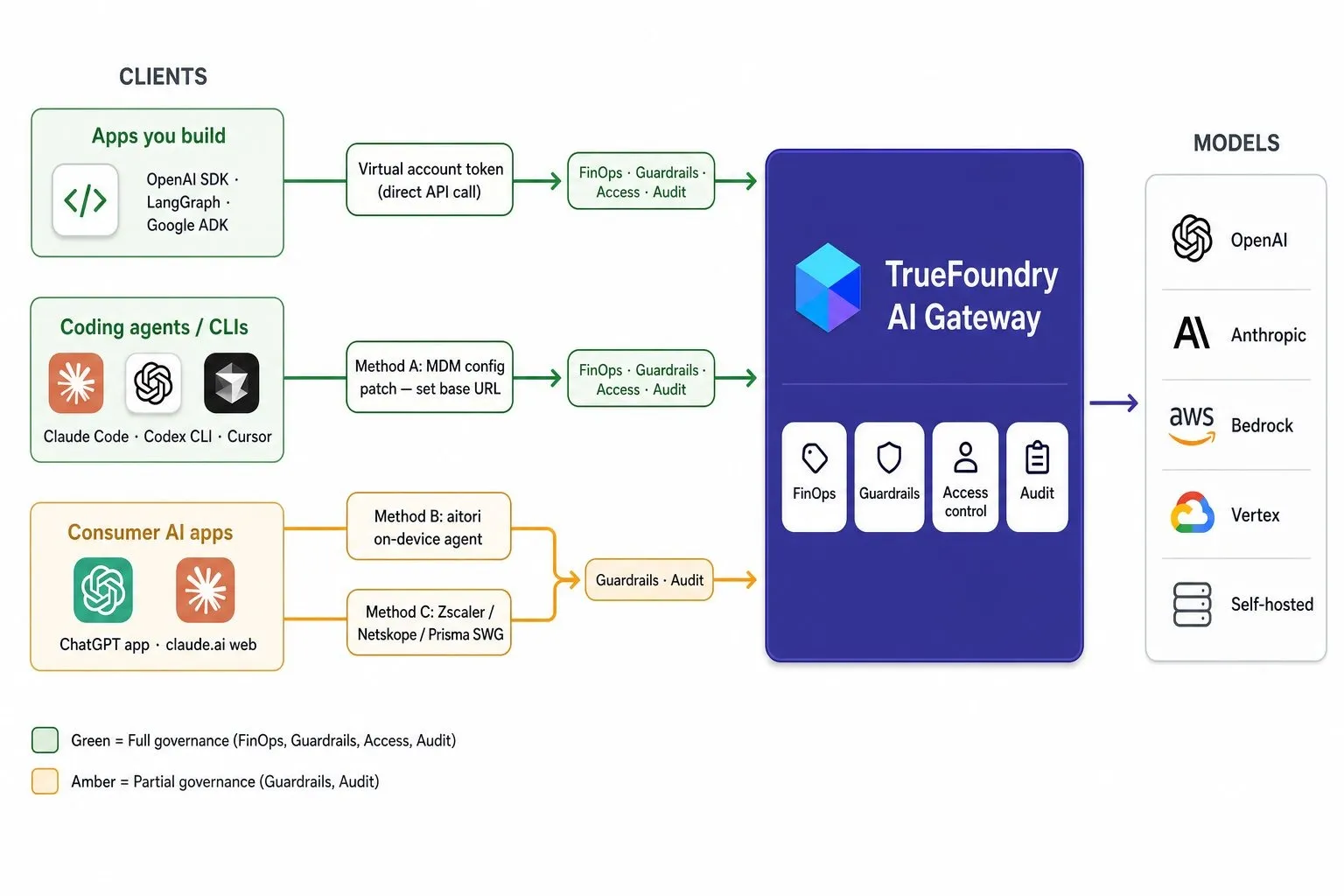
The honest distinction: RunLayer specializes in scanning employee devices to inventory MCP servers and skills that were never declared. TrueFoundry governs and audits the traffic itself and wires into endpoint tooling for the discovery angle. Both give security teams control over unsanctioned AI; they just start from different places.
The table below reflects publicly documented functionality for both platforms at the time of writing.
Pick TrueFoundry when the gateway needs to carry more than security. If your developers call many providers and you want one API, load balancing, and cost controls across all of them, that is the gateway's job. Teams standardizing an LLM gateway for the whole org get model access and MCP governance in the same place.
It also fits when you deploy your own models. Running open-weight models on vLLM or Triton next to the gateway keeps serving and routing in one control plane instead of across two vendors. Regulated industries lean this way too, since the whole platform runs in your own VPC and supports SOC 2, HIPAA, and GDPR. And for agent programs, keeping the MCP Gateway, Agent Registry, and Skills Registry in one place means platform teams set up access once and builders never handle secrets.
The simplest way to frame RunLayer vs TrueFoundry is layer versus platform. RunLayer is a strong security layer over AI activity that already happens, and it is especially good at finding shadow MCP usage on employee devices and monitoring agent behavior at runtime. If that discovery problem is your main concern, it does the job well.
TrueFoundry solves a bigger problem, and it does so without giving up the security controls RunLayer is known for. It is the governed gateway to models, MCP servers, and agents, and it is also where you deploy and serve your own models, fully self-hosted if you need it. Tool-level access, guardrails, MCP threat detection, and audit are all here as part of a platform rather than a separate overlay. For teams that would otherwise build one gateway for models, an MCP layer, a serving stack, and a governance tool, consolidating into one gateway removes moving parts. If you are weighing a security-only MCP gateway against a full platform, that consolidation is the deciding factor.
RunLayer and TrueFoundry both bring governance to enterprise AI, but they are not the same kind of tool. RunLayer is the security specialist that finds and controls shadow MCP and agent usage at the endpoint. TrueFoundry is the platform that unifies models, MCP, and agents behind one gateway you can run in your own VPC, with MCP security, shadow AI governance, model deployment, and compliance all included.
If you are evaluating an enterprise MCP gateway and want models, MCP, and agents governed in one place rather than stitched across vendors, book a demo to see how TrueFoundry handles it end to end.
TrueFoundry AI Gateway offre une latence d'environ 3 à 4 ms, gère plus de 350 RPS sur 1 processeur virtuel, évolue horizontalement facilement et est prête pour la production, tandis que LiteLM souffre d'une latence élevée, peine à dépasser un RPS modéré, ne dispose pas d'une mise à l'échelle intégrée et convient parfaitement aux charges de travail légères ou aux prototypes.




RunLayer est une plateforme de sécurité MCP et d'IA fantôme qui détecte et gère l'utilisation non autorisée d'agents et d'outils, souvent au niveau des appareils via la gestion des appareils mobiles (MDM). TrueFoundry est une passerelle et une plateforme d'IA complètes qui unifient l'accès à plus de 1 000 LLM, serveurs MCP et agents, avec le déploiement de modèles et la conformité intégrés. RunLayer sécurise l'utilisation existante de l'IA ; TrueFoundry est le plan de contrôle sur lequel les équipes s'appuient, et il couvre également la sécurité MCP et l'IA fantôme.
Oui. TrueFoundry gère les outils d'IA tiers tels que Cursor, Claude Code et ChatGPT via la passerelle en utilisant un correctif de configuration MDM, l'agent aitori ou votre passerelle web sécurisée existante. Pour la sécurité MCP, il ajoute un RBAC au niveau de l'outil, des garde-fous pré et post-outil, des politiques Cedar ou OPA, des flux de travail d'approbation et une piste d'audit unifiée, ainsi que des intégrations avec CrowdStrike AIDR, TrojAI et Palo Alto AIRS.
Non, pas au sens des grands modèles de langage. RunLayer se concentre sur les connecteurs MCP, la détection d'IA fantôme et la sécurité d'exécution des agents, plutôt que sur le routage du trafic de modèles entre les fournisseurs. Pour une API unique couvrant plus de 1 000 modèles avec équilibrage de charge et contrôle des coûts, une passerelle IA comme TrueFoundry s'en charge.
Les deux sont solides, mais sous des angles différents. RunLayer met l'accent sur la détection des serveurs MCP fantômes sur les terminaux et la surveillance du comportement des agents avec ToolGuard et AgentGuard. TrueFoundry renforce la sécurité MCP à l'intérieur de la passerelle grâce à une authentification centralisée, un contrôle d'accès basé sur les rôles (RBAC) au niveau des outils, des serveurs MCP virtuels et des garde-fous sur les hooks pré et post-outils, ainsi que des intégrations d'accès aux modèles et de détection des menaces.



Les dernières nouvelles, articles et ressources envoyés dans votre boîte de réception
.png)
.png)
.png)
.png)
.png)
.png)
.png)
.png)
.png)
.png)
.png)


