


September 22, 2026
|
5 minutos de lectura


Obtenga acceso instantáneo a un entorno TrueFoundry en vivo. Implemente modelos, dirija el tráfico de LLM y explore la plataforma completa: su sandbox estará listo en segundos, sin necesidad de tarjeta de crédito.



Published: September 22, 2026
.png)
¡Una forma increíblemente rápida de crear, rastrear e implementar sus modelos!
The OWASP Top 10 for Large Language Model Applications is a consensus list of the most critical security risks in LLM-backed software, maintained by the OWASP GenAI Security Project. The current version is the 2025 list at genai.owasp.org/llm-top-10. The v1.1 list from 2023/24 is still archived there and still widely quoted - so if a post mentions Model Theft or Overreliance, it is describing the retired version.
The 2025 list as OWASP publishes it:
What changed shows where attention moved. System Prompt Leakage and Vector and Embedding Weaknesses are new. Model Denial of Service became the broader Unbounded Consumption. Insecure Plugin Design folded into supply chain and excessive agency as tooling settled around protocols like MCP. Model Theft dropped off entirely.
This is the part most write-ups skip. The Top 10 lists risks, and a risk is not a product feature. Four belong to the inference path, where a gateway sits. Three belong to application code. Three belong to pipelines a gateway never sees.
Four squarely in scope, three partials, three needing an owner elsewhere. If your AI security framework has a gateway row for LLM04 and LLM08, that row is decorative.
A gateway covers LLM01, LLM02, LLM06, and LLM10 well because all four are request-path problems: they happen the moment a prompt goes out or a tool fires, which is the only moment a gateway sees. The rest were decided weeks earlier, in a training run or an indexing job.
Treating the list as a compliance checklist. OWASP publishes a risk taxonomy with mitigation guidance, not a certification. There is no OWASP LLM Top 10 audit and no body that issues a pass. A matrix claiming all ten are “covered” by one tool is written to survive a meeting, not an attack.
Putting output validation in the wrong place. LLM05 is about what your application does with model output. A gateway can flag that a response contains os.system or an unescaped script tag. It cannot stop your service feeding that string into a shell. The control belongs where output is consumed; the gateway check is defence in depth.
Assuming injection detection is prevention. Detection is a classifier, classifiers have false negatives, and attackers iterate against them. The durable mitigation for LLM01 is to assume injection occasionally succeeds and make that survivable - which is really an LLM06 problem. Narrow the tool surface and a successful injection reaches a model with nothing dangerous to call.
Ignoring LLM10 as a billing concern. An agent stuck in a loop is a denial-of-service against your own budget, and high-volume querying is how model extraction works. It is the easiest entry to close, and the most commonly left open.
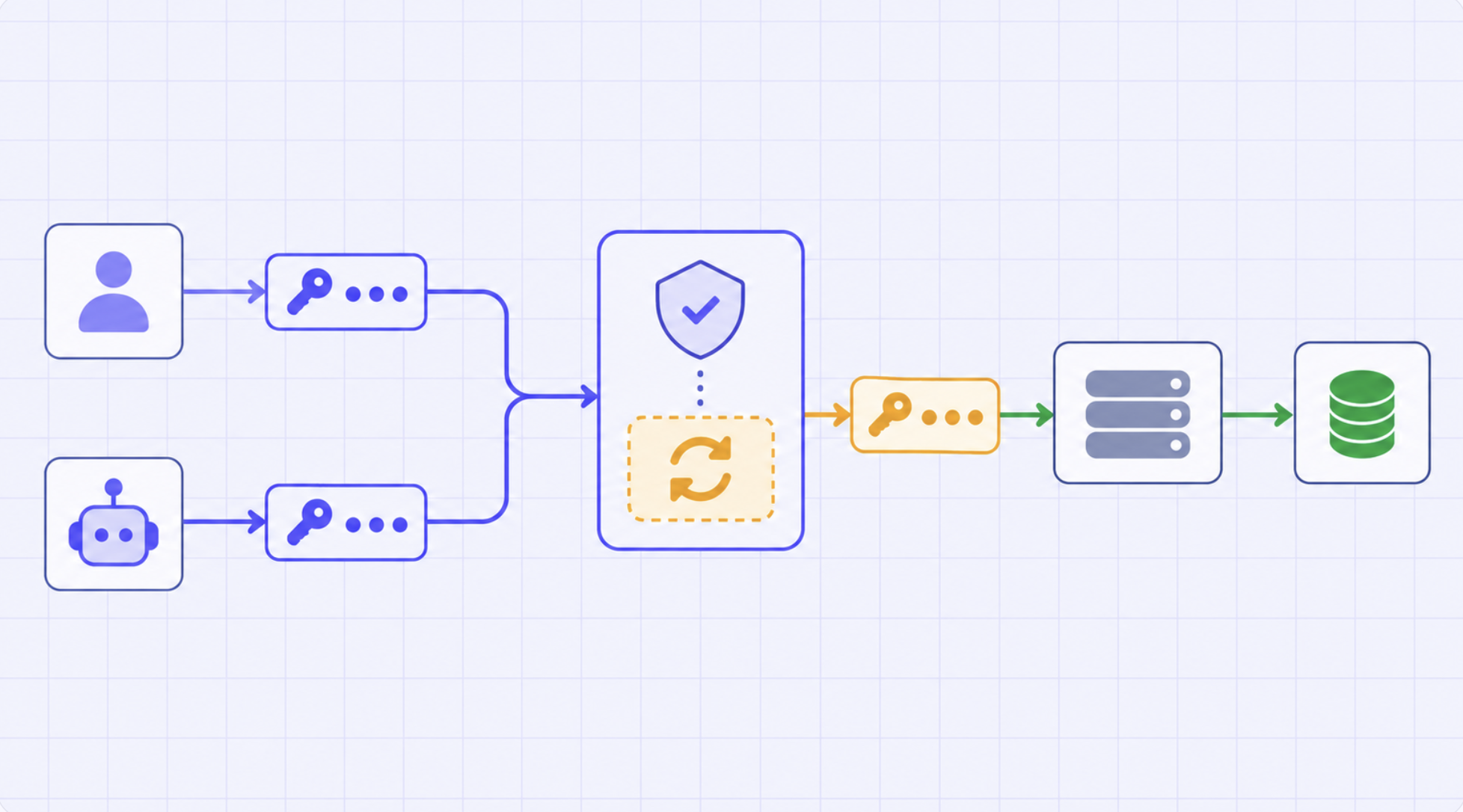
TrueFoundry’s AI Gateway implements these controls as guardrails on hooks in the request path. There are four, and which risks you can address depends on which hook you are on.
For LLM requests: input, before the prompt reaches the model, and output, after it responds.
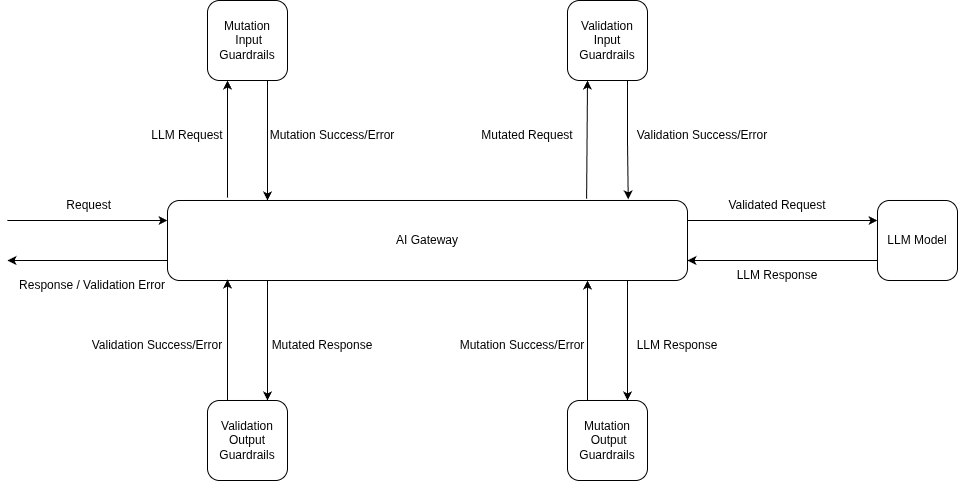
For MCP tool calls: mcp_pre_tool, before the tool executes, and mcp_post_tool, after it returns.
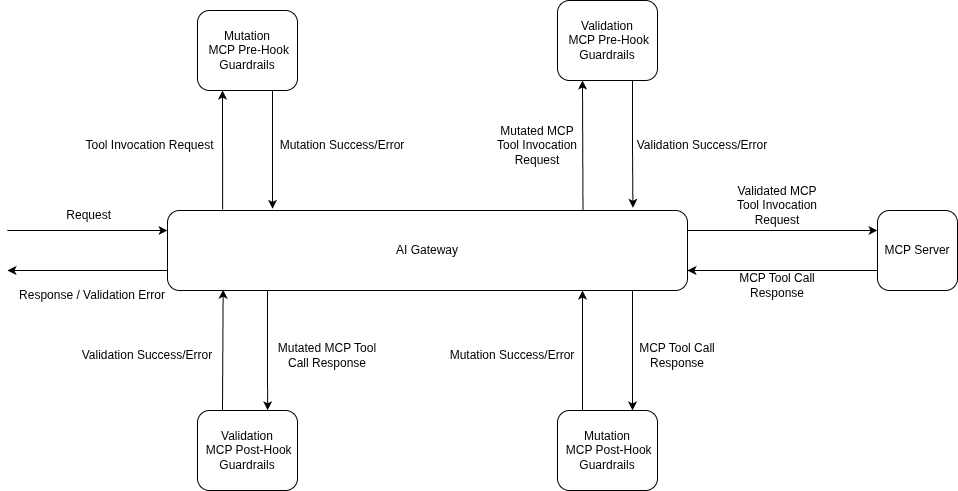
Those MCP hooks make the owasp mcp question tractable. Guardrails run on every tool call separately - five tools in a row means five sets of checks. A pre-tool failure means the tool never runs; a post-tool failure withholds the result.
Each guardrail has an operation mode - validate inspects and can block, mutate also rewrites - and an enforcement strategy covering violations and guardrail errors:
The built-in Prompt Injection guardrail is powered by Azure Prompt Shield and managed by TrueFoundry, with no third-party keys. It analyses the user prompt and any document or context content separately, so indirect injection hidden in a retrieved document is caught alongside a direct “ignore all previous instructions”. Validate-only. Add it from the Guardrails section:
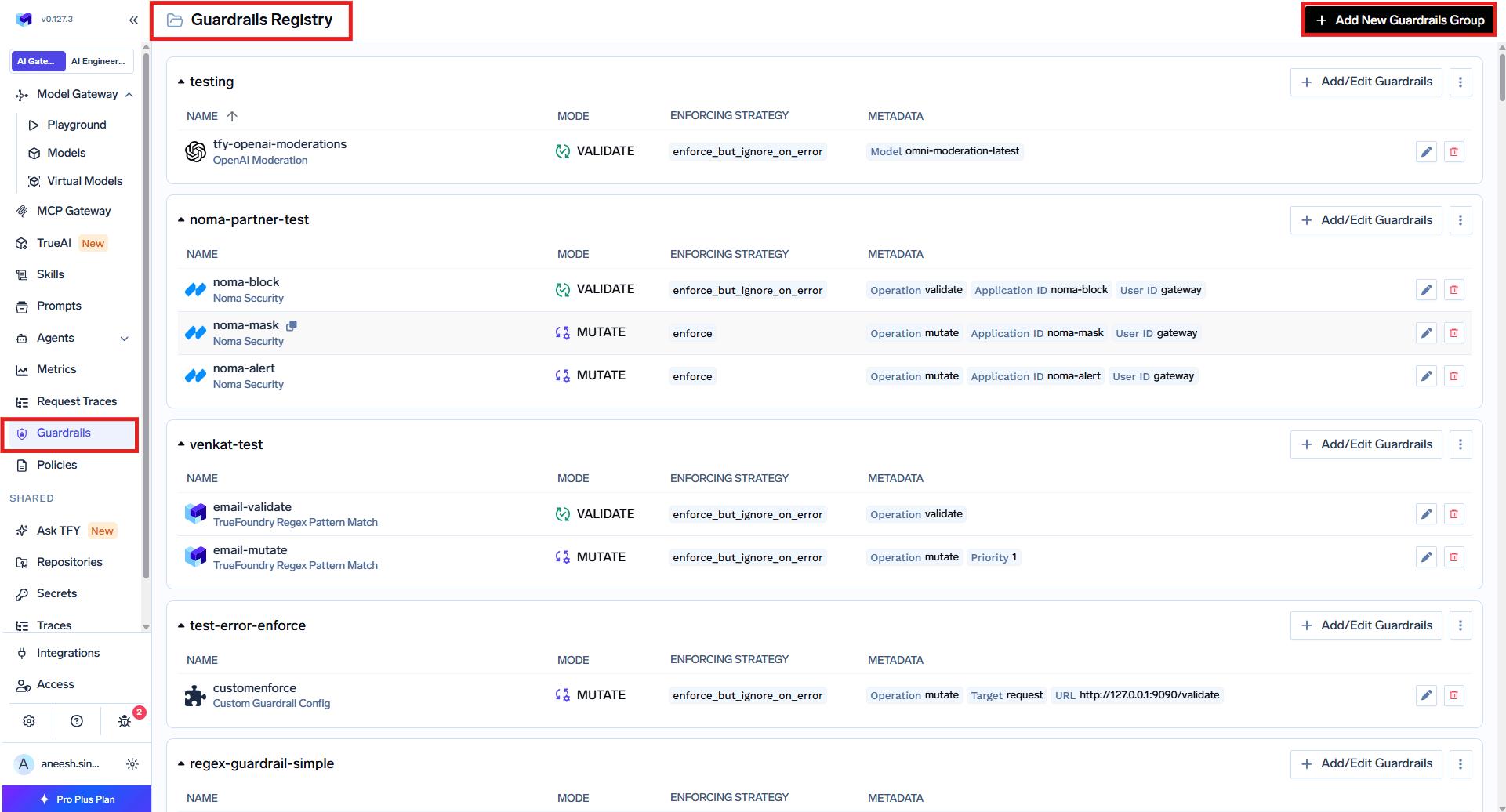
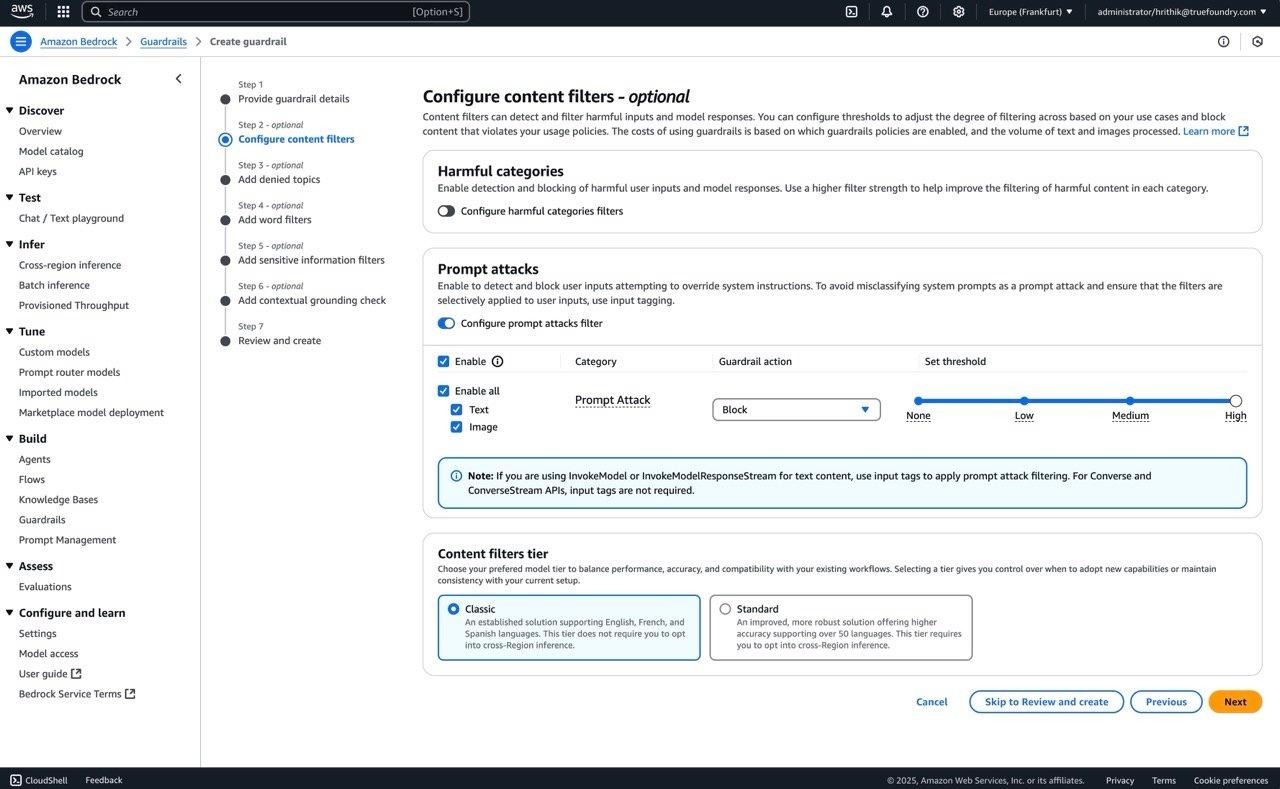
It runs on LLM Input and MCP Pre Tool, where it looks for injection inside tool parameters. To use your own vendor credentials, AWS Bedrock Guardrails does the same job - enable Prompt Attack, set the action to Block, register it:
Two built-ins cover most of this. PII / PHI Detection finds names, addresses, SSNs, and medical record numbers with configurable entity categories. Secrets Detection catches AWS keys, OpenAI and Anthropic API keys, GitHub and GitLab tokens, JWTs, private keys, database connection strings, and high-entropy strings near keywords like api_key.
Secrets Detection is the one to understand: it is the only built-in running on all four hooks, and each catches a different failure.
TrueFoundry AI Gateway ofrece una latencia de entre 3 y 4 ms, gestiona más de 350 RPS en una vCPU, se escala horizontalmente con facilidad y está listo para la producción, mientras que LitellM presenta una latencia alta, tiene dificultades para superar un RPS moderado, carece de escalado integrado y es ideal para cargas de trabajo ligeras o de prototipos.




A consensus list of the ten most critical security risks in LLM applications, from the OWASP GenAI Security Project. The current version is the 2025 list: prompt injection, sensitive information disclosure, supply chain, data and model poisoning, improper output handling, excessive agency, system prompt leakage, vector and embedding weaknesses, misinformation, and unbounded consumption. It is guidance, not a certification - there is no audit to pass.
No. A gateway sits in the request path, so it addresses request-path risks well: prompt injection, sensitive information disclosure, excessive agency, and unbounded consumption. It partly helps with improper output handling, misinformation, and supply chain. Poisoning and vector weaknesses happen in training and retrieval pipelines a gateway never touches.
Mostly through LLM06 Excessive Agency and LLM01 Prompt Injection. An MCP tool call is where a compromised prompt turns into a real action, so the controls that matter sit on the tool path: a mcp_pre_tool hook validating arguments before execution, a mcp_post_tool hook cleaning results before the model sees them, tool-level allowlisting, and approval on destructive calls. TrueFoundry runs guardrails on every tool call separately, not once per conversation.
Yes. TrueFoundry runs in your VPC, on-prem, air-gapped, or hybrid, so prompts and responses never leave your domain even as you route across many providers.
Yes. It includes an MCP Gateway, an Agent Gateway, and an MCP & Agents Registry with tool-level access control. Agents on LangGraph, CrewAI, AutoGen, or a custom framework can all be governed centrally.
Sí. La pasarela es compatible con OpenTelemetry y se integra con Grafana, Datadog, Prometheus o tu pila preferida. Rastrea cada solicitud desde la instrucción (prompt) hasta la ejecución de la herramienta y el modelo, así obtienes un registro unificado sin tener que reemplazar lo que ya tienes en funcionamiento.



Las últimas noticias, artículos y recursos enviados a tu bandeja de entrada



.png)
.png)
.png)
.png)
.png)
.png)
.png)
.png)
.png)
.png)


