


September 22, 2026
|
5 minutos de lectura


Obtenga acceso instantáneo a un entorno TrueFoundry en vivo. Implemente modelos, dirija el tráfico de LLM y explore la plataforma completa: su sandbox estará listo en segundos, sin necesidad de tarjeta de crédito.



Published: September 22, 2026
.png)
¡Una forma increíblemente rápida de crear, rastrear e implementar sus modelos!
Jane, a support engineer, types one sentence into a support copilot: prepare a refund summary for ticket #4521. The copilot hands it to a planner agent, which calls a research agent (Zendesk ticket, linked Jira bug) and a billing agent (Stripe payment record). One human request, six machine-to-machine calls, most made by software that decided on its own to call more software.
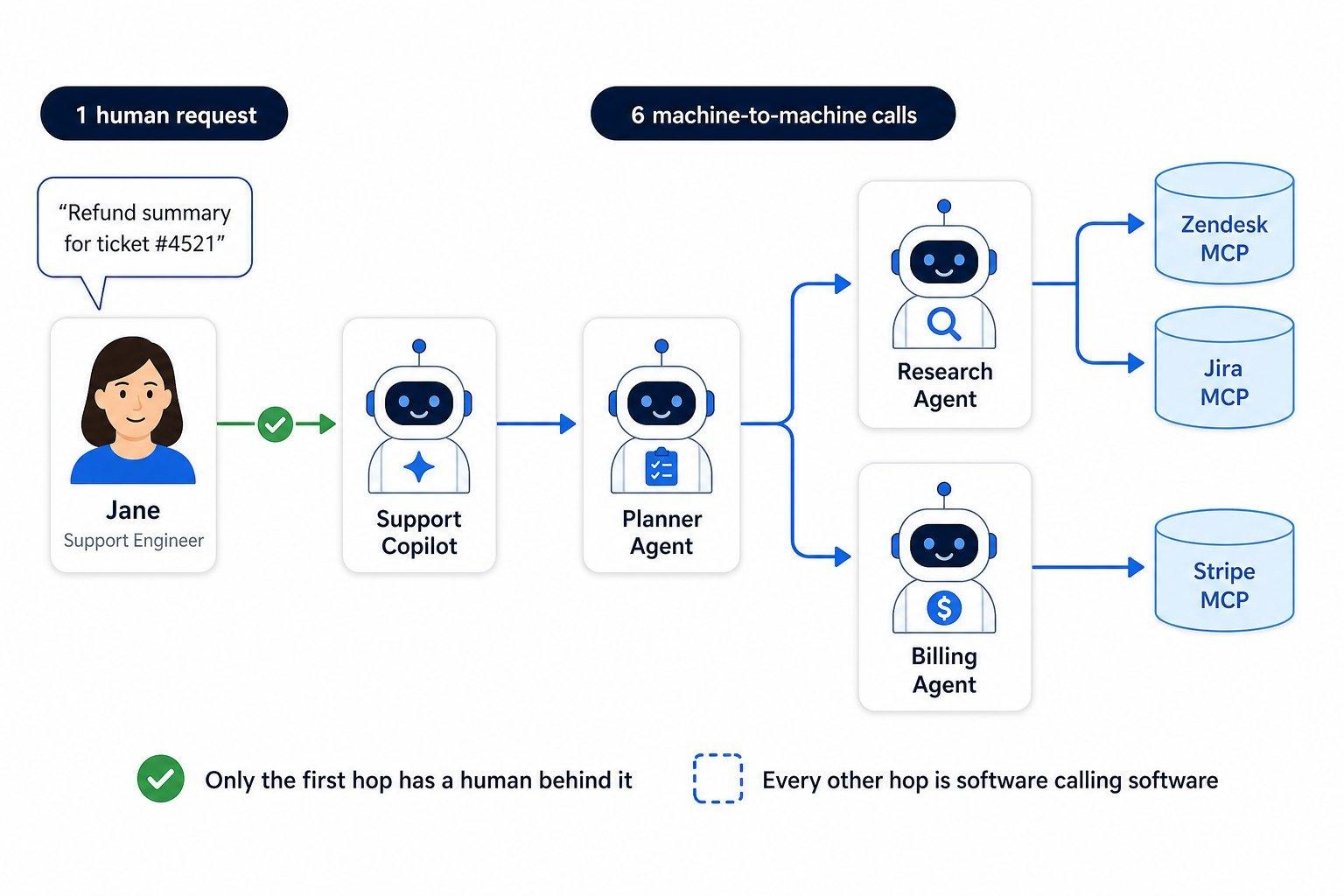
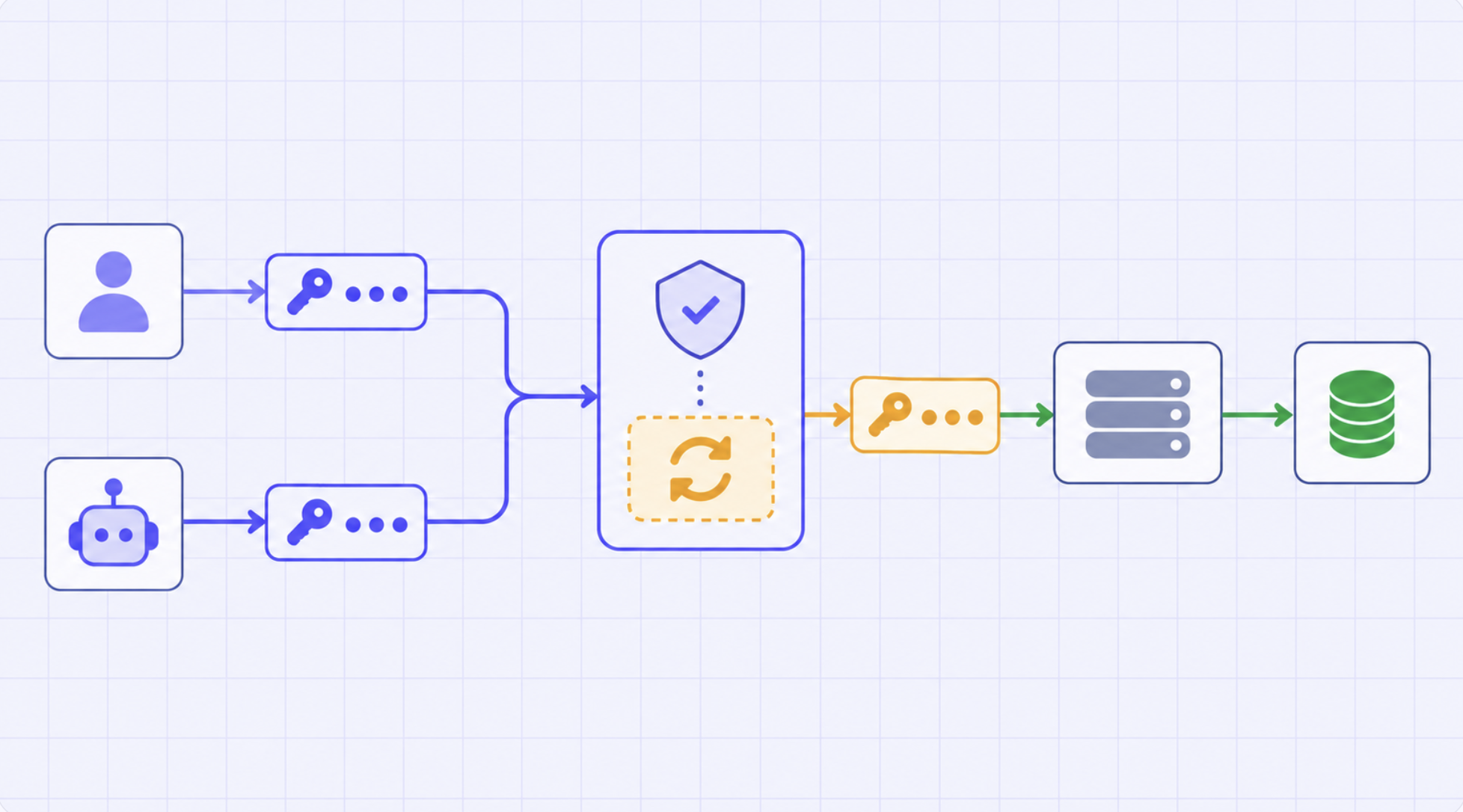
That chain — user → application → agent → sub-agent → MCP tool — is the agentic call path, and it is what agent governance has to control. Every enterprise access model rests on three assumptions: a user sits at the front of the request, the thing making the call is that user, and the scope is what the user consented to. By the third hop all three are false, so three questions stop having answers:
Answering all three at every hop, with evidence, is what agentic AI governance means — five systems, not a paragraph on responsible use.
Most teams reach for one of two shortcuts: let the agent forward the user’s token, or give it a shared service account. Both are wrong, because an agent is neither.
TrueFoundry AI Gateway ofrece una latencia de entre 3 y 4 ms, gestiona más de 350 RPS en una vCPU, se escala horizontalmente con facilidad y está listo para la producción, mientras que LitellM presenta una latencia alta, tiene dificultades para superar un RPS moderado, carece de escalado integrado y es ideal para cargas de trabajo ligeras o de prototipos.




The set of controls that make five questions answerable for every agent at any moment: what agents exist, who is accountable, what each can reach, on whose behalf it acts, and what it actually did. In practice: a registry, an identity per agent, least-privilege grants per target, delegation that carries the user across hops, and a per-hop audit trail with a kill switch.
A service account does what its configuration says and is reviewed on a schedule. An agent interprets an objective, picks its own tools and chains calls, so its behaviour drifts from its defined authority between reviews. Agent governance adds delegation rules, per-hop attribution of the actor chain, and continuous comparison of behaviour with declared scope.
Yes, if your agents cross platforms. Entra governs Entra agents, Okta governs Okta apps, Bedrock governs Bedrock agents, and none governs an agent that starts in one and calls into another. A registry plus a gateway gives one inventory and one enforcement point across all of them.
Yes. TrueFoundry runs in your VPC, on-prem, air-gapped, or hybrid, so prompts and responses never leave your domain even as you route across many providers.
Yes. It includes an MCP Gateway, an Agent Gateway, and an MCP & Agents Registry with tool-level access control. Agents on LangGraph, CrewAI, AutoGen, or a custom framework can all be governed centrally.
Sí. La pasarela es compatible con OpenTelemetry y se integra con Grafana, Datadog, Prometheus o tu pila preferida. Rastrea cada solicitud desde la instrucción (prompt) hasta la ejecución de la herramienta y el modelo, así obtienes un registro unificado sin tener que reemplazar lo que ya tienes en funcionamiento.



Las últimas noticias, artículos y recursos enviados a tu bandeja de entrada



.png)
.png)
.png)
.png)
.png)
.png)
.png)
.png)
.png)
.png)


