


.webp)
September 24, 2026
|
5 minutos de lectura


Obtenga acceso instantáneo a un entorno TrueFoundry en vivo. Implemente modelos, dirija el tráfico de LLM y explore la plataforma completa: su sandbox estará listo en segundos, sin necesidad de tarjeta de crédito.



Published: September 24, 2026
.webp)
¡Una forma increíblemente rápida de crear, rastrear e implementar sus modelos!
Enterprise teams compare Mint MCP and Vercel AI Gateway as AI adoption creates two distinct control problems. Agents need secure access to MCP tools and enterprise data. Applications also need reliable access to multiple AI models through one gateway.
Mint MCP focuses on MCP security and governed tool access. It helps teams manage agent identities, scoped permissions, MCP registries, audit trails, and guardrails around tool usage. Vercel AI Gateway focuses on hosted model access, provider routing, BYOK, observability, and developer velocity.
TrueFoundry adds a third lens through its AI Gateway. It connects governance across model calls, tools, agents, budgets, guardrails, and production observability via a single control plane.
The cleanest way to compare Mint MCP vs. Vercel AI Gateway is by traffic type. Mint MCP exists primarily for agent-to-tool access. It helps security teams decide which agents can use which MCP servers, under which identity, with what permissions.
The underlying Model Context Protocol standardizes how agents discover and invoke external tools. This context protocol creates a common connection model. Enterprises still need authentication, access control, credential handling, and policy enforcement around those connections.
The Mint request path makes that distinction clear. An AI agent or client authenticates with Mint before receiving approved tools. Mint checks the policy, injects the required credentials, records activity, and routes each tool call to the appropriate connector.
The MintMCP Gateway also supports hosted MCP infrastructure and role-based endpoints. Teams can expose selected tool definitions via Virtual MCPs rather than granting every client direct access. Administrators can approve new tools before users or agents receive them.
Vercel AI Gateway governs application-to-model traffic instead. Developers get a single endpoint across hundreds of models. Existing integrations can switch the base URL to Vercel with minimal code and keep familiar SDK patterns.
This resembles an API gateway for AI-specific traffic, although model routing adds different requirements. Vercel's gateway routes requests across supported providers using availability, latency, and configured preferences. Teams evaluating this distinction can also review TrueFoundry's LLM Gateway.
Both rows in the last line deserve a footnote. Mint does ship an LLM gateway, but its docs mark it as early access and describe it as routing model calls to Anthropic's API on the organization's behalf. Vercel does support tool calls where the selected model supports them, but the gateway has no concept of an MCP server, a tool allowlist, or an agent identity. The tradeoffs are real on both sides.
behalf. Vercel does support tool calls where the selected model supports them, but the gateway has no concept of an MCP server, a tool allowlist, or an agent identity. The tradeoffs are real on both sides.
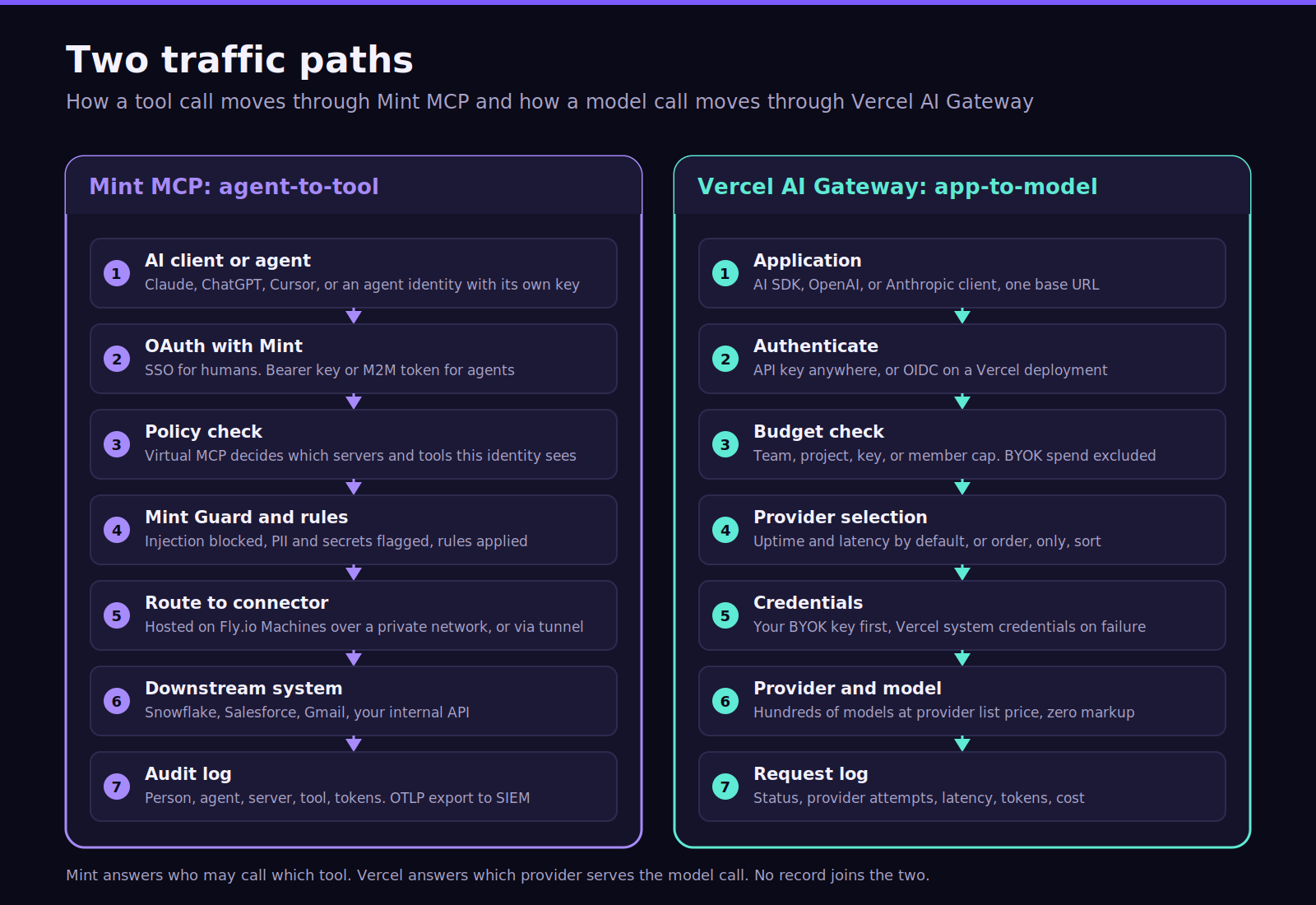
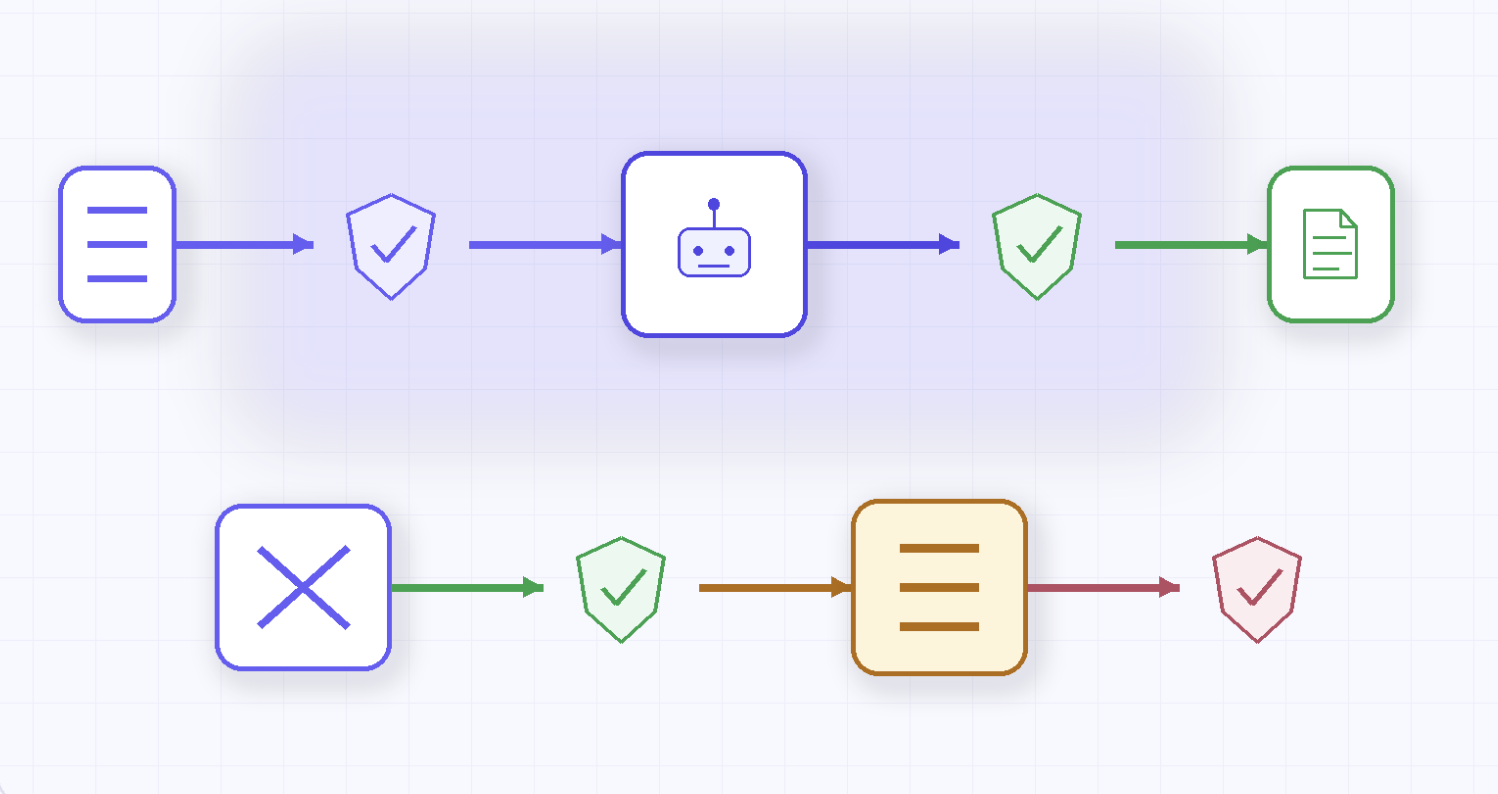
Alt Text: Mint MCP and Vercel AI Gateway traffic paths compared
Mint MCP is strongest when MCP access is the near-term security problem. It gives agents persistent identities, scopes tool permissions, and centralizes credential management. Teams can also create private registries for approved data sources, SaaS services, databases, and internal APIs.
The identity model gives each agent independent credentials and permissions. An agent can use its own key, machine token, or workload identity without borrowing a human credential. Administrators can revoke one agent without changing access for everyone else.
Virtual MCPs then curate available tools into role-based endpoints. A deployment agent receives deployment actions, while a support agent receives approved CRM actions. This model helps enterprises add external tools without exposing every capability available from each server.
Mint also supports rate limiting, custom policies, PII detection, secret scanning, and runtime guardrails. Mint Guard can block risky activity before tool execution, while Agent Monitor tracks MCP calls, commands, and file access in real time.
Agent Monitor also supports developer environments including Cursor and Claude Code. That visibility matters when agents interact with systems outside approved gateway paths. It gives security teams another way to identify unmanaged MCP usage.
Mint also positions the platform for regulated enterprise systems. It is SOC 2 Type II audited and offers HIPAA documentation with BAAs. US and EU residency options are available for organizations with defined compliance requirements.
Teams designing granular MCP permissions can also review TrueFoundry's MCP access control guide.
Choose Mint MCP when:
Vercel AI Gateway is strongest when product teams need fast multi-model access. It provides a hosted AI Gateway API, AI SDK support, BYOK, routing, budgets, and dashboard visibility. The platform now supports text, image, video, audio, and other modalities.
Its main advantage is fast integration. TypeScript applications can use Vercel's native SDK, while existing clients can continue using OpenAI Chat Completions. This unified interface reduces the need for code changes when applications move between supported model providers.
Vercel supports API keys for external environments and OIDC tokens for Vercel deployments. These short-lived tokens use OpenID Connect, avoiding the storage of gateway credentials in supported deployments. BYOK lets teams use existing provider credentials and commercial agreements.
If BYOK fails, Vercel can retry using its system credentials. This retry logic provides automatic failover, with fallback usage charged against Vercel credits. Teams should account for this behavior when designing spend controls.
The gateway also supports provider ordering and model filtering. An AI provider can be selected for cost, latency, availability, or organizational requirements. Vercel's AI gateway routes can also apply centralized routing rules without requiring application changes to be shipped.
For teams building AI applications, the broader Vercel ecosystem adds complementary capabilities. Vercel Sandbox can isolate generated code, while the AI SDK supports agent tooling and text-generation workflows. These capabilities remain separate from MCP gateway governance.
Teams should check current release notes before implementing provider or routing policies. Vercel continues expanding the gateway quickly, including routing rules, provider controls, budgets, and coding-agent integrations.
Choose Vercel AI Gateway when:
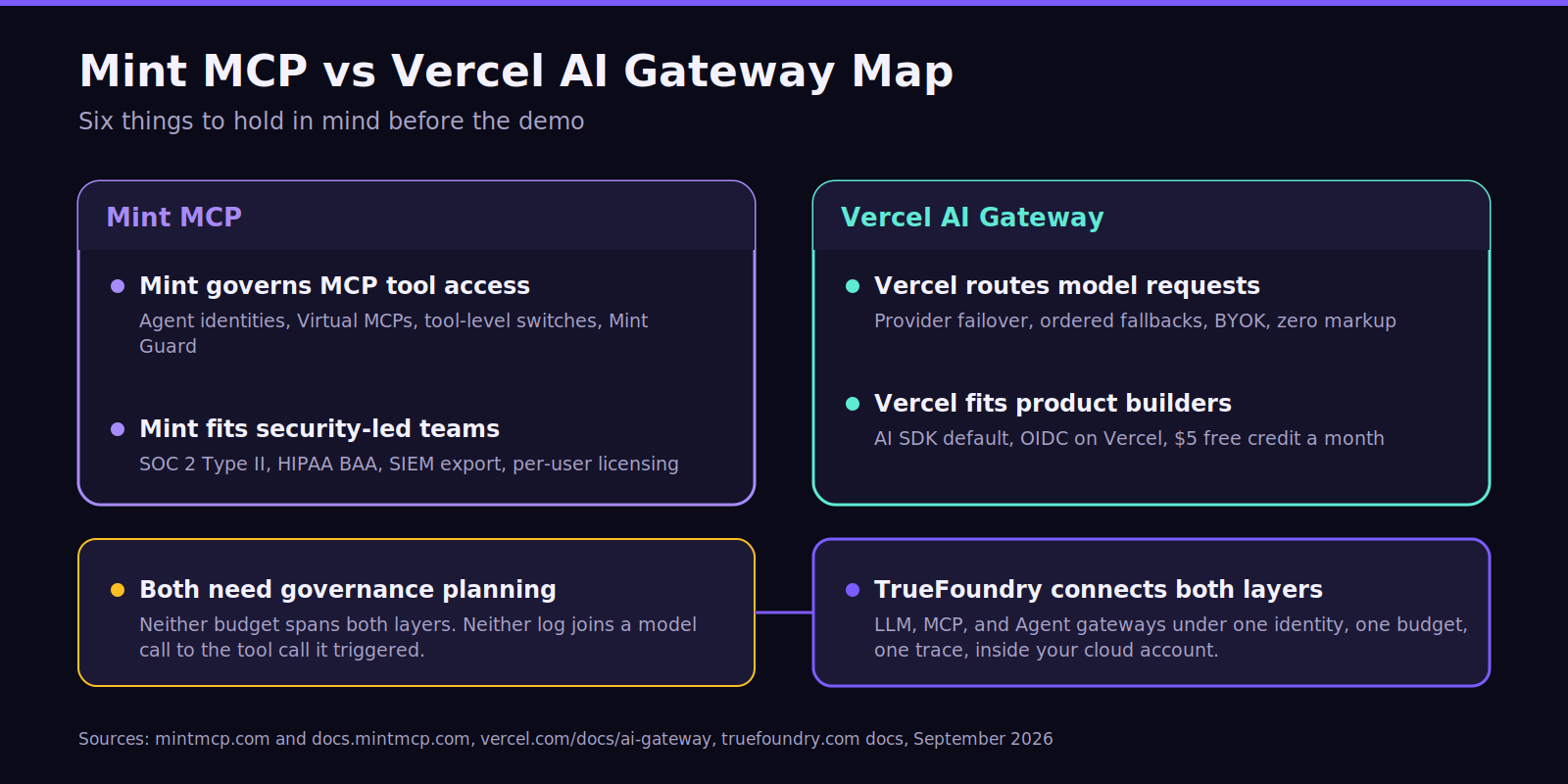
Alt Text: Mint MCP vs. Vercel AI Gateway map with TrueFoundry
Security is where Vercel AI Gateway vs Mint MCP becomes clearer. Mint focuses on agent governance, tool permissions, scoped credentials, SSO, RBAC, and MCP scanning. It is more relevant when agents can change or retrieve data through connected tools.
Mint's policy model controls which MCP servers and tools each identity can access. Administrators can disable destructive operations without removing an entire server. Custom rules can also inspect content and metadata before permitting actions.
Vercel focuses on secure model access. Teams can govern approved providers, budgets, authentication methods, and request visibility. Provider allowlists can apply across a team without application-side changes, while Zero Data Retention policies address selected data retention requirements.
Vercel budgets apply at team, project, key, or user scope. BYOK spend follows different accounting because successful requests use the team's external provider account. This distinction matters when token usage needs centralized financial enforcement.
Neither model should be confused with traditional API management. Agent governance must understand tools, identities, and actions, while model governance must understand models, tokens, provider selection, and budgets.
Requirement
Mint MCP
Vercel AI Gateway
TrueFoundry Angle
Agent identity
Strong MCP focus
Not primary focus
Identity-aware
MCP permissions
Stronger fit
Needs another layer
Native MCP Gateway
Model routing
Limited compared to Vercel
Strong hosted fit
Unified LLM Gateway
Usage visibility
MCP activity focus
Model usage focus
Team and workflow budgets
Agent workflow limits
Needs another layer
Needs another layer
Agent Gateway controls
Audit evidence
MCP-level trails
Gateway request visibility
Unified audit records
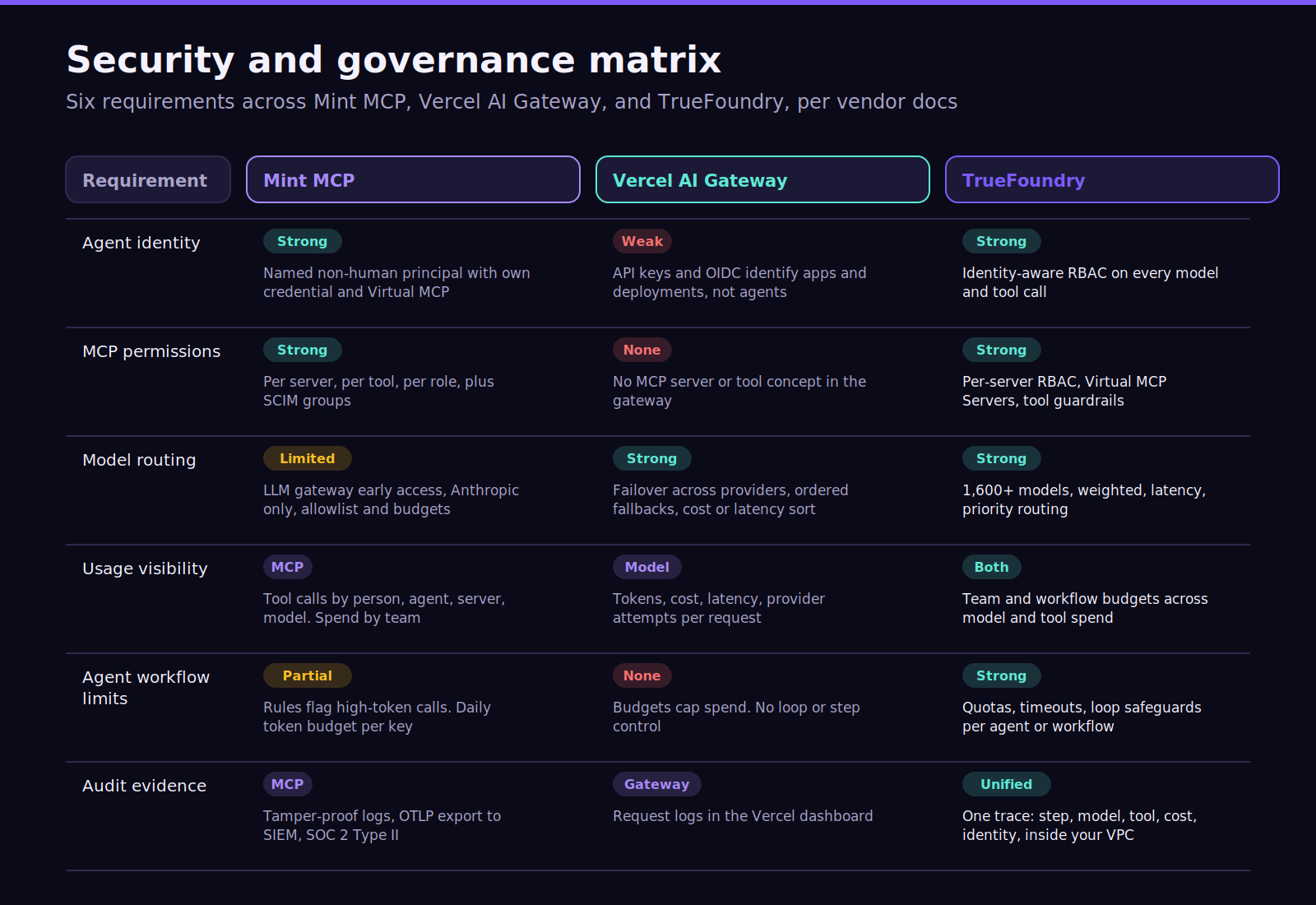
Alt Text: Mint MCP Vercel AI and TrueFoundry governance matrix
Buyers should compare total ownership costs because both vendors charge different amounts. Mint uses custom pricing based on team requirements. Its pricing page references active AI-agent users, platform usage, flexible deployments, enterprise SLAs, and self-hosting options.
Vercel AI Gateway uses prepaid credits with no token markup. Free accounts receive $5 in recurring credits, while paid usage follows provider pricing. The gateway also supports BYOK for organizations that want to use existing provider contracts or their own keys.
Vercel's rate limits differ between account and service conditions, while budgets cap spending across supported scopes. Enterprise invoicing is available, and Vercel states that invoicing avoids payment processing fees.
Deployment remains an important difference. Mint offers managed cloud deployments alongside self-hosted options by arrangement. Vercel provides a managed gateway, with requests processed through the hosted service rather than a self-hosted gateway deployment.
That distinction matters when organizations require full control over prompts, logs, and infrastructure boundaries. Teams should include security review, engineering ownership, and integration effort within the final cost model.
TrueFoundry's AI gateway cost planning explains how model costs, infrastructure, routing, and governance affect total ownership.
Mint MCP vs. Vercel AI Gateway covers two important production layers. Mint governs agent-to-tool access, while Vercel manages application-to-model connectivity. Enterprise workflows often span both layers in a single user request.
A support agent may call an AI model, retrieve customer information through MCP, update a case, and trigger another action. Those steps require a single identity, budget, policy context, and audit record across the full workflow.
Separate systems can leave model requests and tool activity in different logs. This becomes harder as agents gain autonomy and execute multiple actions. A broader governance layer must connect decisions across models and tool boundaries.
Common gaps to evaluate:
These gaps become more important as MCP capabilities expand beyond read-only operations. An agent that can update production systems needs stronger workflow controls than a model answering a question. The Agent Gateway becomes relevant when workflow policies must cover retries, timeouts, quotas, and repeated actions across multiple agents.
CRO Banner:
Title: Move Beyond Hosted Access to Governed Agentic AI Execution
Subtext: Get started with TrueFoundry to govern tools, models, agents, budgets, and audit evidence centrally securely
CTA: Get Started
Alt Text: TrueFoundry governs agentic AI beyond hosted access
Link: https://www.truefoundry.com/book-demo?ref=mint_mcp_vs_vercel_ai_gateway
TrueFoundry fits when enterprises need the model and MCP layers governed together. Its architecture connects provider access, tool permissions, budgets, guardrails, observability, and workflow controls without pushing policy into every application.
The LLM Gateway centralizes provider connectivity, fallback, cost visibility, and intelligent routing. It can apply policies across commercial or self-hosted providers before requests execute.
TrueFoundry's MCP layer combines approved servers through Virtual MCP Servers. Teams can expose selected tools via a single endpoint without deploying an additional server. This gives applications stable access while platform teams control which tools remain visible.
The platform also supports declarative budgets and rate limiting rules. Policies can apply by user, team, model, virtual account, or metadata. Teams can review these YAML changes through pull requests before production deployment:
name: budget-limiting-config
type: gateway-budget-config
rules:
- id: 'support-agents-monthly'
when:
subjects: ['team:support-automation']
metadata:
environment: 'production'
limit_to: 6000
unit: cost_per_month
budget_applies_per: ['user']
alerts:
thresholds: [75, 90, 100]
notification_target:
- type: slack-bot
notification_channel: 'budget-alerts-channel'
channels: ['#ai-spend']
When a support automation user crosses $6,000 for the month, the gateway returns a 429 with `error_origin_level: rate_limit_budget` in the body and the violated rule ID in the `x-tfy-applied-rules` header. Audit mode tracks the same rule without blocking.
The MCP Gateway governs tool access and observability through a central registry, per-server RBAC, OAuth 2.0 token management with automatic refresh, and Virtual MCP Servers that expose a curated subset of tools from multiple registered servers as a single endpoint.
Guardrails attach to tool calls in the same policy file that governs model calls, so one identity and one rule engine sit under both:
name: guardrails-control
type: gateway-guardrails-config
rules:
- id: crm-tools-pii
when:
target:
operator: or
conditions:
mcpServers:
values:
- salesforce-mcp
condition: in
subjects:
operator: and
conditions:
in:
- team:support-automation
llm_input_guardrails: []
llm_output_guardrails: []
mcp_tool_pre_invoke_guardrails:
- pii/pii-detection
mcp_tool_post_invoke_guardrails: []
The Agent Gateway adds workflow limits, circuit breakers, and traceable execution: token- or cost-based quotas per agent, workflow, or environment, timeouts, and loop safeguards for stalled runs, and one trace that shows the step, the model call, the tool call, and the cost.
All three run inside the customer's own AWS, GCP, or Azure account, on-prem, or air-gapped on the Enterprise plan.
Choose TrueFoundry when:
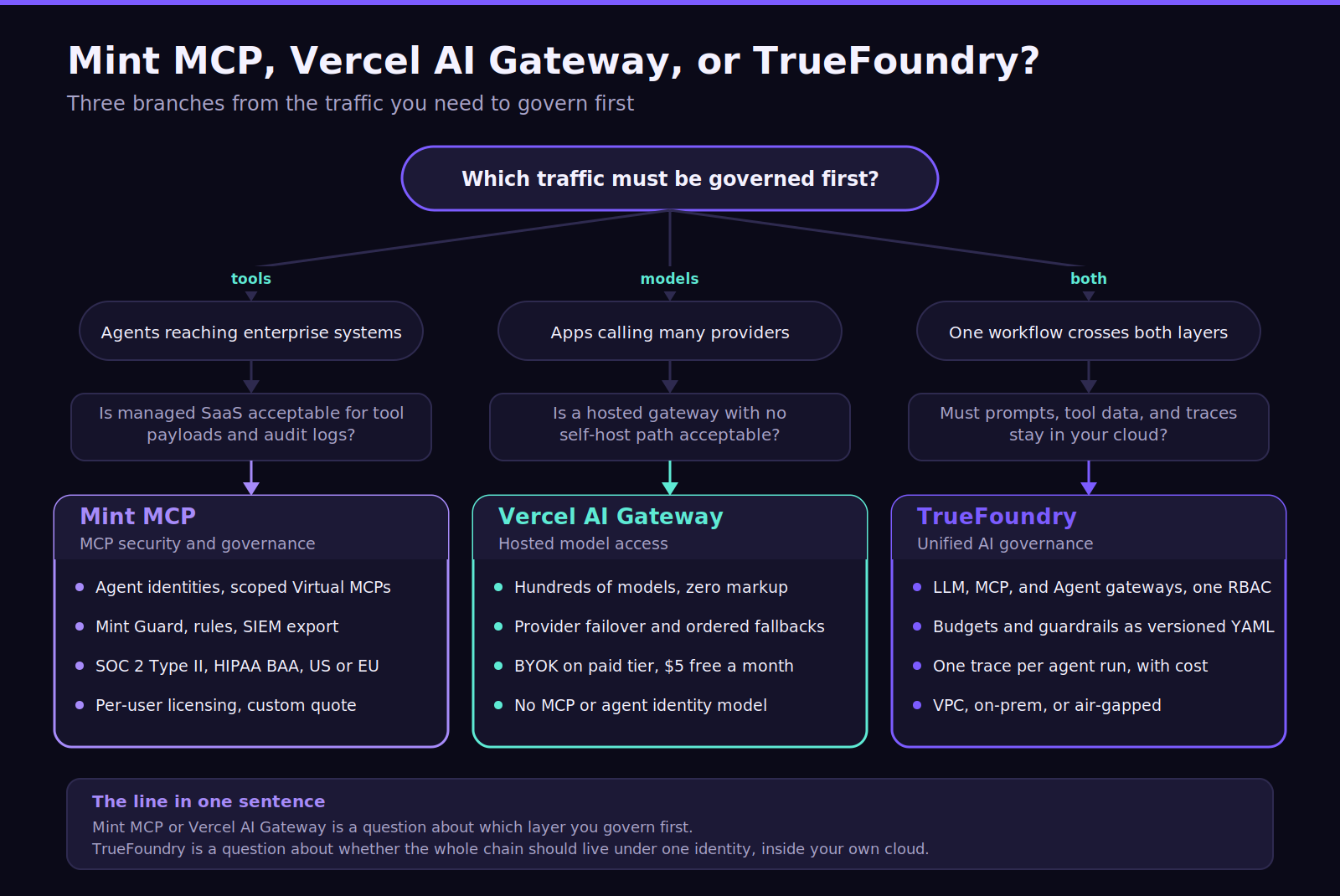
Alt Text: Decision flow for Mint MCP, Vercel AI, and TrueFoundry
Choose Mint MCP when the immediate requirement is governed agent access to enterprise tools. Its strengths include agent identities, role-based access to tools, MCP registries, security scanning, managed connectors, and auditability.
Choose Vercel AI Gateway when hosted multi-model access drives the decision. It gives developers a unified interface, provider routing, BYOK, budgets, and strong visibility with relatively few integration changes.
Choose TrueFoundry when model and tool governance must operate through one enterprise control layer. This becomes more valuable as AI workloads move from simple model access toward autonomous workflows.
The Mint MCP or Vercel AI Gateway decision should therefore start with the traffic requiring control. Tool governance and model routing solve different problems, although modern agent systems increasingly require both.
For teams comparing Vercel AI Gateway or Mint MCP, future workflow complexity should also guide the decision. Model access can eventually expand into tools, actions, and autonomous agents.
TrueFoundry helps enterprises connect governance across models, MCP tools, agents, budgets, and production environments. Book a free demo today to get started.
TrueFoundry AI Gateway ofrece una latencia de entre 3 y 4 ms, gestiona más de 350 RPS en una vCPU, se escala horizontalmente con facilidad y está listo para la producción, mientras que LitellM presenta una latencia alta, tiene dificultades para superar un RPS moderado, carece de escalado integrado y es ideal para cargas de trabajo ligeras o de prototipos.





Las últimas noticias, artículos y recursos enviados a tu bandeja de entrada
.webp)
.png)
.png)
.png)
.png)
.png)
.png)
.png)
.png)
.png)
.png)


