October 30, 2026
|
5 minutos de lectura


Obtenga acceso instantáneo a un entorno TrueFoundry en vivo. Implemente modelos, dirija el tráfico de LLM y explore la plataforma completa: su sandbox estará listo en segundos, sin necesidad de tarjeta de crédito.



¡Una forma increíblemente rápida de crear, rastrear e implementar sus modelos!
For early enterprise AI, human oversight meant reading output before someone acted. A model drafted an answer, a person checked it, and the process stopped there. Artificial intelligence agents can update a CRM record or trigger a downstream workflow. They can also act several times within a single task.
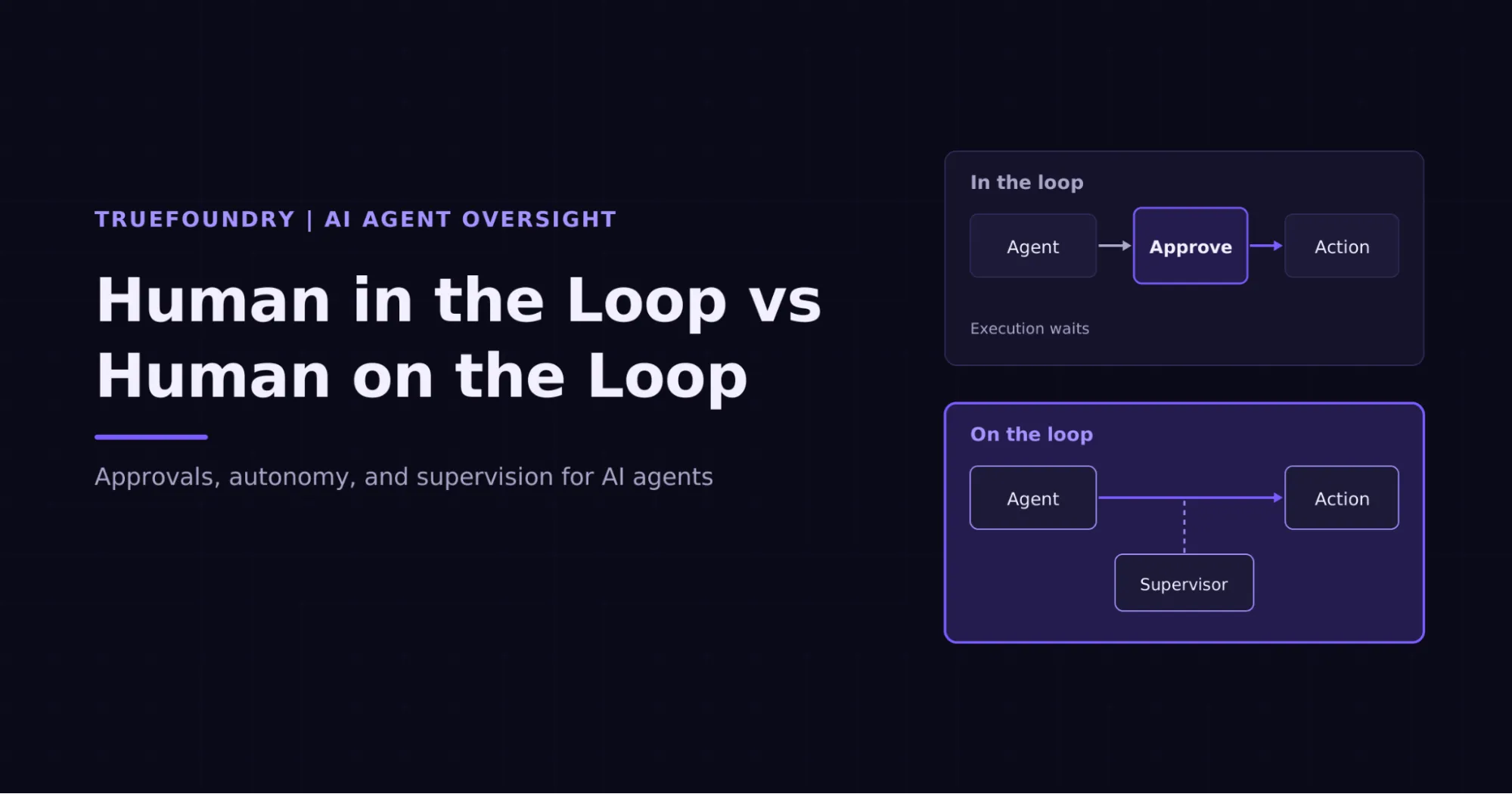
When software can act, teams must decide where human judgment enters execution. Reviewing AI output after execution is too late for a refund to be issued. It also arrives too late after deleted data or changed records. Human on the loop vs human in the loop therefore becomes an execution design decision.
Human-in-the-loop pauses selected actions until someone approves them. Human-in-the-loop allows bounded actions to continue under supervision. Most organizations need both across the entire AI lifecycle. The right balance follows responsible AI practices and depends on action-level risk.
The main difference lies in the timing within the execution workflow. Human-in-the-loop places a person before high-impact actions. Human-in-the-loop adds supervision during execution. Human on the loop vs. human in the loop remains action-specific.
HITL systems can fail slowly through queues and rubber-stamping. HOTL can fail quickly without a working stop control. A risk management framework should define clear guidelines and assign the right people to each path.
NIST treats human roles as a spectrum from autonomous systems to fully manual decisions. Its framework says responsibilities should be clearly defined and differentiated. That makes human in the loop vs. human on the loop a design choice.
EU rules for high-risk AI also require effective human supervision. Article 14 requires people to monitor, override, or interrupt relevant systems. Annex III high-risk requirements apply from December 2027 under current rules. These regulatory requirements make direct human control important for regulated deployments.
Timing becomes clearest inside the execution path itself. Under HITL, a consequential action reaches an approval checkpoint before execution. The reviewer receives context to approve, reject, or modify the request. Execution resumes only after the required human review records a decision.
HOTL removes that checkpoint for actions already trusted within set limits. People monitor real time activity through alerts, traces, and thresholds. They keep stop controls available while the workflow continues. This difference therefore appears directly in workflow state.
The two modes can sit at different layers of one request. An LLM Gateway may govern large language models under HOTL rules. The checkpoint can appear later when an AI agent invokes a sensitive tool. A model call can plan a refund, while tool execution needs approval.
A held tool call should return a pending state instead of failure. The agent must treat that result as a required step. Ignoring the status can cause retries or duplicate attempts. This design pattern keeps a pending request separate from success and failure states:
result = await session.call_tool(

    "issue_refund", {"order_id": "A-1042", "amount": 950}

)

status = (result.meta or {}).get("approval_status")

if status == "pending":

    # The refund has not run. Tell the user and stop calling the tool.

    return "Your refund is waiting for approval from the billing team."
The session is an MCP client connected through the gateway. The status check protects business workflows from premature execution. It also protects operational data from a disconnected manual process that treats pending work as success.
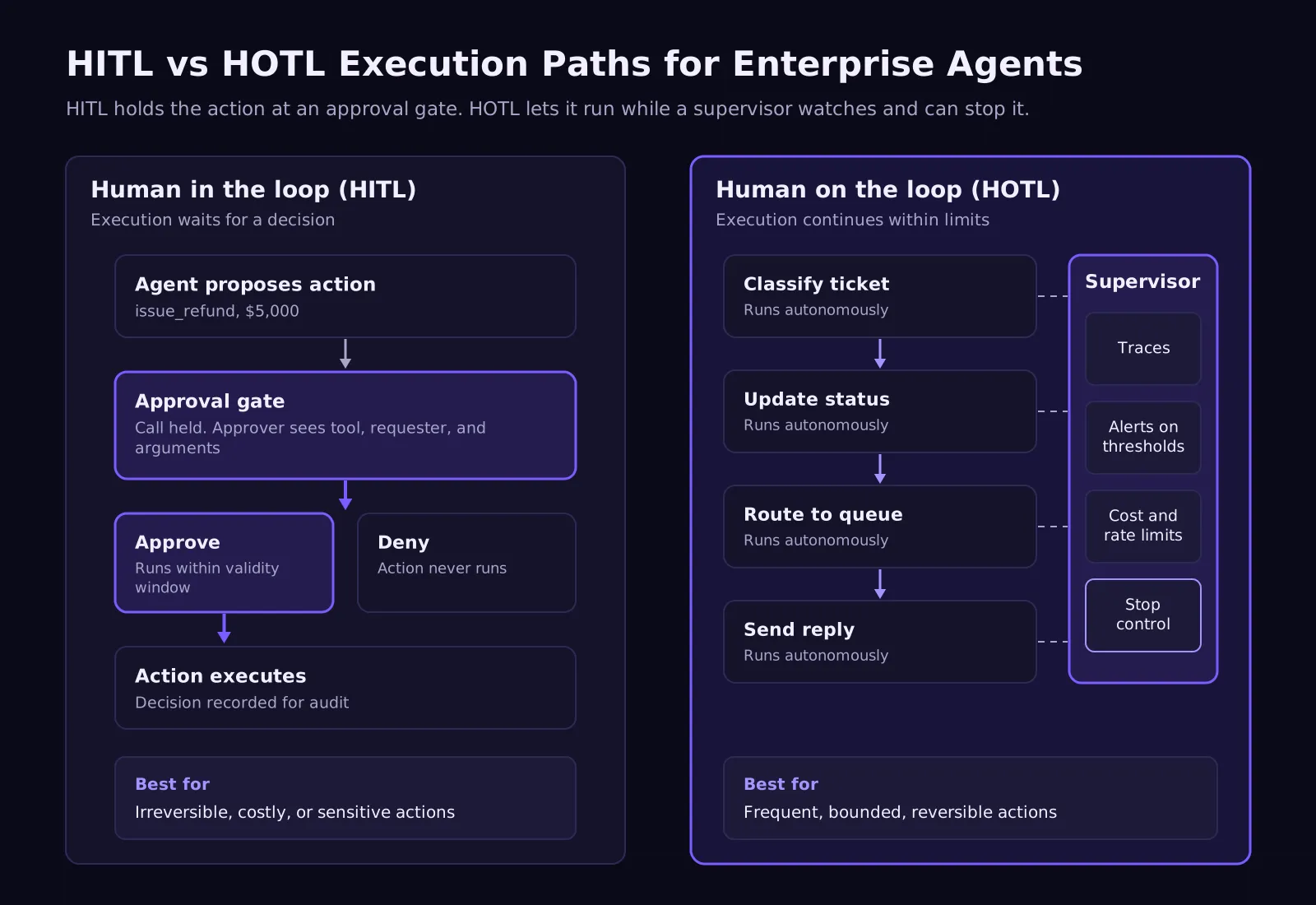
HITL fits when incorrect actions are expensive, sensitive, or difficult to reverse. Financial services teams may use it for large transfers and unusual account changes. Healthcare professionals may need it for sensitive decisions involving protected data. Other use cases include destructive changes, contractual commitments, and intelligent document approval before external submission.
Reviewers need sufficient context for meaningful human involvement. A message stating that an agent wants to update a customer's email provides limited context. A stronger screen shows existing value, proposed value, requester, reason, and impact. That context reduces inconsistent decisions and makes human feedback more useful.
AWS recommends pausing high-risk operations before execution and giving reviewers sufficient context. Its guidance also recommends timestamps, reviewer identities, timeouts, and escalation routes. These controls create audit evidence and prevent delays.
TrueFoundry follows the same principle through its MCP tool approval model. A tool call remains pending until an authorized approver records a decision. The request can show the tool, requester, and proposed arguments before execution. Here, human on the loop vs human in the loop becomes a concrete policy choice
HOTL fits frequent, bounded, observable, and reasonably reversible work. Ticket classification and content routing can become too slow with constant approvals. The supervisor intervenes when activity crosses a defined threshold. This gives the system autonomy without removing safeguards.
Effective HOTL depends on several connected operational controls:
Without these controls, supervisors may have much real control only on paper. The most effective ways preserve oversight through alerts and executable controls. That creates a better fit for high-volume work.
An Agent Gateway becomes useful when supervision spans workflow steps. Model-level rules evaluate one request at a time. Runtime controls can follow retries, tools, budgets, timeouts, and outcomes. Human on the loop vs human in the loop analysis changes as workflows become more autonomous
Yes, human-in-the-loop and human-on-the-loop usually work best within a single workflow. Each mode applies to actions that suit its risk profile. A mature HITL approach does not force approval onto every step. It reserves attention for critical points where people create the most value.
A support agent may retrieve account details, classify issues, and prepare an email draft under supervision. The same workflow can pause before a large refund or contractual change. The customer experience stays fast during routine work. Human agents retain authority over the higher-risk action.
Teams can use natural-language feedback to improve subsequent policies. Repeated corrections strengthen evaluation data and model accuracy. This creates a loop between review outcomes and continuous evaluation. Generative AI systems benefit when useful review signals improve future decisions.
Make the decision per action rather than per agent. One workflow can expose tools with different risks. Treating every tool equally slows safe work or exposes dangerous actions. Human-on-the-loop vs human-in-the-loop should be evaluated based on reversibility, impact, sensitivity, frequency, detection speed, and intervention capability.
A support policy makes these differences concrete in practice. Read-only search can run under supervision with tracing. Reversible status updates may use alerts and rate limits. A large refund may require HITL to exceed a threshold. Customer deletion should stay approval-gated during every sensitive execution.
Per-action policy also answers much control a business needs. Reviewing everything creates fatigue, while approving nothing creates unnecessary exposure. Human-on-the-loop or human-in-the-loop should remain an action-level choice. This gives AI governance teams a clearer operating model.
A person inside the workflow does not automatically make either approach safe. HITL can create long queues and rubber-stamping when low-risk work receives equal scrutiny. Weak context leads to slower, less reliable decisions. Systems generating content may also need review when policies flag hate speech.
HOTL carries the opposite risk because supervisors may lack effective stop controls. People can identify problems and still fail to contain them quickly. Mature systems need revocation, rollback, alerts, and response routes connected to live execution. Otherwise, supervision records incidents instead of preventing them.
Both modes can fail when grants outlive their purpose. Permissions should stay scoped to one requester, tool, and validity window. This keeps risk management aligned with current needs.
Teams should not treat an AI model score as automatic proof of safety. A deeper look should include policy context, impact, historical overrides, and outcomes. The important question is whether supervision protects each action.
Expand autonomy in stages, using production evidence rather than model confidence alone. The human-on-the-loop vs. human-in-the-loop setting should change only after observed behavior supports it. Teams should track approvals, overrides, incidents, and outcomes before reducing supervision.
A practical progression has four clear stages for teams:
Promote an action only when evidence supports the change. Repeated unchanged approvals can support more supervised autonomy. Frequent modifications show that the workflow still needs stricter controls. Treat human in the loop and human on the loop as settings that evolve per tool.
High-risk actions do not need to graduate at all. Some can remain HITL while other work runs under HOTL. In the HOTL VS HITL debate, this permanent split can be a strong end state. It preserves safety while retaining useful workflow automation.
Teams may compare internal evidence with Databricks research or a relevant case study. External findings play an important role, while different decisions still need organization-specific evidence.
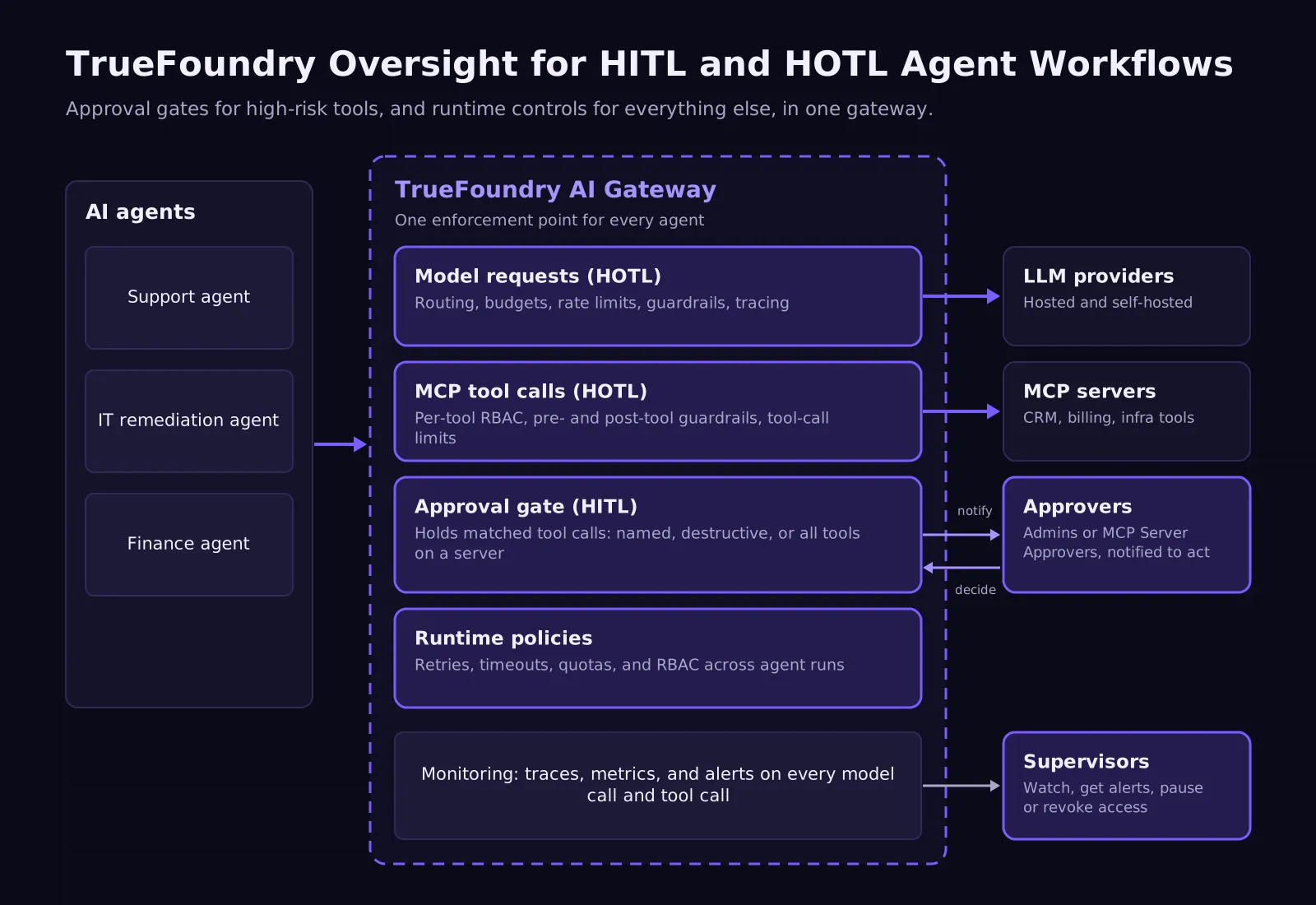
TrueFoundry moves approval logic from application code into shared infrastructure. For HITL, the MCP Gateway can hold matched tool calls before execution. It can then route those requests to authorized approvers under a shared policy. This gives teams consistent enforcement across business systems.
Policies can target specific tools or server scopes. Designated approvers can allow or deny each requested execution with a reason. Validity can cover one execution or a defined time window. This approach adds structure without forcing each application to rebuild approval workflows.
For HOTL, the AI Gateway centralizes identity, guardrails, budgets, rate limits, observability, and policies. The Agent Gateway adds workflow-level controls and step-level tracing. The LLM Gateway can manage model access separately from tool review. Together, these layers support human-on-the-loop vs. human-in-the-loop governance.
TrueFoundry also supports responsible AI practices through MCP access control and agent governance. Agent observability connects model calls, tools, costs, and outcomes into complete traces. These controls help teams replace fragmented approval logic with consistent enterprise AI controls.
If you want to see approval gates and runtime controls working on your own agents, book a demo with the TrueFoundry team.
TrueFoundry AI Gateway ofrece una latencia de entre 3 y 4 ms, gestiona más de 350 RPS en una vCPU, se escala horizontalmente con facilidad y está listo para la producción, mientras que LitellM presenta una latencia alta, tiene dificultades para superar un RPS moderado, carece de escalado integrado y es ideal para cargas de trabajo ligeras o de prototipos.



Las últimas noticias, artículos y recursos enviados a tu bandeja de entrada