


September 19, 2026
|
5 minutos de lectura


Obtenga acceso instantáneo a un entorno TrueFoundry en vivo. Implemente modelos, dirija el tráfico de LLM y explore la plataforma completa: su sandbox estará listo en segundos, sin necesidad de tarjeta de crédito.



Published: September 11, 2026
.webp)
¡Una forma increíblemente rápida de crear, rastrear e implementar sus modelos!
LiteLLM es el proxy LLM de código abierto más utilizado. Resuelve un problema real de forma elegante: se obtiene una API unificada compatible con OpenAI que enruta a través de docenas de proveedores, y la versión comunitaria no tiene costo de ejecución. La lógica de enrutamiento es sólida. La experiencia del desarrollador es buena. Para los equipos que solo necesitan un proxy ligero y tienen la capacidad de DevOps para ejecutarlo, funciona.
La conversación cambia cuando los equipos alcanzan los límites de la versión de código abierto autogestionada y comienzan a evaluar LiteLLM Enterprise. Las referencias públicas y las discusiones con proveedores suelen citar un nivel Básico de alrededor de $250/mes y un nivel Premium cercano a los $30,000/año, pero LiteLLM no publica precios estandarizados y los costos finales suelen negociarse directamente con el proveedor. Estas cifras reflejan estimaciones referenciadas públicamente, pero los precios de LiteLLM no están completamente estandarizados y deben verificarse directamente con el proveedor. LiteLLM Enterprise es un producto autoalojado. Usted aprovisiona la infraestructura, gestiona la base de datos PostgreSQL y la caché de Redis, se encarga de las actualizaciones y los parches de seguridad, y es responsable de la rotación de guardia cuando el proxy se cae a las 2 de la madrugada. Nada de eso aparece en la página de precios.
Esto no es una comparación de listas de características. Es un análisis honesto del costo total de propiedad que cubre los precios de LiteLLM Enterprise, los costos de infraestructura, los gastos generales de mantenimiento de ingeniería, la brecha de gobernanza de MCP y cómo se compara TrueFoundry antes de que se comprometa con un proveedor.
LiteLLM Enterprise es la capa comercial construida sobre el proxy de código abierto. Añade características de gobernanza que no están disponibles en la versión comunitaria: integración SSO/SAML, RBAC granular para acceso a modelos, métricas de Prometheus, devoluciones de llamada personalizadas, barreras de seguridad LLM para filtrado de contenido, autorización JWT y soporte prioritario.
Dos niveles se dirigen a diferentes perfiles organizacionales. Verifique los detalles actuales en litellm.ai/enterprise antes de tomar decisiones de compra.
Los compradores empresariales que comparan opciones de pasarelas de IA a menudo comienzan con la tarifa de licencia y se detienen ahí. El panorama real de costos de LiteLLM Enterprise solo se aclara después de la implementación, cuando llega la factura de infraestructura y la primera rotación de ingeniería aparece en el calendario. Hay tres categorías de costos que superan consistentemente la tarifa de licencia en un horizonte de dos a tres años.
Las cifras a continuación se basan en implementaciones empresariales representativas y puntos de referencia internos en lugar de precios estandarizados del proveedor, y deben tratarse como estimaciones orientativas en lugar de costos fijos.
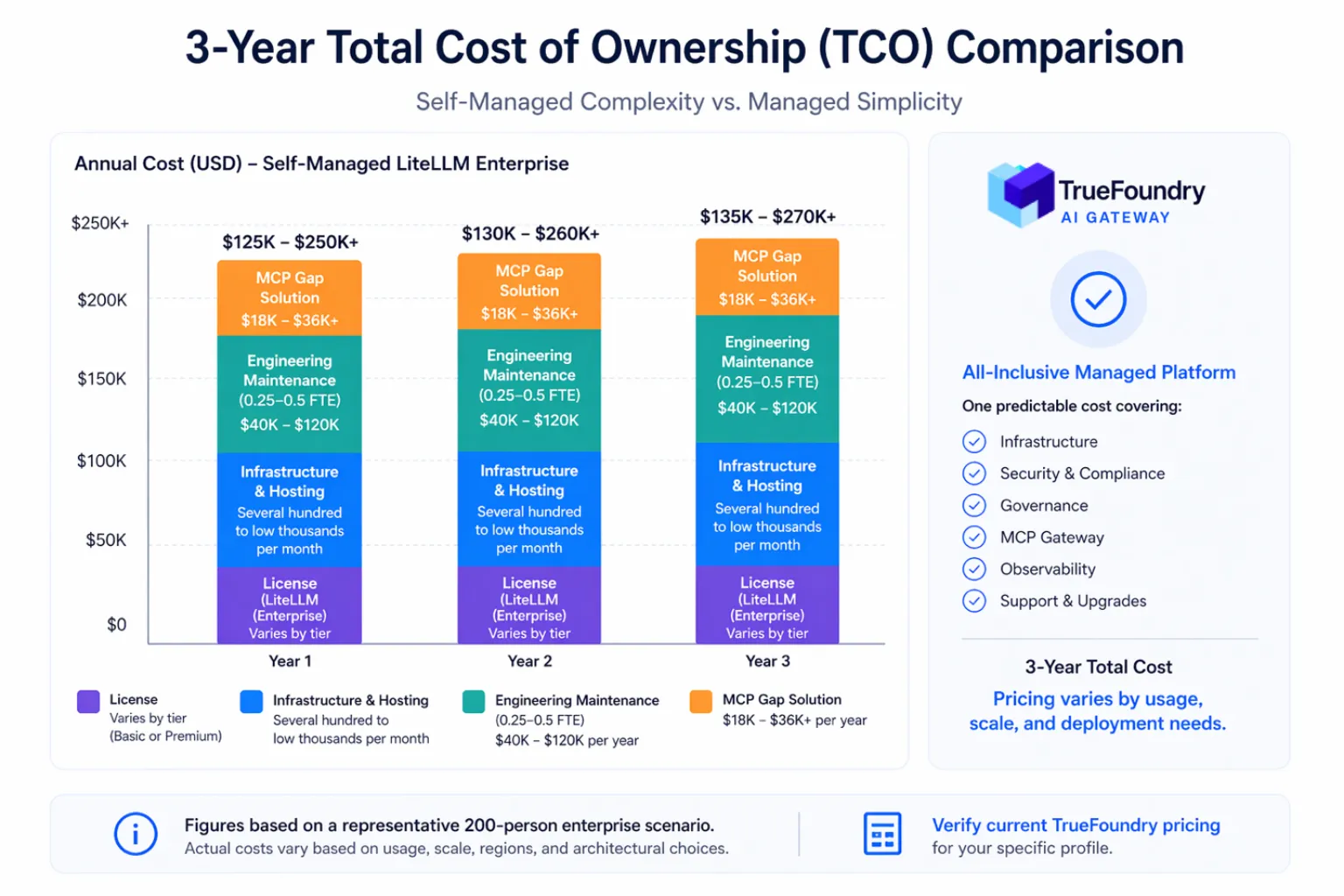
LiteLLM Enterprise normalmente se ejecuta en una pila de cómputo dedicada: un servidor o clúster proxy, a menudo junto con una base de datos PostgreSQL para configuración y registro de auditoría, y una instancia de Redis para almacenamiento en caché y contadores de límite de velocidad. En AWS o Azure, una implementación de alta disponibilidad de grado de producción para un tráfico LLM significativo suele oscilar entre varios cientos y pocos miles de dólares al mes en costos de infraestructura en la nube, aparte de la tarifa de licencia.
Los equipos que necesitan un 99,9% de tiempo de actividad para su pasarela LLM, lo cual es un requisito razonable cuando la pasarela se encuentra en la ruta crítica de las características de IA de producción, requieren redundancia multirregión y replicación de bases de datos que elevan los costos mensuales de infraestructura hacia el extremo superior. Estos costos también aumentan. Los cambios en los precios de los proveedores de la nube, las tarifas de transferencia de datos y los gastos generales de gestión de registros añaden del 10 al 15 por ciento anualmente a una proyección de infraestructura realista a 3 años.
La infraestructura autoalojada requiere una atención continua de ingeniería que no se refleja en los precios del proveedor, pero sí en la planificación de personal. Las actividades incluyen aplicar parches de seguridad, gestionar las actualizaciones de versión (LiteLLM lanza versiones con frecuencia, y las actualizaciones ocasionalmente requieren cambios de configuración), gestionar las interrupciones de la pasarela y gestionar las configuraciones a medida que la organización añade nuevos modelos o equipos.
Las empresas que migran de LiteLLM autogestionado a plataformas gestionadas a menudo subestiman la sobrecarga de ingeniería continua necesaria para mantener el sistema. En la práctica, las organizaciones suelen asignar aproximadamente entre 0.25 y 0.5 de capacidad de ingeniería equivalente a tiempo completo (FTE) para soportar las operaciones de LiteLLM, incluyendo el mantenimiento, la escalabilidad y el trabajo de fiabilidad. Basándose en un costo total de un ingeniero sénior de $250,000 al año, la asignación de 0.25 a 0.5 FTE se traduce en un estimado de $62,500 a $125,000 al año en esfuerzo de ingeniería dedicado puramente a la gestión de infraestructura, a menudo más que la tarifa de licencia. Y esto crece de forma no lineal: una organización que comienza con cinco equipos en LiteLLM y crece a cincuenta descubrirá que la complejidad de la configuración y la carga de mantenimiento se multiplican más rápido que el número de equipos.
Según la documentación actual y la disponibilidad de funciones, LiteLLM no proporciona una pasarela MCP nativa. Las organizaciones que implementan sistemas de IA agéntica donde los agentes invocan herramientas a través del Protocolo de Contexto del Modelo (MCP) necesitan una solución separada para gobernar el acceso al servidor MCP. Esto significa una segunda evaluación de proveedores, una segunda revisión de seguridad, un segundo proceso de adquisición y un proyecto de integración separado para que dos sistemas de gobernanza produzcan una pista de auditoría unificada y apliquen políticas de identidad consistentes.
Gartner proyecta que el 70% de los equipos de ingeniería de software que construyen aplicaciones multimodales utilizarán pasarelas de IA, incluyendo el acceso a herramientas agénticas, para 2028. Las organizaciones que eligen LiteLLM para el enrutamiento de LLM hoy están eligiendo una plataforma que necesitará complementos a medida que crezca su huella de IA agéntica. El costo de integración de conectar dos sistemas de gobernanza separados es real y se subestima constantemente en las decisiones de adquisición iniciales. El costo anual de una segunda herramienta, más la sobrecarga de ingeniería continua de mantener la integración, añade un costo anual adicional significativo dependiendo de la elección del proveedor, la complejidad de la integración y los requisitos de cumplimiento.
A continuación se utiliza un escenario empresarial representativo: una organización de ingeniería de 200 personas que enruta aproximadamente 500 millones de tokens al mes a través de la pasarela, operando en dos proveedores de la nube, con 20 equipos en la plataforma y requisitos de cumplimiento que exigen un registro de auditoría estructurado. Ajuste los números a su perfil real.
LiteLLM Enterprise Premium: Desglose de costos del año 1
La comparación de costos totales a menudo invierte lo que sugiere la comparación solo de licencias. Las organizaciones que tienen en cuenta el mantenimiento de ingeniería y la gobernanza de MCP encuentran que las plataformas gestionadas son competitivas en costos, y a veces más baratas, que las alternativas autoalojadas a escala empresarial. La pregunta no es si la licencia de LiteLLM Enterprise tiene un precio razonable. Lo tiene. La pregunta es si el costo total del modelo autoalojado, incluyendo todo lo que el cliente opera por sí mismo, se ajusta al presupuesto y la capacidad de la organización.
El costo de la licencia y el costo de la infraestructura le dicen lo que paga. La cobertura de funciones le dice lo que obtiene. A continuación se cubren las capacidades que los equipos de adquisición empresariales identifican consistentemente como criterios de evaluación para las decisiones de pasarelas de IA en 2026.
Comparación de características: LiteLLM Enterprise vs TrueFoundry
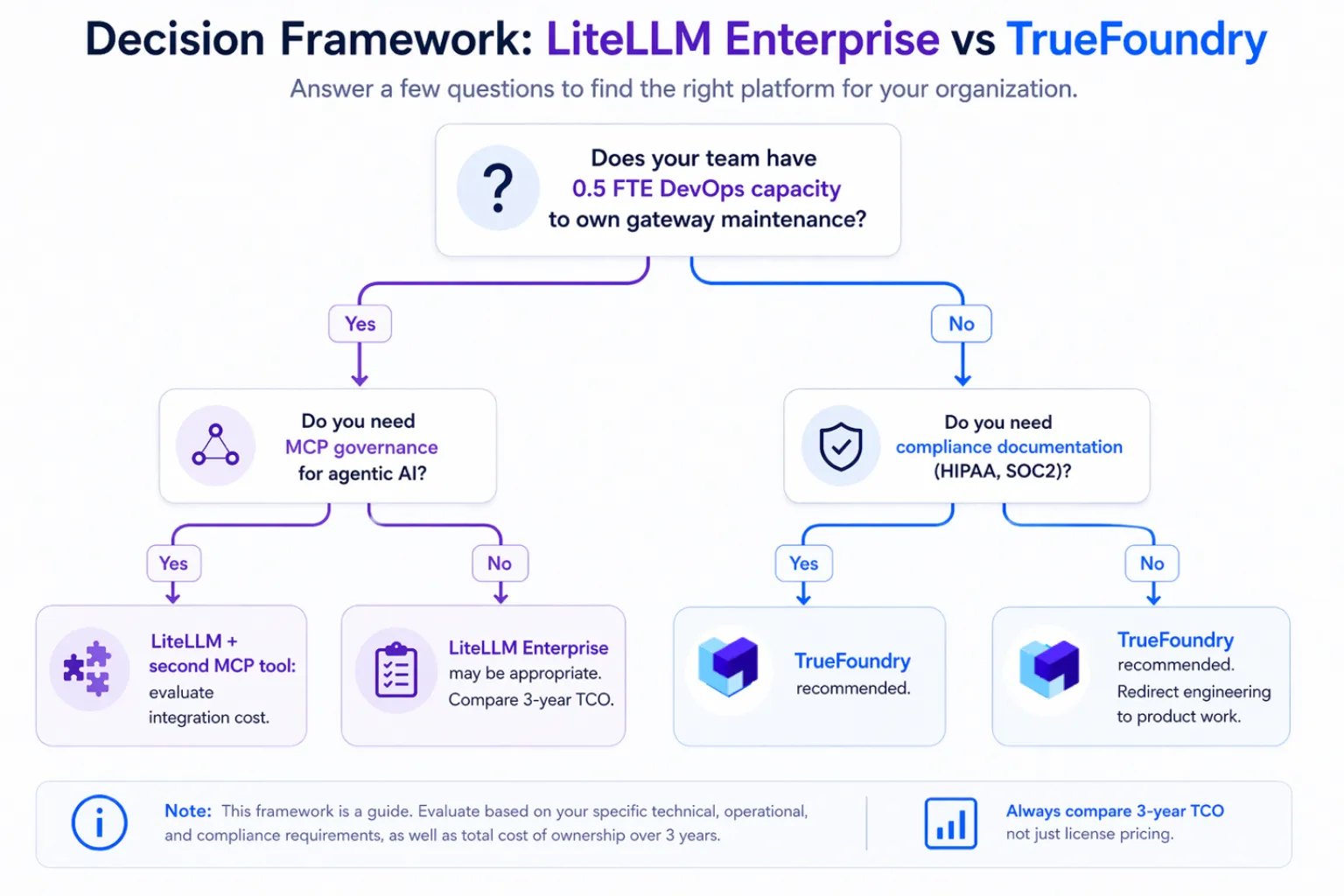
TrueFoundry no es un reemplazo de LiteLLM que haga lo mismo con un precio diferente. Es una plataforma más amplia que aborda la brecha de gobernanza que surge a medida que las implementaciones de IA empresariales maduran más allá del simple enrutamiento de proxy LLM, evolucionando hacia una IA agéntica con uso de herramientas, implementaciones multinube y manejo de datos regulados.
TrueFoundry AI Gateway ofrece una latencia de entre 3 y 4 ms, gestiona más de 350 RPS en una vCPU, se escala horizontalmente con facilidad y está listo para la producción, mientras que LitellM presenta una latencia alta, tiene dificultades para superar un RPS moderado, carece de escalado integrado y es ideal para cargas de trabajo ligeras o de prototipos.




LiteLLM Enterprise Basic, por aproximadamente 250 $ al mes, añade la interfaz de usuario de gestión empresarial, integración SSO/SAML, métricas de Prometheus, autenticación JWT, barreras de seguridad LLM para el filtrado de contenido y un canal de soporte dedicado en Slack al conjunto de características de código abierto. Enterprise Premium, por aproximadamente 30 000 $ al año, añade soporte prioritario con tiempos de respuesta SLA definidos, gestión de cuentas dedicada, desarrollo de funciones personalizadas y asistencia con las certificaciones de cumplimiento para SOC2 y HIPAA.
La distinción práctica radica en el soporte y la asistencia para el cumplimiento. Basic te proporciona las funciones de gobernanza. Premium te ofrece un socio proveedor para la implementación empresarial. Verifica el desglose actual de características en litellm.ai/enterprise antes de comprar, ya que la disponibilidad de las funciones cambia con las versiones.
LiteLLM Enterprise es autoalojado en todos los niveles. La licencia cubre el software y el soporte. El cliente aprovisiona y opera toda la infraestructura: un servidor o clúster proxy, una base de datos PostgreSQL para la configuración y el registro de auditoría, y una instancia de Redis para el almacenamiento en caché y los contadores de límite de velocidad. Las implementaciones de alta disponibilidad requieren balanceadores de carga y replicación de bases de datos adicionales. LiteLLM ofrece opciones de implementación en la nube y autogestionadas, pero la responsabilidad operativa recae en el cliente, independientemente del modelo de implementación que elija.
Las empresas que han migrado de LiteLLM autogestionado a plataformas gestionadas informan sistemáticamente que el mantenimiento consume entre 0,25 y 0,5 equivalentes a tiempo completo de capacidad de ingeniería continua. La implementación inicial requiere de dos a cuatro semanas de tiempo de un DevOps sénior para configurar clústeres de Kubernetes, balanceadores de carga, establecer pipelines de CI/CD e integrar sistemas de monitoreo. El mantenimiento continuo añade de 10 a 20 horas al mes para parches de seguridad, actualizaciones de dependencias, ajustes de escalado y resolución de problemas de infraestructura. La respuesta a incidentes por interrupciones del gateway recae completamente en el equipo de guardia del cliente.
Con un coste total de un ingeniero sénior de 250.000 $ al año, el gasto general de mantenimiento continuo representa entre 62.500 $ y 125.000 $ en gasto anual de ingeniería dedicado exclusivamente a la gestión de infraestructura. Esta cifra aumenta a medida que se incrementa el número de equipos y casos de uso en el gateway.
Sí. El AI Gateway de TrueFoundry expone una API compatible con OpenAI, por lo que las aplicaciones desarrolladas con la API unificada de LiteLLM pueden apuntar al endpoint del gateway de TrueFoundry sin necesidad de reescribir código. La migración implica actualizar las URL de los endpoints, mover las credenciales del proveedor al almacén de credenciales de TrueFoundry, configurar RBAC y los presupuestos de equipo en la interfaz de gestión de TrueFoundry, y configurar la integración de SSO con su proveedor de identidad existente.
El equipo de soluciones de TrueFoundry ofrece soporte para la migración y puede elaborar una comparación personalizada del TCO para los equipos que estén evaluando el cambio. El plazo de migración típico para una organización de ingeniería de tamaño medio es de dos a cuatro semanas para la migración técnica, más un período de ejecución en paralelo para validar el comportamiento antes de desmantelar la implementación de LiteLLM.
El caché semántico de TrueFoundry compara las solicitudes basándose en la similitud semántica en lugar de la coincidencia exacta de cadenas, sirviendo respuestas en caché para solicitudes que son funcionalmente equivalentes, incluso si se formulan de manera diferente. La tasa de reducción documentada de TrueFoundry es de hasta el 40% de las llamadas redundantes a la API de LLM. La implementación de caché de LiteLLM utiliza la coincidencia exacta y no publica puntos de referencia independientes para las tasas de reducción por similitud semántica. Verifique las capacidades actuales de caché de LiteLLM en docs.litellm.ai antes de comparar.
Para organizaciones con alta repetición en los patrones de consulta, como soporte al cliente, búsqueda de documentación o herramientas internas de preguntas y respuestas, la diferencia del caché semántico puede ser sustancial. Con un gasto de $100,000 al mes en la API de LLM, una reducción del 40% gracias al caché semántico genera $40,000 al mes en ahorros directos, lo que compensa una parte significativa de los costos de la pasarela gestionada.
El precio de TrueFoundry se basa en el uso y el modelo de implementación, en lugar de una tarifa fija publicada para esta escala. La opción SaaS totalmente gestionada elimina por completo los costes de infraestructura. La opción de plano de puerta de enlace autohospedado tiene un coste de infraestructura aproximado de 600 $ al mes solo para la implementación de la puerta de enlace. La opción completa de plano de control autohospedado más puerta de enlace tiene un coste aproximado de entre 800 $ y 1000 $ al mes.
Para una organización específica con 50 equipos y mil millones de tokens al mes, el equipo de soluciones de TrueFoundry elaborará un modelo de precios y TCO personalizado que tendrá en cuenta el volumen de tokens, el número de equipos, los requisitos de cumplimiento y el modelo de implementación. Reserve una llamada de 20 minutos para obtener las cifras reales para su escenario en lugar de basarse en estimaciones genéricas.



Las últimas noticias, artículos y recursos enviados a tu bandeja de entrada
.png)
.png)
.png)
.png)
.png)
.png)
.png)
.png)
.png)
.png)
.png)


