


October 1, 2026
|
Lesedauer: 5 Minuten


Erhalten Sie sofortigen Zugriff auf eine TrueFoundry-Live-Umgebung. Stellen Sie Modelle bereit, leiten Sie den LLM-Verkehr weiter und erkunden Sie die gesamte Plattform — Ihre Sandbox ist in Sekundenschnelle einsatzbereit, ohne dass eine Kreditkarte erforderlich ist.



Published: July 6, 2026
.webp)
Unglaublich schnelle Methode zum Erstellen, Verfolgen und Bereitstellen Ihrer Modelle!
RunLayer positions itself as AI enablement and control in one platform, built around the Model Context Protocol. Its connectors expose org-approved tools through one MCP gateway, and the Runlayer Plugin gives Cursor and Claude Code users a single entry point to those tools, skills, and agents.
What sets RunLayer apart is its approach to discovery and runtime security. Its Shadow AI product, called AI Watch, installs as a package on employee machines through Jamf, Intune, Kandji, Mosyle, or another MDM. Once deployed, it finds unsanctioned MCP servers and skills, enforces policy on tool calls in real time, and records agent sessions. On top of that, RunLayer runs ToolGuard, a set of security models for MCP ecosystems, and AgentGuard, which watches an agent's full trajectory to catch attempts at manipulation. Incident management, approvals, audit logs, and Slack alerts round out the security workflow.
There is a trade-off in scope. RunLayer is built to secure and govern how agents use tools. It is not an LLM gateway that routes a thousand models behind one API, and it does not serve or deploy your own models. Teams that need model routing, load balancing, or self-hosted inference will run RunLayer alongside another system rather than in place of one.
Best for: security teams that need to find and control shadow MCP and agent usage across employee devices.
TrueFoundry is a broader platform that puts models, MCP servers, and agents behind one governed gateway. The AI gateway gives developers a single OpenAI-compatible API to more than 1,600 LLMs, so switching providers is as simple as changing the model name. We designed the gateway to sit in the hot path without becoming the bottleneck, adding only about 3 to 4 ms of overhead while serving 350+ RPS on a single vCPU.
Pointing an app at the gateway is a one-line change. You keep the OpenAI SDK and swap the base URL:
from openai import OpenAI

# Point the OpenAI SDK at the TrueFoundry gateway
client = OpenAI(
    api_key="your_truefoundry_api_key",
    base_url="{GATEWAY_BASE_URL}",
)

response = client.chat.completions.create(
    model="openai-main/gpt-4o-mini",   # switch providers by changing this name
    messages=[{"role": "user", "content": "Summarize our Q3 roadmap"}],
)
print(response.choices[0].message.content)
The gateway does much more than route models. It includes load balancing and fallbacks, semantic caching, guardrails for PII and prompt injection, per-team rate limits and budgets, and OpenTelemetry-based observability. On the agentic side, our MCP Gateway centralizes authentication so one key reaches every registered MCP server, with tool-level RBAC and virtual MCP servers that expose a curated subset of tools. The MCP Registry, Agent Registry, and Skills Registry let platform teams publish governed catalogs that agent builders draw from without ever handling raw credentials.
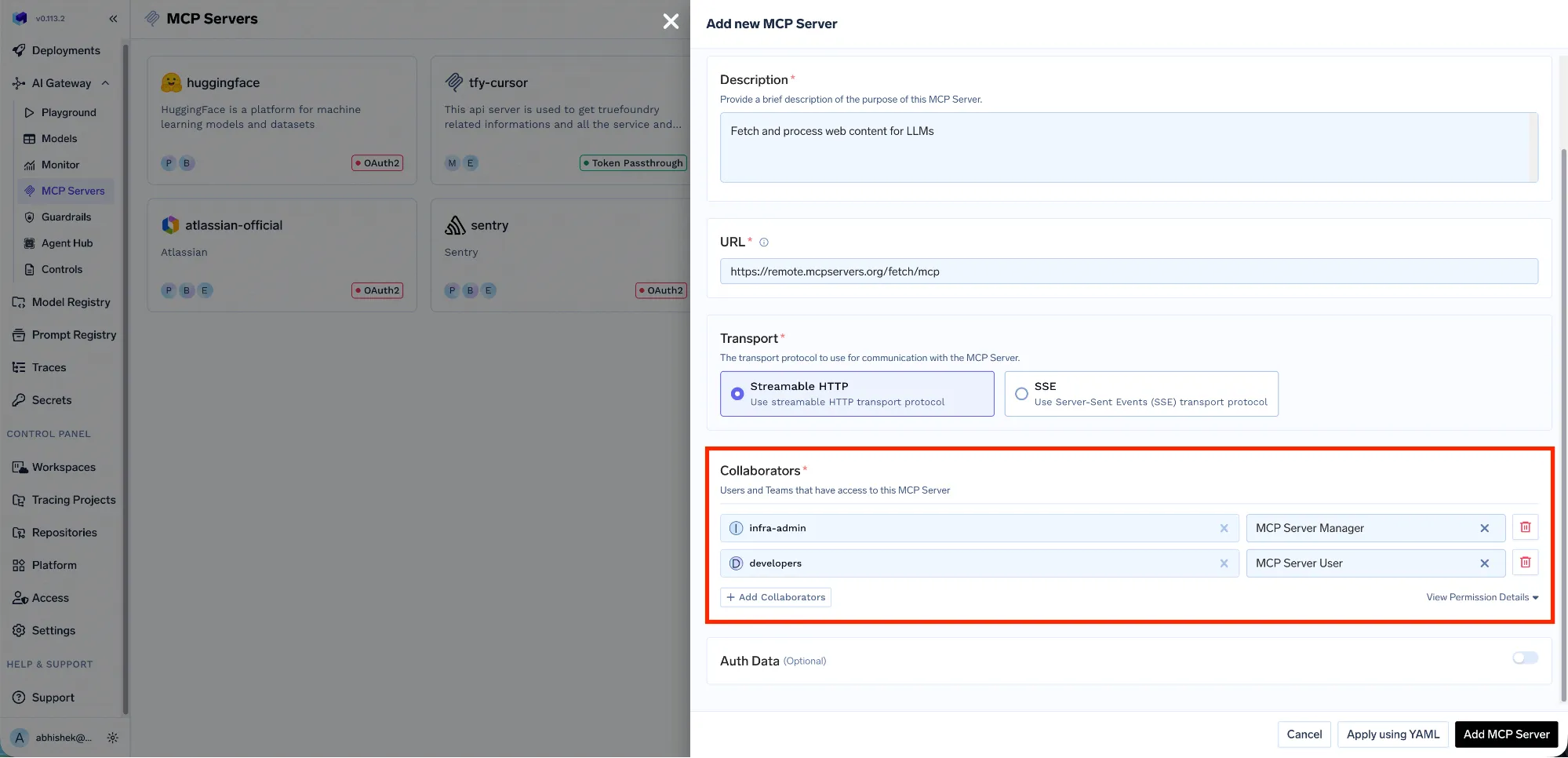
Best for: platform and engineering teams that want models, MCP, and agents governed in one control plane, deployed in their own infrastructure.
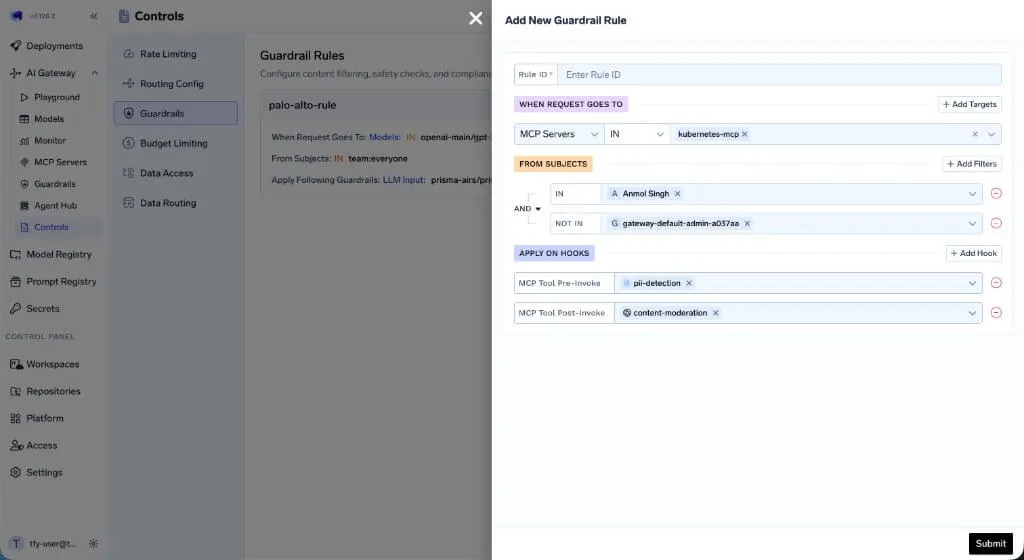
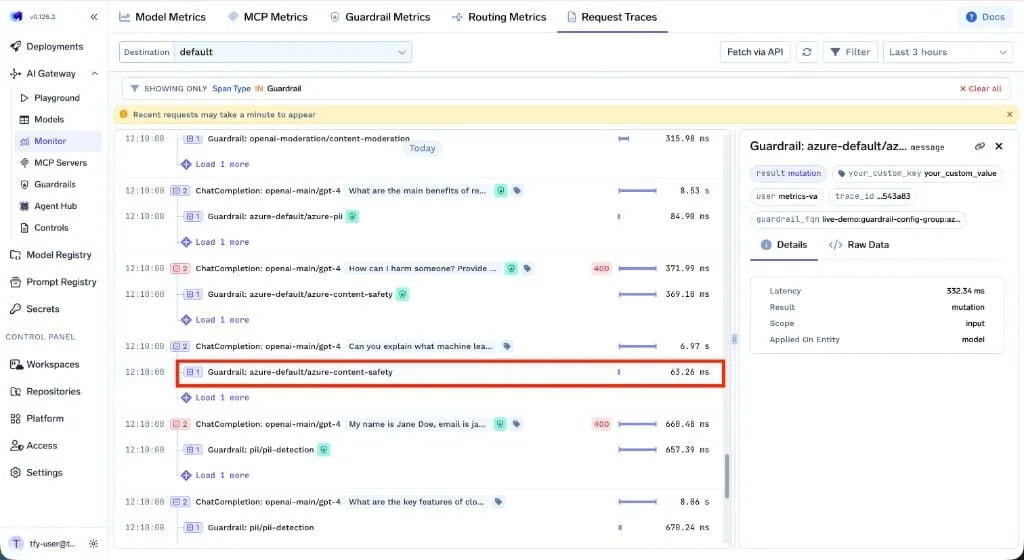
Yes, and this is worth spelling out because it is where the two products overlap most. On MCP security, the TrueFoundry gateway authenticates every call with OIDC, JWT, or API keys, then checks tool-level permissions before a tool runs. You can attach guardrails on four hooks: LLM input, LLM output, MCP pre-tool invoke, and MCP post-tool invoke. Policies can be written in Cedar or OPA, destructive tools can require human approval, and every call is traced with a unified audit trail and a per-agent kill switch.
{
  "llm_input_guardrails": ["global/pii-redaction"],
  "llm_output_guardrails": ["global/openai-moderation"]
}
On shadow AI, TrueFoundry takes a traffic-first approach. It puts one control point in front of every model call and covers both the AI your teams build and the AI your employees use, from Cursor and Claude Code to the ChatGPT app and claude.ai. Cooperative tools route through the gateway with an MDM config patch; the rest are captured with the open-source aitori agent or your existing secure web gateway. For endpoint threat detection, the gateway also integrates with CrowdStrike AIDR, which is built for employee GenAI adoption and MCP tool validation.
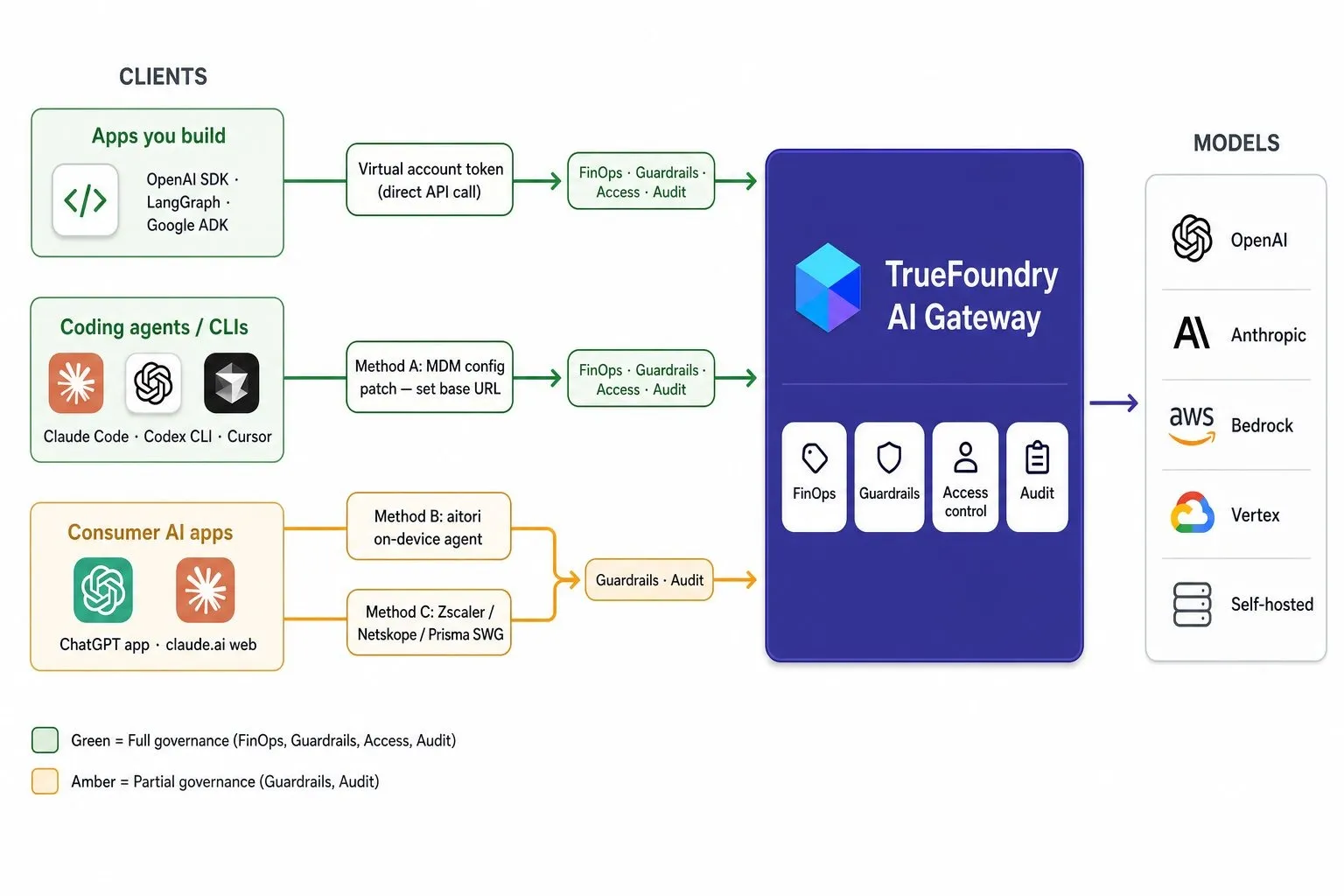
The honest distinction: RunLayer specializes in scanning employee devices to inventory MCP servers and skills that were never declared. TrueFoundry governs and audits the traffic itself and wires into endpoint tooling for the discovery angle. Both give security teams control over unsanctioned AI; they just start from different places.
The table below reflects publicly documented functionality for both platforms at the time of writing.
Pick TrueFoundry when the gateway needs to carry more than security. If your developers call many providers and you want one API, load balancing, and cost controls across all of them, that is the gateway's job. Teams standardizing an LLM gateway for the whole org get model access and MCP governance in the same place.
It also fits when you deploy your own models. Running open-weight models on vLLM or Triton next to the gateway keeps serving and routing in one control plane instead of across two vendors. Regulated industries lean this way too, since the whole platform runs in your own VPC and supports SOC 2, HIPAA, and GDPR. And for agent programs, keeping the MCP Gateway, Agent Registry, and Skills Registry in one place means platform teams set up access once and builders never handle secrets.
The simplest way to frame RunLayer vs TrueFoundry is layer versus platform. RunLayer is a strong security layer over AI activity that already happens, and it is especially good at finding shadow MCP usage on employee devices and monitoring agent behavior at runtime. If that discovery problem is your main concern, it does the job well.
TrueFoundry solves a bigger problem, and it does so without giving up the security controls RunLayer is known for. It is the governed gateway to models, MCP servers, and agents, and it is also where you deploy and serve your own models, fully self-hosted if you need it. Tool-level access, guardrails, MCP threat detection, and audit are all here as part of a platform rather than a separate overlay. For teams that would otherwise build one gateway for models, an MCP layer, a serving stack, and a governance tool, consolidating into one gateway removes moving parts. If you are weighing a security-only MCP gateway against a full platform, that consolidation is the deciding factor.
RunLayer and TrueFoundry both bring governance to enterprise AI, but they are not the same kind of tool. RunLayer is the security specialist that finds and controls shadow MCP and agent usage at the endpoint. TrueFoundry is the platform that unifies models, MCP, and agents behind one gateway you can run in your own VPC, with MCP security, shadow AI governance, model deployment, and compliance all included.
If you are evaluating an enterprise MCP gateway and want models, MCP, and agents governed in one place rather than stitched across vendors, book a demo to see how TrueFoundry handles it end to end.
TrueFoundry AI Gateway bietet eine Latenz von ~3—4 ms, verarbeitet mehr als 350 RPS auf einer vCPU, skaliert problemlos horizontal und ist produktionsbereit, während LiteLM unter einer hohen Latenz leidet, mit moderaten RPS zu kämpfen hat, keine integrierte Skalierung hat und sich am besten für leichte Workloads oder Prototyp-Workloads eignet.




RunLayer ist eine Plattform für MCP-Sicherheit und Shadow AI, die die Nutzung nicht autorisierter Agenten und Tools entdeckt und steuert, oft auf Geräteebene über MDM. TrueFoundry ist ein vollständiges AI-Gateway und eine Plattform, die den Zugriff auf über 1.000 LLMs, MCP-Server und Agenten vereint, mit integrierter Modellbereitstellung und Compliance. RunLayer sichert die bestehende AI-Nutzung; TrueFoundry ist die Steuerungsebene, auf der Teams aufbauen, und deckt zudem MCP-Sicherheit und Shadow AI ab.
Ja. TrueFoundry steuert Drittanbieter-KI-Tools wie Cursor, Claude Code und ChatGPT über das Gateway, entweder mittels eines MDM-Konfigurationspatches, des aitori-Agenten oder Ihres bestehenden sicheren Web-Gateways. Für die MCP-Sicherheit ergänzt es rollenbasierte Zugriffskontrolle (RBAC) auf Tool-Ebene, Schutzmechanismen vor und nach der Tool-Nutzung, Cedar- oder OPA-Richtlinien, Genehmigungsworkflows und einen einheitlichen Audit-Trail, sowie Integrationen mit CrowdStrike AIDR, TrojAI und Palo Alto AIRS.
Nicht im Sinne von LLMs. RunLayer konzentriert sich auf MCP-Konnektoren, die Erkennung von Shadow AI und die Laufzeitsicherheit von Agenten, anstatt Modell-Traffic über verschiedene Anbieter zu leiten. Die Bereitstellung einer einzigen API für über 1.000 Modelle mit Lastausgleich und Kostenkontrolle wird von einem AI-Gateway wie TrueFoundry abgedeckt.
Beide haben ihre Stärken. RunLayer konzentriert sich auf die Erkennung von Shadow-MCP-Servern auf Endpunkten und die Überwachung des Agentenverhaltens mit ToolGuard und AgentGuard. TrueFoundry setzt die MCP-Sicherheit innerhalb des Gateways durch, mit zentralisierter Authentifizierung, RBAC auf Tool-Ebene, virtuellen MCP-Servern und Schutzmechanismen für Pre- und Post-Tool-Hooks, sowie Integrationen für Modellzugriff und Bedrohungserkennung.



Die neuesten Nachrichten, Artikel und Ressourcen werden in Ihren Posteingang gesendet
.png)
.png)
.png)
.png)
.png)
.png)
.png)
.png)
.png)
.png)
.png)


