November 5, 2026
|
5 min read


Blazingly fast way to build, track and deploy your models!
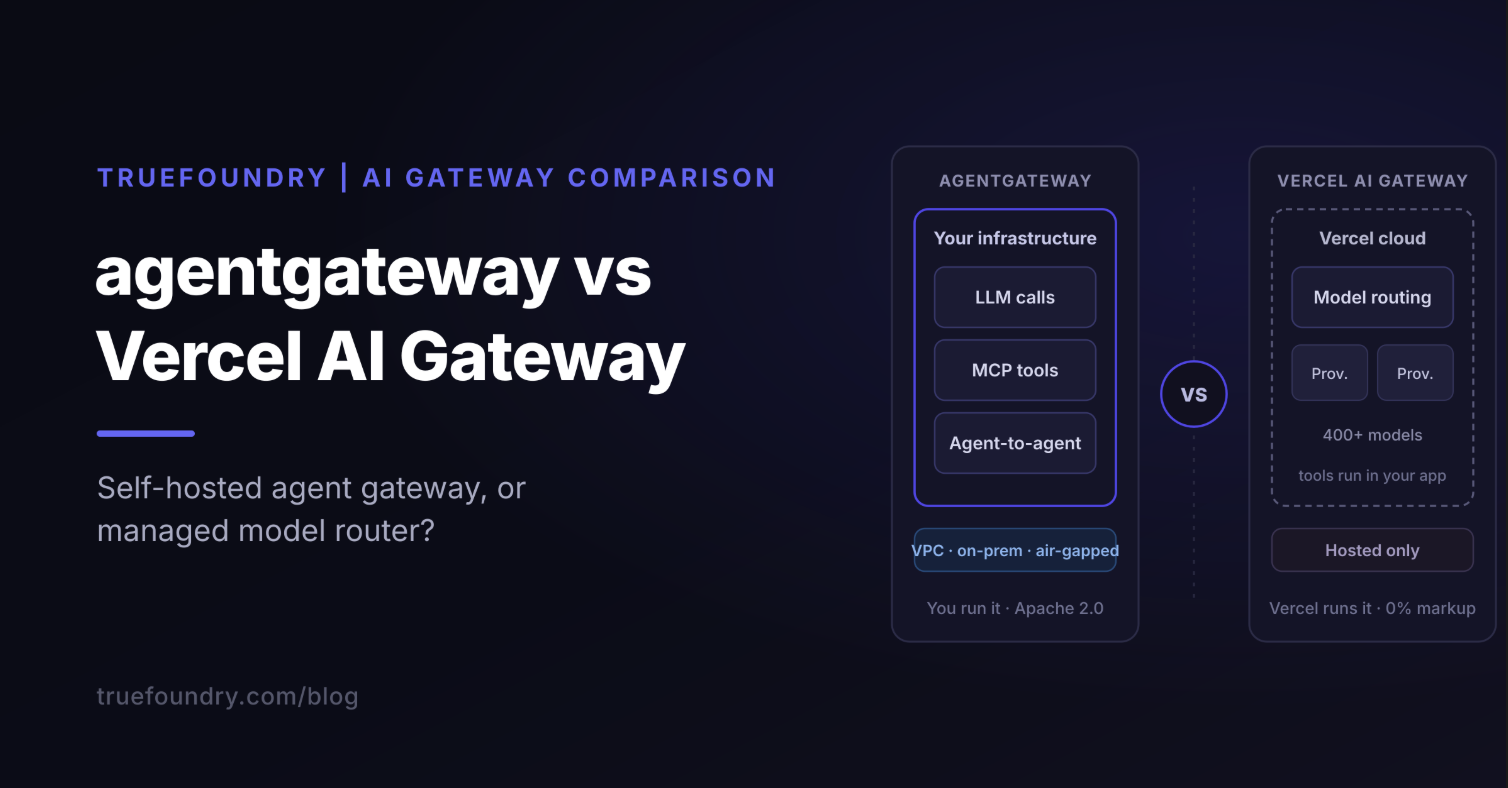
On paper, agentgateway and Vercel AI Gateway do the same job. Both put one OpenAI-compatible endpoint in front of a long list of model providers. In practice they're built for different buyers. Vercel AI Gateway is a hosted service: you send requests to Vercel, and Vercel runs everything behind the endpoint. agentgateway, which Solo.io started and the Linux Foundation now hosts, is open-source software you install and run yourself, and it also governs MCP tool calls and agent-to-agent traffic. So before comparing features, decide whether you want to run a gateway at all, and how much of your traffic will come from agents rather than apps.
We've used both. Our team tested the open-source agentgateway build hands-on (v1.5.0, with the main findings re-checked on v1.6.0), and we ran our own requests through Vercel's hosted gateway. We then checked every claim here against each vendor's docs in November 2026, by which point agentgateway was on v1.7.0.
Vercel AI Gateway sits between your app and the model providers. It holds your credentials, tracks usage and enforces spending limits, all behind one endpoint. It became generally available in August 2025 and grew out of Vercel's web platform and AI SDK. You can call it with OpenAI- or Anthropic-compatible APIs, the AI SDK or plain HTTP, and your app doesn't have to be hosted on Vercel. The catalog lists 400+ models from OpenAI, Anthropic, Google, Amazon Bedrock and others.
You don't deploy anything. Vercel describes the gateway as a Node.js app on its own Fluid compute, with Redis in each region keeping track of quotas, and none of that is your problem. It held up in our tests. Requests went through OpenAI, Google Vertex AI and Amazon Bedrock, tool calls and strict structured output came back valid, and when the primary model had no available provider, the gateway fell back to the backup model we'd set.
The pricing is what most people notice first. Vercel charges a 0% markup on tokens, even when you bring your own provider keys, and every team gets a monthly free credit for a subset of models. Governance features cost extra per request, and team features like SAML single sign-on come with a Vercel plan. The catch is where it runs: Vercel doesn't document any way to run the gateway in your own VPC, on-premises or air-gapped. If you're new to the category, our explainer on what an LLM gateway is covers the basics.
agentgateway isn't an update of Solo's older Gloo AI Gateway. Solo wrote a new proxy in Rust, licensed it Apache 2.0 and handed it to the Agentic AI Foundation under the Linux Foundation. Solo still sells the paid edition, Solo Enterprise for agentgateway. You can run it as one binary that reads one YAML file, as a container, or on Kubernetes with a separate control plane and data plane, where it implements the Gateway API. It's small and quick. Our team had it serving traffic in under 11 seconds from a cold start, it used about 18 MB of memory at idle, and on a network with no internet route it made no calls home.
It handles three kinds of traffic with one policy model: LLM calls, Model Context Protocol (MCP) traffic between agents and tools, and agent-to-agent (A2A) calls. MCP authorization is the part we liked most. You write rules for which tools each caller can use, and the gateway filters the tool list as well, so an agent never sees a tool it isn't allowed to call. The free edition also validates JWTs against your identity provider, limits which models each key can use, enforces spending budgets per key and masks sensitive data like email addresses and card numbers before the prompt leaves your network.
Solo charges for anything that has to be shared across instances. Fleet-wide rate limits, a shared budget resource and a single cost view are all enterprise features. Our agentgateway review goes into much more detail.
The agentgateway column comes from our tests of the open-source build (v1.5.0, re-checked on v1.6.0) and Solo's docs for v1.7.0. The Vercel column comes from Vercel's public docs and our tests on a free-tier account. We checked both in November 2026.
You don't run anything. There's no cluster to size and no upgrades to plan around. That matters more than it sounds: agentgateway ships a minor release roughly every month, and v1.6.0 alone had five breaking changes.
Vercel's prices are public. The token markup (zero), the per-feature fees and the plan prices are all on its website. Solo has no public price list for its enterprise edition, and you can't start a trial without talking to sales.
Limits apply across the whole service. Vercel runs one gateway for everyone, so budgets and quotas hold wherever your traffic comes from. With agentgateway, budgets and rate limits that span several instances need the enterprise edition.
You get 400+ models behind one key. Requests can be ordered or sorted by provider, speed or cost, and can fall back to other providers or models when one fails.
It doesn't keep your prompts. Vercel's gateway doesn't capture prompt or completion text, and you can turn on team-wide zero data retention or block providers that train on prompts.
You choose where it runs: your VPC, your own data center or an air-gapped network. Prompts never pass through someone else's gateway. Vercel's gateway is hosted only.
It understands agents. Per-tool MCP rules, per-caller tool lists and A2A support all use the same policy model as model calls. Vercel leaves tool execution, and any rules about which tools an agent may call, to your application.
It can strip sensitive data. Built-in PII masking removes things like email addresses and card numbers before a request reaches the provider. We didn't find anything equivalent in Vercel's docs.
It talks to your own models. Any OpenAI-compatible endpoint works as a backend, including vLLM or Ollama running on your own hardware. Vercel lets you bring your own key for the providers it supports, but it doesn't document routing to arbitrary private endpoints.
It's open source under a foundation. The code is Apache 2.0 and lives in a Linux Foundation project, so its future doesn't hang on Solo's plans. Leaving is cheap too, because your apps keep using the standard OpenAI API.
We can't test these two the same way, so we won't rank them. agentgateway runs on whatever hardware you give it. Vercel's gateway is a shared service, and the only way to measure it is from the outside.
Read the Vercel number with care. It includes the round trip to Vercel's network, and it jumped around a lot: on 21 of 98 request pairs, going through the gateway was faster than calling OpenAI directly. A model call usually takes hundreds of milliseconds to a few seconds anyway, so neither gateway is likely to be your bottleneck. For streaming, agentgateway added no more than about 12 ms before the first token compared with calling a live provider directly.
Both have a weak spot under load. Vercel's free tier let through about four requests in a row before returning HTTP 429, with no Retry-After header, so we couldn't run an unpaced load test at all. Vercel says buying credits lifts the free-tier limits and that the gateway doesn't rate limit paid requests. We haven't tested that. agentgateway had trouble with large streaming responses: with very long documents, one instance started to degrade at about 30 requests per second. Small streaming requests were fine at every load we tried.
agentgateway costs nothing beyond your infrastructure and the people who look after it. One instance with per-key budgets, PII masking and MCP authorization is free. Solo Enterprise for agentgateway adds fleet-wide rate limits, a budget resource, a cost management UI, on-behalf-of identity, FIPS builds and support. You get a price from sales, because there's no public list. Our Solo AI gateway pricing breakdown has what we could find.
Vercel charges no markup on tokens, even ones billed to your own provider keys, and every team gets a monthly free credit for some models. To use your own keys, you have to buy credits first. The governance features are where the bill grows:
On Vercel, routing costs almost nothing. The fees come from the controls your security team will want switched on, so price those before you commit. On agentgateway the license can be free. What you pay for is engineering time, plus the enterprise edition once you run several instances.
Vercel budgets are soft caps. The request that crosses the limit still completes, and spend on your own provider keys doesn't count toward Gateway budgets at all. agentgateway's per-key budgets also let the crossing request finish.
Vercel bills you when your own key fails. If a request made with your provider key fails, Vercel retries it on its own credentials and charges your credit balance. Set spend limits with your provider as well as in the gateway.
Don't load test on Vercel's free tier. Vercel documents free-tier limits per model, but in our tests the limit behaved as if it covered the whole account. Switching models didn't reset it, and having free credit left didn't help. Buy credits before you run a real evaluation.
agentgateway makes one more call than the docs suggest. A retry setting of 1 means two calls to the provider, and the retries go out with no delay unless you configure a backoff.
agentgateway streams can hang. Set responseIdleTimeout on streaming routes. It arrived in v1.6.0, and from v1.7.0 it covers MCP responses too. Without it, a provider that stops partway through a stream keeps the connection open for as long as the client is willing to wait.
agentgateway's free limits are per instance. Budgets and rate limits don't add up across replicas unless you buy the enterprise edition, which is easy to miss until you scale out.
Vercel will run the gateway for you, but only in its own cloud. agentgateway runs anywhere, but you operate it, and shared state across instances costs extra. The TrueFoundry AI Gateway covers both cases. You can use it as managed SaaS, run the gateway in your VPC with a control plane we host, or self-host it in your VPC, on-premises or air-gapped. Gateway pods get configuration and access rules from the control plane in real time, along with rate-limit and budget counters aggregated centrally, so limits apply across replicas without a paid upgrade.
It gives you 1,000+ LLMs behind one OpenAI-compatible API, routes to self-hosted models from the same control plane, and governs LLM, MCP and agent traffic with tool-level access control. It can also require human approval before destructive tool calls. Budgets can be scoped by team, model or provider account, and SSO, RBAC and audit logging come built in. If you're stuck choosing between a managed router and a self-hosted agent gateway, see how the TrueFoundry AI Gateway handles both, or book a demo.
The choice comes down to two questions: who runs the gateway, and what traffic does it need to control? If you want managed model routing with no markup, and a hosted service meets your data rules, Vercel AI Gateway is the easier path. If the gateway has to live in your own network, or your agents need per-tool access control, agentgateway is the better fit. If you need both, book a TrueFoundry demo.
TrueFoundry AI Gateway delivers ~3–4 ms latency, handles 350+ RPS on 1 vCPU, scales horizontally with ease, and is production-ready, while LiteLLM suffers from high latency, struggles beyond moderate RPS, lacks built-in scaling, and is best for light or prototype workloads.


agentgateway is open-source software you deploy and operate yourself, and it governs model calls, MCP tool calls and agent-to-agent traffic. Vercel AI Gateway is a managed service that routes model requests across providers, with no gateway for you to run and no self-hosted option.
No self-hosted, VPC or air-gapped deployment is documented. The gateway is reached at Vercel's hosted endpoint. Vercel's bring-your-own-cloud offering covers application code and functions, not the AI Gateway itself.
Yes. agentgateway is licensed Apache 2.0 and hosted by the Agentic AI Foundation under the Linux Foundation. Solo.io sells Solo Enterprise for agentgateway, which adds fleet-wide rate limits, cost management and support.
Models routed through the gateway can request tool calls, but your application executes the tools. A tool-authorization layer inside the gateway, like agentgateway's per-tool rules, is not documented.
They can't be compared directly. In our tests, agentgateway added about 2 to 5 ms on a single vCPU against a local mock provider. Vercel AI Gateway added 211 ms at the median when measured from a client in San Jose against direct OpenAI calls on a free-tier account, a figure that includes the network hop to Vercel.
Yes. TrueFoundry runs as managed SaaS, as a gateway plane in your cloud, or self-hosted in your VPC, on-premises or air-gapped, so request data can stay inside your environment.



The latest news, articles, and resources sent to your inbox