.png)
September 29, 2026
|
5 min read


Published: September 29, 2026
.png)
Blazingly fast way to build, track and deploy your models!
The rename is not cosmetic for anyone doing procurement: the docs still live under docs.datadoghq.com/llm_observability/ and the pricing anchor is still ?product=llm-observability, so the old name is far from dead — it is just no longer what the product is called.
The second change is the pricing model itself, rebuilt between February and July 2026. Verified against the Internet Archive:
The old card read: “Starting At $8 / Per 10K monitored LLM requests, per month” with “Minimum of 100K LLM requests per month.” That 100K was never an included allowance — it was a contractual minimum billable volume. Retention add-on rates then moved again between July and September. Two structural changes in seven months means any figure from a post older than about eight weeks is probably wrong.
[SCREENSHOT: Datadog — the Agent Observability card on datadoghq.com/pricing showing the Free and Pro tiers and the per-10K span fine print]
Free — $0/month, up to 40K LLM spans per month, 15-day trace retention, unlimited context and evals, full feature access. Pro — $160/month annual: “100K LLM spans per month included. Additional spans: $3.5 per 10K LLM spans.” 15-day retention, with three commitment levels for that first 100K: $240 on-demand, $200 month-to-month, $160 annual.
Two omissions from the headline copy. Retention tiers are ambiguous — Datadog never says whether the 30/60/90-day rates are additive to or replacements for the $3.50 base; by analogy with APM Indexed Spans on the same page they read as replacements, but that is inference. [VERIFY] in writing. And there is an unstated regional premium: the page’s own embedded region map gives us/eu $160 + $3.50, ap2/uk1 $192 + $4.20, and ap1 $200 + $4.38 — 25% more for an identical SKU.
Here the model is better than its reputation. From the pricing FAQ:
“An LLM span is a single call to an LLM provider such as OpenAI or Anthropic. One agent workflow can generate multiple LLM spans… Datadog bills only on LLM spans, not on tool spans, retrieval spans, or other workflow spans surrounding the model call.”
Seven span kinds exist and exactly one bills: LLM. Workflow, agent, tool, task, embedding and retrieval are free, and kind decides rather than nesting depth — so RAG embedding calls cost nothing even though they hit a model. Where total spans outnumber LLM spans five to one, that narrow denominator matters, and most per-span comparisons against Datadog ignore it. One inconsistency: the SDK docs say billing “is based on the volume of spans you send”, contradicting the pricing page’s explicit “LLM spans only.”
[SCREENSHOT: Datadog — an agent trace showing span kind labels (llm, tool, workflow, retrieval) in the flame graph]
This is where bills surprise people.
It does not require APM. Verbatim: “No. Agent Observability is a standalone product and can be purchased without any other Datadog subscription.”
It does not draw on APM allotments. The allotments page lists Infrastructure, Infra Pro/Enterprise, APM, APM Pro and Serverless — Agent Observability appears nowhere on it. Every span above the Free or Pro tier is net-new spend, never absorbed by headroom you already pay for.
Are LLM traces also billed as APM traces? We will not assert this, because Datadog documents it neither way. [VERIFY]. What is verifiable, and telling: for AI Guard Datadog promises a carve-out — “It includes an APM allotment, so customers without APM aren’t billed for the ingestion of traces AI Guard emits.” No equivalent statement exists for Agent Observability, and the same ddtrace / dd-trace library powers both. Model the interaction rather than assume isolation.
The volume is opt-out, not opt-in. Turning the product on needs an explicit DD_LLMOBS_ENABLED=1. But once on, “All integrations are enabled by default” — so adding OpenAI, LangChain, Bedrock, CrewAI or MCP produces billable spans with no code change. Opting out is per-integration: integrations_enabled=False (Python), plugins: false (Node), or DD_PATCH_MODULES.
The cost lever: DD_LLMOBS_SAMPLE_RATE (0.0-1.0, default 1.0; needs Python ddtrace >= 4.12.0, Node dd-trace >= 5.110.0, Java >= 1.66.0). Datadog states “Sampling does not affect your Agent Observability metrics… these metrics remain based on 100% of your application’s instrumented traffic.” You cut span volume without blinding dashboards — a genuinely good design.
Define one reference agent run: 1 request → 1 trace → 4 LLM calls + 3 tool calls + 2 retrievals. Nine spans, four billable.
A — 50,000 runs/mo = 200,000 LLM spans (450,000 total spans)
Pro base, first 100,000 spans = $160.00
Additional 100,000 / 10,000 = 10 units
10 x $3.50 = $35.00
Annual total = $195.00 / month
On-demand: $240 + (10 x $5.00) = $290.00 / month
B — 500,000 runs/mo = 2,000,000 LLM spans (4,500,000 total)
Pro base, first 100,000 spans = $160.00
Additional 1,900,000 / 10,000 = 190 units
190 x $3.50 = $665.00
Annual total = $825.00 / month
On-demand: $240 + (190 x $5.00) = $1,190.00 / month
Substitute your own volume: cost = 160 + 3.50 x ((LLM spans - 100,000) / 10,000), floored at $160 between 40K and 100K spans, $0 below 40K.
Did the repricing help you? Against the old $8 per 10K with an $80/month floor, break-even lands near 278,000 LLM spans per month (our arithmetic from the published rates):
Small and spiky workloads either went free or got worse; large, steady ones got materially cheaper. If your budget predates July 2026 and you sit in the middle band, it is wrong.
This is a serious product, and Datadog’s line — “Every tier includes the full agent engineering platform from day one” — is backed by the feature list.
Pre-production: human review and annotation, versioned datasets from production traces, a Playground, structured experiments, offline evaluators.
Production: span-level tracing of inputs, outputs and metadata across prompts, retrieval, tool calls and decisions; latency, token and cost monitoring; evaluators including hallucination and drift; security scanning for prompt injection, sensitive data exposure and unsafe outputs; correlation with backend services, infra and RUM under one trace ID. Patterns adds topic clustering, Insights outlier detection.
Evaluations: custom LLM-as-a-judge at span, trace or session scope, managed evaluations, end-user feedback, external evals via API, a NeMo integration and Annotation Queues. The managed catalogue is short, though — the docs list only Language Mismatch and Sensitive Data Scanning. Sensitive Data Scanner is included at no extra cost but metered: “For every 10K LLM spans, you receive an allotment of 1 GB of SDS processing.” Overflow behaviour is undocumented. [VERIFY].
Correlation is the honest core of the value: if Datadog already holds your infra metrics, APM traces, logs and RUM sessions, agent traces landing beside them with the same alerting is worth real money.
Three of these are first-party. The fourth needs careful attribution, and gets it. Note first that every “Datadog alternatives” page we checked quoted a wrong rate, a wrong unit, or a tier that does not exist.
1. Guardrails are not in the price. Agent Observability detects prompt injection as an evaluation. Real-time blocking is AI Guard, listed on the same pricing page with “Custom Quote / Contact Us for Pricing.” Datadog’s FAQ: “Yes. AI Guard is a standalone product. It is billed separately from LLM Observability.” The metering is unusual — “Billed per 1,000,000 input tokens evaluated, including the full conversation context” — so you re-pay for the whole conversation every turn. No public rate.
[SCREENSHOT: Datadog — the AI Guard product card showing “Contact Us for Pricing” and the per-million-input-tokens footnote]
2. “Unlimited evals” has a billing side door. Evaluations carry no separate SKU, but Datadog’s own LLM-as-a-judge docs state: “Note: Enabling tracing increases the number of billed spans sent to Datadog.” A UI toggle converts eval volume into billable span volume, and the pricing page’s “unlimited context and evals” bullet does not mention it.
3. Defaults moved quietly. Experiment results retention was 90 days by default in February 2026; it is now 15 days, with 3 months only on a commitment. Trace data is 15 days, trace metrics 15 months, datasets versioned 3 years.
4. Bill shock — what the record supports. We found no credible first-hand report of bill shock specific to Datadog LLM Observability or Agent Observability. What exists is platform-wide, older, and belongs to named sources:
We also could not substantiate the widely repeated claim that Datadog auto-activates LLM Observability and charges for it. Activation is explicit. The defensible version: the product is opt-in, the volume is opt-out.
The units are not comparable, so headline-to-headline tables are meaningless. Below is the same reference workload — 50,000 runs/month = 200,000 LLM spans, 450,000 total spans — priced under each vendor’s own meter, at list, annual where offered.
Two corrections. Datadog’s denominator is roughly five times smaller than Opik’s or Arize’s here, because it ignores tool, retrieval and workflow spans — its nominal $350 per million LLM spans is not comparable to Opik’s $50 per million of all spans. And the “not published” cells are a finding, not a gap in our research: LangSmith, Arize AX and Datadog’s own AI Guard genuinely do not publish those rates. Of the list, only Phoenix, Opik, Langfuse and Helicone offer a free self-hostable path; Datadog has neither an open-source build nor a self-host option.
Start with the honest part. Datadog is a far broader product than TrueFoundry, and this is not a like-for-like replacement. It does infrastructure, APM, logs, RUM, synthetics, security and database monitoring. If you need one pane of glass across the whole estate, that is Datadog’s job and TrueFoundry does not do it. Running both is normal.
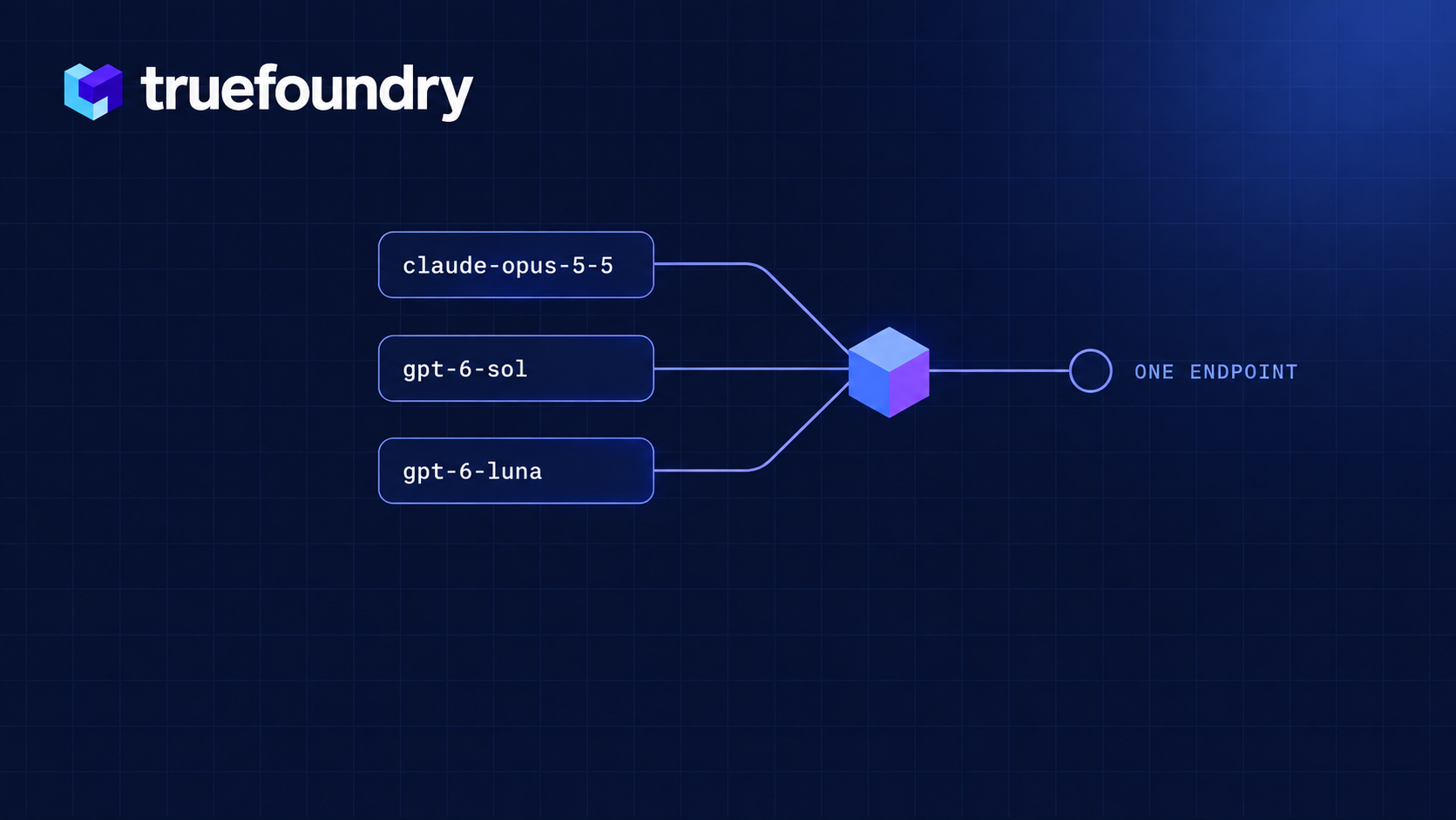
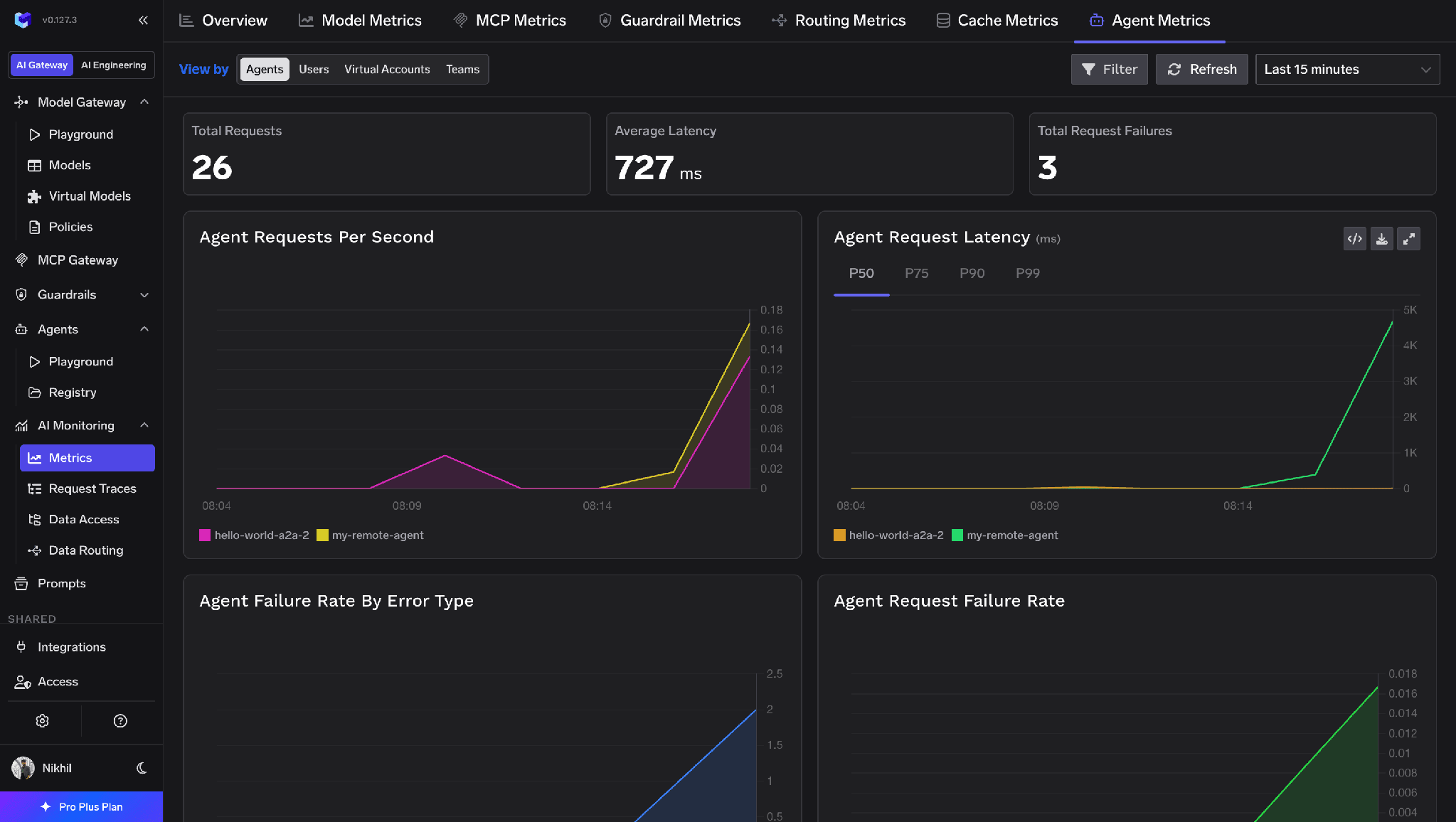
What TrueFoundry changes is where the telemetry comes from, and therefore what it costs. The AI Gateway sits in the request path between your applications and 1,000+ LLMs behind one OpenAI-compatible API, adding roughly 3-4 ms of latency and sustaining 350+ RPS on 1 vCPU. Because every model and MCP tool call already passes through it, metrics and traces are a by-product of serving the request — no per-span charge, because spans are not the billing unit. Pricing is users plus gateway requests: Developer $0 for 3 users and 10K requests per user per month; Pro $25/user/month with 20K pooled requests per user and $20 per additional 100K.
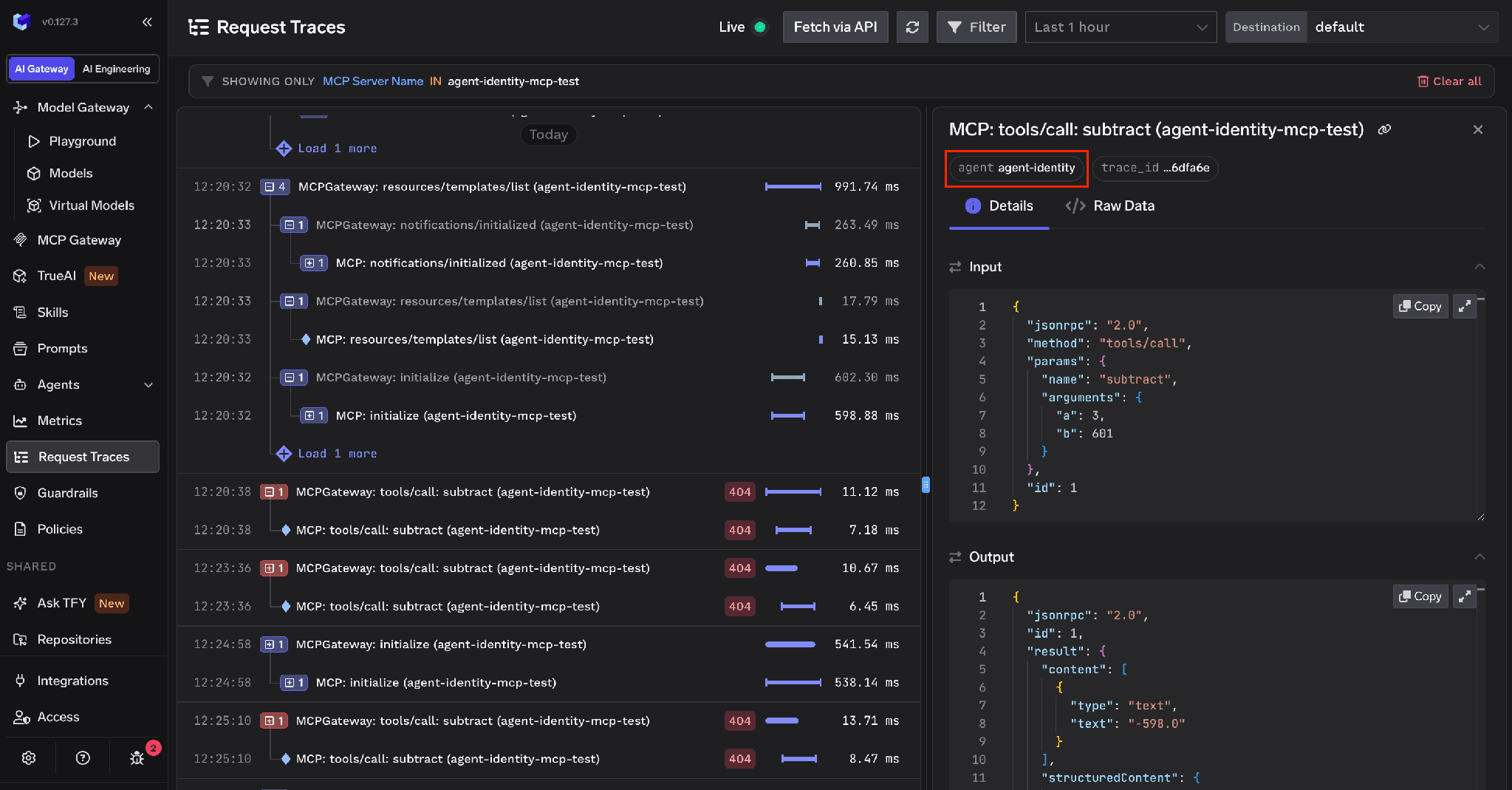
The traces are real span hierarchies, not flat logs. A guarded chat completion produces a root ChatCompletion span, a Guardrail span, the guardrail’s outbound call, a Model span and the model’s outbound call — each carrying cost, token and latency attributes, each attributed to the subject that created it. That is the hierarchy AI agent observability needs, without instrumenting the agent.
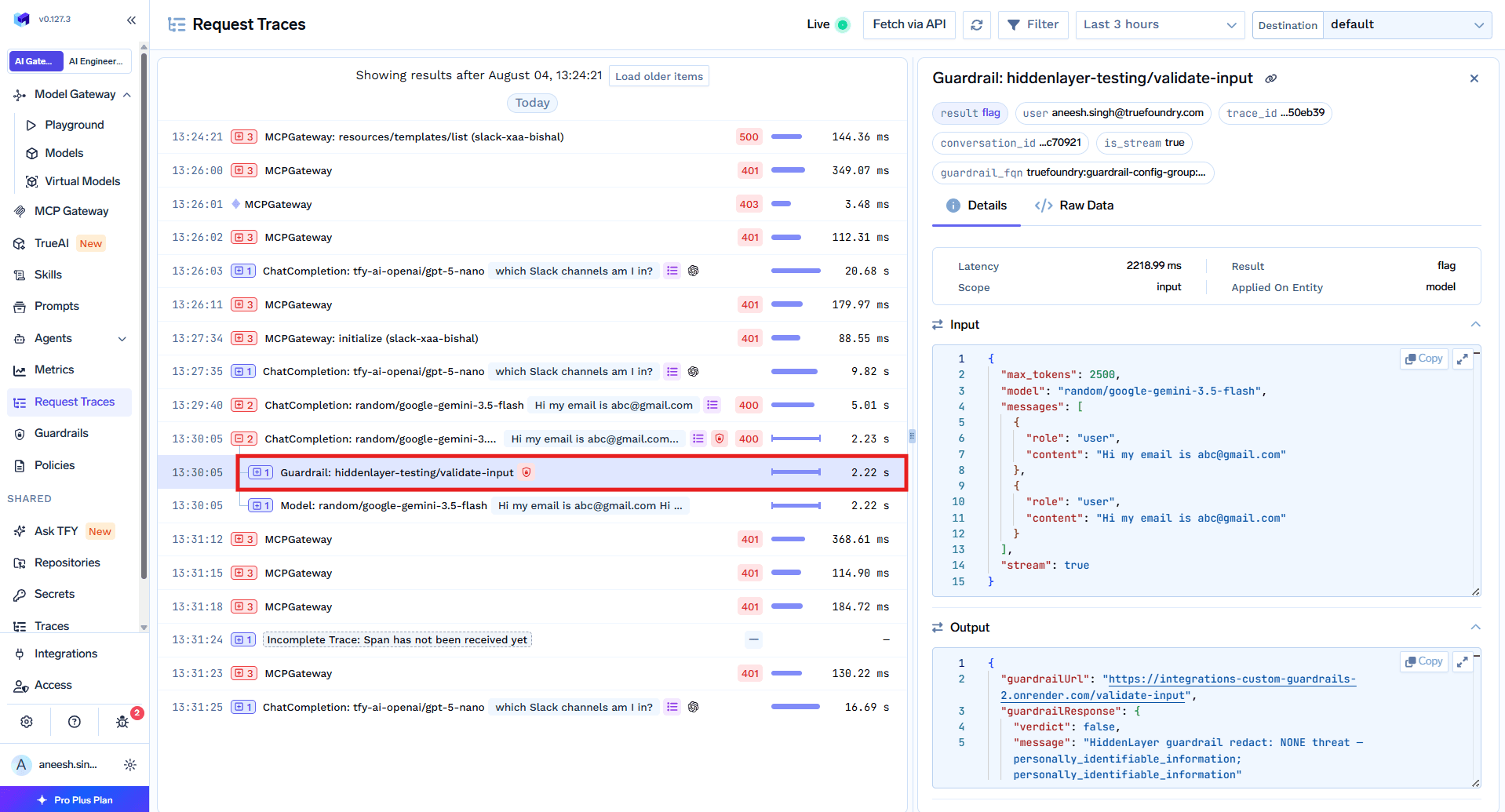
Because the gateway is in the request path rather than beside it, two things become possible that an observability-only tool cannot do. Guardrails run inline — PII redaction, prompt injection detection, moderation, blocking rather than scoring — with no separate per-token SKU. And budgets are enforced, not just reported: spend limits that stop requests, per user, team, model or metadata key.
Want the data in Datadog anyway? TrueFoundry emits OpenTelemetry-compliant traces, and OTEL export from the gateway works against any OTLP-compatible backend — the gateway becomes the collection point, Datadog the correlation layer.
The honest limitation: if you do not want a proxy in the request path, most of this is inert, and our eval tooling is less developed than eval-first platforms like Braintrust or DeepEval. Cost observability and enforcement is where the gateway earns its place.
Datadog’s 2026 repricing is more reasonable than its reputation suggests: the billable unit is the narrowest in the market, sampling does not blind the dashboards, and at scale the marginal rate is 56% below February’s. The case against is what sits outside the card — guardrails as a separate contact-us SKU, retention beyond 15 days at a rate whose interaction with the base is undocumented, no host allotment, and two structural changes in seven months.
It comes down to what you want to own. If you want one vendor correlating everything and accept a metered span count, Datadog is a strong, broad product and nothing here argues otherwise. If you would rather the telemetry be a by-product of a control point you already need — one that enforces budgets and runs guardrails inline, and exports to Datadog over OTEL if you want both — that is the gateway-native argument.
All prices above are Datadog’s published list rates as read on 25 September 2026 and are subject to change. Verify at datadoghq.com/pricing before committing.
TrueFoundry AI Gateway delivers ~3–4 ms latency, handles 350+ RPS on 1 vCPU, scales horizontally with ease, and is production-ready, while LiteLLM suffers from high latency, struggles beyond moderate RPS, lacks built-in scaling, and is best for light or prototype workloads.




Two tiers under the new name, Agent Observability: Free at $0/month for up to 40K LLM spans, 15-day retention; and Pro at $160/month annual with 100K LLM spans included and $3.50 per additional 10K. Month-to-month is $200 and $4.20 per 10K; on-demand $240 and $5.00 per 10K. Rates are higher in ap1, ap2 and uk1.
Yes — Datadog renamed it. /product/llm-observability/ 301-redirects to /products/ai/agent-observability/. The docs path and pricing anchor still use the old name, which is why both appear in search.
A single call to an LLM provider. Of the seven span kinds, only LLM bills — workflow, agent, tool, task, embedding and retrieval are free.
No — Datadog states it is standalone. It also does not draw on APM allotments, so every span above your tier is net-new spend. Whether LLM traces are separately billed as APM traces is undocumented; ask your account team.
No. Agent Observability detects prompt injection as an evaluation. Real-time blocking is AI Guard, a separate product billed per million input tokens evaluated including full conversation context, with no published rate.
Use DD_LLMOBS_SAMPLE_RATE — sampling does not affect Agent Observability metrics, which stay based on 100% of instrumented traffic.



The latest news, articles, and resources sent to your inbox
.png)
.png)
.png)
.png)
.png)
.png)
.png)
.png)
.webp)
.webp)