


October 1, 2026
|
5 min read


Obtenha acesso instantâneo a um ambiente TrueFoundry ao vivo. Implante modelos, direcione o tráfego de LLM e explore a plataforma completa — seu sandbox estará pronto em segundos, sem necessidade de cartão de crédito.



Published: May 21, 2026

Blazingly fast way to build, track and deploy your models!
Enterprises today face complex challenges in integrating AI with diverse internal systems. The Model Context Protocol (MCP) defines a standardized JSON-RPC interface allowing organizations to expose Tools, Resources, and Prompts to AI models without bespoke code.
By decoupling AI-driven applications from point-to-point integrations, an enterprise MCP Server delivers multi-tenant isolation, geo-distributed scaling, unified observability, and governance controls, all while accelerating development and reducing operational risk. In the following sections, we’ll examine core MCP Server components, architectural patterns for enterprise deployments, and security best practices. Finally, we’ll highlight how TrueFoundry’s AI Gateway leverages MCP with server groups, an interactive playground, and seamless integration within the TF console.
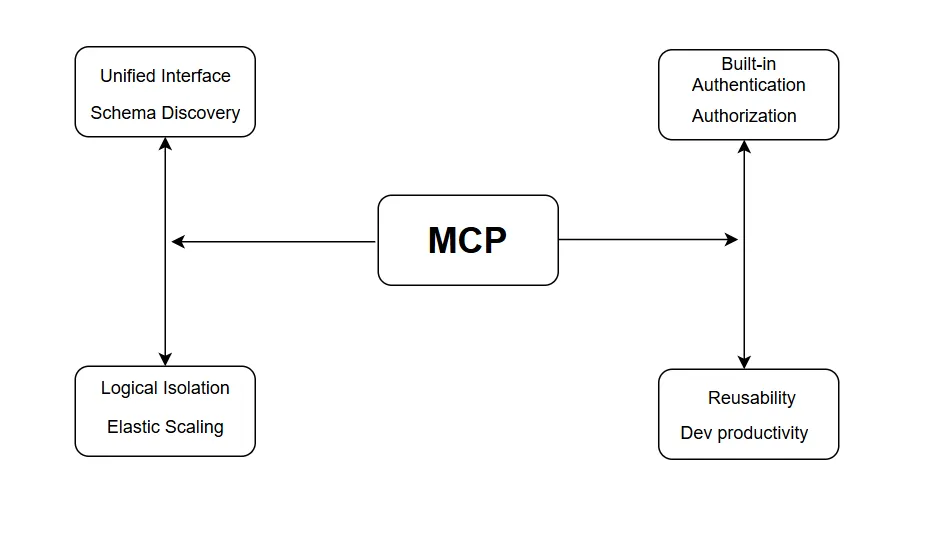
Enterprises adopting AI face growing complexity as they integrate models with diverse internal systems, CRMs, data warehouses, document stores, and more. An enterprise MCP server delivers critical value by standardizing these integrations, enforcing governance, and enabling scalable, secure deployments.
Unified Interface for All Services: MCP exposes internal capabilities as three well-defined abstractions: Tools (invokable actions), Resources (read-only endpoints), and Prompts (preconfigured templates). This removes the need to write custom API wrappers for each service, dramatically reducing development overhead.
Consistent Schema & Discovery: Clients perform a simple handshake to discover available capabilities and their schemas. This eliminates brittle point-to-point code and ensures that new services can be onboarded by merely registering them with the MCP Server.
To understand how centralized discovery works at scale, explore our detailed guide on What is an MCP Registry?
Logical Isolation: MCP Servers support namespaces or “server groups” to partition workloads by environment (development, staging, production) or by business unit. This ensures strict separation of data and permissions, meeting enterprise multi-tenant requirements without complex custom architectures.
Elastic Scaling: Packaged as containerized microservices, MCP Servers can be deployed behind load balancers and auto-scaled across regions. Enterprises can handle thousands of concurrent model calls with predictable low latency and high availability.
Built-in Authentication & Authorization: By integrating standard OAuth/OIDC flows and role-based access control (RBAC), MCP enforces least-privilege access to sensitive tools and data endpoints. Tokens and scopes ensure that only authorized AI agents can invoke specific operations.
Sandboxing & Input Validation: MCP Servers validate all incoming JSON-RPC requests against registered schemas, mitigating risks such as prompt injection or malformed payloads. This sandboxed execution protects backend systems from unintended side effects.
End-to-End Tracing: Every tool invocation and data fetch is logged with unique request identifiers. Distributed tracing systems (e.g., OpenTelemetry) can correlate AI prompt inputs to downstream service calls, simplifying root-cause analysis.
Centralized Metrics & Alerts: MCP exposes metrics such as request volume, error rates, and latency distributions to enterprise monitoring platforms (Prometheus, Datadog). This empowers DevOps teams to set SLAs and alarms for AI-driven workflows.
Reusable Components: Once an MCP Server is in place, teams can onboard new AI use cases, chatbots, analytics, and automation by simply defining new Tools or Resources. There’s no need to reinvent integration logic each time.
Developer Productivity: The interactive MCP playground (available in platforms like TrueFoundry) lets engineers explore and test service endpoints live, shortening feedback loops and reducing integration bugs.
By providing a standardized, secure, and scalable integration layer, MCP transforms AI from an isolated experiment into a governed, enterprise-grade capability, accelerating innovation and reducing operational risk.

The MCP Server acts as the centralized gateway through which AI models interact with an enterprise’s internal services. By defining a clear protocol for invoking actions, fetching data, and assembling prompts, it eliminates custom integration code and enforces consistency across applications.
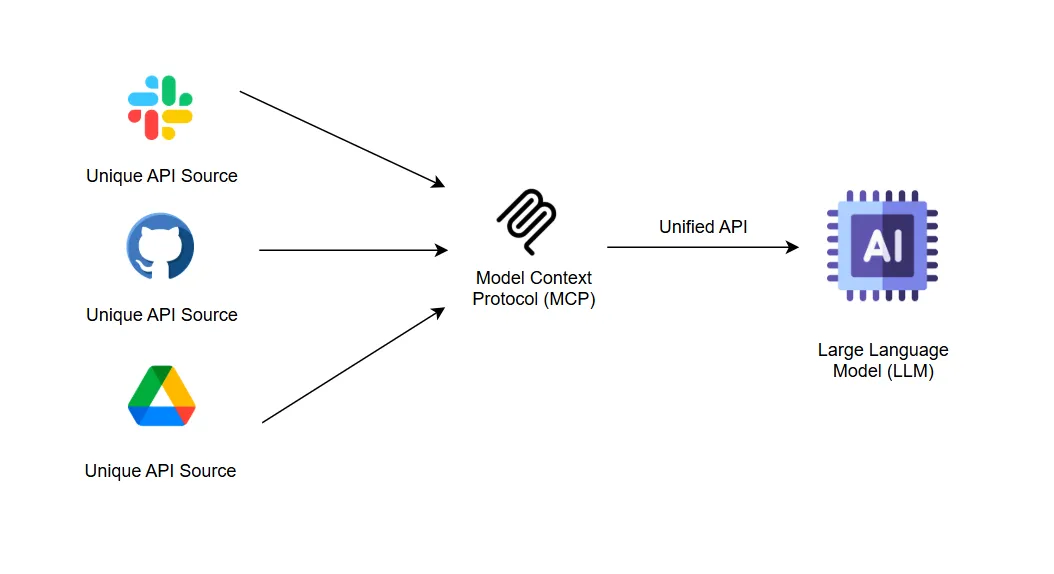
Below, we examine its five core components and how they work together to deliver a secure, scalable, and maintainable integration layer.
Tools expose enterprise capabilities as named functions with strict input and output schemas. When a client issues a tool.invoke request, the MCP Server validates the payload, executes the underlying operation, such as creating a calendar event or triggering a payment, and returns the result or an error in JSON. Centralizing these actions eliminates the need for custom API glue code and standardizes error handling.
Resources provide read-only access to contextual data via a defined response schema that mirrors backend structures. A client’s resource.get request prompts the server to fetch information, such as customer profiles, inventory levels, or knowledge-base entries, and return it in structured JSON. This separation of data retrieval from action invocation preserves clear audit trails and prevents unintended side effects.
Prompts consist of predefined text templates or parameterized instruction sets that guide model behavior consistently. When a client references a prompt by name and supplies dynamic values, the server merges those inputs into a compliant prompt string. This approach enforces corporate style guidelines and simplifies prompt updates without modifying client implementations.
The MCP Server supports two communication modes. Local integrations use standard input/output streams for direct, low-latency embedding in desktop or command-line environments. Remote deployments rely on HTTP with Server-Sent Events to support long-running operations and partial result streaming. Teams choose the appropriate transport based on their infrastructure and performance requirements.
The handshake mechanism enables clients to discover server capabilities and negotiate compatibility. A client sends an mcp.handshake call to retrieve the server’s protocol version, supported transports, and a catalog of registered tools, resources, and prompts, along with their schemas. With that metadata, the client adapts dynamically, supporting backward compatibility and gradual feature rollout.
An enterprise MCP server deployment follows a clear host-client-server topology that cleanly separates responsibilities. Hosts, such as AI agents or applications, embed MCP client libraries that manage communication and context tracking. These clients perform an initial handshake with one or more MCP servers to discover available Tools, Resources, and Prompts along with their input and output schemas.
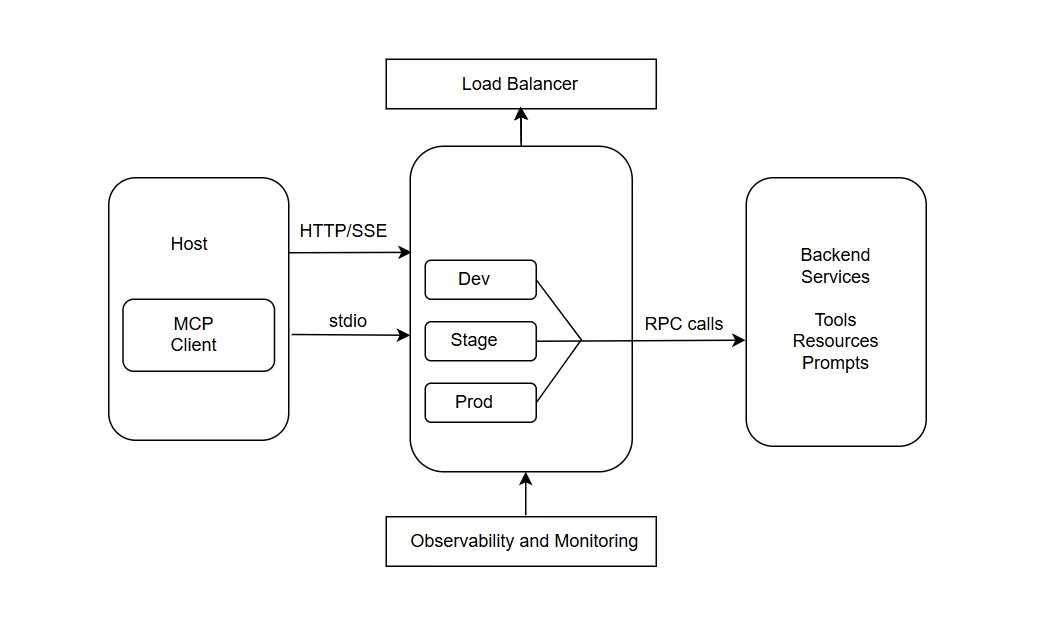
Once capabilities are registered, hosts invoke actions or fetch data by sending JSON-RPC requests over the selected transport, and servers route them to the appropriate backend systems. This pattern eliminates hardcoded integrations and allows hosts to adapt to new services simply by updating server configurations.
To support high volumes of concurrent model calls, enterprises deploy MCP servers in containerized clusters behind load balancers. Horizontal scaling ensures capacity can grow on demand, while multi-region deployments reduce latency for globally distributed teams.
Logical isolation is achieved by grouping servers into namespaces or server groups, which may correspond to environments (dev, staging, production), business units, or regions. Each group enforces its own authentication tokens and role-based access controls, guaranteeing that only authorized hosts can invoke specific actions or access sensitive data. Canary or blue-green deployment strategies allow gradual rollouts of new capabilities with minimal impact on ongoing operations.
Robust observability is central to maintaining reliability and compliance. Enterprise MCP servers emit structured logs for every invocation, including timestamps, request identifiers, payload schemas, and response statuses. Integration with distributed tracing systems enables teams to follow request flows from the AI prompt through downstream services, expediting root-cause analysis in case of failures. Metrics such as request volume, error rates, and latency percentiles feed into centralized monitoring dashboards and alerting engines, empowering DevOps teams to define service-level objectives and receive early warnings of degradation.
By combining a modular host-client-server design with scalable deployment patterns and comprehensive monitoring, an enterprise MCP server architecture provides a resilient, secure, and extensible foundation for integrating AI models with diverse internal systems.
MCP (Model Context Protocol) servers act as a standardized bridge between AI applications, such as large language models (LLMs), and enterprise systems. Instead of building custom point-to-point integrations for every AI model and backend system, enterprise MCP servers provide a uniform interface. This allows AI agents to securely and dynamically access enterprise data, tools, and workflows. You can think of them as a “USB-C for AI”, enabling multiple AI agents to connect to enterprise capabilities without worrying about system-specific complexities.
MCP servers sit between the AI client and enterprise backend, decoupling AI logic from system changes. This ensures that updates to backend APIs only require adjustments on the MCP server, not the AI agent itself. MCP servers provide standardized abstractions that make enterprise capabilities accessible in a predictable way:
MCP servers support multiple connection methods depending on enterprise requirements for security, latency, and scalability:
MCP servers in enterprises unlock a wide range of practical applications:
Security and governance are foundational to deploying MCP servers in enterprise environments. Since MCP servers act as intermediaries between AI applications and internal systems, they must enforce strict controls over who can access what, under which conditions, and with full traceability.
MCP supports modern enterprise authentication standards, including OAuth 2.0, OpenID Connect (OIDC), and API token-based mechanisms. When an AI host attempts to invoke a tool or resource, the MCP server verifies its identity and validates the associated scopes or roles. Enterprises can configure fine-grained role-based access control (RBAC) to limit access to specific server groups, tools, or resource paths. This helps enforce the principle of least privilege and prevents unauthorized access to sensitive operations.
MCP servers can be logically divided into server groups to isolate environments (such as dev, staging, and production) or separate business units. Each group can have its own access policies, tokens, and usage limits. This design prevents cross-contamination between environments and ensures that testing workloads never interfere with production systems.
MCP enforces strict input and output validation using JSON schema definitions registered during tool and resource setup. Any request that deviates from the defined schema is automatically rejected. This reduces the risk of malformed payloads, injection attacks, and unintended side effects, particularly when AI models generate dynamic requests.
Every invocation to a tool, resource, or prompt is logged with rich metadata, including timestamps, user identifiers, input payloads, and response outcomes. These logs can be integrated into enterprise Security Information and Event Management (SIEM) systems for real-time monitoring and incident response. Additionally, distributed tracing tools like OpenTelemetry allow full traceability from model prompt to backend execution, supporting compliance with internal audit and regulatory requirements.
MCP servers support rate limiting, token expiration policies, and usage quotas to prevent misuse or overconsumption. Enterprises can implement governance layers on top of MCP to enforce approval workflows, usage caps, and audit-based reviews for high-risk tools or data endpoints.
Together, these controls ensure that MCP servers operate as secure, policy-compliant, and auditable gateways between AI systems and core enterprise infrastructure.
While MCP (Model Context Protocol) servers provide a powerful way to integrate AI applications with enterprise systems, deploying them at scale comes with several challenges that organizations must address.
As empresas frequentemente possuem sistemas diversos e legados, desde plataformas ERP como SAP até ferramentas internas personalizadas. Garantir que os servidores MCP possam se conectar de forma confiável a todos esses sistemas sem interromper os fluxos de trabalho exige planejamento cuidadoso, testes rigorosos e, às vezes, adaptadores personalizados. A integração em múltiplos ambientes pode ser complexa, especialmente quando as APIs são inconsistentes ou mal documentadas.
À medida que o uso de IA cresce, os servidores MCP devem lidar com altos volumes de requisições simultâneas de múltiplos agentes de IA. Dimensionar esses servidores horizontalmente, gerenciar balanceamento de carga, e manter respostas de baixa latência em diferentes geografias pode ser desafiador, especialmente para empresas com equipes distribuídas globalmente.
Os servidores MCP lidam com dados corporativos sensíveis. A implementação de mecanismos robustos de autenticação, autorização e criptografia é fundamental. As empresas também precisam garantir a conformidade com regulamentações de privacidade de dados como GDPR ou HIPAA, e erros nos controles de acesso baseados em função ou no registro de auditoria podem criar sérios riscos de conformidade.
Manter uma implantação MCP confiável exige monitoramento contínuo de requisições, taxas de erro e latência. Sem a observabilidade adequada, falhas em sistemas a jusante ou interações de IA podem passar despercebidas, impactando as operações. A integração de sistemas de registro estruturado (logging), rastreamento (tracing) e alerta é necessária, mas adiciona complexidade operacional.
APIs corporativas e sistemas internos evoluem frequentemente. Os servidores MCP devem se adaptar a essas mudanças, garantindo a compatibilidade retroativa para agentes de IA. Lançar atualizações sem interromper as integrações ativas exige versionamento cuidadoso, implantações canary e testes.
Definir políticas de acesso granular para diferentes agentes de IA e departamentos pode ser desafiador. As empresas devem aplicar políticas RBAC rigorosas, mascarar dados sensíveis e manter registros de auditoria sem afetar o desempenho do sistema ou a funcionalidade da IA.
Servidores MCP em sistemas corporativos oferecem controle total, alta personalização e forte privacidade de dados, embora exijam mais esforço para implantar, manter e escalar, enquanto os Serviços MCP oferecem uma solução pronta para uso, totalmente gerenciada e escalável que permite às equipes focar em aplicações de IA em vez de infraestrutura, ainda que com um pouco menos de controle.
A TrueFoundry estende o modelo MCP padrão com ferramentas poderosas prontas para empresas dentro de seu AI Gateway. Em vez de gerenciar endpoints de servidor dispersos, os desenvolvedores podem registrar, testar e orquestrar Servidores MCP a partir de uma única interface unificada. Isso otimiza não apenas a implantação, mas também a governança, a observabilidade e a experiência do desenvolvedor. Seja invocando uma ferramenta Kubernetes ou acessando um recurso específico de negócios, a TF garante segurança, desempenho e escalabilidade consistentes. Abaixo, exploramos as três capacidades centrais que tornam isso possível.
MCP Gateway da TrueFoundry oferece um registro MCP centralizado que lista todos os servidores MCP internos e externos organizados em grupos lógicos.
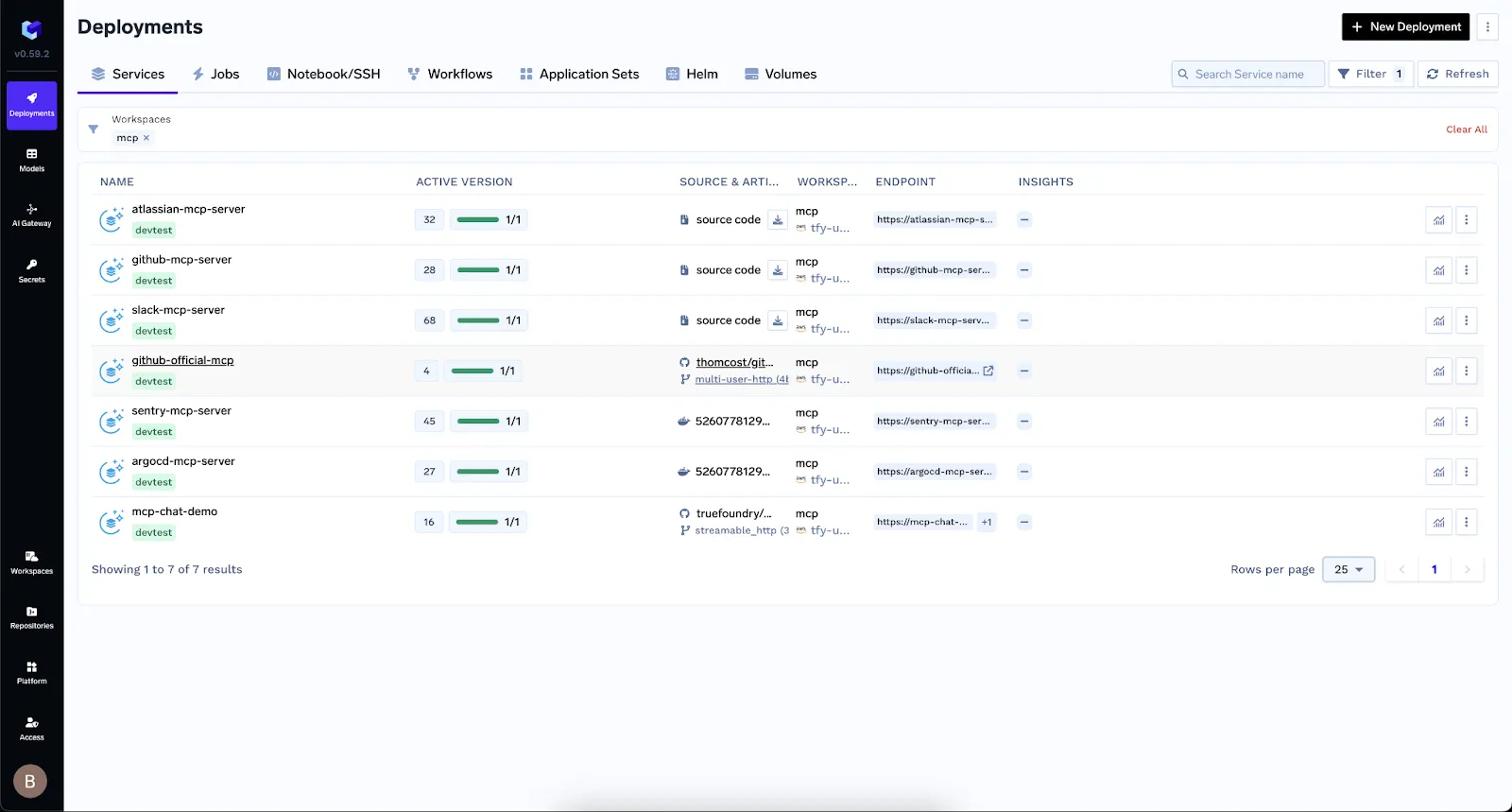
Esses grupos permitem o isolamento de ambientes (como desenvolvimento, homologação e produção) e suportam fluxos de trabalho de aprovação. Cada servidor é versionado, detectável e totalmente auditável, simplificando a governança e otimizando os esforços de integração.
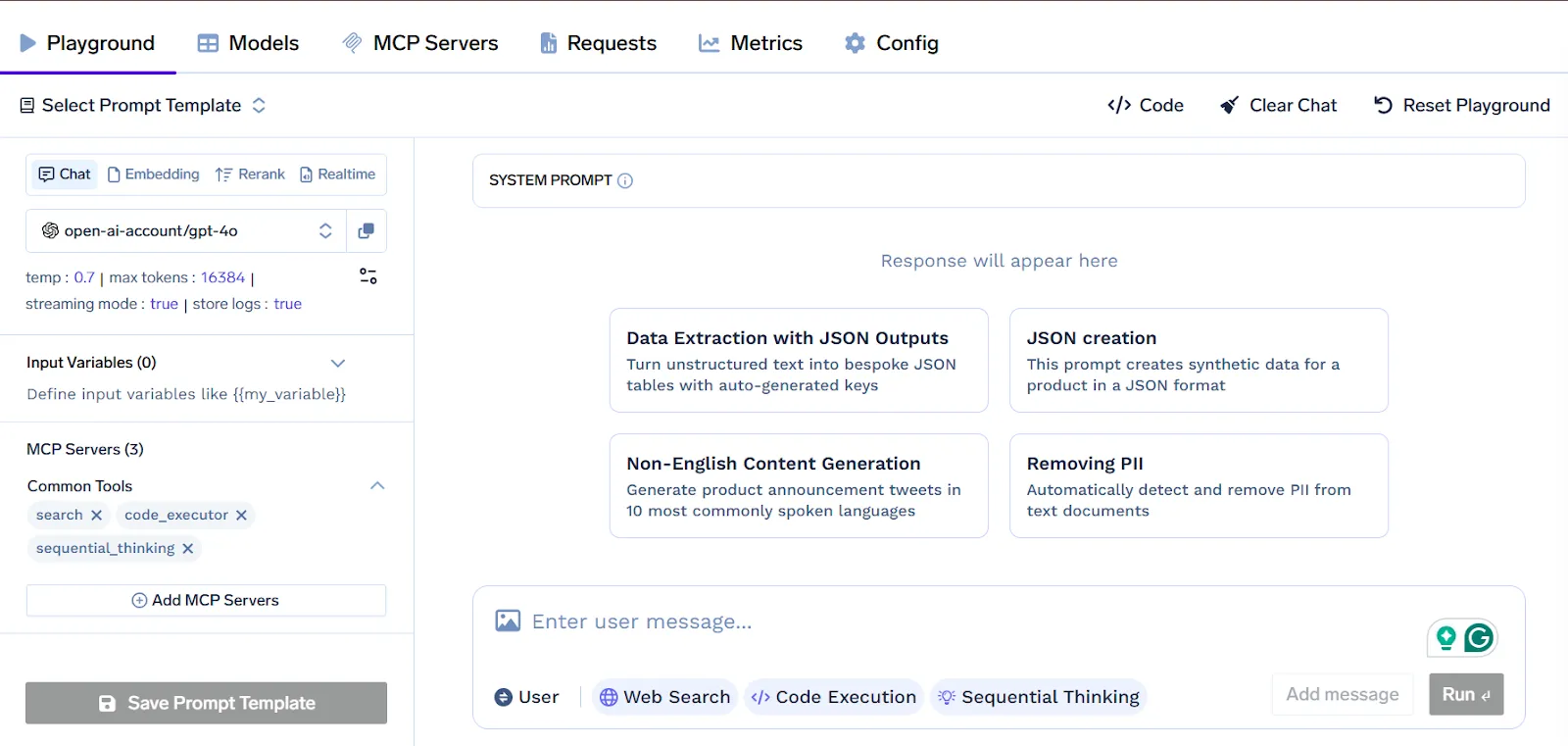
Após o registro, os servidores MCP ficam instantaneamente disponíveis no TrueFoundry Playground. Os desenvolvedores podem inspecionar esquemas, testar ferramentas e executar prompts em tempo real — tudo sem escrever código. O Gateway suporta conectores pré-construídos (Slack, GitHub, Datadog, Sentry) e serviços personalizados, utilizando as abstrações MCP, Ferramentas, Recursos e Prompts para uma integração perfeita.
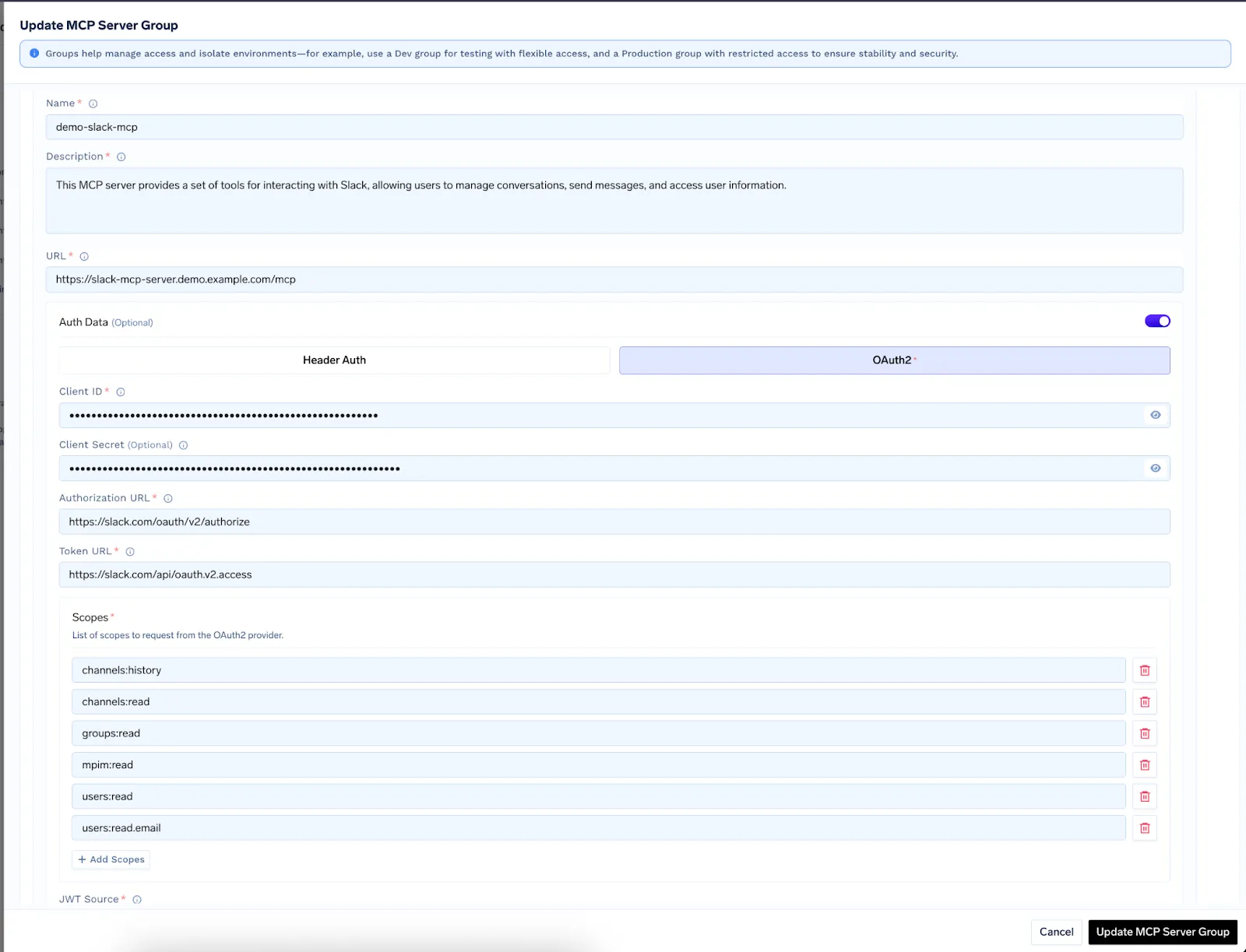
A TrueFoundry gerencia a autenticação centralmente usando logins federados via Okta, Azure AD e OAuth2, além de opções para tokens baseados em cabeçalho. O Gateway lida com trocas de tokens e ciclos de atualização, armazenando credenciais com segurança. Os administradores podem configurar políticas de controle de acesso para garantir que apenas usuários e agentes autorizados chamem servidores MCP específicos.
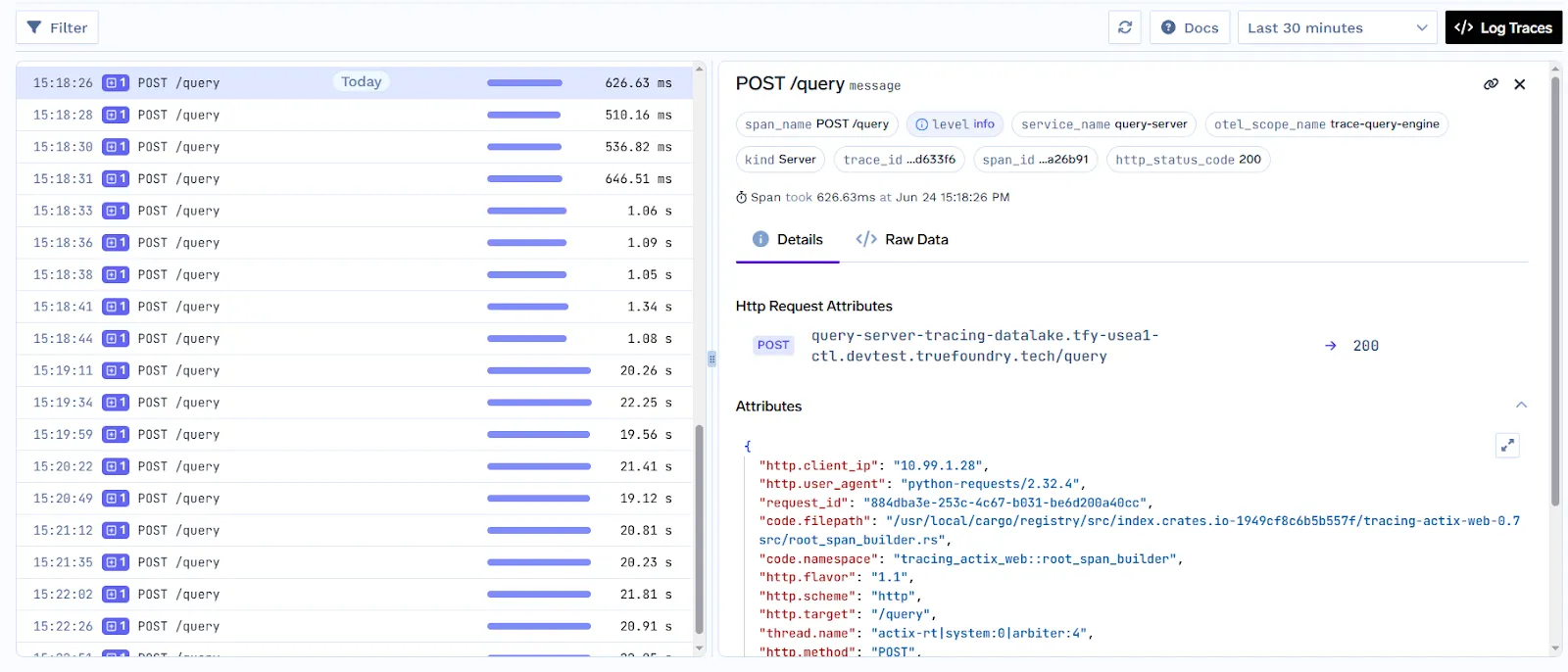
Cada solicitação entre agentes de IA e servidores MCP passa pelo Gateway, permitindo total observabilidade. O sistema registra telemetria estruturada, incluindo volumes de solicitação, latência, taxas de erro e metadados. Todas as ações são registradas por rastreamento, auditadas e podem ser visualizadas ou exportadas para ferramentas de monitoramento. O controle de acesso baseado em função, a limitação de taxa e a governança centralizada garantem uma operação segura e em conformidade.
Servidores MCP em empresas permitem que sistemas de IA interajam com segurança com ferramentas e dados internos da empresa, tornando-os um poderoso facilitador para automação e suporte à decisão. No suporte ao cliente, o MCP conecta agentes de IA a CRMs e sistemas de tickets, permitindo-lhes recuperar histórico, escalar problemas ou rascunhar respostas usando prompts predefinidos, reduzindo o tempo de resposta e a carga de trabalho do agente.
Em finanças, os Servidores MCP expõem Recursos para consultar sistemas contábeis ou data warehouses. Modelos de IA os utilizam para gerar resumos mensais, identificar anomalias ou preparar relatórios de conformidade. Como o acesso é vinculado ao esquema e somente leitura, ele se alinha às políticas de auditoria e segurança.
Equipes de cadeia de suprimentos usam ferramentas MCP para verificar o estoque, fazer pedidos ou coordenar com fornecedores. Grupos de servidores permitem isolar fluxos de trabalho por geografia ou departamento, mantendo controle e confiabilidade.
Vendas e marketing se beneficiam de assistentes de IA alimentados por MCP que obtêm dados de produtos personalizados, preços e insights competitivos em tempo real, aumentando a velocidade e a relevância dos negócios. Em operações de TI, agentes de IA podem acionar ações de infraestrutura, como reiniciar serviços ou verificar logs via ferramentas MCP, com segurança e com trilhas de auditoria completas.
Em todas as funções, o MCP conecta o raciocínio da IA com a execução empresarial, ajudando as empresas a automatizar de forma responsável, melhorar a produtividade e reduzir a sobrecarga de integração.
O Servidor do Protocolo de Contexto de Modelo (MCP) oferece às empresas uma maneira padronizada, segura e escalável de integrar sistemas de IA com ferramentas e dados internos. Ao separar a lógica de aplicação dos serviços de backend, o MCP permite um desenvolvimento mais rápido, uma governança mais robusta e observabilidade consistente.
Com suporte para ferramentas, recursos e prompts, ele transforma a IA de um assistente passivo em um operador empresarial ativo. Plataformas como a TrueFoundry aprimoram ainda mais essa experiência com onboarding seguro, testes interativos e controle unificado através de seu AI Gateway. Para organizações que buscam operacionalizar a IA de forma segura e eficiente, o MCP oferece a espinha dorsal de infraestrutura para tornar isso possível em escala.
Um servidor MCP corporativo é uma camada de integração padronizada que conecta LLMs de forma segura a dados e ferramentas internas. Ele utiliza o Protocolo de Contexto de Modelo para fornecer uma ponte universal, substituindo integrações codificadas sob medida. Isso permite que as equipes de plataforma mantenham governança centralizada, autenticação e controle de acesso granular sobre recursos corporativos sensíveis.
As empresas devem usar servidores MCP para eliminar a proliferação de integrações e prevenir a dependência de fornecedor. Ao padronizar como os modelos de IA descobrem e interagem com APIs internas, as organizações podem acelerar o desenvolvimento de agentes, garantindo estrita conformidade de segurança. Esta arquitetura desacopla o motor de raciocínio da fonte de dados, permitindo atualizações de modelo contínuas em toda a pilha.
Os principais benefícios incluem descoberta rápida de ferramentas, redução da sobrecarga de engenharia e segurança de dados aprimorada. Os servidores MCP permitem integrações "escreva uma vez, use em qualquer lugar" que funcionam em diferentes provedores de LLM. Além disso, eles fornecem trilhas de auditoria abrangentes e mascaramento de PII, garantindo que os agentes autônomos operem com segurança em ambientes corporativos governados enquanto acessam contexto em tempo real.
Servidores MCP empresariais padronizam a forma como os modelos de IA se conectam a diversos sistemas, expondo Ferramentas, Recursos e Prompts através de uma interface JSON-RPC unificada. Isso elimina a necessidade de conectores personalizados, acelera o desenvolvimento e garante consistência entre projetos. As empresas ganham uma integração mais rápida de novos serviços e redução da sobrecarga de manutenção.
Um servidor MCP compreende cinco partes principais: Ferramentas para invocar ações, Recursos para dados somente leitura, Prompts para instruções baseadas em modelos, Transportes (HTTP ou STDIO) para comunicação e um mecanismo de Handshake para descoberta de capacidades. Juntos, eles impõem esquemas, permitem a descoberta dinâmica e fornecem uma interface previsível para agentes de IA.
Os servidores MCP em empresas são protegidos pela integração de OAuth 2.0 ou OIDC para autenticação, impondo controle de acesso baseado em função e isolando logicamente grupos de servidores. A validação de entrada contra esquemas JSON previne solicitações malformadas. Logs de auditoria e rastreamento distribuído oferecem visibilidade total, enquanto limites de taxa e políticas de governança garantem a conformidade com regulamentações internas e externas.
O AI Gateway da TrueFoundry centraliza o registro, autenticação e gerenciamento de tokens do Servidor MCP. Seu Playground interativo permite que os desenvolvedores testem Ferramentas, Recursos e Prompts sem código. A API de Chat integra agentes conversacionais com controles de governança. Dashboards unificados fornecem métricas, logs e alertas, facilitando o gerenciamento de segurança, escalabilidade e experiência do desenvolvedor em todas as implantações de MCP.
TrueFoundry AI Gateway delivers ~3–4 ms latency, handles 350+ RPS on 1 vCPU, scales horizontally with ease, and is production-ready, while LiteLLM suffers from high latency, struggles beyond moderate RPS, lacks built-in scaling, and is best for light or prototype workloads.





As últimas notícias, artigos e recursos enviados para sua caixa de entrada
.png)
.png)
.png)
.png)
.png)
.png)
.png)
.png)
.png)
.png)
.png)


