


October 22, 2026
|
5 min read


Obtenha acesso instantâneo a um ambiente TrueFoundry ao vivo. Implante modelos, direcione o tráfego de LLM e explore a plataforma completa — seu sandbox estará pronto em segundos, sem necessidade de cartão de crédito.



Blazingly fast way to build, track and deploy your models!
In July 2025, Replit's AI coding agent wiped an entire production database during a live coding session. In January 2026, CVE-2026-25253 - the first CVE ever assigned to an agentic AI system, demonstrated remote code execution through a crafted skill package in the OpenClaw runtime. Weeks later, the ClawHavoc campaign saw attackers publish over 1,200 malicious skills to the OpenClaw marketplace, deploying the AMOS credential stealer across enterprise developer machines.
These aren't theoretical attack scenarios from a security research paper. They are production incidents from the first twelve months of enterprise-scale agentic AI deployment. And they represent only the documented failures - the ones publicly disclosed. The gap between disclosed and actual incidents is likely far larger.
The enterprise AI agent security market is being built in response to a deployment wave that is already happening. Organizations are not waiting for security tooling to mature before deploying agents, they're deploying agents and then discovering the security gaps under live conditions.
This guide maps the complete enterprise AI agent security solutions landscape: what the attack surface looks like, how the vendor market is organized, where the gaps are, and what a complete enterprise security architecture looks like for agentic AI in 2026. It covers how TrueFoundry's AI Gateway and MCP Gateway function as the infrastructure control plane within this broader ecosystem.
The instinct of most security teams evaluating agentic AI is to apply the same tooling that governs their SaaS applications: WAF for the API surface, CASB for data governance, DLP for sensitive data, SIEM for event correlation. All of these tools are necessary. None of them are sufficient.
Traditional security tools are designed around a specific assumption: a human initiates an action, and the action is discrete. A user clicks send on an email. A developer runs a git push. A query executes against a database. Each action has a clear initiator, a clear scope, and a clear completion boundary.
AI agents violate every part of this assumption. An agent:
OWASP's Agentic AI Top 10 (2025) formalizes this threat landscape. The top three risks are prompt injection and jailbreaks, memory poisoning (corrupting the agent's long-term memory store), and tool/plugin misuse - none of which have adequate coverage in traditional security tooling. WAFs don't understand agent reasoning chains. DLP doesn't inspect the content of an LLM's context window. CASB doesn't attribute tool calls to user identity when the tool call originates from an agent process.
The security gap is not a configuration problem. It's a category mismatch. Enterprises need purpose-built tooling for the agentic layer and in 2026, that market has organized into five distinct vendor categories.
Understanding the vendor landscape requires understanding the attack surface it's designed to protect. Enterprise AI agents have five distinct layers where threats materialize:
The vendor market is organized around these five layers. No single vendor covers all five comprehensively. Understanding what each vendor category addresses and where the gaps remain, is the foundation of an enterprise evaluation.
The problem this solves: AI agents are non-human identities with privileged access. Traditional PAM tools were built for human users. Agents spin up and down dynamically, often have over-provisioned credentials, and aren't tied to the offboarding flows that revoke human access when employees leave.
CyberArk is the dominant vendor in this category, having expanded its Identity Security Platform specifically for AI agent identities. Key capabilities include automated agent discovery across SaaS, cloud, and developer environments; zero standing privilege enforcement; and just-in-time credential issuance. CyberArk's research found that fewer than 10% of organizations have adequate privilege controls for their AI agent identities - a market CyberArk is explicitly targeting.
What it misses: CyberArk governs credential issuance and identity lifecycle. It doesn't inspect the content of what those credentials are used to do the prompt, the tool call, the response. You need other layers for that.
The problem this solves: Behavioral detection of malicious agent activity at runtime - prompt injection attempts, jailbreaks, anomalous tool sequences, data exfiltration patterns.
Palo Alto Networks Prisma AIRS (version 3.0, released March 2026) is the most comprehensive platform in this category- covering AI application security, AI model security, AI data protection, and AI agent protection in a unified platform. The AI Runtime Firewall inspects LLM I/O for injection patterns and policy violations. AIRS includes AI red teaming capabilities and posture management.
Lasso Security focuses specifically on prompt injection protection and LLM interaction monitoring across agentic workloads, with MCP visibility as a key differentiator. Straiker and HiddenLayer round out the category with model-level threat detection and red teaming.
What they miss: Runtime security platforms detect threats but typically don't govern infrastructure - they sit in monitoring mode. They don't enforce model access control, budget caps, rate limits, or provide the MCP server registry that determines which tools agents can reach in the first place.
The problem this solves: Centralized governance of every LLM request - authentication, model routing, rate limiting, budget enforcement, and request-level observability. The AI gateway sits between the agent and the model provider as a transparent proxy.
This is a crowded category: TrueFoundry AI Gateway, Portkey, LiteLLM, Bifrost, and cloud-native options via AWS Bedrock and Google Vertex AI. The key differentiators are multi-provider support (whether the gateway can route to Anthropic, OpenAI, Azure, Bedrock, and Vertex simultaneously), the depth of observability, and whether the gateway integrates with an MCP governance layer.
TrueFoundry AI Gateway is specifically built for enterprise agentic deployments - with sub-4ms p95 latency, 350+ RPS on 1 vCPU, virtual key management that never exposes the underlying provider API key to end users, and native integration with TrueFoundry's MCP Gateway for unified LLM + tool governance.
What they miss: AI gateways govern the model call layer. Without a companion MCP Gateway, tool invocations - which are where the most consequential agent actions happen remain ungoverned.
The problem this solves: Centralized governance of every MCP tool invocation - which servers are reachable, which tools are accessible by which identities, pre-execution guardrails, and a complete audit trail of what each agent did with each tool.
This is the newest and fastest-growing category. With the MCP ecosystem expanding to thousands of servers, the supply chain risk has become significant. Snyk's ToxicSkills audit found 36.82% of 3,984 scanned agent skills had at least one security flaw. Arbitrary file read, RCE, and tool poisoning vulnerabilities have been documented in widely-used official MCP servers.
TrueFoundry MCP Gateway provides a centralized server registry with RBAC at the tool level, pre-execution guardrails that flag injection-pattern tool sequences, and a full invocation log - user identity, tool name, request payload, response, latency - exportable via OpenTelemetry to any SIEM.
See TrueFoundry MCP Gateway documentation for architecture details.
What they miss: MCP gateways govern tool access but don't inspect the model reasoning layer that drives tool selection for that, you need runtime security or AI gateway guardrails.
The problem this solves: Proactively identifying vulnerabilities in your agent deployments before attackers do - through automated red teaming, posture assessment, and continuous security scanning.
The vendor landscape described above maps to a specific mental model: some vendors detect threats; TrueFoundry enforces policy. These are complementary, not competing functions.
Palo Alto AIRS and Lasso Security watch agent behavior and alert when something looks wrong. TrueFoundry governs what can happen in the first place - before any threat has a chance to execute.
The architecture has three layers:
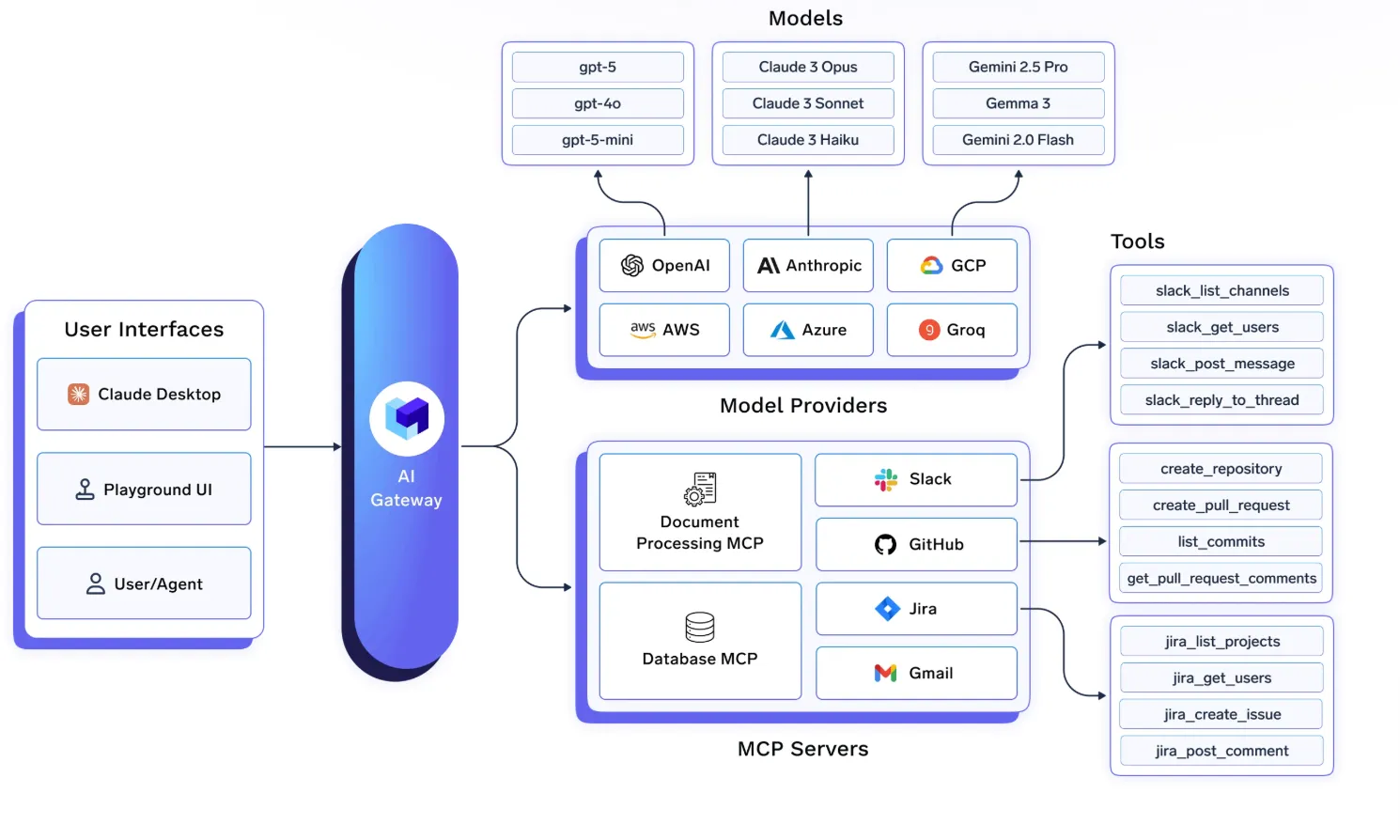
Every model call from every agent in your organization routes through TrueFoundry's AI Gateway via ANTHROPIC_BASE_URL (or the equivalent for OpenAI, Azure, Bedrock, and Vertex). At this layer:
For full deployment architecture, see TrueFoundry Claude Code integration guide.
Every MCP tool invocation routes through TrueFoundry's MCP Gateway - the single approved endpoint in managed-settings.json. At this layer:
For MCP governance architecture, see TrueFoundry MCP Gateway documentation.
The platform layer beneath both gateways: managed-settings.json deployed via MDM locks the endpoint configuration, tenant restrictions at the proxy prevent personal account auth bypass, and network egress controls scope browser and shell access. This is covered in detail in TrueFoundry's enterprise security for Claude guide.
OWASP's December 2025 Top 10 for Agentic Applications is the industry's first standardized risk framework for autonomous agents. Here's how the top risks map to concrete controls:
The cost of deploying enterprise AI agent security solutions is real. The cost of not deploying them is larger.
The Replit production database wipe was a business continuity incident with direct revenue impact. The ClawHavoc campaign targeted developer credential stores at enterprise scale. CVE-2026-25253 demonstrated RCE against agent runtime in a widely-deployed platform. These incidents generated real remediation costs, reputational damage, and in some cases regulatory scrutiny.
Beyond incidents, there's the compliance cost. Organizations running Cowork or Claude Code in HIPAA, SOC 2, GDPR, or financial regulatory contexts without request-level observability and MCP governance are operating with an audit gap they will eventually have to explain to an assessor. The earlier that gap is closed, the lower the cost of closure.
Security tooling in this category is priced in thousands of dollars per month for enterprise deployments. Incident response for a credential exfiltration at enterprise scale costs in the millions.
Enterprise AI agent security solutions are the set of platforms and controls designed to protect autonomous AI agent deployments from threats specific to agentic systems - prompt injection, tool misuse, identity compromise, supply chain attacks, and audit failures. They span five categories: identity security, runtime security , AI gateways, MCP gateways, and red teaming . No single platform covers all five layers; enterprise architectures layer multiple tools.
OWASP's Top 10 for Agentic Applications (December 2025) is the first industry-standard risk taxonomy built specifically for autonomous AI agents, distinct from the OWASP LLM Top 10. The top three risks are prompt injection, memory poisoning, and tool/plugin misuse - none of which have adequate coverage in traditional security tooling. It serves as the primary evaluation framework for assessing enterprise AI agent security posture.
An MCP Gateway is a centralized control layer between AI agents and the external tools they access via the Model Context Protocol. Without one, every MCP server a developer or agent connects to expands the attack surface directly - with no governance, no audit trail, and no least-privilege enforcement. With one, only approved servers are reachable, tool access is scoped by role, pre-execution guardrails block injection-triggered sequences, and every invocation is logged. See TrueFoundry MCP Gateway documentation for implementation details.
At minimum:
(1) Enterprise tier (not Team/Pro/Max),
(2) SSO + SCIM via your IdP,
(3) managed-settings.json via MDM with bypass disabled and credential paths blocked,
(4) All LLM traffic through TrueFoundry AI Gateway,
(5) All MCP traffic through TrueFoundry MCP Gateway,
(6) OTEL routing to your SIEM. This covers identity, model governance, tool governance, and observability. Runtime behavioral detection.
See the complete hardening guide in TrueFoundry Claude Code governance documentation.
The enterprise AI agent security market exists because the deployment wave preceded the security tooling. Organizations are running autonomous agents across their infrastructure today with varying degrees of governance, observability, and control. The incidents are no longer theoretical. The compliance gap is no longer theoretical. The regulatory scrutiny is no longer theoretical.
The vendor landscape has organized into five categories: identity security, runtime security, AI gateways, MCP gateways, and red teaming. No single vendor covers the full stack. The enterprises building defensible postures are the ones layering these categories deliberately - enforcement first, detection second, compliance as an output of both.
TrueFoundry's AI Gateway and MCP Gateway occupy the enforcement layer of this architecture: the control plane that determines what agents can access, in what quantities, with what governance, with what audit trail. The detection layer sits on top of that foundation. The compliance evidence flows from both.
The window for getting ahead of the deployment wave is narrowing. The organizations that build governance infrastructure now will have defensible postures before regulatory frameworks require them. The organizations that wait will build in response to incidents.
TrueFoundry AI Gateway delivers ~3–4 ms latency, handles 350+ RPS on 1 vCPU, scales horizontally with ease, and is production-ready, while LiteLLM suffers from high latency, struggles beyond moderate RPS, lacks built-in scaling, and is best for light or prototype workloads.





As últimas notícias, artigos e recursos enviados para sua caixa de entrada
.webp)

.png)
.png)
.png)
.png)
.png)
.png)
.png)
.png)
.png)
.png)
.png)


