


August 26, 2026
|
5 min read


Obtenha acesso instantâneo a um ambiente TrueFoundry ao vivo. Implante modelos, direcione o tráfego de LLM e explore a plataforma completa — seu sandbox estará pronto em segundos, sem necessidade de cartão de crédito.



Blazingly fast way to build, track and deploy your models!
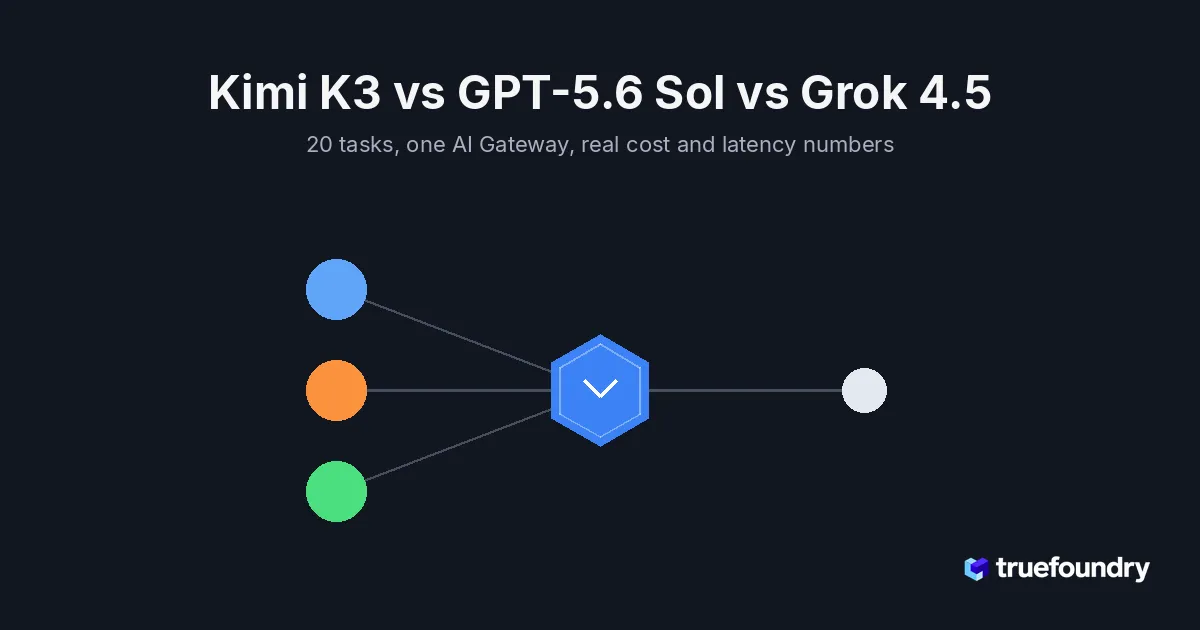
Moonshot AI's Kimi K3 opened at number one on the Arena.ai WebDev leaderboard, ahead of GPT-5.6 Sol, while pricing well below the frontier models it was compared against. That's one leaderboard measuring one thing: blind human preference on generated frontend code. We wanted to know whether that win holds up past frontend generation, so we ran our own task suite through TrueFoundry AI Gateway. Same 20 prompts, sent to Kimi K3, GPT-5.6 Sol, and Grok 4.5, each graded by a held-out judge model against a fixed rubric, covering debugging, code review, agentic terminal reasoning, and repo comprehension along with straight algorithmic coding.
Kimi K3 finished on top for quality: 4.9 out of 5 across the full 20-task suite. Grok 4.5 came in close behind at 4.7, and GPT-5.6 Sol trailed at 4.15. So the reputation is earned. This is a genuinely strong model well outside the frontend lane it was benchmarked on.
The asterisk is latency, and it's a big one. Kimi K3's median response time was about 81 seconds, roughly six to seven times slower than GPT-5.6 Sol or Grok 4.5, both of which typically answered in 11 to 13 seconds. The mean gap looks even worse (330 seconds versus 14) because one task took Kimi K3 over 78 minutes to finish. That's an outlier extreme enough to treat as a real finding rather than noise: whatever caused it happened on an actual call in this run, and it's exactly the kind of thing a quality-only leaderboard would never catch. Cost follows the same pattern. Kimi K3 averaged about $0.047 per task, roughly seven times Grok 4.5's $0.0065 and double GPT-5.6 Sol's $0.0235.
So here's the honest read: Kimi K3 earns the top quality score, but Grok 4.5 gets within 0.2 points of it for a fraction of the cost and a fraction of the wait. That gap isn't a rounding error once you're building anything closer to production, an agent loop, a CI check, a user-facing tool. If cost and speed matter as much as raw correctness, and for most real workloads they do, Grok 4.5 is the stronger practical pick, even though it isn't the one topping the arena leaderboard.
The category breakdown turns up two things more useful than any single average.
First, GPT-5.6 Sol came back completely empty on four separate tasks: two agentic-reasoning prompts and two code-review prompts, each scoring the minimum for producing nothing at all. That isn't a borderline miss. It's a reliability gap, and it only shows up because the suite ran enough tasks to hit it four times, all of them clustered in the agentic and review categories rather than spread evenly across the board.
Second, Grok 4.5 had exactly one real failure in the whole suite: it couldn't produce the shell command sequence asked for, finding recently modified files that import a deprecated module. A single miss out of 20 is still a strong result, but it's worth pointing out that Grok 4.5's one failure and GPT-5.6 Sol's four both landed in the same category, agentic reasoning, where models have to work through multi-step terminal problems without actually executing anything. Kimi K3 was the only one of the three with a perfect score across every agentic task.
Third, and the most interesting result in the whole run: Kimi K3 and Grok 4.5 both made the exact same mistake on the same repo-comprehension task. Given a six-month changelog and asked which two changes most likely caused a new performance regression, both models pointed to April's page-size increase as a primary culprit, when the stronger explanation was March's synchronous audit-logging middleware writing to the primary database on every request. GPT-5.6 Sol got partial credit here, essentially swapping the two but explaining its reasoning well enough to earn some of it back. Two independently trained models converging on the same wrong answer says more than either model's overall score does. It suggests something about how these models weigh recency against causal severity when changes are laid out in chronological order, rather than being one model's particular blind spot.
Kimi K3's Arena win is real, and it holds up on quality across a much broader task mix than the leaderboard it was measured on. But quality was never the only variable that mattered here. Grok 4.5 delivers 96 percent of Kimi K3's score for roughly a seventh of the cost and a sixth of the typical response time, and Kimi K3's one tail-latency spike is the sort of thing a single-axis leaderboard would never catch. GPT-5.6 Sol's four empty responses, clustered in agentic and review tasks, are worth flagging if you're relying on it for either of those. And the shared misattribution on the changelog task is the one result here that says something about model reasoning in general, not just about where any one model lands in the ranking.
If this kind of result has you thinking about swapping a default model or running more than one behind the same integration, staged cutovers between model versions are worth reading before you commit to one.
Methodology note: 20 tasks across five categories (algorithmic coding, debugging, agentic/terminal reasoning, code review, and repo comprehension), each scored 1 to 5 by a held-out judge model against a fixed per-task rubric, run through TrueFoundry AI Gateway with identical prompts across all three models. The 60 generation calls to the three tested models cost roughly $1.53 total; that figure doesn't include the separate cost of the judge model scoring each response.
TrueFoundry AI Gateway delivers ~3–4 ms latency, handles 350+ RPS on 1 vCPU, scales horizontally with ease, and is production-ready, while LiteLLM suffers from high latency, struggles beyond moderate RPS, lacks built-in scaling, and is best for light or prototype workloads.





As últimas notícias, artigos e recursos enviados para sua caixa de entrada


.webp)


.png)
.png)
.png)
.png)
.png)
.png)
.png)
.png)
.png)
.png)
.png)


