



October 5, 2023
|
5 min read


Obtenha acesso instantâneo a um ambiente TrueFoundry ao vivo. Implante modelos, direcione o tráfego de LLM e explore a plataforma completa — seu sandbox estará pronto em segundos, sem necessidade de cartão de crédito.



Published: May 29, 2026

Blazingly fast way to build, track and deploy your models!
The rise of Agentic AI, where AI systems operate semi-autonomously across workflows, APIs, and data sources—has fundamentally changed the data landscape. Every prompt, response, and contextual action in an AI system is data: data that may reveal intellectual property, customer interactions, or even sensitive corporate strategies. As organizations scale these AI systems globally, a question that once belonged to compliance teams has now become a boardroom concern: where does your data live, and who can access it?
This is the essence of data residency — ensuring that data remains within a defined geographic or legal boundary. What was once a regulatory checkbox has become a strategic necessity in an increasingly geopolitical AI landscape.
In this article, we explore why data residency is gaining urgency in the Agentic AI world, what Gartner calls the emerging trend of geopatriation, and how organizations can build for sovereignty and scale using an AI Gateway architecture, and how TrueFoundry’s AI Gateway delivers flexible, region-aware data control that aligns with these evolving imperatives.
Data residency refers to where organizational data is physically stored and legally governed. In the pre-AI era, this typically applied to structured data—databases, CRMs, analytics systems. Today, in the AI era, this extends far beyond storage. Every AI model interaction generates new forms of data: prompts, completions, embeddings, logs, and contextual memory.
Each of these elements can contain: - Sensitive intellectual property or trade secrets. - Personally identifiable or regulated information (PII). - Confidential business strategies or customer details. Even ephemeral data - stored only for milliseconds during inference can fall under data-sovereignty rules if it crosses borders. AI therefore expands the definition of data residency from “where data rests” to “where it moves
For organizations leveraging third-party LLM APIs or global AI platforms, even transient data may pass through jurisdictions with different privacy laws. Under regulations such as the EU GDPR, India’s Digital Personal Data Protection Act (DPDP), or Australia’s Privacy Act, these cross-border transfers create compliance and reputational risks.
In short: AI isn’t just producing insights - it’s generating new data liabilities. Every inference request is a micro-transaction of sensitive data that needs to be treated with the same rigor as stored information.
Historically, only highly regulated sectors- financial services, healthcare, defense, and government worried about data residency. But in 2025, the trend has gone mainstream. Gartner’s Understanding the Landscape of Cloud Repatriation and Geopatriation (Sept 2025) notes that non-U.S. organizations are increasingly cautious about hosting data with U.S. or China-based cloud hyperscalers. Legislative developments like the U.S. CLOUD Act have intensified these concerns by granting U.S. authorities access to data held by American providers, even if that data resides outside U.S. borders. Major hyperscalers have also responded with sovereign-cloud offerings - AWS European Sovereign Cloud, Google’s EU Sovereign Cloud, and Microsoft Cloud for Sovereignty each designed to reassure enterprises facing rising regulatory fragmentation.
In parallel, global enterprises are facing fragmentation in data regulation: - The EU enforces strict cross-border data transfer limits under GDPR. - India mandates storage of critical personal data within the country. - Australia and the Middle East are introducing region-specific AI governance frameworks.
According to Gartner, inquiries about cloud sovereignty and geopatriation rose 305% in the first half of 2025, signaling that this concern has moved from niche to critical. In other words, organizations no longer view data residency as compliance hygiene—they see it as strategic risk management.
This shift is particularly pronounced for AI-first companies and SaaS providers. Their products often rely on user prompts, inference logs, and AI model telemetry that might traverse global infrastructure. For them, ensuring jurisdictional control isn’t optional—it’s foundational to customer trust and regulatory continuity.
In its Top Strategic Technology Trends for 2026 report (Oct 2025), Gartner introduced a pivotal concept: Geopatriation. Defined as the relocation of workloads from hosting environments perceived to carry geopolitical risks to those offering greater sovereignty, geopatriation is expected to reshape how enterprises design their digital stacks.
Gartner predicts that by 2030, more than 75% of European and Middle Eastern enterprises will geopatriate their workloads into solutions that mitigate geopolitical exposure—up from less than 5% in 2025. This is a staggering projection, underscoring that sovereignty is becoming as important as scalability.
Gartner also positions Geopatriation within its Vanguard theme—alongside Preemptive Cybersecurity, Digital Provenance, and AI Security Platforms—indicating that data sovereignty is now core to digital trust. In an AI-driven enterprise, digital trust directly correlates with adoption, customer confidence, and regulatory resilience.
In essence, data sovereignty has become a board-level technology strategy, not merely a compliance checkbox.
As organizations embrace agentic AI systems, the AI stack must evolve to embed residency controls at every layer—from inference to observability. Here are five design principles for AI architectures that respect jurisdictional data boundaries:
These design principles ensure not just compliance, but also operational agility. Sovereign-by-design systems are inherently more adaptable to evolving data laws.
In an AI-first enterprise, the AI Gateway becomes the nexus for enforcing sovereignty. Sitting between applications, users, and AI models, the gateway centralizes all AI traffic, providing a single point to apply residency and governance policies. This is also why modern AI gateways are increasingly being viewed as part of broader AI security platforms, because they combine routing, policy enforcement, auditability, and data-sovereignty controls in one operational layer.
Em essência, o AI Gateway atua como um controlador de tráfego e firewall de conformidade, garantindo que a inovação não ocorra à custa da soberania.
O da TrueFoundry AI Gateway foi construído com a residência e soberania de dados em sua essência. Ele permite que as organizações escalem cargas de trabalho de IA globalmente, mantendo um controle regional rigoroso.
Essa arquitetura capacita as empresas a atender aos requisitos de soberania de dados sem sacrificar escalabilidade, latência ou produtividade do desenvolvedor.
Key Metrics for Evaluating Gateway
| Criteria | What should you evaluate ? | Priority | TrueFoundry |
|---|---|---|---|
| Latency | Adds <10ms p95 overhead for time-to-first-token? | Must Have | ✅ Supported |
| Data Residency | Keeps logs within your region (EU/US)? | Depends on use case | ✅ Supported |
| Latency-Based Routing | Automatically reroutes based on real-time latency/failures? | Must Have | ✅ Supported |
| Key Rotation & Revocation | Rotate or revoke keys without downtime? | Must Have | ✅ Supported |
| Key Rotation & Revocation | Rotate or revoke keys without downtime? | Must Have | ✅ Supported |
| Key Rotation & Revocation | Rotate or revoke keys without downtime? | Must Have | ✅ Supported |
| Key Rotation & Revocation | Rotate or revoke keys without downtime? | Must Have | ✅ Supported |
| Key Rotation & Revocation | Rotate or revoke keys without downtime? | Must Have | ✅ Supported |

Abaixo está uma representação conceitual de como uma empresa multirregional pode gerenciar fluxos de dados de IA através do AI Gateway da TrueFoundry.
Nesta configuração: - Prompts e respostas de usuários em cada região são tratados pelo endpoint local do AI Gateway.
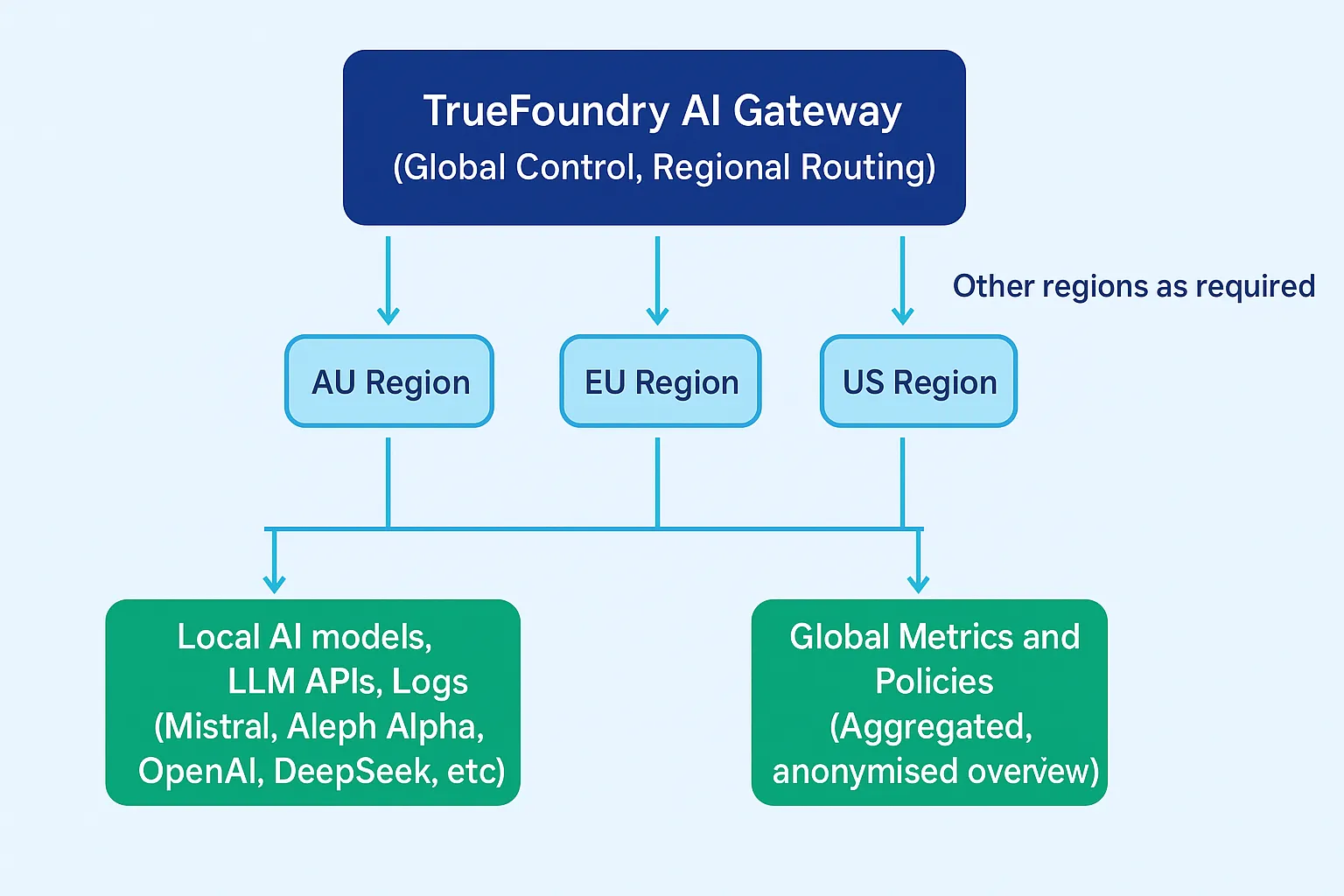
- Logs são armazenados regionalmente e nunca cruzam jurisdições.
- Administradores globais mantêm visibilidade sobre métricas de desempenho e uso, mas sem acessar dados brutos.
Esta arquitetura proporciona soberania de dados sem fragmentação—uma camada de IA unificada que respeita fronteiras enquanto mantém a coesão.
À medida que os sistemas de IA Agente automatizam fluxos de trabalho e tomam decisões cada vez mais autônomas, a fronteira de confiança entre organizações e modelos de IA está se expandindo. As organizações que vencerem nesta nova era serão aquelas que conseguirem equilibrar agilidade com soberania.
A residência de dados não é mais uma lista de verificação de conformidade; é um pilar fundamental da estratégia de infraestrutura de IA. A identificação da geopatriation pela Gartner como uma das principais tendências tecnológicas para 2026 valida essa trajetória — as empresas estão reconhecendo que onde seus dados residem impacta diretamente quão segura e responsavelmente podem inovar.
Gateways de IA como os da TrueFoundry representam a próxima evolução na infraestrutura de IA empresarial. Eles capacitam as organizações a escalar globalmente, operar localmente e permanecerem em conformidade sem esforço. Em um mundo onde a IA está em toda parte, o controle sobre a localização dos dados equivale ao controle sobre o destino.
Referências:
As 10 Principais Tendências Tecnológicas da Gartner para 2026
Compreendendo o Cenário da Repatriação e Geopatriação da Nuvem
TrueFoundry AI Gateway delivers ~3–4 ms latency, handles 350+ RPS on 1 vCPU, scales horizontally with ease, and is production-ready, while LiteLLM suffers from high latency, struggles beyond moderate RPS, lacks built-in scaling, and is best for light or prototype workloads.





As últimas notícias, artigos e recursos enviados para sua caixa de entrada



.png)

.png)
.png)
.png)

.png)
.png)
.png)
.png)
.png)
.png)
.png)


