September 15, 2026
|
5 min read


Published: September 15, 2026
Blazingly fast way to build, track and deploy your models!
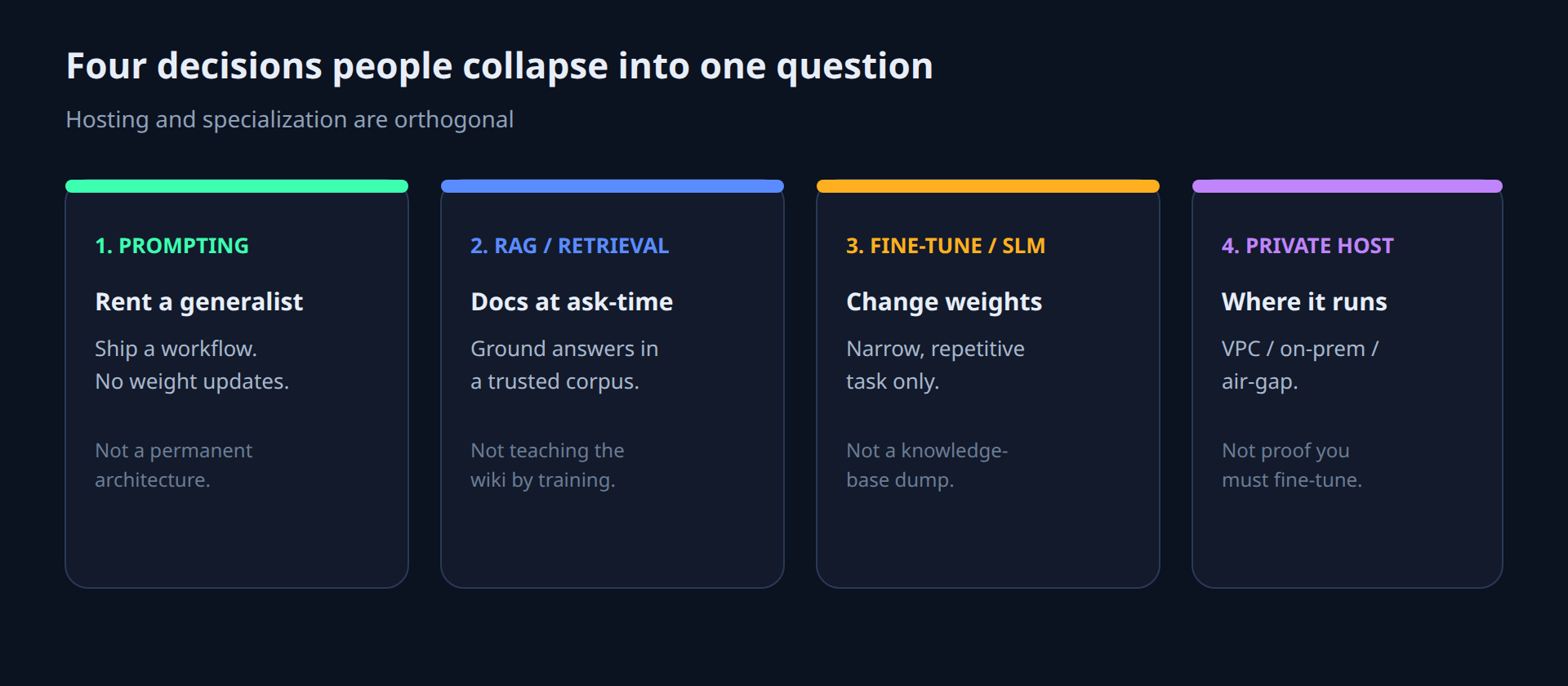
Teams often ask "SLM or LLM?" as if that answers the product. It doesn't. Four different decisions get mashed together:
You can prompt a private LLM. You can fine-tune and still call a public API for the open-ended parts. Hosting and specialization are orthogonal. Mixing them up is how regulated teams stall for a quarter on GPUs when the real blocker was a missing doc index.
For how teams keep model choice and spend under control once traffic is live, see what an LLM gateway is (https://www.truefoundry.com/blog/llm-gateway). The gateway question comes after you know which track you are on.
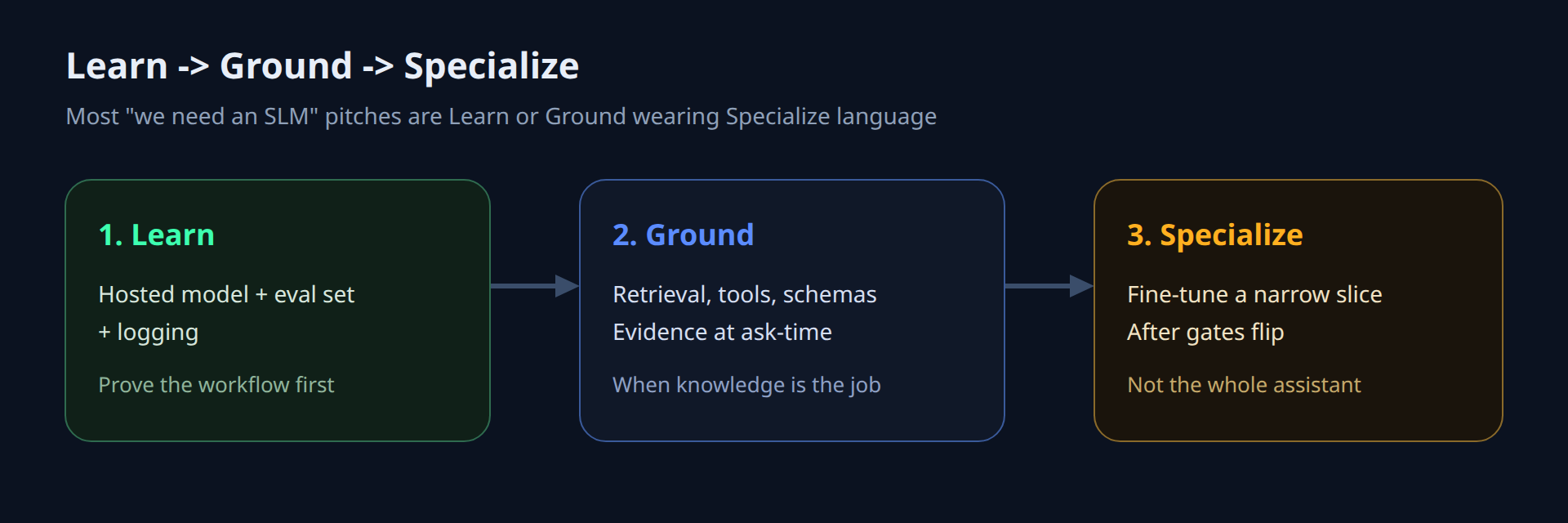
Once you separate those four decisions, the roadmap collapses into three tracks:
Most "we need an SLM" pitches are really Learn or Ground problems wearing Specialize language.
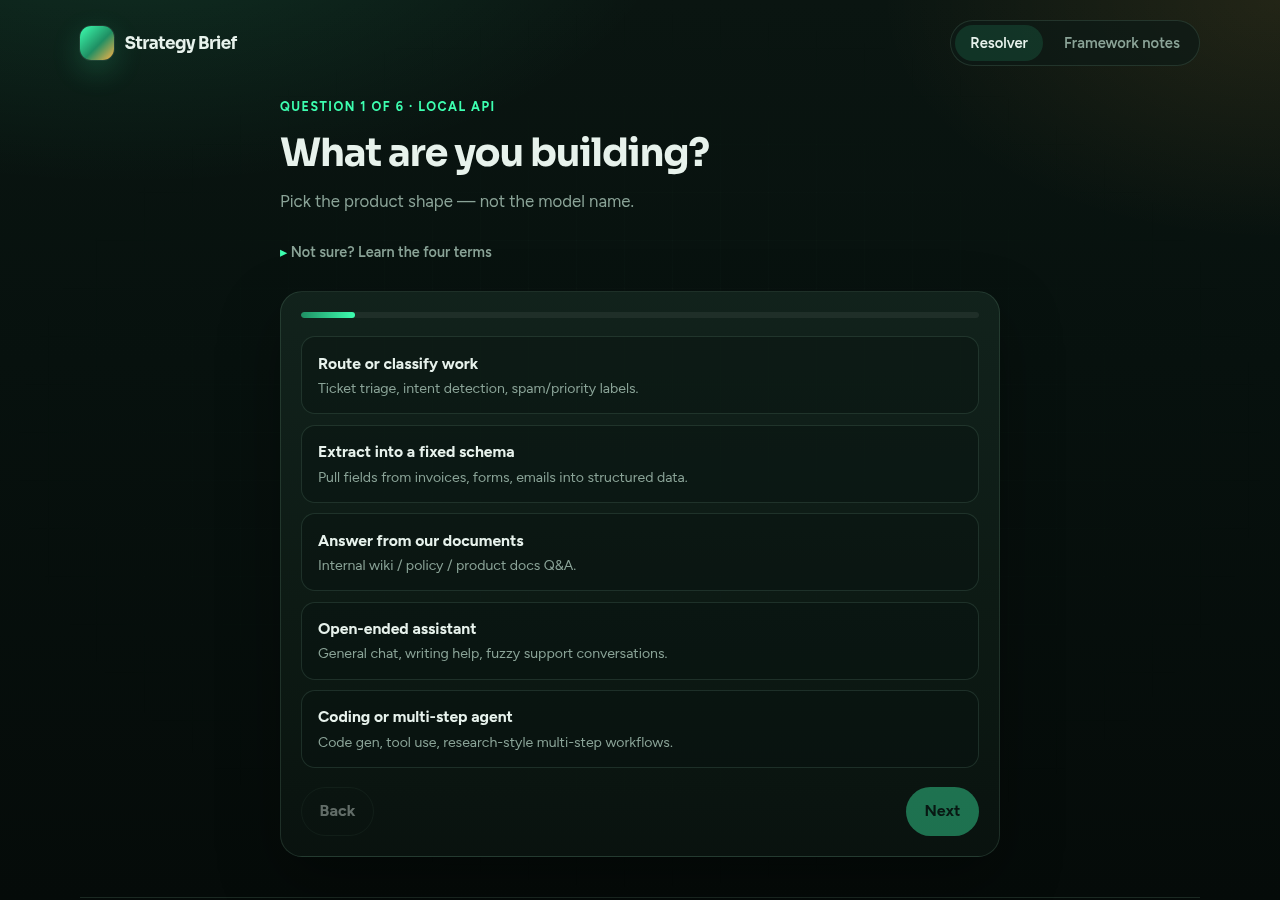
We built a small fine-tuning vs prompting resolver (https://benchmark-accelerators.ml.tfy-eo.truefoundry.cloud/fine-tuning-vs-slm) around that framing. Answer a handful of product questions and it returns a diagnosis, locked vs current tracks, and a copy-paste memo. Same rubric every time, so PM, eng, and security argue from one sheet.
----------------------------------------
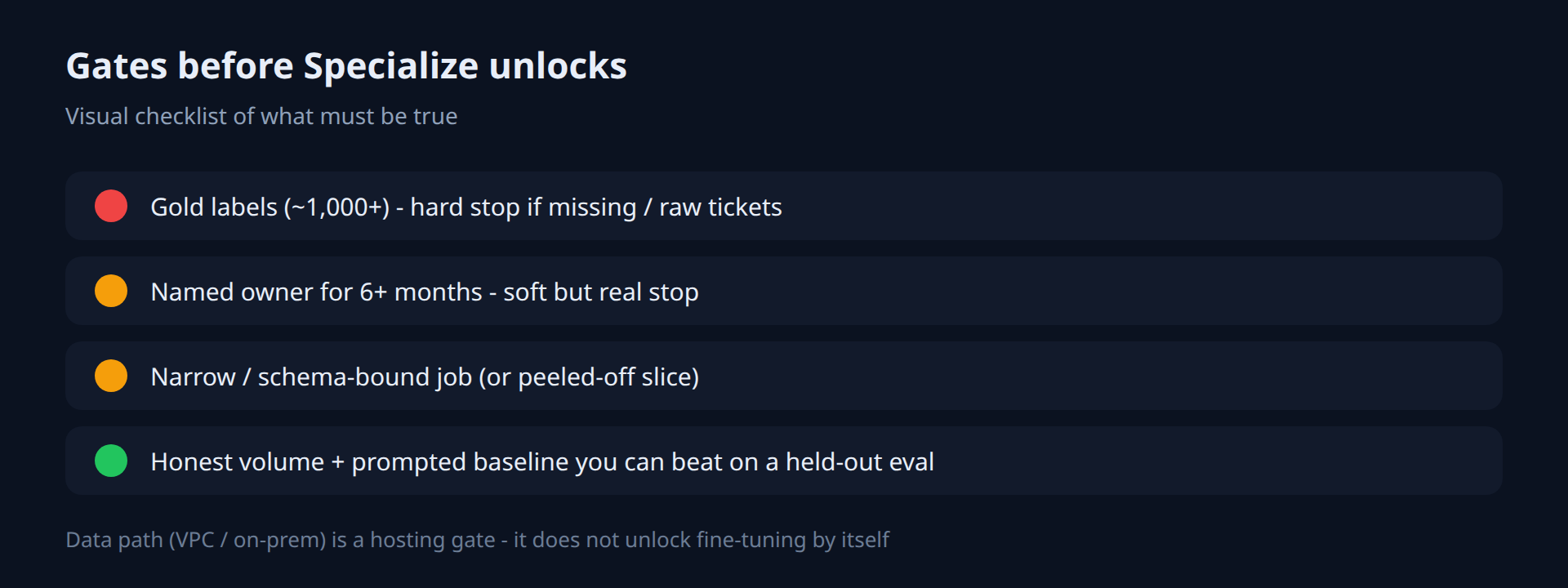
Gates before Specialize unlocks
Developer enthusiasm matters. Vendor demos matter less. Neither replaces gates.
Is this ticket triage, field extraction, docs Q&A, open chat, or a multi-step agent?
Closed or schema-bound work can specialize later. Open-ended assistants and coding agents almost never should be fine-tuned first. If you can peel off a narrow sub-task (classify, then draft), specialize only that slice.
Internal / low risk can start on a public API with normal vendor review. Customer PII needs a privacy review. Regulated data (PHI, finance residency, air-gap) forces VPC or on-prem.
That decision is hosting. It does not unlock fine-tuning by itself. For spend and latency once volume grows, LLM cost optimization (https://www.truefoundry.com/blog/llm-cost-optimization) is the parallel conversation, not a substitute for labels.
Historical tickets and chat logs are not a training set until someone marks the correct output. Dumping a CSV into LoRA mostly memorizes noise.
TrueFoundry AI Gateway delivers ~3–4 ms latency, handles 350+ RPS on 1 vCPU, scales horizontally with ease, and is production-ready, while LiteLLM suffers from high latency, struggles beyond moderate RPS, lacks built-in scaling, and is best for light or prototype workloads.




When the job is narrow and repetitive, you have ~1,000+ clean labeled examples, a named owner for evals and redeploys, enough volume that unit cost or latency hurts, and a prompted baseline you can beat on a held-out set. If any of those are missing, keep prompting (and add RAG if the job is knowledge).
Fine-tuning changes model weights for a specialist behavior. RAG retrieves trusted docs at ask-time so answers stay grounded and fresh. Private hosting is where inference runs. You can combine them in any order; picking VPC hosting does not mean you must fine-tune.
Usually one of: no held-out eval, labels that were raw tickets, an open-ended job that should not have been specialized, or no owner to keep the specialist from drifting. Specialize without a scoreboard is guessing.
Route traffic through an AI gateway. Set default models. Gate premium access. Expose per-team spend. TrueFoundry's AI Gateway gives engineering leads usage and cost visibility across 1,000+ LLMs behind one OpenAI-compatible API, so model choices do not pile into billing surprises while you are still proving the product.
Yes. TrueFoundry runs in your VPC, on-prem, air-gapped, or hybrid, so prompts and responses never leave your domain even as you route across many providers.
.webp)
.webp)
.webp)
.webp)