


September 22, 2026
|
5 min de lecture


Accédez instantanément à un environnement TrueFoundry en direct. Déployez des modèles, acheminez le trafic LLM et explorez la plateforme complète : votre sandbox est prête en quelques secondes, aucune carte de crédit n'est requise.



Published: September 22, 2026
.png)
Une méthode incroyablement rapide pour créer, suivre et déployer vos modèles !
The OWASP Top 10 for Large Language Model Applications is a consensus list of the most critical security risks in LLM-backed software, maintained by the OWASP GenAI Security Project. The current version is the 2025 list at genai.owasp.org/llm-top-10. The v1.1 list from 2023/24 is still archived there and still widely quoted - so if a post mentions Model Theft or Overreliance, it is describing the retired version.
The 2025 list as OWASP publishes it:
What changed shows where attention moved. System Prompt Leakage and Vector and Embedding Weaknesses are new. Model Denial of Service became the broader Unbounded Consumption. Insecure Plugin Design folded into supply chain and excessive agency as tooling settled around protocols like MCP. Model Theft dropped off entirely.
This is the part most write-ups skip. The Top 10 lists risks, and a risk is not a product feature. Four belong to the inference path, where a gateway sits. Three belong to application code. Three belong to pipelines a gateway never sees.
Four squarely in scope, three partials, three needing an owner elsewhere. If your AI security framework has a gateway row for LLM04 and LLM08, that row is decorative.
A gateway covers LLM01, LLM02, LLM06, and LLM10 well because all four are request-path problems: they happen the moment a prompt goes out or a tool fires, which is the only moment a gateway sees. The rest were decided weeks earlier, in a training run or an indexing job.
Treating the list as a compliance checklist. OWASP publishes a risk taxonomy with mitigation guidance, not a certification. There is no OWASP LLM Top 10 audit and no body that issues a pass. A matrix claiming all ten are “covered” by one tool is written to survive a meeting, not an attack.
Putting output validation in the wrong place. LLM05 is about what your application does with model output. A gateway can flag that a response contains os.system or an unescaped script tag. It cannot stop your service feeding that string into a shell. The control belongs where output is consumed; the gateway check is defence in depth.
Assuming injection detection is prevention. Detection is a classifier, classifiers have false negatives, and attackers iterate against them. The durable mitigation for LLM01 is to assume injection occasionally succeeds and make that survivable - which is really an LLM06 problem. Narrow the tool surface and a successful injection reaches a model with nothing dangerous to call.
Ignoring LLM10 as a billing concern. An agent stuck in a loop is a denial-of-service against your own budget, and high-volume querying is how model extraction works. It is the easiest entry to close, and the most commonly left open.
TrueFoundry’s AI Gateway implements these controls as guardrails on hooks in the request path. There are four, and which risks you can address depends on which hook you are on.
For LLM requests: input, before the prompt reaches the model, and output, after it responds.
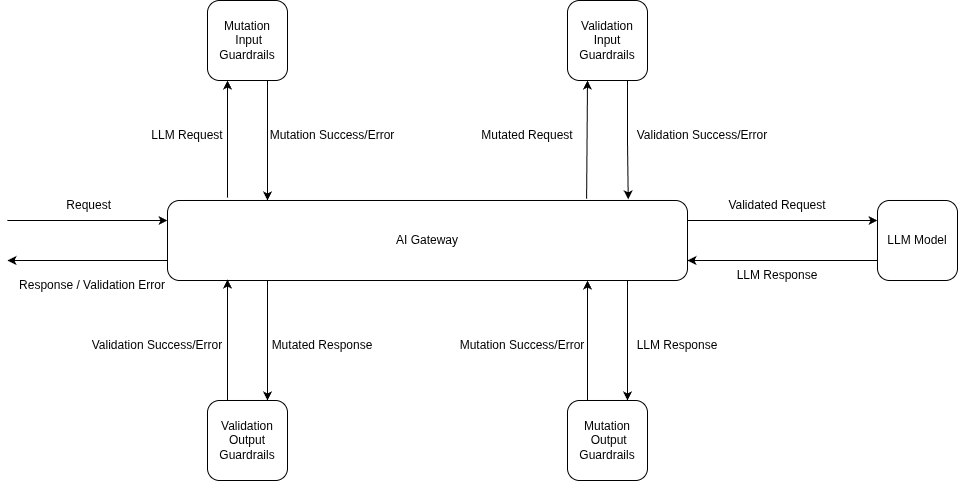
For MCP tool calls: mcp_pre_tool, before the tool executes, and mcp_post_tool, after it returns.
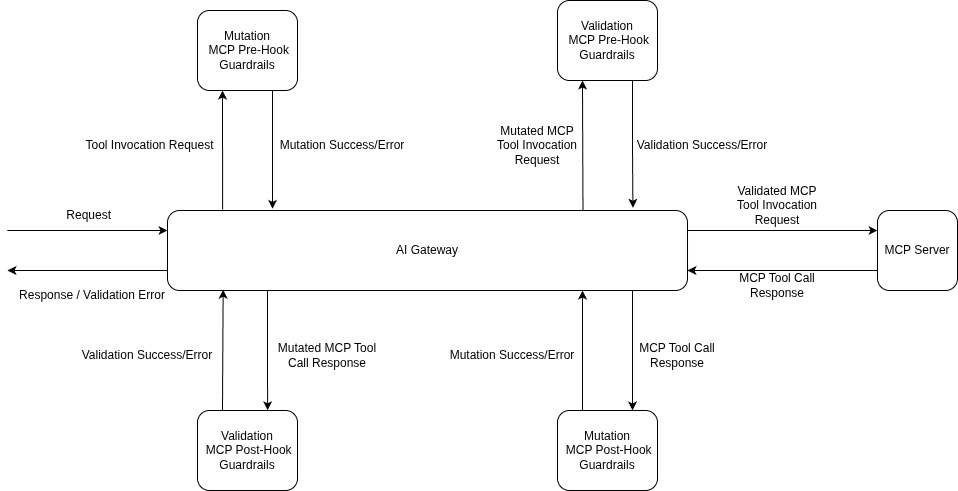
Those MCP hooks make the owasp mcp question tractable. Guardrails run on every tool call separately - five tools in a row means five sets of checks. A pre-tool failure means the tool never runs; a post-tool failure withholds the result.
Each guardrail has an operation mode - validate inspects and can block, mutate also rewrites - and an enforcement strategy covering violations and guardrail errors:
TrueFoundry AI Gateway offre une latence d'environ 3 à 4 ms, gère plus de 350 RPS sur 1 processeur virtuel, évolue horizontalement facilement et est prête pour la production, tandis que LiteLM souffre d'une latence élevée, peine à dépasser un RPS modéré, ne dispose pas d'une mise à l'échelle intégrée et convient parfaitement aux charges de travail légères ou aux prototypes.




A consensus list of the ten most critical security risks in LLM applications, from the OWASP GenAI Security Project. The current version is the 2025 list: prompt injection, sensitive information disclosure, supply chain, data and model poisoning, improper output handling, excessive agency, system prompt leakage, vector and embedding weaknesses, misinformation, and unbounded consumption. It is guidance, not a certification - there is no audit to pass.
No. A gateway sits in the request path, so it addresses request-path risks well: prompt injection, sensitive information disclosure, excessive agency, and unbounded consumption. It partly helps with improper output handling, misinformation, and supply chain. Poisoning and vector weaknesses happen in training and retrieval pipelines a gateway never touches.
Mostly through LLM06 Excessive Agency and LLM01 Prompt Injection. An MCP tool call is where a compromised prompt turns into a real action, so the controls that matter sit on the tool path: a mcp_pre_tool hook validating arguments before execution, a mcp_post_tool hook cleaning results before the model sees them, tool-level allowlisting, and approval on destructive calls. TrueFoundry runs guardrails on every tool call separately, not once per conversation.
Yes. TrueFoundry runs in your VPC, on-prem, air-gapped, or hybrid, so prompts and responses never leave your domain even as you route across many providers.
Yes. It includes an MCP Gateway, an Agent Gateway, and an MCP & Agents Registry with tool-level access control. Agents on LangGraph, CrewAI, AutoGen, or a custom framework can all be governed centrally.
Oui. La passerelle est compatible OpenTelemetry et s'intègre à Grafana, Datadog, Prometheus, ou à votre pile technologique préférée. Elle trace chaque requête, du prompt à l'exécution de l'outil et du modèle, vous offrant ainsi une journalisation unifiée sans avoir à remplacer ce que vous utilisez déjà.



Les dernières nouvelles, articles et ressources envoyés dans votre boîte de réception

.png)
.png)
.png)
.png)
.png)
.png)
.png)
.png)
.png)
.png)


