October 14, 2026
|
5 minutos de lectura


Obtenga acceso instantáneo a un entorno TrueFoundry en vivo. Implemente modelos, dirija el tráfico de LLM y explore la plataforma completa: su sandbox estará listo en segundos, sin necesidad de tarjeta de crédito.



Published: October 14, 2026

¡Una forma increíblemente rápida de crear, rastrear e implementar sus modelos!
A lot of LLM calls in production exist to answer one question about a piece of text. Is this a refund request? How urgent is it? How frustrated is the customer? Decision models are built for that job. They answer typed questions and return probabilities instead of generated text: a yes/no probability, a pick from a fixed list, or a score on a scale. TrueFoundry AI Gateway now serves them on two routes, POST /v1/decisions and POST /v1/systemone, across seven providers.
You call them with the TrueFoundry API key you already use and address models as account-name/model-display-name. The gateway injects the provider credential. Tracing, cost tracking, rate limits, budgets and access control apply the same way they do for every other model on the gateway.
Try the Decisions API on the TrueFoundry AI Gateway →
Two routes that share one provider list, so any model whose type is Decision works on either route:
/v1/decisions (alias /decisions) takes OpenAI's Decisions format: an input plus a list of predicate, choice and score questions. /v1/systemone (alias /systemone) takes the System One format: a state plus a map of noul, choice and score questions, the same bodies TypeSafe Jev uses.
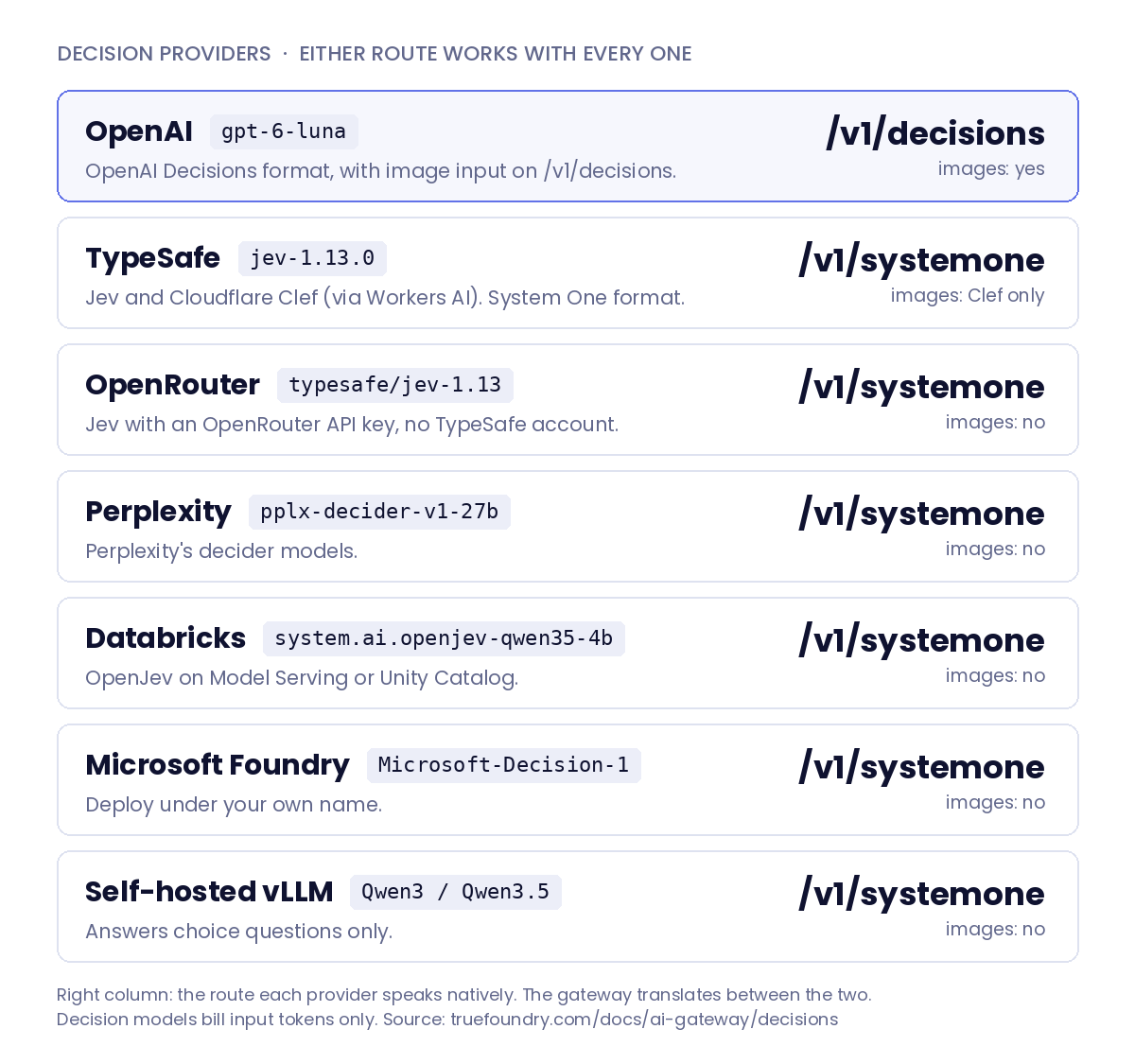
The two formats describe the same idea in different words. In System One, a yes/no question is a noul and answers are keyed by the names you give your questions. In OpenAI's format it is a predicate, and answers come back as a list in question order. The gateway does the mapping per target. Text parts of an OpenAI input are joined into the System One state. A noul's criteria are folded into the instructions OpenAI sees. A System One question without instructions gets a generic one when it goes to OpenAI, which requires them.
The result is that switching provider is a change to the model string. Point a /v1/systemone body at an OpenAI decision model and you still get System One answers keyed by question name. Point a /v1/decisions body at a TypeSafe Jev model and you still get OpenAI-shaped answers.
Every answer carries probabilities. A score question with the levels calm, mildly annoyed and angry returns the score, a confidence and a probability per level, so your code can apply its own thresholds instead of parsing free text.
TypeSafe was already reachable through Custom Endpoints, which forward raw HTTP to the TypeSafe API. That path remains available as a transparent proxy, but it has no cost tracking, and you cannot switch providers by changing the model. The new routes use models in your catalog, so you get access control, tracing, cost tracking, virtual models, and the ability to change provider without changing the request body.
Virtual models are where this pays off. A virtual model whose model types include decision can load-balance or fail over across decision targets, including a mix of OpenAI and System One providers. The gateway translates each attempt into that target's format and translates the successful answer back into the format of the route you called. Your application calls one model name throughout.
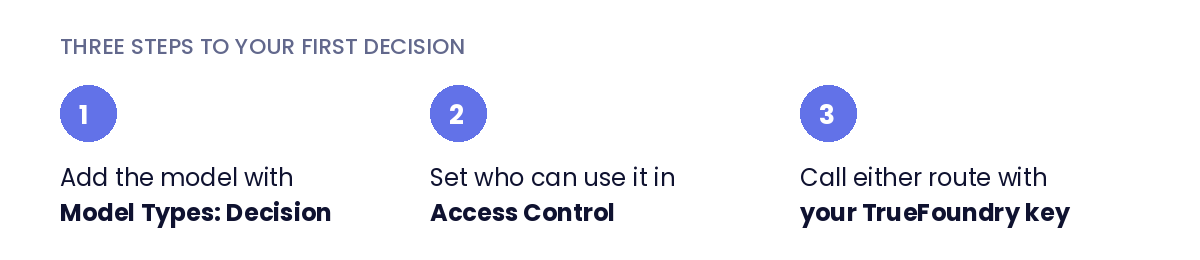
Step 1: Add the provider account and the model. In the gateway, open AI Gateway → Models, pick the provider and add its credentials. For TypeSafe that is a TypeSafe API key, with an optional base URL that points at Cloudflare Workers AI. Then add the model with Model Types set to Decision; a chat model cannot serve these routes. Pin a versioned model ID where the provider offers one (jev-1.13.0 rather than jev-latest) so confidence thresholds stay stable across releases, and set the output cost to 0.
Step 2: Set Access Control so the model is scoped to the right users and teams from the first request.
Step 3: Call either route. Send your TrueFoundry API key; the gateway injects the upstream credential. Set GATEWAY_BASE_URL without a trailing slash.
import os

import requests

gateway_base_url = os.environ["GATEWAY_BASE_URL"].rstrip("/")
response = requests.post(
    f"{gateway_base_url}/v1/systemone",
    headers={"Authorization": f"Bearer {os.environ['TFY_API_KEY']}"},
    json={
        "model": "my-typesafe-account/jev",
        "state": "Customer wrote: I was charged twice for my order #4411 and want one of the charges refunded today.",
        "questions": {
            "is_refund_request": {
                "type": "noul",
                "instructions": "Is the customer asking for a refund?",
            },
            "urgency": {
                "type": "choice",
                "instructions": "How urgent is this?",
                "criteria": {
                    "low": "can wait a week",
                    "high": "needs action today",
                },
            },
            "frustration": {
                "type": "score",
                "instructions": "How frustrated is the customer?",
                "criteria": ["calm", "mildly annoyed", "angry"],
            },
        },
    },
    timeout=60,
)
response.raise_for_status()
print(response.json()["answers"]["is_refund_request"])
Model IDs are namespaced as account-name/model-display-name. Change "model" to an OpenAI decision model such as openai-main/gpt-6-luna and OpenAI answers the same body, still keyed by question name. The OpenAI-format version of this request, and an image example, are in the Decisions API docs.
/v1/decisions, as inline data: URLs; hosted URLs and file IDs are not supported. Other providers get a 400 before they are called. Cloudflare Clef, added through a TypeSafe account, accepts images on the System One images field instead.choice questions only, and needs a vLLM build that includes vllm#59299 (after v0.31.0).true and "true", or a one-label choice or one-level score sent to OpenAI all return a 400 before any provider is called.{"type": "refusal", "name": ...}.Reach for a decision model when the output you need is a label, a yes/no or a score you will compare against a threshold: routing support tickets, flagging content, checking a document against a rule. Running it through TrueFoundry keeps the choice of provider in gateway config, where you can change it without touching the request body.
Try the Decisions API on the TrueFoundry AI Gateway →
TrueFoundry AI Gateway ofrece una latencia de entre 3 y 4 ms, gestiona más de 350 RPS en una vCPU, se escala horizontalmente con facilidad y está listo para la producción, mientras que LitellM presenta una latencia alta, tiene dificultades para superar un RPS moderado, carece de escalado integrado y es ideal para cargas de trabajo ligeras o de prototipos.





Las últimas noticias, artículos y recursos enviados a tu bandeja de entrada
.png)
.png)


.png)
.png)
.png)
.png)
.png)