September 22, 2026
|
5 min read


Obtenha acesso instantâneo a um ambiente TrueFoundry ao vivo. Implante modelos, direcione o tráfego de LLM e explore a plataforma completa — seu sandbox estará pronto em segundos, sem necessidade de cartão de crédito.


Published: September 22, 2026
Blazingly fast way to build, track and deploy your models!
A guardrail is not one safety switch. Its hook, operation mode, enforcement strategy, scope, failure behavior, and evidence determine what the system actually guarantees.
TrueFoundrySeptember 19, 20269 min read
Source framing. This explainer is based on TrueFoundry’s AI Gateway Guardrails Overview and Configure Guardrail Policies documentation as reviewed September 19, 2026. It reflects the documented LLM input/output and MCP pre/post hooks; validate and mutate modes; three enforcement strategies; union of matching policies; asynchronous LLM input validation; synchronous mutation, output, and MCP checks; streaming limitation for LLM output guardrails; and trace spans. Threat models, rollout gates, and application authorization patterns are recommended engineering practice.
“We have a PII detector” says little about system behavior. Where does it run? Does it see the prompt before the model, the completed response, tool arguments, or tool results? Can it rewrite data, only block it, or merely log? What happens if the detector times out? Does streaming release content before a complete response exists?
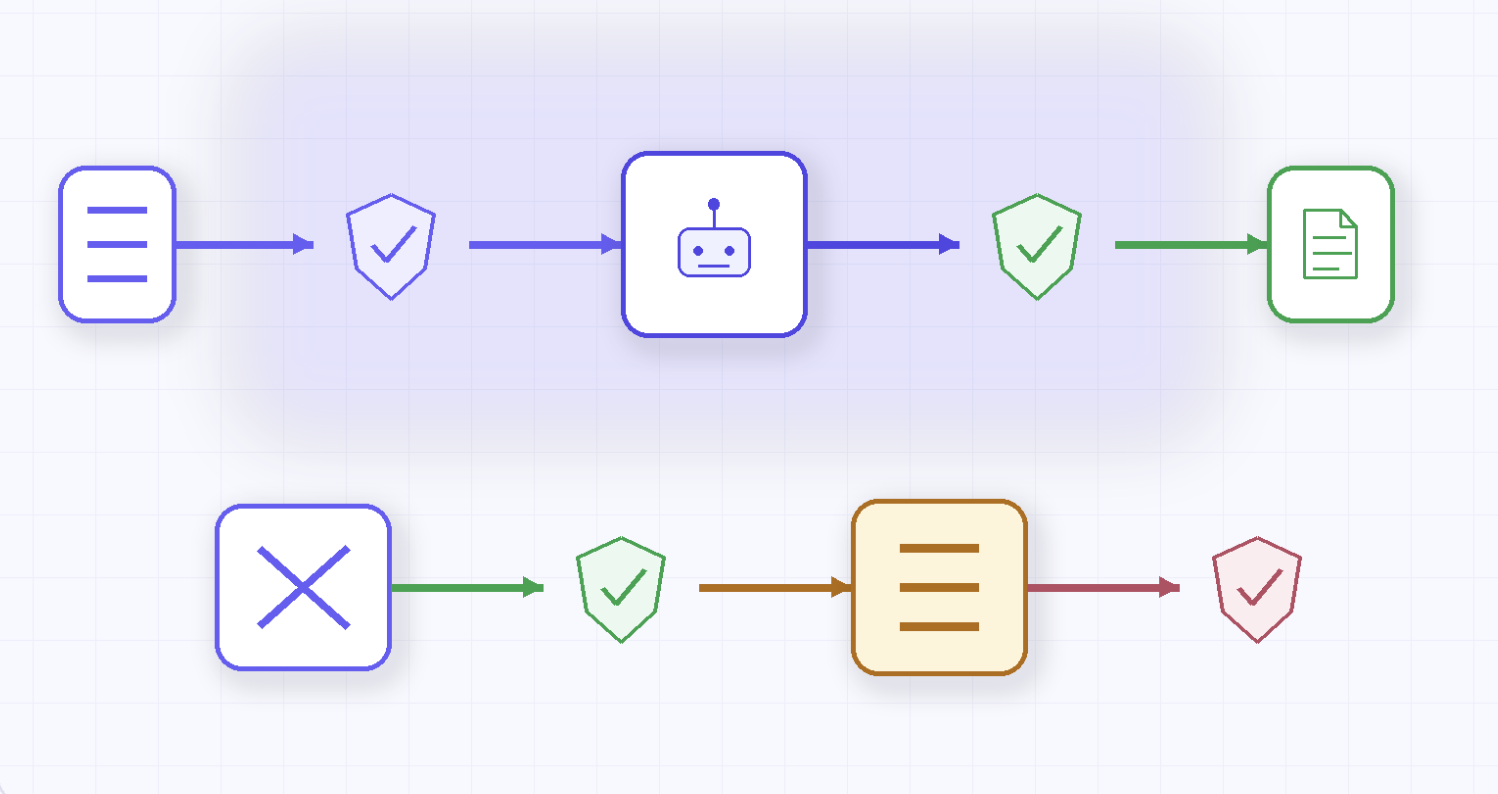
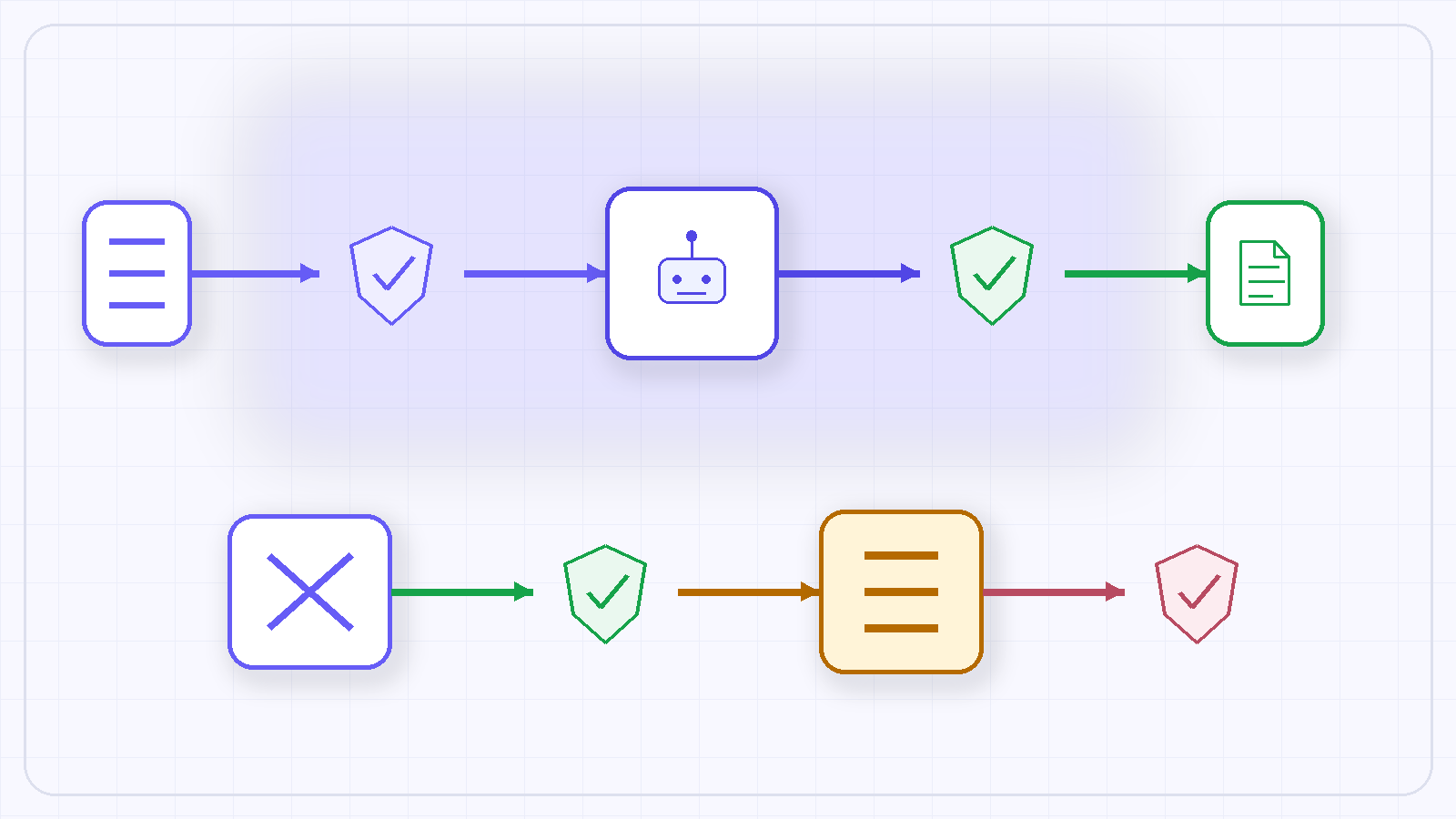
TrueFoundry AI Gateway exposes four guardrail hooks: LLM Input, LLM Output, MCP Tool Pre-Invoke, and MCP Tool Post-Invoke. That topology is the foundation. An input mutation can redact data before model exposure. An output check can withhold a completed response. A pre-tool check can stop an operation before execution. A post-tool check can prevent a sensitive result from reaching the model—but cannot undo a side effect the tool already committed.
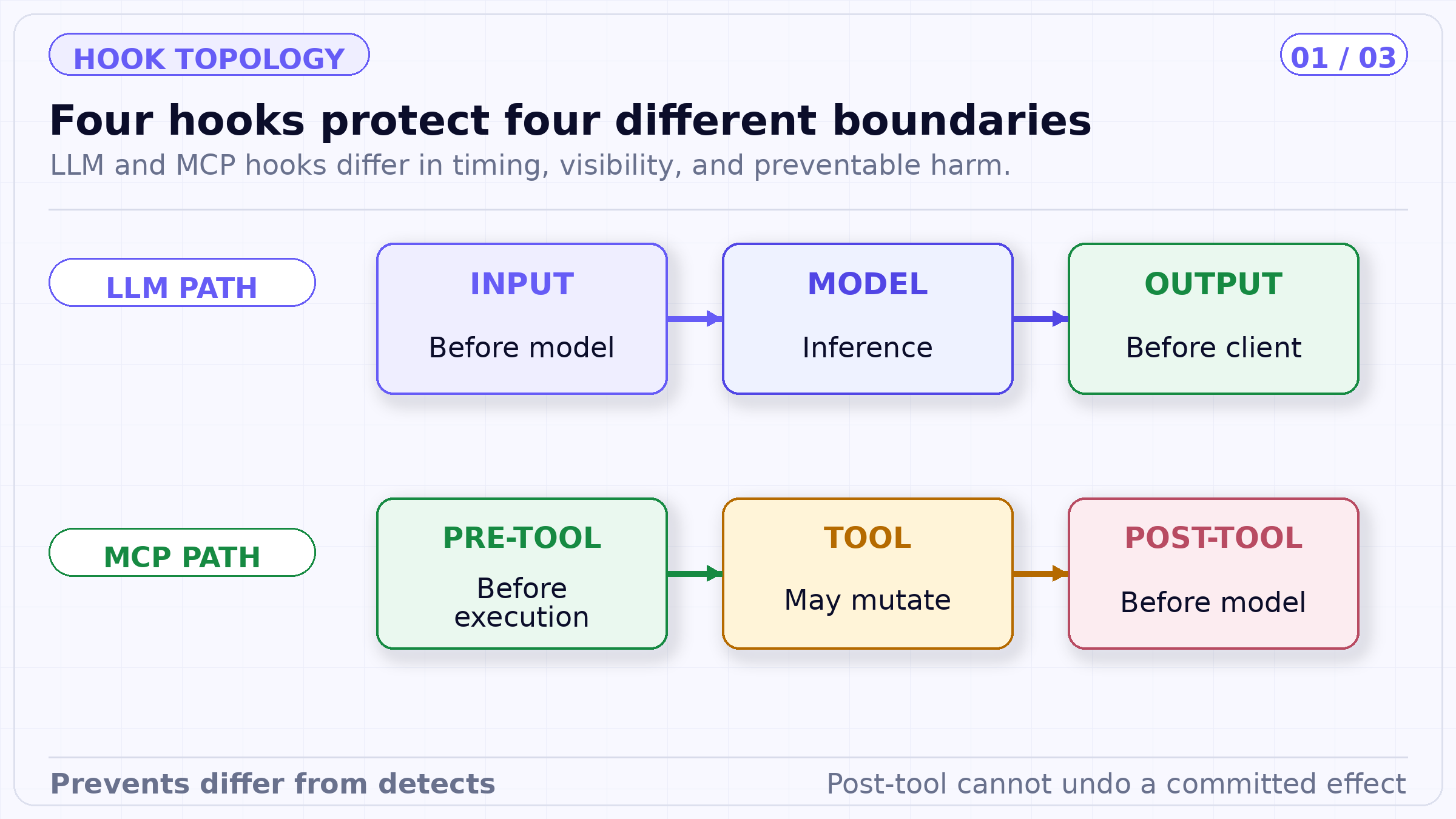
The hook diagram emphasizes temporal reach. A control placed after an operation can govern disclosure of its result but cannot retroactively prevent the operation itself.
In Validate mode, a guardrail inspects data and can block without rewriting it. In Mutate mode, it can transform the data and can also block. Mutation guardrails run sequentially by priority because the output of one becomes the input of the next.
Order therefore matters. A redaction step may remove evidence a later detector needs, while a normalization step may make a later policy more reliable. Version and test the full ordered chain. Do not interpret “all guardrails passed” without knowing which representation each one evaluated.
For MCP calls, pre-tool mutation or validation sees the arguments before the operation. Post-tool controls see the result after execution. If a SQL tool has already changed a database, blocking its response protects downstream context but not the database. Side-effect safety needs authorization, constrained tool contracts, idempotency, and reconciliation in addition to content guardrails.
TrueFoundry documents three strategies. Enforce blocks on a violation and also blocks when the guardrail itself errors. Enforce But Ignore On Error blocks detected violations but lets traffic through if the guardrail fails. Audit lets traffic through and records both findings and guardrail errors.
These choices should be made per hook and risk, not as a universal organizational preference. A strict pre-tool authorization check for a destructive production operation may need fail-closed behavior. An auxiliary relevance scorer on a low-risk internal assistant may be allowed to degrade. The decision should name the harm of a false negative, the harm of a false positive, the detector’s reliability, and the available fallback.
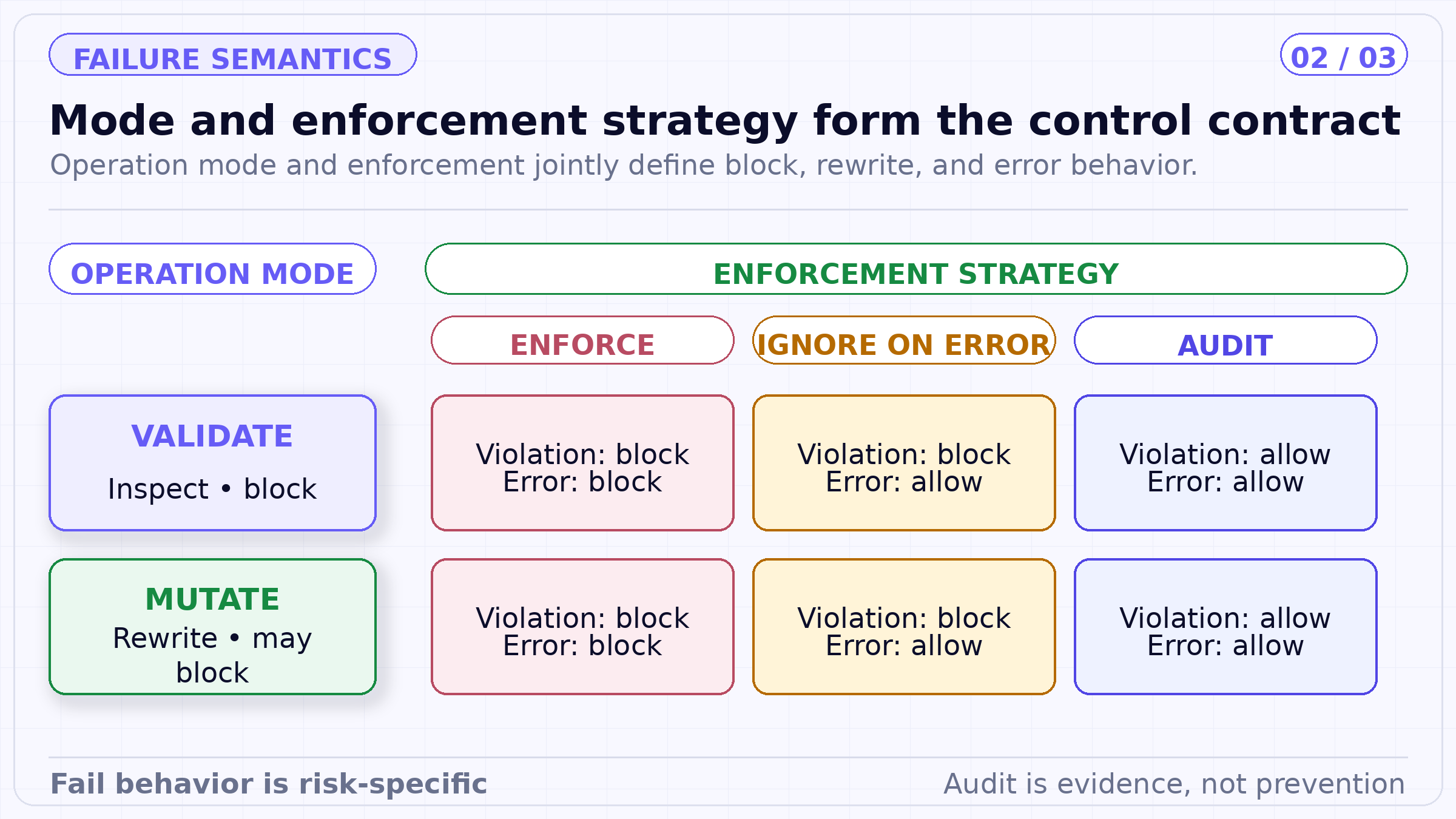
Operation mode and enforcement strategy are orthogonal. Teams need both axes to know whether data is rewritten, blocked, allowed on error, or only observed.
TrueFoundry documents input mutation as synchronous before the model request. Input validation can run in parallel with the model call. If validation fails while the model is running, the gateway cancels that request. Output mutation and validation occur after the model response, so their latency is on the return path and model cost has already been incurred.
MCP pre- and post-tool guardrails run synchronously. Pre-tool latency delays execution but can prevent the cost and side effect of a bad call. Post-tool latency delays delivery of the result and can redact or withhold it, but the tool invocation has already happened.
HookTimingWhat a block preventsWhat it cannot undoLLM InputMutation before model; validation may overlap model execution.Unsafe prompt reaching or completing at the model, depending on mode.Work already performed before a late validation cancellation.LLM OutputAfter the complete model response.Rejected content reaching the client.Model cost already incurred.MCP Pre-InvokeBefore each tool call.The tool call and its side effect.Effects from earlier calls in the trajectory.MCP Post-InvokeAfter the tool returns.Unsafe result reaching the model.The tool’s committed effect.
The current TrueFoundry documentation states that LLM output guardrails are skipped for streamed responses because the gateway does not have a complete response to evaluate before chunks are delivered. Input guardrails still apply. If a use case requires gateway-side output checks, the request must be non-streaming.
This is a material architecture decision, not a footnote. A client that assembles streamed output and validates afterward can detect a problem, but it cannot retract content already shown or acted on. Applications must choose between immediate token delivery and complete-response enforcement, or design an intermediate buffer that delays release.
For LLM messages, TrueFoundry documents a scope control covering the full conversation, the last message, or the last N messages. A narrow window reduces cost and exposure but can miss attacks distributed across turns. A full-history check can be expensive and may send more sensitive content to an external guardrail provider.
System prompts are excluded from guardrails by default in the current documentation, with a named exception for CrowdStrike AIDR analysis. MCP pre/post checks scan full tool arguments or results rather than using the LLM message scope. Teams should document these visibility boundaries explicitly so “the conversation is guarded” does not imply every instruction and field was inspected.
Guardrails can be attached per request through a header or through gateway policies. Policies match models, MCP servers and tools, users, teams, virtual accounts, and request metadata. TrueFoundry documents that all rules are evaluated; guardrails from every matching rule are combined per hook.
That union model is additive. A broad baseline can apply PII detection while a production metadata rule adds a stricter injection detector and a specific MCP tool rule adds SQL policy. Omitted target or subject conditions match broadly, so an accidentally incomplete rule can apply more widely than intended.
Per-request guardrail headers bypass policies, according to the configuration documentation. Control who can send those headers and whether application-chosen guardrails are acceptable for the workload. A request should not be able to select a weaker policy simply because it knows an integration name.
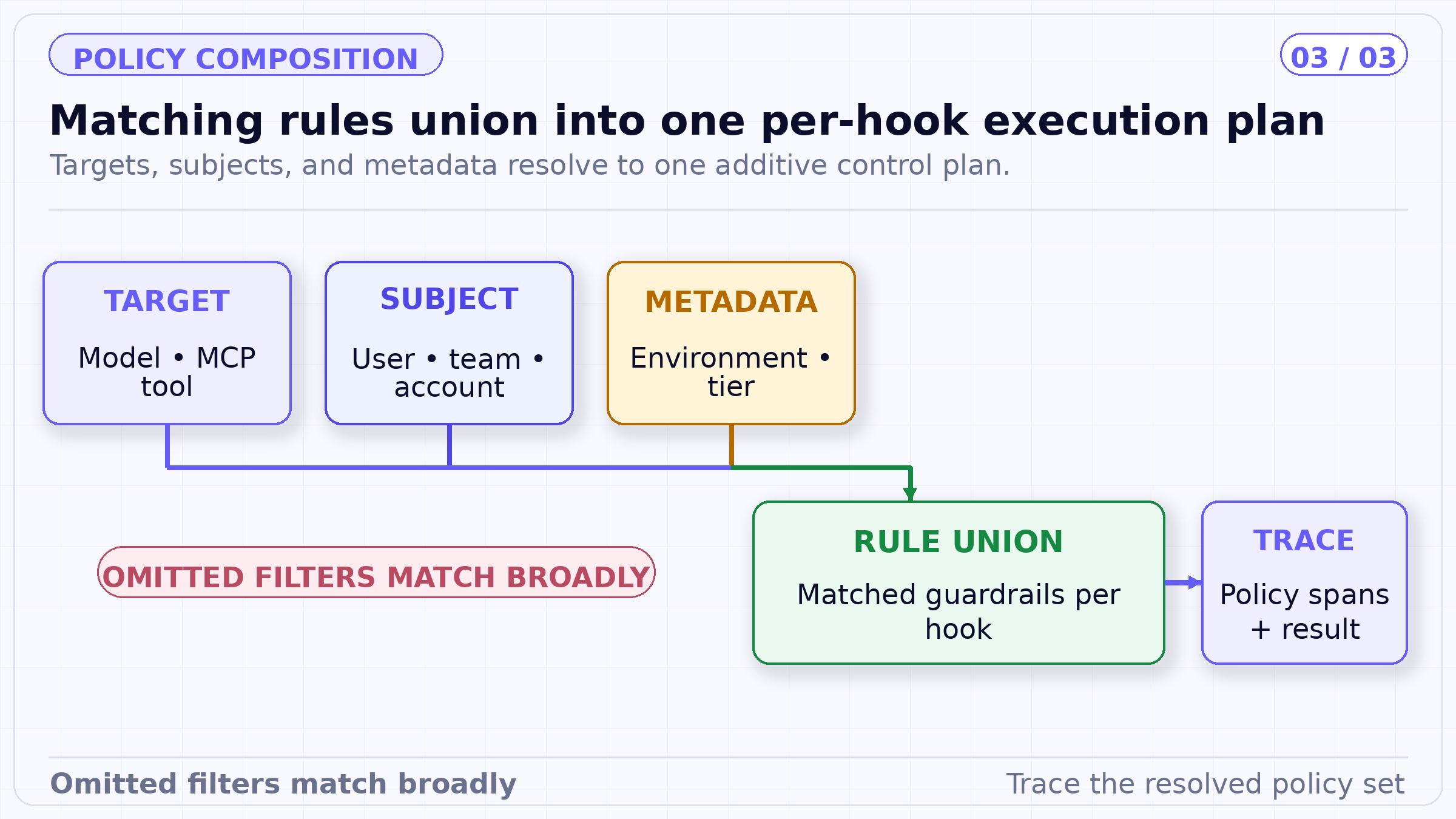
Policy rules compose additively. The effective control is the resolved union for this subject, target, tool, metadata, and hook—not any single rule viewed in isolation.
TrueFoundry records guardrail execution as spans in request traces, including timing and results. Blocked requests are traced as well. That makes latency, findings, mutations, and enforcement outcomes inspectable.
A span proves that a configured guardrail ran and reported a result under a versioned setup. It does not prove the detector had perfect coverage or that the final business action was safe. Preserve detector version, policy version, hook, scope, input digest, mutation digest, enforcement result, error, and latency. Join those records with tool attempts and authoritative outcomes.
Some guardrails run on TrueFoundry-managed infrastructure; others call external providers or custom services. The selected hook and message scope determine what data that processor can receive. Before enabling a provider, document fields, regions, retention, encryption, subprocessors, credentials, timeout behavior, and whether the service uses inputs for training.
Minimize data before it leaves the gateway when possible. A local mutation step can remove secrets before a broader external classifier runs, but ordering must be tested so redaction does not destroy the signal needed for detection. Keep provider selection environment-aware: TrueFoundry’s documentation marks several managed built-ins as SaaS-only and points self-hosted deployments to alternatives.
A request can match several policy rules, and each rule can attach several guardrails at several hooks. The effective plan is therefore a resolved set, not just a policy name. Record the rule IDs, policy version, integration versions, priorities, enforcement strategies, scope, and custom error behavior that applied to the request.
Promote guardrail changes like software releases. Test a candidate plan in audit or shadow analysis, compare it with the current plan on captured representative inputs, review false positives and false negatives, then roll it out to bounded traffic. A rollback should restore the complete resolved configuration, including ordering and failure semantics.
Count evaluated requests, skipped hooks, guardrail errors, timeouts, violations, mutations, blocks, cancellations, and latency by integration and policy version. Report rates over eligible traffic rather than raw block counts. A detector showing zero findings is healthy only if it actually ran on the intended scope.
For MCP controls, join pre-tool blocks with attempted tool calls and post-tool findings with tool outcomes. For LLM controls, distinguish input cancellations, output rejections, and streamed responses where output checks were skipped. Sample allowed traffic for human review so silent false negatives have a chance to become visible.
Audit mode is useful for calibration because it shows potential findings without blocking. Before promotion, label sampled traffic, measure false positives and false negatives, test provider timeouts, and estimate latency and cost. Move to an enforcement strategy only after the organization has chosen failure behavior and an operator can interpret the evidence.
Do not assume a falling block rate means the system improved. It can also mean a detector stopped running, scope narrowed, traffic changed, or users learned to route around the control. Monitor coverage and error rates alongside violations.
A guardrail’s real contract is the combination of hook, visibility, mode, order, enforcement strategy, policy match, and failure behavior. Naming only the detector leaves most of the system unspecified.
TrueFoundry AI Gateway makes these decisions explicit across both model and MCP traffic and records their execution in traces. The application still owns business authorization, side-effect correctness, and outcome evidence. That boundary is not a weakness; it is what keeps content inspection from being mistaken for complete agent safety.
Editorial disclosure. This article reflects TrueFoundry’s engineering interpretation of the cited public materials as of September 19, 2026. Product capabilities are scoped to linked documentation. Examples and operating defaults are illustrative; they are not legal advice, an audit opinion, an independent benchmark, or a guarantee of security, safety, or compliance.
TrueFoundry AI Gateway delivers ~3–4 ms latency, handles 350+ RPS on 1 vCPU, scales horizontally with ease, and is production-ready, while LiteLLM suffers from high latency, struggles beyond moderate RPS, lacks built-in scaling, and is best for light or prototype workloads.





As últimas notícias, artigos e recursos enviados para sua caixa de entrada



.png)
.png)
.png)
.png)
.png)
.png)
.png)
.png)
.png)
.png)