


October 1, 2026
|
5 min read


Published: September 23, 2026
Blazingly fast way to build, track and deploy your models!
AI infra isn’t a single monolith now, it has evolved into an ecosystem of models, agents, tools, data stores and control planes. AI infrastructure has evolved beyond a single model or platform. Today’s enterprise stack is a sprawling ecosystem of LLMs, agents, vector databases, orchestration frameworks, and control planes — each with its own APIs, formats, and governance rules. At enterprise level this heterogeneity creates both opportunities and problems, teams can pick the best model for a job, but different providers speak different APIs, return different shapes, and need different governance.
Enterprises want the flexibility to use the best model for each task, but every provider speaks a different API, returns a different schema, and requires different credentials. Without a unifying layer, teams end up writing brittle integrations and managing scattered observability and compliance.
The answer is architectural, not procedural.
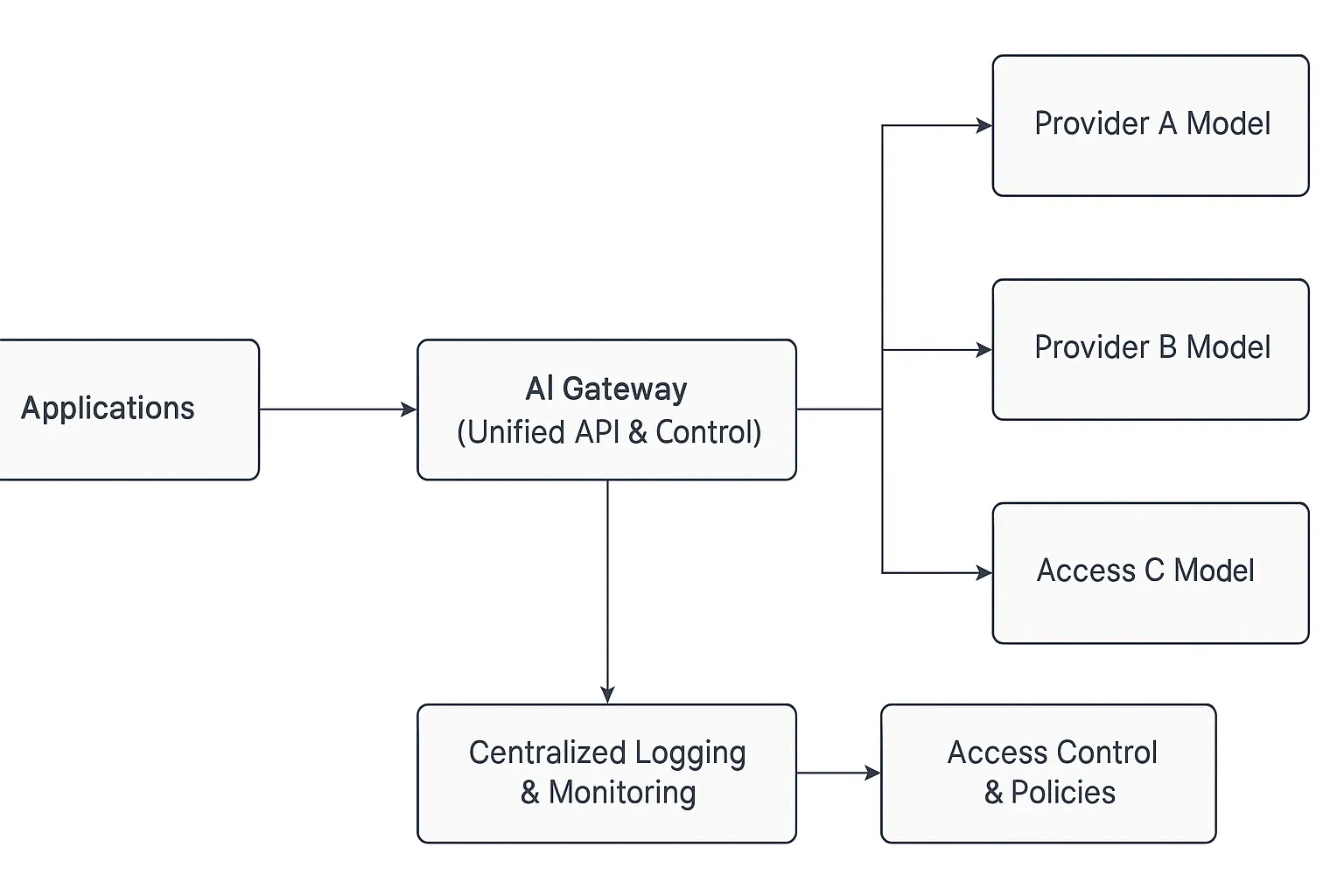
AI interoperability must be designed — not patched. And the key enabler of that design is the AI Gateway: a central layer that standardizes how applications interact with models, tools, and agents. An AI Gateway acts as the “common language” of your AI ecosystem. It normalizes inputs and outputs, enforces security and compliance policies, routes traffic intelligently, and provides unified observability. In short, it turns fragmented AI infrastructure into a cohesive, governed system.
In very simple terms AI Interoperability is the ability of AI systems to work and integrate together in a seamless manner. This in turn means your stack follows common interfaces and formats, for example handing over a task from model A to model B should not require schema level changes, or change in API configurations. AI interoperability lets “different models, APIs, data formats, and systems work together without requiring custom code for every integration. In other words, you can switch between providers, combine multiple LLMs, or upgrade models—all without breaking your existing infrastructure.
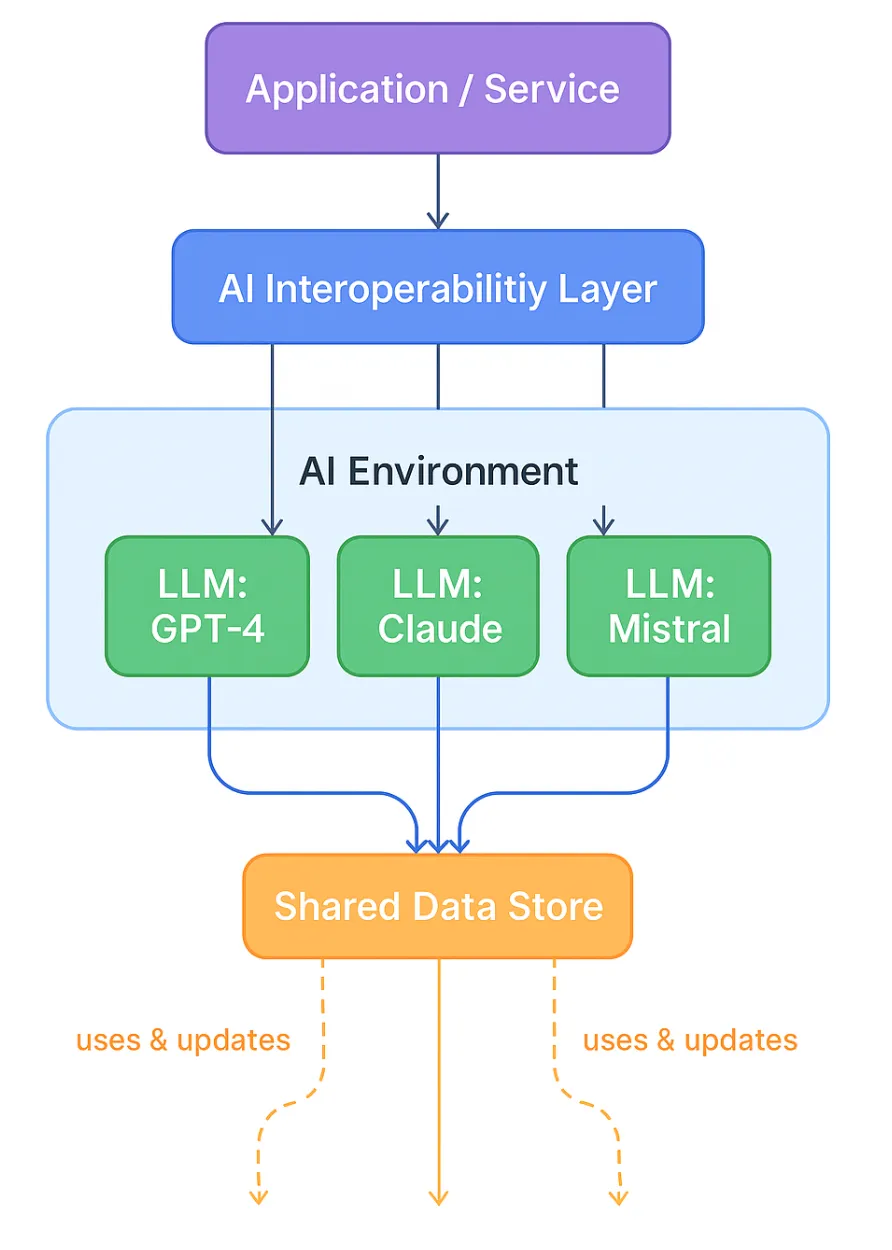
Another aspect to AI Interoperability is making “different AI systems, models, and agents work together, seamlessly exchanging data, making decisions collaboratively, and triggering actions across platforms”. This goes beyond just APIs: it means AI agents share context and language, coordinate their tasks, and reuse each other’s outputs. Think of it like connected workflows in an organization – your email, CRM, and project tracker each have their own job, but when they share data they form a smooth automated process. AI interoperability similarly reduces silos by letting models and tools talk a common language.
AI Interoperability is all about building flexible and modular systems with :
Flexible and modular systems are good to have but hard to maintain, why do we even need AI Interoperability?
The answer is short and simple, and let’s understand it with a simple example. Suppose you want to use 2 different models Gemini, and Claude for a single task, Gemini specializes in handling very long context windows, whereas Claude specializes in depth reasoning problems, having a single unified interface which lets you switch models easily, eliminates your code level changes, and makes your application more robust due to diversity of tasks it can handle. Another good example is how some small models might help in handling easier queries, and save a ton of cost, as complex reasoning LLMs can shoot up your cost pretty quickly.
Interoperability reduces:
In a world where new models appear weekly, interoperability ensures your stack remains adaptive, resilient, and future-proof, improves productivity, decision quality, amplifies AI strengths, makes AI orchestration faster and brings down integration costs.
Enterprise-grade interoperability can be understood across three layers:
Additional building blocks include:
A simple example:
Instead of applications managing multiple connectors, the AI Gateway exposes one API endpoint. It handles key management, schema normalization, and routing logic internally — letting developers call any model through the same interface.
There are a few major challenges in achieving integration of diverse AI systems. Here are a few explained :
def normalize_prompt(template, vars, model_family):
    prefix = {
        "gpt": "SYSTEM: enterprise assistant; JSON_ONLY=true\n",
        "claude": "Human: enterprise assistant\nAssistant:",
        "mistral": "<s>[INST] enterprise assistant [/INST]"
    }.get(model_family.lower(), "")

    safe_vars = {k: str(v).replace("{", "{{").replace("}", "}}") for k,v in vars.items()}
    return prefix + template.format(**safe_vars)
from opentelemetry import trace
tracer = trace.get_tracer(__name__)

def log_call(model_name, request_meta, response_meta):
    with tracer.start_as_current_span("model_call") as span:
        span.set_attribute("model.name", model_name)
        span.set_attribute("request.tokens", request_meta.get("tokens",0))
        span.set_attribute("response.latency_ms", response_meta.get("latency_ms",0))
def route_request(task_type: str, cost_limit: float, latency_target: int):
    routing_rules = {
        "reasoning": "claude-3",
        "summarization": "gpt-4o-mini",
        "bulk_text": "mistral-7b",
    }
    # Select model based on task type
    model = routing_rules.get(task_type.lower())
    # Apply policy overrides (cost and latency aware)
    if cost_limit < 0.01:
        model = "mistral-7b"      # cheapest
    elif latency_target < 1000:
        model = "gemini-flash"    # fastest
    elif not model:
        model = "gpt-4o"          # default fallback
    return model
import hashlib, json
def secure_payload(data, key):
    sanitized = {k:v for k,v in data.items() if k not in ("pii","secrets")}
    encrypted = hashlib.sha256(json.dumps(sanitized).encode() + key.encode()).hexdigest()
    return {"data_hash": encrypted, "meta": {"secured": True}}
If done right, AI interoperability delivers strong benefits to both technology and business.
AI interoperability turns isolated capabilities into a cohesive system. It upgrades your AI from a set of smart tools into a smart system.
An AI Gateway is a middleware that centralizes components that makes interoperability practical. The gateway provides a single entry point and handles the diversity of models and tools behind the scenes. It provides a single, consistent entry point for all AI interactions and handles provider-specific quirks behind the scenes. In effect, it unifies the AI ecosystem. The gateway abstracts away each provider’s quirks (like different endpoints, credentials and formats), enabling seamless interoperability.
Key Metrics for Evaluating Gateway
| Criteria | What should you evaluate ? | Priority | TrueFoundry |
|---|---|---|---|
| Latency | Adds <10ms p95 overhead for time-to-first-token? | Must Have | ✅ Supported |
| Data Residency | Keeps logs within your region (EU/US)? | Depends on use case | ✅ Supported |
| Latency-Based Routing | Automatically reroutes based on real-time latency/failures? | Must Have | ✅ Supported |
| Key Rotation & Revocation | Rotate or revoke keys without downtime? | Must Have | ✅ Supported |
| Key Rotation & Revocation | Rotate or revoke keys without downtime? | Must Have | ✅ Supported |
| Key Rotation & Revocation | Rotate or revoke keys without downtime? | Must Have | ✅ Supported |
| Key Rotation & Revocation | Rotate or revoke keys without downtime? | Must Have | ✅ Supported |
| Key Rotation & Revocation | Rotate or revoke keys without downtime? | Must Have | ✅ Supported |
TrueFoundry’s AI Gateway is built precisely for this.
It acts as the proxy layer between your applications and model providers or MCP servers, offering access to 1,000+ models through a single, unified interface.
Key capabilities include:
これらの機能を一元化することで、TrueFoundryはチームがコネクタを構築したり、ルーティングロジックを記述したり、個別のダッシュボードを管理したりする必要をなくします。このゲートウェイは、 AIインフラストラクチャの神経系、あらゆるモデルとエージェントにわたって一貫性、セキュリティ、信頼性を強制します。
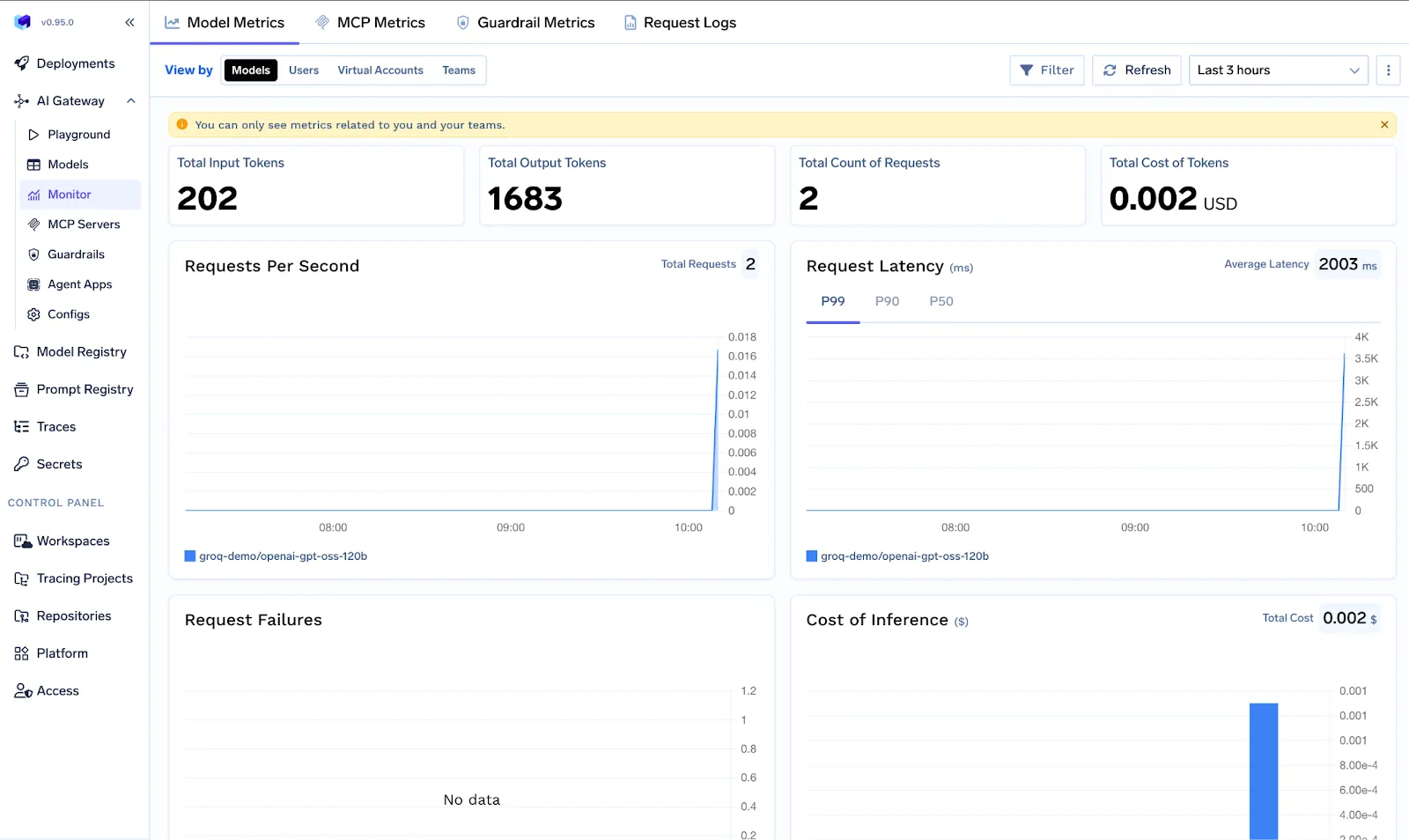
TrueFoundryのプラットフォームは、単一のインターフェースで1000以上のモデルへのアクセスを提供し、セキュリティとガバナンスを一元的に管理します。TrueFoundryの機能リストは、相互運用性を可能にする要素を正確に示しています。具体的には、統合されたAPI呼び出し、APIキー管理、きめ細やかなアクセス制御、ユーザー/モデルごとのレート制限、モデルインスタンス間のロードバランシング、コスト予算管理、コンテンツガードレール、統合された可観測性などです。これらの機能は、AIゲートウェイがどのように制御を標準化するかを示しています。つまり、すべてのモデルが単一のポリシーとメトリクスのセットによって管理されるようになるのです。
これらの懸念事項を一元化することで、AIゲートウェイは相互運用性を劇的に簡素化します。すべてのアプリケーションでコネクタを構築する代わりに、モデルを1か所で構成できます。ゲートウェイは、クエリを動的にルーティングしたり(例:トラフィックウェイトを調整するなど)、モデルの1つがダウンした場合にバックアップモデルにフェイルオーバーしたりすることも可能です。複数の情報源が指摘しているように、これはエンタープライズAIのコントロールプレーンとなります。例えば、AIゲートウェイに関するある分析では、従来のAPIプロキシを超える機能、すなわちトークンベースのレート制限、応答のコンテンツレビュー、マルチバックエンドロードバランシング、セッションコンテキスト管理などを導入していると指摘しています。
これらのタスクを処理することで、AIゲートウェイは設計上、相互運用性を可能にします。これらは、多言語AIスタックを単一のプラットフォームのように感じさせるインターフェースです。
AIの相互運用性の導入は旅のようなものです。以下のベストプラクティスは、設計と実装を通じてチームを導くことができます。
重要なのは、後からソリューションを後付けするのではなく、接続性を考慮して事前に設計することです。歴史が示すように、早期の標準化は報われます。ある分析が指摘するように、システムが定着するまで待つと統合ははるかに困難になります。
AIの相互運用性はインフラの一部です。プロバイダー、モダリティ、コントロールプレーンを横断してAIシステムが増加するにつれて、それらを円滑に連携させる能力が、組織が成長するか停滞するかを決定します。毎月新しいAPIが登場し、コンプライアンス規則が厳しくなる中で、すべてのモデルを手動で接続する古いアプローチは通用しません。
まさにそこで AI Gateway 状況を一変させます。例えば、 TrueFoundry は、かつて 統合の悪夢であったものを にに変えます。 ガバナンスの効いた、 監視可能な、そして プラグイン可能な コントロールレイヤー 1つのAPI、1つのポリシーサーフェス、1つの監査証跡 — どんなに多くのモデルやエージェントを接続しても。各チームが新しいプロバイダーごとにコネクタやロギングを再開発する代わりに、ゲートウェイがエンタープライズAIの運用基盤となります。トラフィックを賢くルーティングし、セキュリティとレート制限を自動的に適用し、すべてのベンダーで機能する統合された監視プレーンを提供します。
これは、イノベーションが混乱を招くことなく実現される、持続可能なAI導入の基盤となります。アーキテクチャに組み込まれた相互運用性は、真の柔軟性を解き放ちます。各タスクに最適なモデルを選択し、より迅速に実験し、制御を失うことなくコストを予測可能に保つことができます。
企業が単一モデルのデプロイから数十のモデルのオーケストレーションへと進化するにつれて、相互運用性を後付けではなく第一級の設計目標として扱う企業は、より迅速に動き、より賢く費用を使い、将来にわたって通用するでしょう。AIゲートウェイは単なるミドルウェアではありません。マルチモデル時代のバックボーンであり、断片化されたAIスタックを、永続的に機能するまとまりのあるガバナンスの効いたシステムへと変革します。
TrueFoundry AI Gateway delivers ~3–4 ms latency, handles 350+ RPS on 1 vCPU, scales horizontally with ease, and is production-ready, while LiteLLM suffers from high latency, struggles beyond moderate RPS, lacks built-in scaling, and is best for light or prototype workloads.



.png)
.png)
.png)
.png)
.png)
.png)
.png)
.png)
.png)
.png)
.png)





