


.webp)
October 24, 2026
|
5 min de lecture


Accédez instantanément à un environnement TrueFoundry en direct. Déployez des modèles, acheminez le trafic LLM et explorez la plateforme complète : votre sandbox est prête en quelques secondes, aucune carte de crédit n'est requise.



.webp)
Une méthode incroyablement rapide pour créer, suivre et déployer vos modèles !
Most enterprises protect databases, applications, and filesystems through established access controls. Far fewer apply equivalent safeguards across AI systems, creating gaps around models, tools, agents, and connected data. These gaps can expose sensitive data and increase security risks. They can also complicate investigations following serious security incidents.
AI access control defines which users, services, or agents may interact with enterprise AI resources. It also governs permitted actions after authentication and authorization succeed. Effective access management must cover every human user, service identity, and AI agent involved throughout the workflow.
Modern environments introduce additional challenges because generative AI applications connect models with tools and enterprise information. An LLM Gateway can centralize model authentication and permissions behind one governed interface. This architecture protects the user experience while reducing fragmented authorization across large language models.
This guide explains what is AI access control, its four operating models, and its core security principles. It also examines how artificial intelligence strengthens existing controls. Finally, it explains how infrastructure-level enforcement protects models, agents, tools, and enterprise data.
The meaning of AI access control is straightforward, although implementation becomes difficult in complex environments. It defines which identities may reach models, agents, tools, and datasets. It also determines permitted operations after an identity receives authenticated and authorized access.
Three areas define the practical scope of AI access control:
These protections prevent unauthorized access to sensitive information, protected systems, and company intellectual property. They also limit unauthorized actions after a legitimate user begins an agentic workflow. Effective governance encompasses identity, delegated authority, resource permissions, and all resulting access decisions.
Unlike conventional applications, agents may continue to act across multiple tools after receiving a single request. Therefore, authorization cannot stop at the initial login. Policies must follow the user’s identity through every model call, retrieval request, and tool invocation.
Enterprise access control systems use established frameworks for granting, enforcing, and reviewing permissions. These access control models remain relevant for AI workloads, although agents introduce dynamic execution and delegated authority. Traditional access control therefore provides the foundation, while contextual rules address modern AI behavior.
Discretionary Access Control allows resource owners to decide who receives access. Within AI environments, individual teams may manage model credentials, tool permissions, and agent configurations. This flexibility can support experimentation when workflows remain small and clearly owned.
The approach becomes difficult across distributed teams and shared production resources. Inconsistent decisions can cause credential sprawl, privilege creep, and weak accountability. DAC therefore requires centralized review before access expands beyond isolated development environments.
Mandatory Access Control applies organization-defined classifications instead of resource-owner discretion. Models receive permissions according to information labels and resource restrictions. This model suits government, healthcare, financial, and defense environments with strict handling requirements.
MAC can prevent selected models from processing restricted records or production datasets. Its strength depends on accurate classification and consistent security policies. Weak labeling may create compliance failures or expose information beyond approved boundaries.
Teams should connect MAC rules with applicable AI security frameworks. This alignment helps translate regulatory compliance requirements into defined classifications, controls, evidence, and ownership.
Role-Based Access Control assigns permissions according to organizational responsibilities. Engineering, support, analytics, and security roles receive access to predefined models or tools. This model simplifies provisioning when responsibilities remain stable across teams and applications.
RBAC supports identity governance, identity management, and repeatable policy enforcement across enterprise workloads. Gateway enforcement evaluates roles before requests reach models or tools. Centralized AI governance also connects permissions with accountability, auditability, and lifecycle oversight.
Attribute-Based Access Control evaluates identity, department, environment, time, resource classification, and request origin. These contextual signals support dynamic access policies for complex agentic workflows. Policies can permit customer-support tools during approved hours and deny production resources elsewhere.
ABAC can also examine user behavior, current risk, and recent access patterns in real time. It supports granular decisions when task conditions change quickly. Clear policy precedence remains necessary because competing attributes may produce inconsistent outcomes.
.webp)
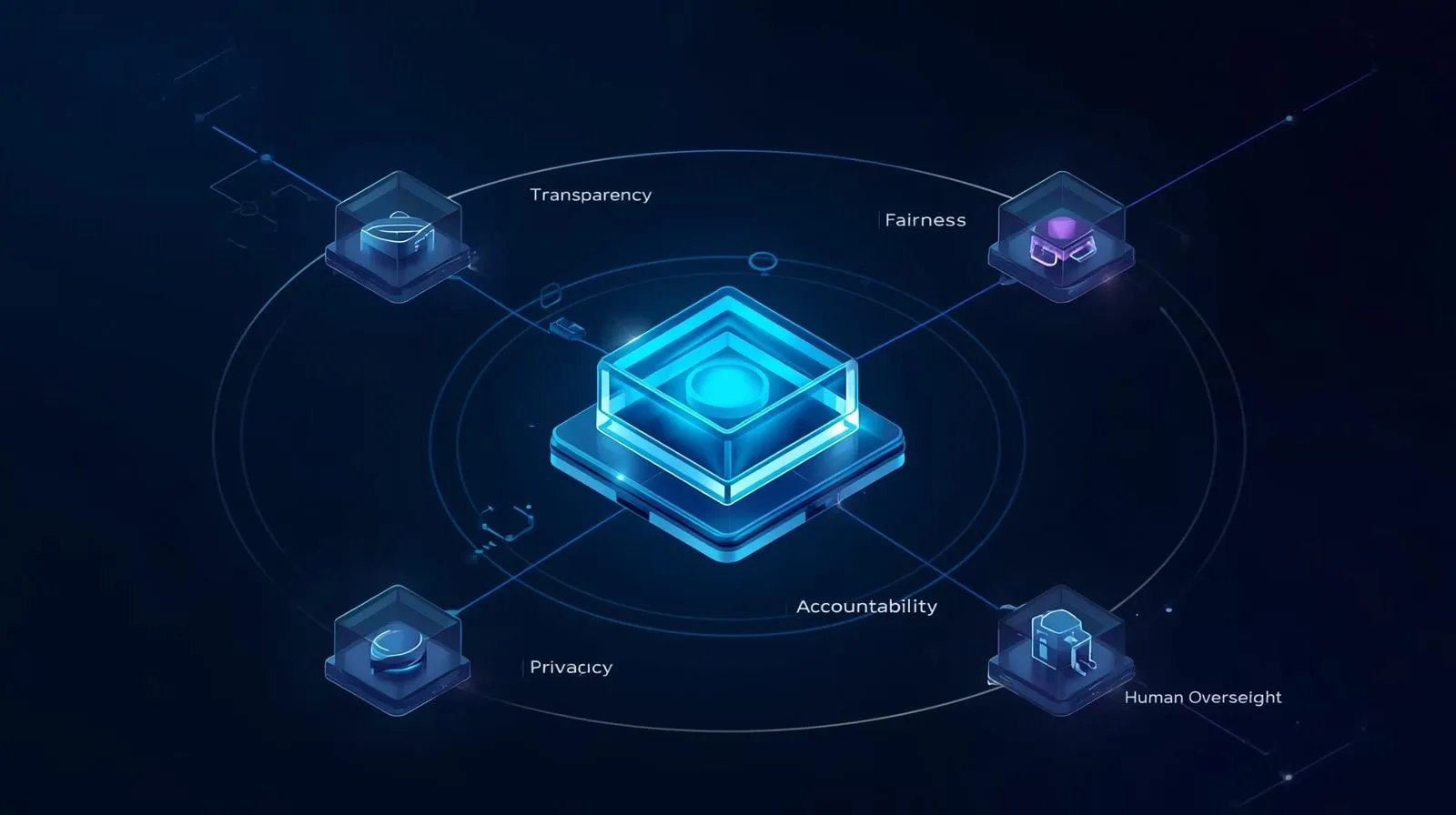
Strong AI access control depends on four principles that apply across all access models. These best practices reduce exposure created by permission misconfiguration. They strengthen the organization’s security posture and connect permission design with enterprise risk management.
These principles also reduce exposure to emerging AI security threats. Every permission should have an owner, an approved purpose, a review schedule, and a revocation condition.
AI also strengthens existing access operations through faster analysis and adaptive decision-making. Machine learning can examine large amounts of data across users, services, devices, and applications. These capabilities supplement traditional methods while helping teams recognize changing risk before harmful access continues.
AI can also strengthen physical security across facilities and restricted areas. Facial recognition, video analytics, and IoT devices can help identify physical security threats. These capabilities should operate within governed security systems that address privacy, proportionality, and false-positive handling.
Embedding AI access control inside application code becomes difficult as models, agents, and tools multiply. TrueFoundry applies access rules through the AI Gateway, which operates within the inference path. It centralizes authentication, authorization, monitoring, and controls through a single platform.
This infrastructure-level approach strengthens data security because every request crosses the same enforcement layer. It also helps teams identify misconfigurations before they become serious security weaknesses. Policies remain consistent across providers, applications, agents, tools, and deployment environments.
Book a demo to see how TrueFoundry centralizes identity, policy controls, and auditability across every enterprise AI workload in production.
TrueFoundry AI Gateway offre une latence d'environ 3 à 4 ms, gère plus de 350 RPS sur 1 processeur virtuel, évolue horizontalement facilement et est prête pour la production, tandis que LiteLM souffre d'une latence élevée, peine à dépasser un RPS modéré, ne dispose pas d'une mise à l'échelle intégrée et convient parfaitement aux charges de travail légères ou aux prototypes.





Les dernières nouvelles, articles et ressources envoyés dans votre boîte de réception


.png)
.png)
.png)
.png)
.png)
.png)
.png)
.png)
.png)
.png)
.png)


