


.png)
October 15, 2026
|
5 min de lecture


Accédez instantanément à un environnement TrueFoundry en direct. Déployez des modèles, acheminez le trafic LLM et explorez la plateforme complète : votre sandbox est prête en quelques secondes, aucune carte de crédit n'est requise.



Published: October 14, 2026
.webp)
Une méthode incroyablement rapide pour créer, suivre et déployer vos modèles !
One AI agent answering questions is a tool. Five agents researching, deciding, drafting, reviewing, and acting on live enterprise systems is a different kind of AI system. It carries different governance requirements once it runs in production systems.
Multi-agent orchestration is the layer that determines whether the second case stays useful. Without it, the same coordination that produces leverage also causes stacking errors, unclear audit trails, and inference bills that nobody can reconstruct afterward.
This guide covers the multi-agent orchestration meaning, how the runtime works, the frameworks teams choose from in 2026, and what those frameworks leave for operators to handle. It closes with how TrueFoundry manages the governance layer that orchestrated systems require.
Multi-agent orchestration is the practice of coordinating multiple AI agents toward a shared goal. Each individual agent owns a defined role, capability, or subtask inside a larger workflow.
The pattern differs from single-agent AI in several ways. Work is split among specialist agents rather than routed through a single AI agent that handles everything in sequence. Autonomous agents pass results to one another, hand off subtasks, and combine outputs as the workflow progresses. An orchestration layer sitting above the individual agents picks who runs when, what context they receive, what they can touch, and how the entire system behaves on failure.
This represents a fundamental shift in how enterprise AI is structured. A single tool with general capabilities gives way to coordinated, agentic systems with specialized roles and a clear structure for achieving broader objectives.

AI governance technologies operationalize an organization’s AI policies by providing oversight, risk management, compliance, observability and security across the AI life cycle. This Hype Cycle identifies the technologies that will help organizations implement AI governance responsibly and drive adoption at scale.
Understanding the mechanics helps teams design for failure before it happens. Four runtime behaviors define how a well-built multi-agent orchestration system actually operates.
An orchestrator agent reads the top-level goal. It splits the goal into discrete subtasks suited to specialist agents. The sequence and dependencies across those tasks are the central orchestrator's responsibility to manage.
Outputs come back through the same orchestrator agent. Each specialist agent's output gets scored. The orchestrator agent decides whether the step succeeded or needs another attempt. It judges when the objective has been met well enough to stop the loop and produce the final output.
A sub-agent runs inside a defined role. Access is limited to the specific external tools, data sources, and model capabilities required by its function. Narrow scoping keeps agentic systems tractable when something inevitably goes wrong.
Results flow back to the orchestrator agent, which folds those outputs into the context for later steps. That continuous feedback loop of information throughout the workflow gives orchestrated systems their leverage over a single AI agent handling everything sequentially.
State that persists across steps separates orchestrated complex workflows from chained single-agent calls. Earlier outputs feed later decisions. The user does not have to re-supply context at every stage. That continuity is one of the primary reasons for building agentic AI this way.
Persistence brings a new failure mode in exchange. A wrong fact written into the state at step two can corrupt every subsequent step. That pattern makes debugging a multi-agent orchestration failure significantly harder than debugging a single AI agent failure, which is why defined error handling matters from day one.
Production systems require defined behavior for failure cases that nobody enjoys thinking about during prototyping. An agent fails. A sub-agent times out. A sub-agent returns malformed output. Retry policies and paths to manual intervention must be defined in advance.
Without explicit error handling at the orchestration layer, two things happen. A single point of failure in one sub-agent stalls the entire system. Or the orchestrator agent pushes ahead with incomplete information and produces output that looks plausible but is wrong in ways nobody catches until later.
.webp)
Several frameworks are available for building multi-agent orchestration systems. Each solves the orchestration coordination problem in a different way. Choosing the right one for your business needs depends on complexity, team expertise, and production systems' reliability requirements.
Workflows in LangGraph take the shape of directed graphs. Nodes, conditional edges, and every transition stay under explicit developer control. Time-travel debugging across agent steps comes built in. That matters more in production systems than it sounds during a demo.
Best fit: Complex workflows with conditional branching, human-in-the-loop checkpoints, and fault tolerance needs that demand predictable, auditable execution paths.
Microsoft's primary multi-agent offering is now Microsoft Agent Framework, released in public preview on October 1, 2025. Two products were merged into one: AutoGen for multi-agent orchestration patterns, and Semantic Kernel for enterprise AI concerns such as telemetry and Azure integration.
Both predecessor frameworks entered maintenance mode during the consolidation. All future development is focused on the unified platform. The multi-agent orchestration patterns AutoGen pioneered, including group chat, debate, and reflection, now run on top of Semantic Kernel's enterprise foundation.
AG2 is separate. The AG2 project is a community fork of the original AutoGen 0.2, maintained outside Microsoft by some of the framework's original creators. AG2 is not Microsoft Agent Framework despite frequent confusion in older documentation.
A crew of role-playing agents is the central abstraction in CrewAI. Every AI agent carries a defined role, goal, and tool set. The crew metaphor maps onto how business leaders already think about complex tasks and workflow design for their customer support and customer service workflows.
Limits emerge at scale. Fine-grained conflict resolution becomes harder in complex branching scenarios. Teams with strict production systems, reliability and state management requirements often move to LangGraph once the prototype must stay up continuously.
Hierarchical agent trees are the model in Google ADK. A central orchestrator delegates to sub-agents, which may in turn have sub-agents. Native support for the A2A protocol enables cross-framework AI agent communication, which matters for teams building on new agents from generative AI providers across multiple frameworks.
.webp)
Orchestration frameworks solve the coordination problem. They do not solve the governance, cost, or auditability problems that arise when agentic AI moves from prototypes to enterprise systems that run on sensitive customer data for customer queries and customer history workflows.
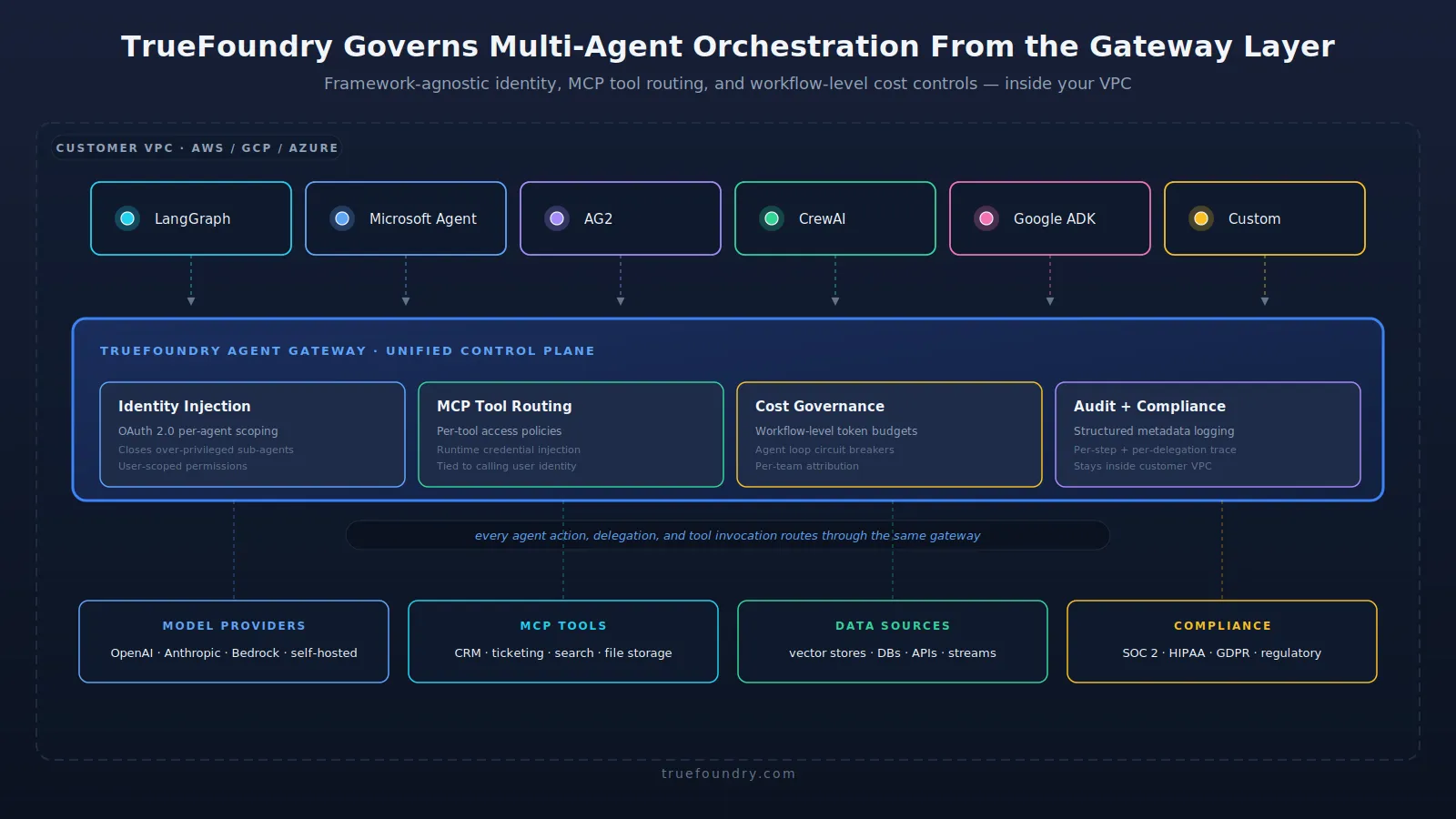
None of the orchestration frameworks enforces which autonomous agents or users can access which external tools, large language models, or data. Security policies get delegated to individual application code. That code scales inconsistently across teams and drifts over time, creating gaps that compound as the number of agents grows.
Token costs stack up fast. A five-agent workflow triggering three model calls per AI agent per step generates 15 or more inference calls per customer support request. No native cost ceiling at the framework layer catches a runaway feedback loop before it appears on a bill.
Audit trails produced by orchestration frameworks are execution logs, not compliance artifacts. Producing evidence of what each individual agent accessed, when, and on whose authority requires layering external logging infrastructure on top of whatever the framework emits. This is a competitive advantage gap: organizations that treat governance as a first-class concern close faster than those that treat it as an afterthought.
Framework lock-in shows up at the model provider layer. Switching large language models across AI agent roles often means framework-level refactoring rather than a configuration change. That constrains the multi-cloud and multi-vendor strategies most enterprise AI teams want to pursue through the model context protocol and new capabilities from providers.
The TrueFoundry Agent Gateway sits above any multi-agent orchestration framework. It governs what orchestrated systems can do, what they can access, and what running them costs, without changing the orchestration-layer logic itself.
ag to walk through how the gateway handles framework-agnostic identity, MCP tool routing, and workflow-level cost controls inside your own VPC for your multi-agent orchestration workloads.
TrueFoundry AI Gateway offre une latence d'environ 3 à 4 ms, gère plus de 350 RPS sur 1 processeur virtuel, évolue horizontalement facilement et est prête pour la production, tandis que LiteLM souffre d'une latence élevée, peine à dépasser un RPS modéré, ne dispose pas d'une mise à l'échelle intégrée et convient parfaitement aux charges de travail légères ou aux prototypes.





Les dernières nouvelles, articles et ressources envoyés dans votre boîte de réception
.png)
.webp)
.png)
.png)
.png)

.png)
.png)
.png)
.png)


