


October 8, 2026
|
5 min de lecture


Accédez instantanément à un environnement TrueFoundry en direct. Déployez des modèles, acheminez le trafic LLM et explorez la plateforme complète : votre sandbox est prête en quelques secondes, aucune carte de crédit n'est requise.



Published: October 6, 2026

Une méthode incroyablement rapide pour créer, suivre et déployer vos modèles !
<!--meta-description: Les meilleures alternatives à IBM ContextForge en 2026, comparées selon l'hébergement géré, la gouvernance d'entreprise et le coût total de possession.slug: /blog/ibm-contextforge-alternativesprimary-kw: ibm contextforge alternatives-->Alternatives à IBM ContextForge : les 5 meilleures options pour 2026
IBM ContextForge, le projet open source mcp-context-forge , est une solution efficace en tant que passerelle, registre et proxy MCP gratuit : il prend en charge les transports HTTP, WebSocket, SSE et stdio, propose une interface d'administration, une authentification par portée OAuth et le traçage OpenTelemetry. Pour une équipe plateforme qui souhaite un contrôle total et n'est pas réticente à gérer elle-même Kubernetes et Redis, c'est un point de départ raisonnable.
Les équipes commencent à chercher ailleurs pour plusieurs raisons récurrentes : elles ne veulent pas supporter la charge de l'hébergement et de la maintenance, elles ont besoin d'une passerelle IA et MCP unifiée plutôt que d'un simple proxy MCP, elles exigent une gouvernance d'entreprise native (SSO, RBAC à l'échelle de l'organisation, contrôle budgétaire, journaux d'audit), ou elles ont besoin d'un SLA fournisseur plutôt que d'un support communautaire.
1. TrueFoundry : le meilleur choix pour les entreprises
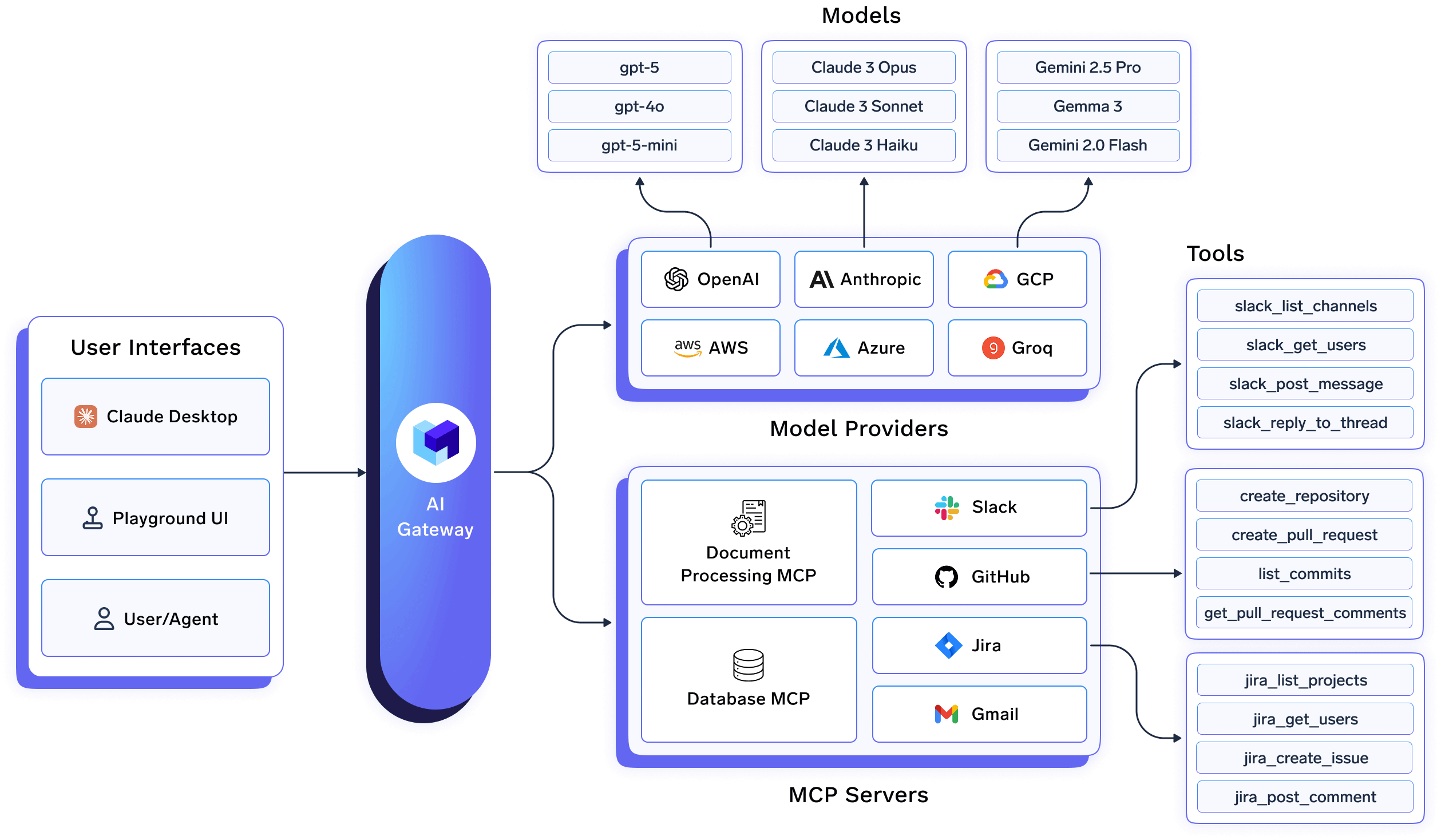
TrueFoundry associe une passerelle IA et une passerelle MCP au sein d'un même plan de contrôle, avec plus de 1 000 LLM accessibles via une API unique compatible OpenAI, une latence de passerelle d'environ 3 à 4 ms et une prise en charge de plus de 350 requêtes par seconde sur un seul vCPU. Contrairement à ContextForge, il est disponible sous forme de solution SaaS entièrement gérée ; vous n'avez donc aucun cluster Kubernetes à provisionner avant de pouvoir enregistrer votre premier serveur MCP.
Concernant spécifiquement le volet MCP, TrueFoundry applique le contrôle d'accès basé sur les rôles (RBAC) aux serveurs MCP enregistrés, prend en charge les serveurs MCP virtuels et journalise chaque appel d'outil avec des métriques complètes. La solution est également conforme aux normes SOC 2, HIPAA et RGPD, et peut être déployée dans des environnements VPC, sur site ou totalement isolés (air-gapped) pour les équipes soumises à des exigences de résidence des données.
Avantages :
Inconvénients :
Idéal pour : Les entreprises qui souhaitent centraliser la gouvernance MCP et la gestion de passerelle LLM/IA sur une seule plateforme, avec un SLA de support et des certifications de conformité, plutôt que d'assembler et d'héberger l'équivalent à partir de composants open source.
<img src="https://cdn.prod.website-files.com/6291b38507a5238373237679/696f68d3d72ee5517beded3e_Group%2039603.webp" alt="TrueFoundry AI Gateway guardrails configuration screenshot" style="max-width:100%;border-radius:8px;" />
Tarification : Plan Développeur gratuit (50 000 requêtes/mois), plan Pro à 499 $/mois, plan Pro Plus à 2 999 $/mois, et offre Entreprise personnalisée. Détails complets sur truefoundry.com/pricing.
Essayer TrueFoundry AI Gateway →
Runlayer est un plan de contrôle IA axé sur l'identité des agents, la détection du Shadow AI et une passerelle MCP gouvernée offrant un accès à un catalogue de plus de 18 000 MCP. C'est une solution plus adaptée que ContextForge pour les entreprises qui doivent identifier les agents non gérés déjà actifs dans l'organisation, plutôt que de simplement servir de proxy pour le trafic MCP connu.
Runlayer ne publie pas ses tarifs et est vendu uniquement via des contrats entreprise. Contrairement à ContextForge, il n'existe pas d'option auto-hébergée. La solution est conforme aux normes SOC 2, HIPAA et RGPD.
Idéal pour : Les grandes entreprises déployant des agents au sein de nombreuses équipes, ayant besoin de détecter le Shadow AI en plus de la gouvernance MCP, et prêtes à adopter une plateforme gérée sur devis personnalisé.
Lasso est une plateforme de sécurité IA, et non une passerelle. Elle couvre la détection, l'évaluation des risques, le red teaming automatisé et l'application des règles d'exécution pour les agents et les applications IA. Elle applique les politiques au niveau du proxy, de l'API ou de la passerelle, sans être elle-même la passerelle.
Si l'attrait de ContextForge réside dans la combinaison « gouvernance et proxy en un seul endroit », Lasso ne remplace pas cette fonction ; il s'ajoute à la passerelle que vous utilisez déjà. La tarification est de type entreprise, sur devis.
Idéal pour : Les équipes de sécurité souhaitant un red teaming approfondi et une détection des menaces pour l'IA agentique, tout en utilisant une passerelle (ContextForge, TrueFoundry ou autre) séparément.
Portkey est une passerelle IA offrant une large couverture des fournisseurs de LLM, la mise en cache, l'observabilité et des intégrations de garde-fous. Son support MCP est moins approfondi que celui d'une passerelle MCP spécialisée comme ContextForge ou TrueFoundry ; il est donc plus adapté aux équipes dont le besoin principal est le routage LLM, le MCP n'étant qu'une préoccupation secondaire.
Idéal pour : Les équipes dont la charge de travail principale est la gestion d'API LLM, avec la gouvernance MCP comme exigence secondaire et mineure.
LiteLLM est une passerelle et un proxy LLM open source, similaire dans l'esprit à ContextForge mais axé sur le trafic LLM plutôt que sur le MCP/A2A. Les équipes utilisant déjà LiteLLM pour le routage LLM se tournent parfois vers ContextForge pour ajouter la gouvernance MCP. Les deux sont souvent évalués comme des composants open source complémentaires plutôt que comme des substituts directs.
Idéal pour : Équipes souhaitant rester entièrement en open source et prêtes à gérer et assembler elles-mêmes des proxys LLM et MCP distincts.
<table style="width:100%;border-collapse:collapse;margin:1.5em 0;"><thead><tr><th style="text-align:left;padding:10px 12px;border:1px solid #e0e0e0;background:#f7f7f8;">Fonctionnalité</th><th style="text-align:left;padding:10px 12px;border:1px solid #e0e0e0;background:#f7f7f8;">TrueFoundry</th><th style="text-align:left;padding:10px 12px;border:1px solid #e0e0e0;background:#f7f7f8;">IBM ContextForge</th><th style="text-align:left;padding:10px 12px;border:1px solid #e0e0e0;background:#f7f7f8;">Runlayer</th><th style="text-align:left;padding:10px 12px;border:1px solid #e0e0e0;background:#f7f7f8;">Lasso Security</th></tr></thead><tbody><tr><td style="padding:10px 12px;border:1px solid #e0e0e0;">Passerelle IA + Passerelle MCP sur une plateforme unique</td><td style="padding:10px 12px;border:1px solid #e0e0e0;">Oui</td><td style="padding:10px 12px;border:1px solid #e0e0e0;">MCP/A2A/REST uniquement</td><td style="padding:10px 12px;border:1px solid #e0e0e0;">Passerelle MCP + gouvernance des agents</td><td style="padding:10px 12px;border:1px solid #e0e0e0;">Non, couche de sécurité uniquement</td></tr><tr><td style="padding:10px 12px;border:1px solid #e0e0e0;">Option gérée / SaaS</td><td style="padding:10px 12px;border:1px solid #e0e0e0;">Oui</td><td style="padding:10px 12px;border:1px solid #e0e0e0;">Non, auto-hébergé uniquement</td><td style="padding:10px 12px;border:1px solid #e0e0e0;">Oui, géré uniquement</td><td style="padding:10px 12px;border:1px solid #e0e0e0;">Oui, géré uniquement</td></tr><tr><td style="padding:10px 12px;border:1px solid #e0e0e0;">Tarification publique</td><td style="padding:10px 12px;border:1px solid #e0e0e0;">Oui, à partir de 0 $/mois</td><td style="padding:10px 12px;border:1px solid #e0e0e0;">Gratuit (OSS), coûts d'infrastructure en sus</td><td style="padding:10px 12px;border:1px solid #e0e0e0;">Non, devis personnalisé</td><td style="padding:10px 12px;border:1px solid #e0e0e0;">Non, devis personnalisé</td></tr><tr><td style="padding:10px 12px;border:1px solid #e0e0e0;">Open source</td><td style="padding:10px 12px;border:1px solid #e0e0e0;">Non (commercial, auto-hébergeable)</td><td style="padding:10px 12px;border:1px solid #e0e0e0;">Oui</td><td style="padding:10px 12px;border:1px solid #e0e0e0;">Non</td><td style="padding:10px 12px;border:1px solid #e0e0e0;">Non</td></tr><tr><td style="padding:10px 12px;border:1px solid #e0e0e0;">VPC / sur site / air-gapped</td><td style="padding:10px 12px;border:1px solid #e0e0e0;">Oui</td><td style="padding:10px 12px;border:1px solid #e0e0e0;">Oui, conçu pour l'auto-hébergement</td><td style="padding:10px 12px;border:1px solid #e0e0e0;">Non</td><td style="padding:10px 12px;border:1px solid #e0e0e0;">Partiel (composants sur site)</td></tr><tr><td style="padding:10px 12px;border:1px solid #e0e0e0;">Certifications de conformité</td><td style="padding:10px 12px;border:1px solid #e0e0e0;">SOC 2, HIPAA, prêt pour le RGPD</td><td style="padding:10px 12px;border:1px solid #e0e0e0;">Non applicable (auto-géré)</td><td style="padding:10px 12px;border:1px solid #e0e0e0;">SOC 2, HIPAA, RGPD</td><td style="padding:10px 12px;border:1px solid #e0e0e0;">Entreprise (détails non publics)</td></tr></tbody></table>
Si votre équipe utilise déjà Kubernetes à grande échelle, dispose de la bande passante SRE nécessaire pour corriger et surveiller un service supplémentaire, et souhaite éviter tout coût de licence tout en conservant un contrôle total sur le code source, ContextForge est une option tout à fait valable. Il est activement maintenu par IBM, possède un véritable écosystème de plugins et évite totalement le verrouillage propriétaire. Le compromis est que tout ce qui dépasse le cadre du « code gratuit » (hébergement, support, interface de gouvernance, conformité) devient la responsabilité de votre équipe plutôt que celle d'un fournisseur.
Quelle est la meilleure alternative à IBM ContextForge pour les entreprises ?TrueFoundry est la solution la plus adaptée aux entreprises qui recherchent une gouvernance combinée de passerelle IA et de passerelle MCP sur une plateforme gérée, avec une tarification publique, des certifications de conformité et des options de déploiement en VPC, sur site ou en environnement isolé (air-gapped).
Existe-t-il une alternative gratuite à IBM ContextForge ?LiteLLM est l'option open source gratuite la plus proche, bien qu'elle se concentre sur le proxy LLM plutôt que sur la gouvernance MCP. ContextForge lui-même reste gratuit et open source ; la plupart des véritables alternatives sont des produits commerciaux gérés.
Quelles sont les alternatives à IBM ContextForge spécifiquement pour la gouvernance MCP ?TrueFoundry et Runlayer proposent tous deux une gouvernance axée sur MCP (RBAC, serveurs MCP virtuels, journalisation des appels d'outils) en tant que plateformes gérées, ce qui élimine la charge d'hébergement Kubernetes et Redis inhérente à l'auto-hébergement de ContextForge.
TrueFoundry prend-il en charge les serveurs MCP auto-hébergés comme le fait ContextForge ?Oui. La passerelle MCP de TrueFoundry prend en charge les serveurs MCP auto-hébergés à partir de l'offre Pro Plus, en plus du RBAC et des serveurs MCP virtuels.
Puis-je déployer TrueFoundry dans mon propre VPC ou sur site ?Oui. TrueFoundry s'exécute dans votre VPC, sur site, en environnement isolé, en mode hybride ou sur plusieurs clouds, sans qu'aucune donnée ne quitte votre domaine, offrant la même flexibilité de déploiement qui attire les équipes vers des solutions open source auto-hébergées comme ContextForge.
ContextForge est un excellent choix si vous disposez de l'équipe d'infrastructure nécessaire pour le gérer. Si vous préférez ne pas avoir à gérer cette charge opérationnelle, TrueFoundry couvre les mêmes besoins en matière de gouvernance MCP, tout en ajoutant la gestion de passerelle IA via une plateforme managée aux tarifs transparents. Réserver une démo pour découvrir comment elle gère la gouvernance que vous prévoyez actuellement de construire vous-même.
TrueFoundry AI Gateway offre une latence d'environ 3 à 4 ms, gère plus de 350 RPS sur 1 processeur virtuel, évolue horizontalement facilement et est prête pour la production, tandis que LiteLM souffre d'une latence élevée, peine à dépasser un RPS modéré, ne dispose pas d'une mise à l'échelle intégrée et convient parfaitement aux charges de travail légères ou aux prototypes.





Les dernières nouvelles, articles et ressources envoyés dans votre boîte de réception

.png)
.png)
.png)
.png)
.png)
.png)
.png)


