Obtenga acceso instantáneo a un entorno TrueFoundry en vivo. Implemente modelos, dirija el tráfico de LLM y explore la plataforma completa: su sandbox estará listo en segundos, sin necesidad de tarjeta de crédito.
9,9
TrueFoundry vs Portkey vs Helicone: Comparación de pasarelas de IA empresariales para 2026
TrueFoundry vs Portkey vs Helicone: Comparativa de pasarelas de IA empresariales para 2026
TrueFoundry, Portkey y Helicone figuran en las listas de preseleccionados de pasarelas de IA empresariales. Cada uno ha logrado una adopción real y resuelve el problema central del proxy de LLM con verdadera competencia: una API unificada para múltiples proveedores, registro de uso y visibilidad básica de costes. Si esos son sus únicos requisitos, la comparación es breve y el precio será el factor decisivo.
La comparación se complica más para los equipos empresariales en fase de adquisición con datos regulados, implementaciones de IA agéntica, entornos multinube o requisitos de auditoría de cumplimiento. Estas tres plataformas realizaron compensaciones arquitectónicas fundamentalmente diferentes. Portkey comienza en 49 $ al mes y es compatible con más de 1600 LLM, lo que la convierte en una de las opciones más accesibles para desarrolladores del mercado. Helicone es de código abierto y gratuito para autoalojar, diseñado principalmente para la profundidad de la observabilidad. TrueFoundry es una plataforma empresarial completa que combina pasarela de IA, pasarela MCP, despliegue de modelos y gestión multinube en un único plano de control diseñado para los requisitos de las empresas Fortune 500.
Esta comparación está diseñada para líderes de ingeniería, arquitectos de plataformas y responsables de TI que evalúan plataformas de pasarela de IA para uso en producción. Se centra en seis dimensiones que determinan consistentemente la idoneidad empresarial, incluyendo la profundidad de la gobernanza, la flexibilidad de despliegue, el control de acceso y la preparación para el cumplimiento normativo. Todas las capacidades de la plataforma se derivan de la documentación disponible públicamente y reflejan el estado de cada producto en el momento de la redacción.
Las Seis Dimensiones de Evaluación que Diferencian las Pasarelas Empresariales de las Herramientas para Desarrolladores
La cobertura de proveedores y el precio base son lo básico. Toda pasarela de IA seria es compatible con OpenAI, Anthropic y Azure. Las dimensiones que se presentan a continuación son las que determinan si su CISO aprueba el despliegue, si su equipo de cumplimiento puede producir la evidencia de auditoría que necesita y si la plataforma escala de cinco a quinientos equipos sin que surjan lagunas de gobernanza en el proceso.
Pasarela MCP y gobernanza de IA agéntica: Los agentes de IA que invocan herramientas a través del Protocolo de Contexto del Modelo necesitan una capa de gobernanza para ese acceso a herramientas, separada y adicional a la gobernanza del acceso a modelos. A medida que las herramientas de IA agéntica se estandarizan en la ingeniería empresarial, este es el diferenciador más importante para 2026. Su ausencia obliga a una segunda adquisición, un segundo proyecto de integración y una pista de auditoría de doble sistema que los equipos de cumplimiento deben conciliar.
Despliegue local y en VPC: La capacidad de ejecutar la plataforma completa dentro de la propia cuenta en la nube del cliente sin salida de datos a la infraestructura del proveedor. Requerido para datos cubiertos por HIPAA y para organizaciones con obligaciones de residencia de datos. Las certificaciones de cumplimiento en un producto SaaS no satisfacen este requisito, independientemente del estado de certificación del proveedor.
SSO empresarial y RBAC: Integración con Okta, Azure Active Directory o SAML 2.0 para una gestión completa del ciclo de vida de la identidad, no solo inicio de sesión único. Los desarrolladores que se incorporan o abandonan la organización obtienen y pierden acceso a la pasarela de IA a través de los mismos flujos de trabajo de aprovisionamiento y desaprovisionamiento que rigen todos los demás sistemas empresariales.
Cumplimiento normativo y registro de auditoría estructurado: Registros de auditoría estructurados y consultables en formato JSON con cobertura de campos que satisfacen los requisitos de SOC2, HIPAA y GDPR, almacenados en la propia infraestructura de la organización con retención configurable. Los registros de solicitudes sin procesar en el panel de control de un proveedor no son evidencia de auditoría de cumplimiento.
Plano de control unificado multinube: Una única interfaz de gestión que gobierna AWS, Azure y GCP simultáneamente con un registro de auditoría unificado y políticas RBAC consistentes. Los despliegues por nube con una sobrecarga de gestión separada crean lagunas de gobernanza y dificultan significativamente la elaboración de informes de cumplimiento.
Despliegue de modelos más allá del enrutamiento de pasarela: La capacidad de desplegar y servir modelos ajustados y LLM de código abierto desde la misma plataforma que gobierna el acceso a los modelos de proveedor. Las plataformas solo de pasarela requieren una solución de servicio de modelos separada, una canalización de despliegue separada y una gobernanza separada para los modelos autoalojados.
TrueFoundry: Plataforma de IA Empresarial Integral
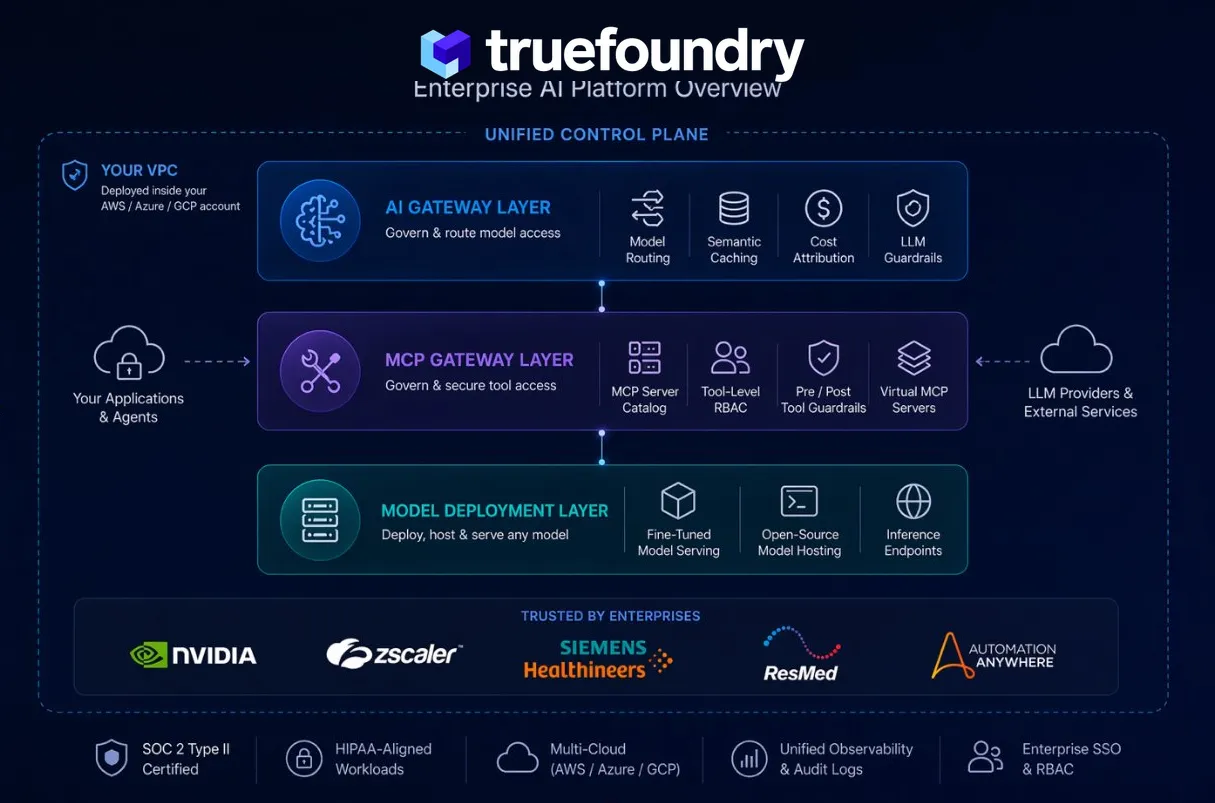
TrueFoundry no fue construida como una puerta de enlace de IA a la que se le añadieron funciones empresariales más tarde. Es una plataforma de IA empresarial donde la puerta de enlace de IA, la puerta de enlace MCP, la infraestructura de despliegue de modelos y la gestión multinube son capas integradas de un único plano de control diseñado desde el principio para los requisitos empresariales regulados.
Entre los despliegues empresariales confirmados se incluyen NVIDIA, Zscaler, Siemens Healthineers, ResMed y Automation Anywhere. La plataforma procesa más de 10 mil millones de solicitudes al mes en empresas de la lista Fortune 1000 y gestiona más de 1.000 clústeres. Cuenta con la certificación SOC2 Tipo II y es compatible con cargas de trabajo alineadas con HIPAA en AWS GovCloud.
Capacidades de la puerta de enlace de IA: Se conecta a más de 1.600 LLM a través de una API unificada con una sobrecarga de latencia de milisegundos de un solo dígito bajo, dependiendo de la configuración. Los modelos virtuales enrutan el tráfico entre proveedores por peso, latencia o prioridad, con reintentos automáticos y recuperación ante fallos cuando un proveedor deja de funcionar. El almacenamiento en caché de coincidencia exacta y semántico funciona a través del encabezado x-tfy-cache-config, utilizando la coincidencia de similitud de coseno con OpenAI text-embedding-3-small en SaaS y un modelo de incrustación configurable en despliegues autoalojados. La atribución de costos por equipo y los límites de presupuesto estrictos que bloquean nuevas solicitudes cuando se alcanza un presupuesto son configurables en la interfaz de gestión. El registro de auditoría completo fluye a AI Gateway > Monitor > Requests y se exporta a través de OpenTelemetry a Grafana, Datadog o Splunk.
Puerta de enlace MCP: La capa de gobernanza de MCP de producción más completa en esta comparación. Un catálogo de servidores centralizado con flujos de trabajo de verificación rige qué servidores MCP llegan a los entornos de desarrollador. OAuth2 con seis patrones de autenticación salientes gestiona todo el ciclo de vida de las credenciales descendentes. El RBAC a nivel de herramienta aplicado en la puerta de enlace garantiza que los agentes solo descubran e invoquen las herramientas que su rol autoriza. Las salvaguardas previas a la herramienta, que incluyen SQL Sanitizer, detección de inyección de prompts y detección de secretos, se ejecutan antes de que se ejecute cualquier herramienta. Las salvaguardas posteriores a la herramienta, que incluyen la validación posterior a la ejecución, como PII y comprobaciones de seguridad de salida, se ejecutan antes de que los resultados lleguen al agente. Los servidores MCP virtuales permiten a los equipos de plataforma componer subconjuntos de herramientas seleccionados a partir de múltiples servidores. Cada llamada a la herramienta se registra en JSON estructurado con metadatos completos.
Despliegue de VPC local: Cuatro opciones de despliegue cubren todo el espectro, desde SaaS totalmente gestionado sin costo de infraestructura hasta un Control Plane completo más un Gateway Plane dentro de la nube del cliente, con un costo de infraestructura aproximado de $800 a $1.000 al mes, basado en escenarios de despliegue empresarial representativos. Las opciones 3 y 4 garantizan que ningún dato de inferencia de LLM o parámetro de invocación de herramientas MCP salga del perímetro empresarial para llegar a la infraestructura de TrueFoundry. Los registros de auditoría se escriben en el propio almacenamiento S3, GCS o Azure Blob del cliente en formato Parquet, consultables a través de Spark, DuckDB o Athena.
Despliegue de modelos incluido: El servicio de modelos ajustados, el alojamiento de modelos de código abierto y la gestión de puntos finales de inferencia residen en la misma plataforma que la puerta de enlace, bajo la misma infraestructura de RBAC y registro de auditoría. Las organizaciones no necesitan una solución de servicio de modelos separada.
Ideal para: Empresas de la lista Fortune 500 en industrias reguladas que requieren una única plataforma que gobierne el acceso a modelos, el acceso a herramientas de agente y el despliegue de modelos con aislamiento de VPC, documentación SOC2 Tipo II y SLAs contractuales.
Portkey: Puerta de Enlace Amigable para Desarrolladores con una Cobertura de LLM Decente
Portkey logró una fuerte adopción por parte de los desarrolladores al hacer que el enrutamiento de LLM fuera realmente accesible. Con una tarifa de plataforma de $49 al mes, y los tokens LLM facturados por separado a través de los proveedores, es la entrada de menor costo a una puerta de enlace de IA con soporte comercial y características realmente cercanas a las empresariales. Las más de 1.600 integraciones de LLM a través de una API unificada hacen que Portkey sea excepcional para equipos que necesitan una amplia cobertura de proveedores sin mantener integraciones individuales. El panel de observabilidad, el versionado de prompts y las capacidades de pruebas A/B están pulidos y son amigables para los desarrolladores.
Portkey cuenta con las certificaciones SOC2, HIPAA, GDPR e ISO. Estas se aplican a la infraestructura SaaS de Portkey, donde los datos de los clientes pasan por los sistemas de Portkey antes de llegar a los proveedores de LLM. La plataforma da servicio a más de 200 empresas en producción, con un volumen significativo de tokens procesados diariamente a través de su plataforma.
Cobertura y enrutamiento de LLM: Más de 1.600 integraciones de LLM representan la cobertura de proveedores más amplia en esta comparación. El enrutamiento de respaldo, el equilibrio de carga y el enrutamiento condicional basado en la capacidad del modelo están todos disponibles. La puerta de enlace de código abierto en GitHub admite el autoalojamiento bajo una licencia permisiva para equipos que desean un control total sobre la capa de enrutamiento.
Observabilidad y gestión de prompts: El seguimiento de sesiones, la atribución de costos por equipo, el versionado de prompts y las pruebas A/B son detallados y están listos para producción. La observabilidad de Portkey es una verdadera fortaleza para los equipos de ingeniería que depuran el rendimiento del modelo y la calidad de los prompts a escala.
Certificaciones SOC2, HIPAA, GDPR, ISO: Las certificaciones de cumplimiento de Portkey reducen la carga de evaluación de riesgos del proveedor para los equipos de adquisiciones que evalúan una pasarela SaaS. Esta es una ventaja significativa sobre las alternativas de código abierto autoalojadas, donde el cliente implementa y certifica sus propios controles.
Estado de MCP en 2026: Portkey introdujo la compatibilidad con MCP y se posiciona como una de las primeras pasarelas en incorporarla, con autenticación y descubrimiento unificados para servidores MCP internos y externos. A principios de 2026, esto se describe como acceso anticipado. Las empresas con implementaciones activas de IA agéntica deben verificar la madurez actual de las funciones, específicamente si las barreras de seguridad Pre Tool, los registros de auditoría estructurados por herramienta y el RBAC a nivel de herramienta están listos para producción, antes de comparar esto con la implementación de la pasarela MCP de TrueFoundry.
Implementación local: Existe una opción de implementación empresarial con aislamiento de red (air-gapped) para organizaciones con requisitos de aislamiento de VPC. El alcance de esta opción, qué características están disponibles en comparación con el producto en la nube y el modelo de gestión operativa deben confirmarse con el equipo de ventas empresariales de Portkey antes de tratarla como equivalente a una implementación totalmente nativa de VPC.
Ideal para: Startups y equipos de ingeniería de tamaño mediano que necesitan enrutamiento y observabilidad completos de LLM a un bajo costo de entrada, se sienten cómodos con un modelo de implementación SaaS y tienen tiempo para evaluar si el acceso anticipado a MCP de Portkey cumple con sus requisitos de gobernanza de IA agéntica.
Helicone: Plataforma de Observabilidad de Código Abierto
Helicone es una plataforma de observabilidad de LLM de código abierto, Y Combinator W23, de autoalojamiento gratuito bajo la licencia Apache 2.0. Una versión alojada como SaaS está disponible para equipos que prefieren una infraestructura gestionada. Helicone mantiene por separado una pasarela de IA de código abierto escrita en Rust, un proxy ligero distinto de la propia plataforma de observabilidad.
Para los equipos de ingeniería que necesitan registro detallado de llamadas LLM, depuración de prompts, análisis de consumo de tokens y propiedad total de su infraestructura de observabilidad, Helicone ofrece un valor real con una sobrecarga de integración mínima. Añadir Helicone es un cambio de código de una sola línea. La observabilidad captura cuerpos completos de prompts y respuestas, recuentos de tokens, latencia, costo, modelo y metadatos personalizados.
Código abierto y de autoalojamiento gratuito: El código base completo de Helicone está disponible en GitHub bajo la licencia Apache 2.0. Las implementaciones autoalojadas utilizan Docker Compose para el desarrollo local o un gráfico Helm de producción para cargas de trabajo empresariales. Los equipos con la capacidad de ingeniería para operar la plataforma solo pagan los costos de infraestructura.
Profundidad de la observabilidad: El registro completo del cuerpo de prompts y respuestas, los recuentos de tokens, la latencia, el costo, el modelo y los metadatos personalizados hacen que la observabilidad de Helicone sea sólida para la depuración y el análisis de costos. La integración con LangGraph proporciona visibilidad de los rastros de flujos de trabajo multiagente. La API de costos de LLM cubre más de 300 modelos para la atribución de costos.
Situación de MCP: Helicone publica un servidor MCP que da a clientes como Claude Desktop acceso de lectura a los registros de solicitudes y datos analíticos de Helicone. Esto no es una pasarela de gobernanza de MCP. No controla qué herramientas pueden invocar los agentes, no aplica RBAC en el acceso a herramientas, no ejecuta barreras de seguridad Pre Tool antes de la ejecución de la herramienta, ni produce registros de auditoría estructurados por llamada a herramienta. Las empresas que implementan agentes que invocan herramientas críticas para el negocio a través de MCP necesitan una pasarela MCP diseñada específicamente para ello, no un servidor MCP de observabilidad.
Brechas en la gobernanza empresarial: El enfoque de Helicone es la observabilidad. El RBAC con aplicación estricta, el aprovisionamiento SCIM, los informes de cumplimiento estructurados, los bloques de presupuesto por equipo y la aplicación de políticas en la capa de solicitud están ausentes del producto principal o requieren contacto empresarial. La versión autoalojada deja toda la seguridad, la configuración de alta disponibilidad y la implementación de controles de cumplimiento en manos del cliente. Helicone cumple con SOC2 y GDPR para su producto SaaS; las implementaciones autoalojadas requieren que el cliente implemente y certifique sus propios controles.
Ideal para: Equipos de ingeniería que desean una observabilidad profunda de las llamadas LLM para depuración, análisis de costos y monitoreo de la calidad de los prompts, con control total sobre su infraestructura de observabilidad, y que se sienten cómodos utilizando herramientas separadas para el enrutamiento de la pasarela, la gobernanza de MCP y la implementación de modelos.
Comparación directa de características
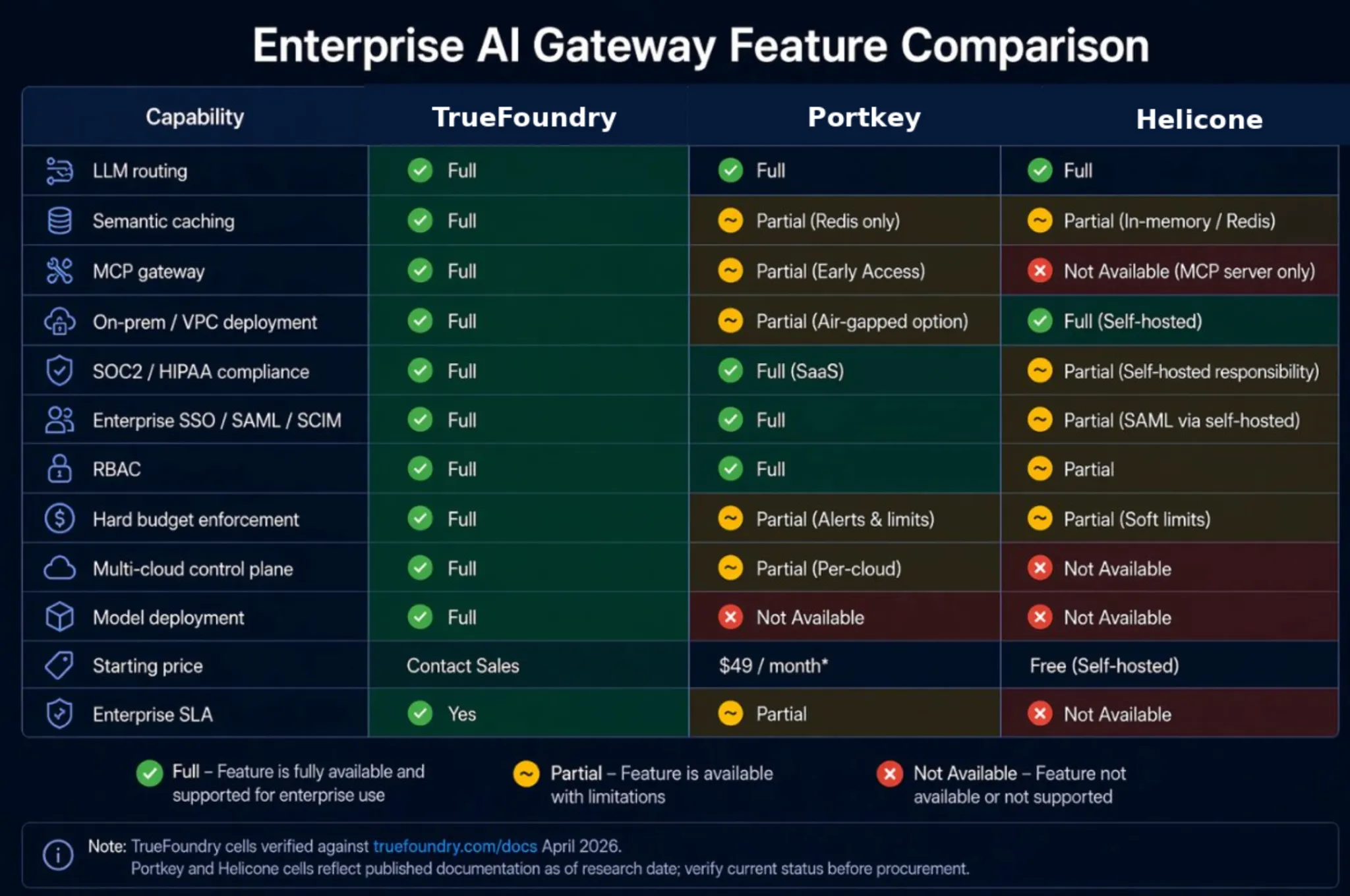
La siguiente tabla evalúa las plataformas de pasarela de IA empresariales según un conjunto consistente de criterios relevantes para implementaciones en producción, incluyendo control de acceso, cobertura de gobernanza, flexibilidad de implementación y preparación para el cumplimiento normativo. Las capacidades de TrueFoundry se basan en la documentación de producto disponible públicamente. La disponibilidad de características para otras plataformas refleja la funcionalidad documentada públicamente en el momento de la redacción y puede cambiar a medida que los productos se actualicen.
Capability
TrueFoundry
Portkey
Helicone
LLM routing and multi-provider
Full: 1,600+ LLMs via unified API; Virtual Models with
weight, latency, or priority routing; automatic retries and
fallback
Full: 1,600+ LLMs; fallback, load balancing, conditional
routing based on model capability
Partial: 100+ providers; routing available via separate
open-source AI Gateway; observability is the primary focus
Semantic caching
Full: exact-match and semantic via x-tfy-cache-config header;
cosine similarity matching; up to 40% redundancy reduction
(TrueFoundry documented)
Full: semantic caching available (verify current reduction
benchmarks with Portkey)
Partial: caching available via header; verify semantic vs
exact-match capability in current version
MCP gateway
Full: OAuth2, RBAC, server catalog with vetting workflow,
Pre/Post Tool guardrails, Virtual MCP Servers, metadata
policies
Partial: MCP compatibility introduced in early 2026 described
as early access; verify governance depth before procurement
Not available: Helicone publishes an MCP server for read
access to its own observability data only; not an agent tool
governance gateway
On-prem/VPC deployment
Full: customer's own AWS, Azure, or GCP; zero data egress to
TrueFoundry infra; Gateway Plane ~$600/month infra; Control
Plane + Gateway ~$800-$1,000/month
Partial: Enterprise air-gapped deployment option available;
verify feature scope and management capability with Portkey
sales
Partial: Docker and Helm self-hosting available under Apache
2.0; enterprise Helm chart for production; all security
hardening is customer's responsibility
SOC2 / HIPAA compliance
Full: SOC2 Type II certified; HIPAA-aligned VPC deployment;
audit logs written to customer's own S3/GCS/Azure Blob in
Parquet format
Full: SOC2, HIPAA, GDPR, ISO certifications for SaaS product
(applies to Portkey infrastructure; verify for air-gapped
option)
Partial: SOC2 and GDPR compliance for SaaS product;
self-hosted requires customer to implement and certify own
controls
Enterprise SSO/SAML/SCIM
Full: Okta, Azure AD, SAML 2.0, any JWKS-compatible IdP; full
identity lifecycle management across all deployment options
Full: SSO and SCIM on enterprise tier; verify tier
requirements and availability for air-gapped option
Partial: need to verify the current IdP support for
self-hosted version; enterprise features require contacting
enterprise@helicone.ai
RBAC by team and role
Full: tool-level and model-level RBAC enforced at gateway;
per-team, per-environment, per-agent policies updated without
server redeployment
Partial: workspace and role-based access available;
per-department budgets and usage quotas; verify tool-level
enforcement granularity
Full: hard token spending limits per team, service, and
endpoint that block new requests when budget is reached; not
advisory
Partial: budget controls and spending quotas available; verify
whether enforcement is hard-block or soft advisory limit
Not available in core product: cost tracking and alerts
available; hard blocking requires verification with Helicone
Multi-cloud unified control plane
Full: AWS, Azure, GCP simultaneously from single management
interface; consistent RBAC and audit log across all clouds
Partial: multi-provider LLM routing; not unified multi-cloud
infrastructure governance in a single control plane
Not available: observability SaaS or self-hosted per
deployment; no unified multi-cloud management layer
Model deployment and hosting
Full: fine-tuned model serving, open-source model hosting,
inference endpoint management; governed by same access control
and audit logging as gateway
Not available: gateway and observability only; separate model
serving solution required
Not available: observability platform and gateway proxy only;
no model hosting capability
Starting price
Enterprise pricing: contact TrueFoundry sales; self-hosted
Gateway Plane from ~$600/month infrastructure cost; fully
managed SaaS available
$49/month platform fee; LLM tokens billed separately by
providers; enterprise tier for air-gapped and advanced
governance
Free: open-source self-hosted under Apache 2.0; SaaS tier
available; enterprise pricing on request
Enterprise SLA
Full: contractual SLA and dedicated support for enterprise
accounts
Partial: verify current SLA terms and response times with
Portkey sales; enterprise support available
Not available for self-hosted; SaaS SLA terms apply to hosted
product only
Cómo TrueFoundry resuelve lo que Portkey y Helicone no pueden
Las limitaciones de Portkey y Helicone para uso empresarial no son fallos de ejecución. Reflejan el resultado natural de diferentes prioridades de diseño. Portkey está optimizado para la accesibilidad del desarrollador y la cobertura de proveedores de LLM. Helicone está optimizado para la profundidad de la observabilidad y la transparencia de código abierto. Ninguno de los dos fue construido principalmente para los requisitos de gobernanza de una empresa regulada que implementa IA agéntica a escala.
Pasarela MCP: el requisito empresarial que Portkey y Helicone no pueden igualar actualmente: La pasarela MCP de TrueFoundry es la única opción de grado de producción en esta comparación con salvaguardas completas Pre-Herramienta y Post-Herramienta, un catálogo de servidores con flujos de trabajo de verificación, RBAC a nivel de herramienta y registros de auditoría estructurados por invocación. Portkey introdujo una compatibilidad temprana con MCP, pero las empresas deben verificar la profundidad de la gobernanza frente a sus requisitos reales de implementación de agentes antes de tratarla como equivalente. La presencia de MCP de Helicone es un servidor de acceso a datos para su propia plataforma de observabilidad, no una capa de gobernanza de herramientas de agente. Para las empresas donde los agentes de IA invocan herramientas a través de MCP, esta brecha no es opcional de cubrir. Es la capa de control que hace que la IA agéntica sea desplegable sin crear acceso no auditado a sistemas críticos para el negocio.
Implementación en VPC: los datos nunca salen de su perímetro: Las opciones de TrueFoundry, Gateway Plane y Control Plane más Gateway Plane, se implementan completamente dentro de la cuenta en la nube del cliente. Todos los datos de inferencia de LLM y los parámetros de invocación de herramientas MCP permanecen dentro del perímetro empresarial. La opción air-gapped de Portkey requiere una adquisición de nivel empresarial y verificación del alcance. La opción autoalojada de Helicone otorga control de datos, pero la implementación de toda la seguridad y el cumplimiento recae en el equipo del cliente. Para datos clínicos cubiertos por HIPAA o registros financieros con requisitos de residencia de datos, la distinción entre un producto SaaS certificado por el proveedor y una VPC controlada por el cliente es la diferencia entre un control compensatorio y el cumplimiento total.
Aplicación estricta del presupuesto: no solo paneles: TrueFoundry aplica límites estrictos de gasto de tokens por equipo, servicio y punto final a través de Controles de Presupuesto en la pasarela. Cuando el presupuesto de un equipo se agota, las nuevas solicitudes se detienen antes de llegar a un proveedor de modelos. La diferencia entre un pico de costos visible en un panel y un pico de costos que se bloquea antes de que ocurra es la diferencia entre observabilidad y gobernanza. Verifique si los controles de presupuesto de Portkey operan como una aplicación estricta de bloqueo de solicitudes o como alertas de umbral antes de hacer esta comparación para un escenario de implementación específico.
Plataforma ML completa: más allá de solo la pasarela: Tanto Portkey como Helicone son herramientas de pasarela y observabilidad. Ninguno de los dos aloja modelos ajustados o de código abierto. Las organizaciones que necesitan implementar sus propios modelos junto con la gobernanza del acceso a los modelos de proveedores necesitan una solución separada si eligen cualquiera de las plataformas. TrueFoundry cubre el servicio de modelos ajustados, el alojamiento de modelos de código abierto y la gestión de puntos finales de inferencia bajo la misma infraestructura de control de acceso y registro de auditoría que la capa de pasarela. No hay una implementación de servicio de modelos separada para gestionar o gobernar.
SLAs empresariales y soporte dedicado: TrueFoundry ofrece SLAs contractuales de tiempo de actividad y éxito del cliente dedicado para cuentas empresariales. Para las organizaciones donde la pasarela de IA se encuentra en la ruta crítica de las aplicaciones empresariales de producción, un SLA contractual es un requisito de adquisición, no un beneficio opcional.
TrueFoundry AI Gateway ofrece una latencia de entre 3 y 4 ms, gestiona más de 350 RPS en una vCPU, se escala horizontalmente con facilidad y está listo para la producción, mientras que LitellM presenta una latencia alta, tiene dificultades para superar un RPS moderado, carece de escalado integrado y es ideal para cargas de trabajo ligeras o de prototipos.
Diseñado para la velocidad: ~ 10 ms de latencia, incluso bajo carga










.png)
.png)
.png)
.png)
.png)
.png)
.png)


