


September 26, 2026
|
Lesedauer: 5 Minuten


Erhalten Sie sofortigen Zugriff auf eine TrueFoundry-Live-Umgebung. Stellen Sie Modelle bereit, leiten Sie den LLM-Verkehr weiter und erkunden Sie die gesamte Plattform — Ihre Sandbox ist in Sekundenschnelle einsatzbereit, ohne dass eine Kreditkarte erforderlich ist.



Published: September 24, 2026
Unglaublich schnelle Methode zum Erstellen, Verfolgen und Bereitstellen Ihrer Modelle!
Die Wahl des einzusetzenden KI-Agententyps ist eine Architekturentscheidung, keine reine Begriffsdefinition. Der Agententyp bestimmt, wie er ohne menschliches Eingreifen argumentiert und agiert. Er bestimmt auch, wie weitreichend seine Aktionen sind und welche Governance-Ebene er vor dem Produktionseinsatz benötigt.
Ein einfacher Reflex-Agent, der einen Sensorwert liest, benötigt andere Kontrollen als ein Multi-Agenten-System, das CRM-, Datenbank- und Kommunikations-Stacks koordiniert. Die Klassifizierung beeinflusst die Infrastrukturentscheidung. Infrastrukturentscheidungen prägen das Risikoprofil.
Dieser Leitfaden behandelt jede Agentenkategorie, welche Aufgaben sie erfüllt, wo sie in Unternehmensszenarien eingesetzt wird und wie TrueFoundry die Governance für alle diese Kategorien handhabt.
Lesen Sie auch: Was ist KI-Observability
Ein KI-Agent ist ein autonomes Softwaresystem, das Eingaben wahrnimmt, diese mithilfe eines Modells oder Logiksystems verarbeitet und Aktionen zur Erreichung eines Ziels ausführt. Menschliche Anweisungen sind nicht bei jedem Schritt erforderlich.
Die Autonomie-Schleife unterscheidet einen Agenten von einem gewöhnlichen Modellaufruf. Die Schleife läuft ab: bewerten, entscheiden, handeln, beobachten und basierend auf dem, was sich ergibt, fortfahren. In dieser Schleife liegt der Wert für Unternehmens-Workflows. Hier konzentriert sich auch das Governance-Risiko in dem Moment, in dem ein Agent ohne Kontrollen zu arbeiten beginnt.
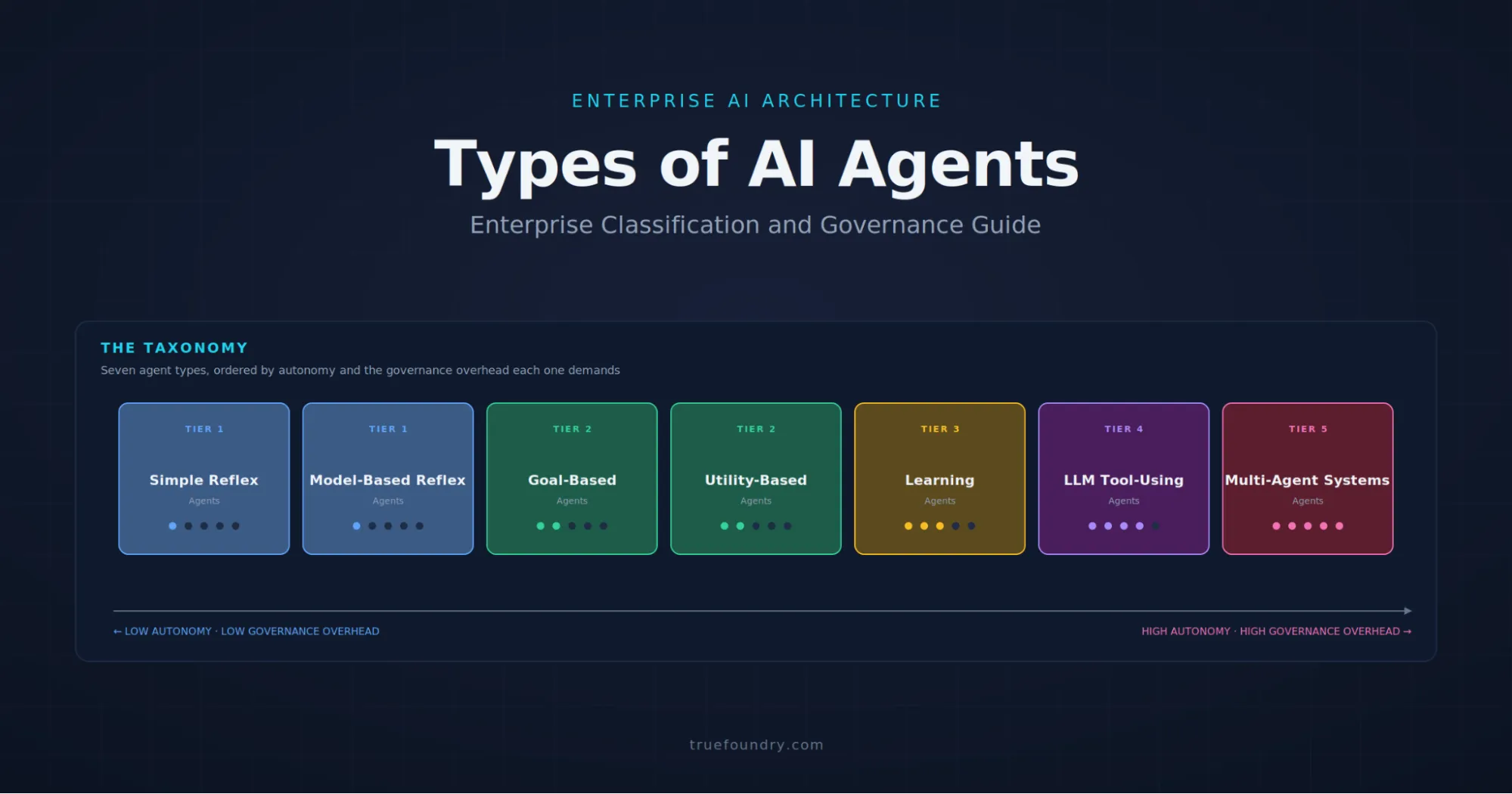
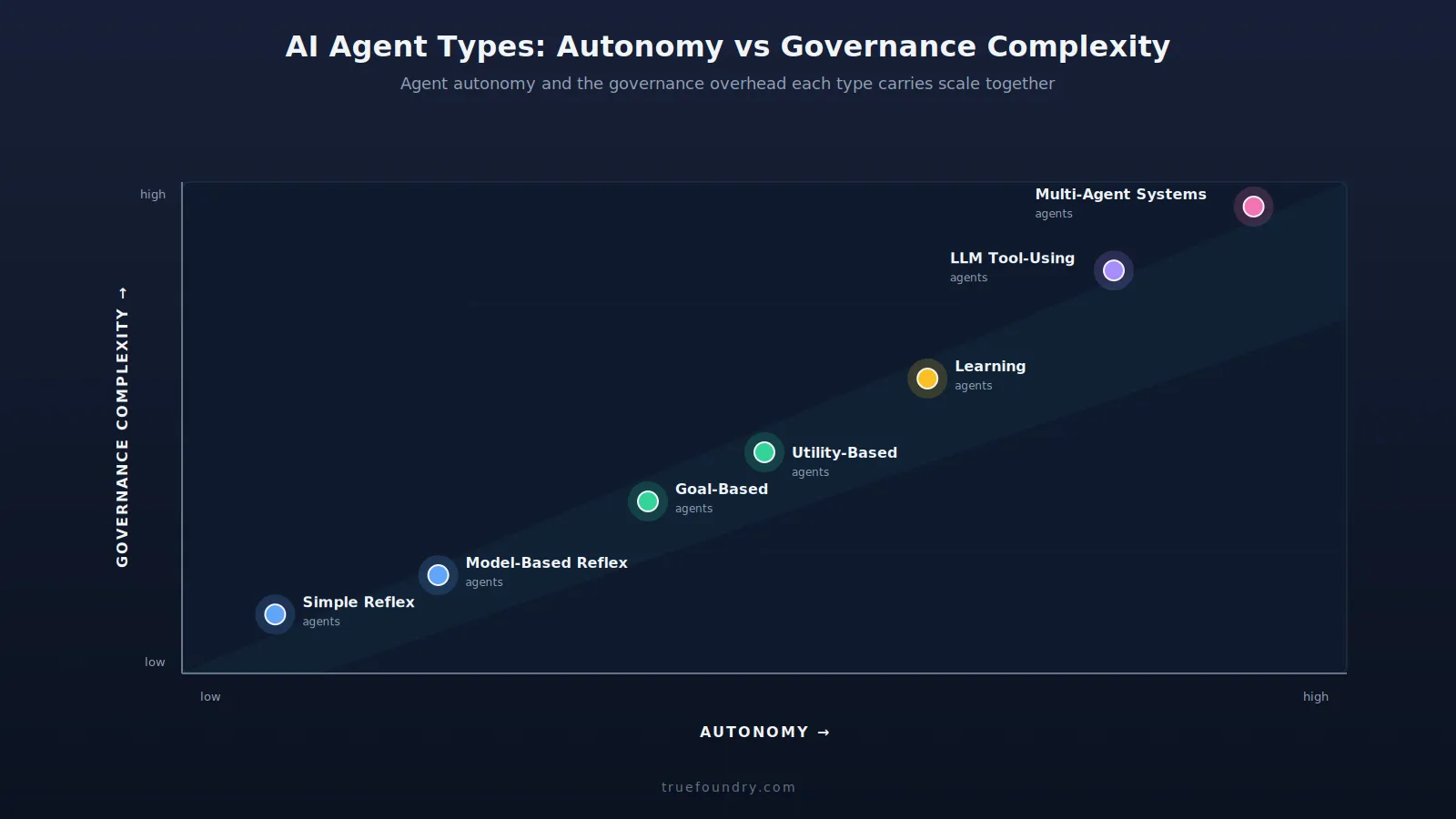
Die folgende Taxonomie reicht von einfacheren Agenten mit festen Regeln und ohne Gedächtnis bis hin zu den komplexesten Multi-Agenten-Systemen. Je weiter unten in der Liste, desto mehr Autonomie besitzt jeder Agententyp.
Diese Entwicklung ist entscheidend für das Verständnis verschiedener Arten von KI-Agenten und was jeder einzelne in der Produktionsinfrastruktur benötigt.
.webp)
Das einfachste Muster in der Taxonomie der KI-Agententypen. Der einfache Reflex-Agent agiert strikt auf Basis der aktuellen Eingabe unter Verwendung vordefinierter Bedingungs-Aktions-Regeln. Er speichert keine Erinnerung an frühere Interaktionen und erstellt keine Pläne für zukünftige Zustände.
Wesentliche Merkmale:
Grenzen und Schwachstellen: Alles, was außerhalb des Regelsatzes liegt, wird nicht berücksichtigt. Es gibt keine Argumentation, keine Anpassung und keinen Weg zur Erledigung mehrstufiger Aufgaben.
Einsatzbereiche: Spamfilter, industrielle Sensordatenüberwachung, regelbasierte Alarmsysteme und überall dort, wo eine konsistente Reaktion auf bekannte Muster die einzige Aufgabe ist. Diese Agenten eignen sich hervorragend für repetitive Aufgaben, die Geschwindigkeit und Präzision über Anpassungsfähigkeit stellen.
Ein Schritt über das einfache Reflex-Agenten-Muster hinaus. Dieser Agententyp führt ein internes Modell der Umgebung mit sich, das darstellt, wie sich die Welt im Laufe der Zeit verändert. Dadurch kann er unvollständige oder mehrdeutige Eingaben verarbeiten, indem er fehlende Informationen aus dem Weltmodell ergänzt, anstatt zu versagen.
Der Agent nutzt seinen internen Zustand, um bei unvollständigen Informationen bessere Entscheidungen zu treffen. Der interne Zustand muss jedoch weiterhin manuell programmiert werden. Der Agent lernt nicht aus Erfahrung, was die Anpassungsfähigkeit in dynamischen Umgebungen stark begrenzt.
Anwendungsbereiche: Autonome Fahrzeugnavigation, Robotik, Computer-Vision-Systeme und industrielle Steuerungssysteme, bei denen die Verfolgung des internen Zustands der Umgebung die Qualität jeder Entscheidung in teilweise beobachtbaren Umgebungen verbessert.
Zielbasierte Agenten bewerten mögliche Aktionen anhand eines definierten Zielzustands und wählen die Abfolge von Schritten aus, die das System am wahrscheinlichsten von seinem aktuellen Zustand zum Ziel führt, wobei sie die zukünftigen Konsequenzen jedes verfügbaren Pfades berücksichtigen.
Wo es schiefgehen kann: Die Leistung hängt von der Qualität der Zieldefinition ab. Ein schlecht definiertes Ziel führt zu einem Agenten, der das wörtliche Ziel erreicht, aber das beabsichtigte Ergebnis verfehlt – ein klassisches Beispiel für Spezifikations-Gaming.
Anwendungsbereiche: Routenoptimierung, Lieferkettenoptimierung und Workflow-Automatisierung. Diese Agenten eignen sich überall dort hervorragend, wo der Endzustand klar definierbar ist und die Aufgabe des Agenten darin besteht, den optimalen Pfad zu finden.
Ein enger Verwandter des zielbasierten Agenten, mit einer Ergänzung. Dieser Typ von KI-Agent weist verschiedenen möglichen Ergebnissen eine Nutzenfunktion zu und wählt Aktionen, die den erwarteten Nutzen maximieren. Das Ergebnis ist ein prinzipiengeleitetes Abwägungsverhalten bei konkurrierenden Zielen, anstatt eines binären Zielerreichungsansatzes.
Die korrekte Spezifikation von Nutzenfunktionswerten in großem Maßstab ist der schwierige Teil. Falsch ausgerichtete Funktionen erzeugen Agenten, die aggressiv für die falsche Metrik optimieren, was Goodharts Gesetz in der Praxis manifestiert.
Anwendungsbereiche: Finanzportfolio-Optimierung, Ressourcenallokationssysteme und Empfehlungssysteme. Dies sind Kontexte, in denen der Agent Ergebnisse nach Geschäftswert unter Unsicherheit bewerten muss.
Eine Architektur für lernende Agenten besteht aus vier Hauptkomponenten, die zusammenarbeiten:
Aktuelle Bedenken: Trainingsstabilität und Sicherheit sind beides echte Risiken. Lernende Agenten zeigen unerwartetes Verhalten, wenn Belohnungssignale falsch spezifiziert sind oder wenn sich die Umgebung während des Einsatzes ändert. Robuste Feedbackschleifen sind erforderlich, um emergentes Verhalten abzufangen, bevor es die Nutzer erreicht.
Anwendungsbereiche: Personalisierungs-Engines, dynamische Preissysteme, Betrugserkennung und prädiktive Analysen. Dies sind Kontexte, in denen sich optimales Verhalten ständig ändert und manuelle Regelaktualisierungen nicht mithalten können. Reinforcement Learning und maschinelles Lernen, gestützt durch sorgfältig kuratierte Trainingsdaten, sind die Kernmechanismen, die diesen Agententyp antreiben.
Das größte Interesse von Unternehmen an KI-Agententypen konzentriert sich derzeit auf diese Kategorie. Der Agent nutzt große Sprachmodelle für Argumentation, Planung und natürliche Sprachkommunikation, gepaart mit der Fähigkeit, externe Tools, APIs, Datenbanken, Suchfunktionen und Codeausführung aufzurufen, um reale Aktionen auszuführen.
Hier häufen sich drei Bedenken:
Generative KI und natürliche Sprachverarbeitung treiben die Schnittstellenschicht an, während sich die Risiken der agentischen KI in der Tool-Aufruf-Schicht konzentrieren.
Anwendungsbereiche: Automatisierung des Kundensupports, interne Wissensassistenten, Entwickler-Copiloten und agentische KI-Workflows, die über das CRM, Ticketing- und Datensysteme angebunden sind, über das TrueFoundry MCP Gateway.
Dies sind die KI-Agenten mit den strengsten Governance-Anforderungen in jeder Unternehmensarchitektur. Eine detaillierte Aufschlüsselung der spezifischen Sicherheitsrisiken dieses Typs finden Sie unter MCP-Sicherheitsrisiken und Best Practices.
Das Prinzip: komplexe Aufgaben auf mehrere hierarchische Agenten verteilen, wobei jeder überschaubare Unteraufgaben bearbeitet und einem Orchestrator Bericht erstattet, der den gesamten Workflow auf ein gemeinsames Ziel hin koordiniert.
Die Governance-Komplexität skaliert schneller als die Anzahl der Agenten. Eine einzige falsch konfigurierte Berechtigung in einem einzelnen Agenten wirkt sich auf jeden anderen Agenten aus, der am Workflow beteiligt ist.
Anwendungsfälle: End-to-End-Workflow-Agenten für die Automatisierung von Geschäftsprozessen, Forschungs- und Analyse-Pipelines, Datenagenten für Analyse-Workflows, Softwareentwicklungs-Agenten und alles, was mehrere spezialisierte KI-Systeme erfordert, die nacheinander in verschiedenen Branchen laufen.
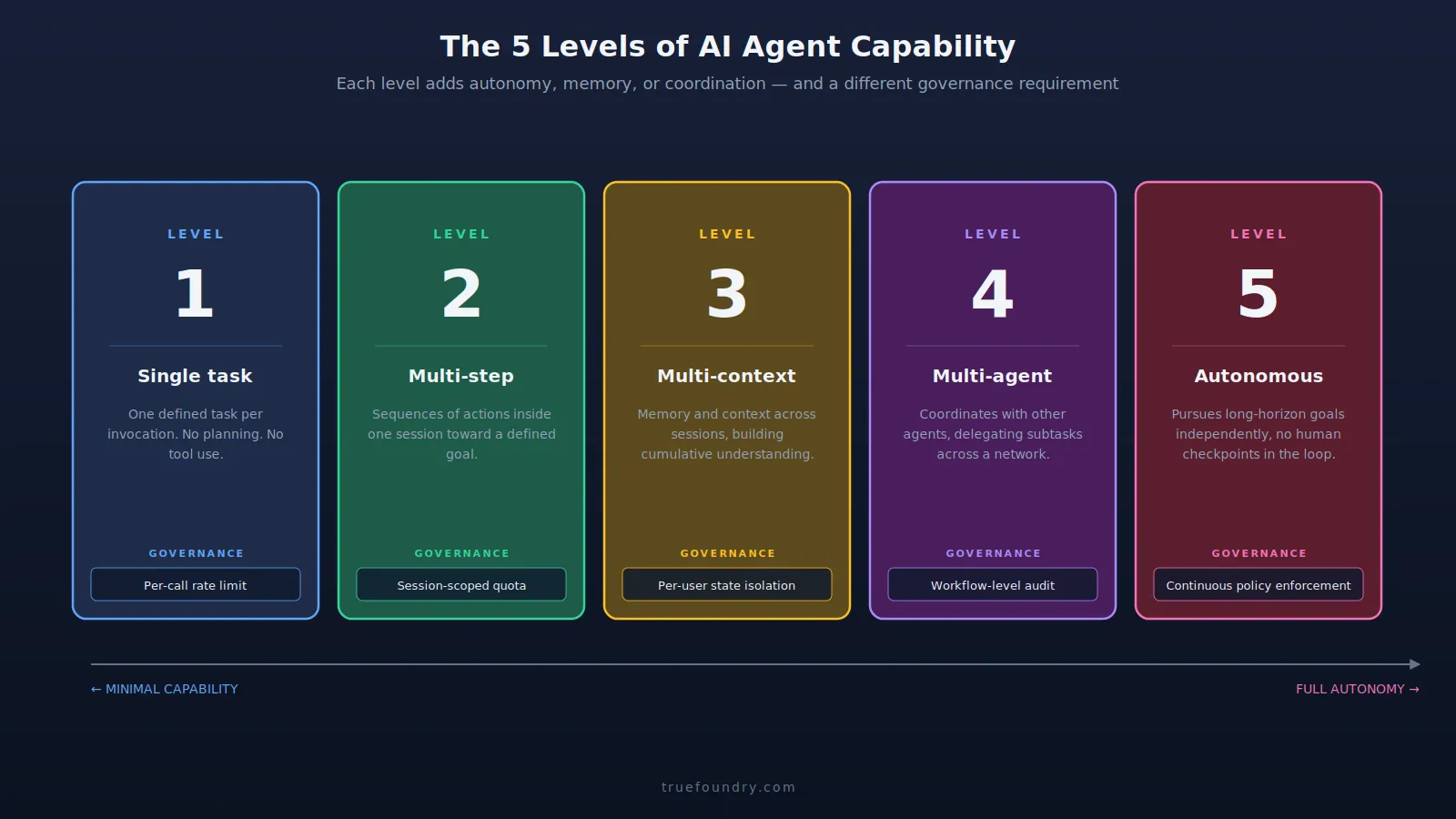
Eine ergänzende Betrachtungsweise für KI-Agenten-Typen, nach Fähigkeitsstufe statt nach Architektur. Die fünf Stufen beschreiben das Ausmaß an Autonomie und Koordination, das ein Agent aufrechterhalten kann, unabhängig von seinem zugrunde liegenden Agententyp.
Der Autonomiegrad, mit dem ein Agent arbeitet, bestimmt direkt die erforderliche Governance-Infrastruktur. Ein Agent der Stufe 1, der einfache Aufgaben in einer Einzelagenten-Konfiguration bearbeitet, und ein autonomer Agent der Stufe 5 in der Produktion erfordern grundlegend unterschiedliche Kontrollschichten.
Das TrueFoundry AI Gateway bündelt ein LLM Gateway, ein MCP Gateway, und ein Agenten-Gateway zur Steuerung jeder Agentenkategorie von einer einzigen VPC-nativen Steuerungsebene aus. Dieselben Kontrollen decken einen werkzeugnutzenden Kundendienst-Agenten und ein koordiniertes Multi-Agenten-Forschungssystem ab.
Für Teams, die mehrere Agententypen in der Produktion betreiben oder einen Multi-Agenten-Rollout planen, buchen Sie eine Demo mit dem TrueFoundry-Team.
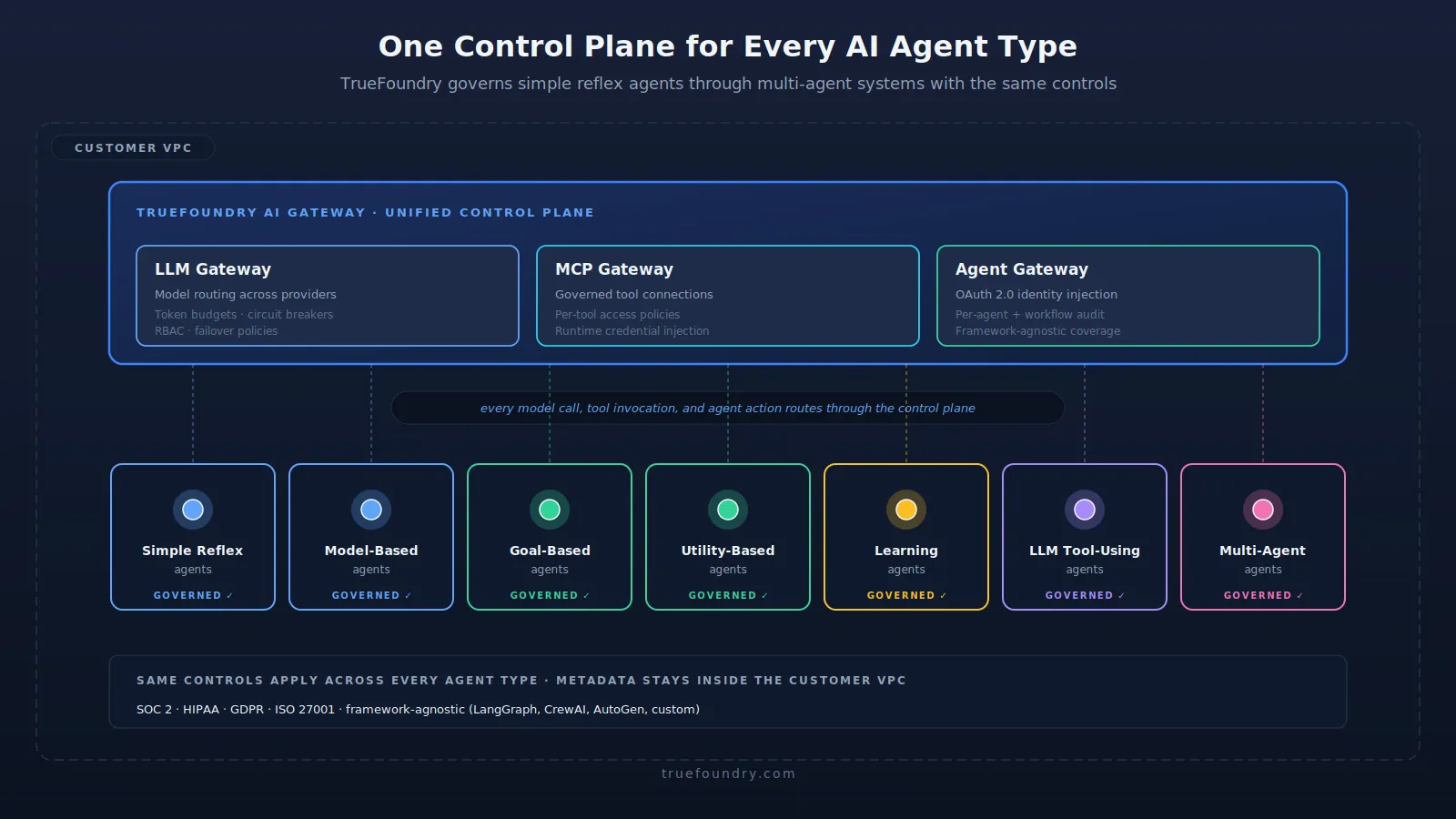
TrueFoundry AI Gateway bietet eine Latenz von ~3—4 ms, verarbeitet mehr als 350 RPS auf einer vCPU, skaliert problemlos horizontal und ist produktionsbereit, während LiteLM unter einer hohen Latenz leidet, mit moderaten RPS zu kämpfen hat, keine integrierte Skalierung hat und sich am besten für leichte Workloads oder Prototyp-Workloads eignet.





Die neuesten Nachrichten, Artikel und Ressourcen werden in Ihren Posteingang gesendet


.webp)
.webp)
.webp)
.webp)
.webp)
.png)
.png)
.png)
.png)
.png)
.png)


