September 13, 2026
|
Lesedauer: 5 Minuten


Erhalten Sie sofortigen Zugriff auf eine TrueFoundry-Live-Umgebung. Stellen Sie Modelle bereit, leiten Sie den LLM-Verkehr weiter und erkunden Sie die gesamte Plattform — Ihre Sandbox ist in Sekundenschnelle einsatzbereit, ohne dass eine Kreditkarte erforderlich ist.


Published: June 16, 2026
Unglaublich schnelle Methode zum Erstellen, Verfolgen und Bereitstellen Ihrer Modelle!
Six months after Noor’s loops moved off her laptop, Northwind has eleven registered triage and maintenance loops, and the problems have changed shape. Nothing is on fire the way the weekend token bill was on fire. Instead: two loops both “own” the release-notes draft and overwrite each other every Friday; the Tuesday dependency-bump loop quietly stopped doing anything useful three weeks ago because a model it depended on was deprecated and it kept passing its own checker anyway; a security reviewer noticed that the loop reading inbound bug reports will cheerfully follow instructions written in a bug report; and the cheapest, most-used loop now spends more than the next four combined, and nobody can say whether it’s worth it. None of these are the failures the first post fixed. They’re the failures that only appear once the pattern works well enough to multiply. That’s the subject here.
The first post did the vertical translation — laptop primitive to governed primitive, one loop at a time. This post does the horizontal one: what an organization has to make true across loops and over their lifetime. The vocabulary still follows Addy Osmani’s June 2026 essay and the surrounding discussion (Steinberger, Cherny, Willison), paraphrased with credit; the enterprise half follows TrueFoundry’s Agent Harness and Gateway documentation.
The first post vs. this one
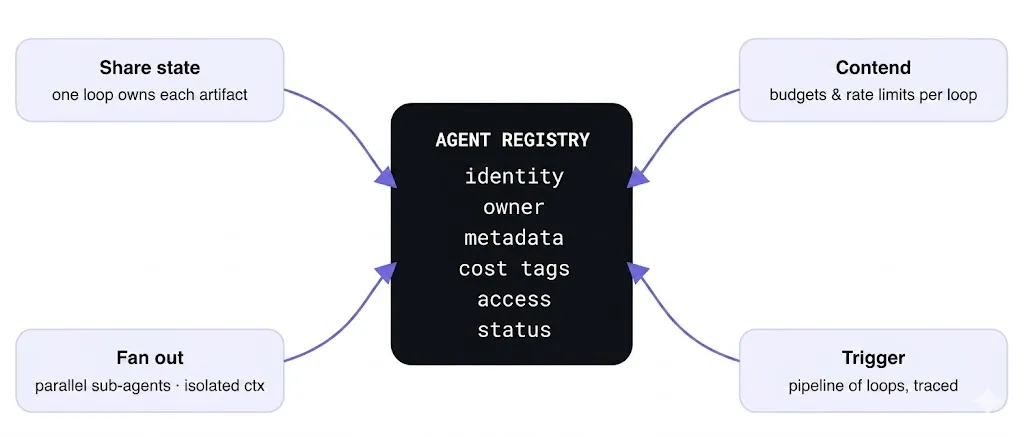
Osmani’s anatomy describes a loop in the singular — one heartbeat, one set of skills, one maker and one checker. That is the right way to learn the pattern and the wrong way to run it, because loops do not stay solitary. They are useful, so they reproduce, and the moment there are several they start interacting in four ways the single-loop picture never has to account for.
Four ways loops interact once there is more than one
The fan-out case is already first-class on the harness. TrueFoundry’s Agent Harness sub-agents let the root agent delegate focused subtasks to parallel sub-agents, each with its own isolated context, returning only concise results — a context-hygiene win and a fleet-management win, since each delegated run is a unit you can trace independently. Delegation is deliberately one level deep and sub-agents can’t message the user — guardrails against a fleet that spawns a fleet that spawns a fleet. (Worth being precise: sub-agents share the root agent’s tools and sandbox, so the isolation here is about context, not a separate set of tool grants — privilege boundaries belong at the agent and MCP level, which is the next section.)
The operating pattern that answers all four interactions is to treat each loop as a registered agent definition rather than a script, so the fleet has an inventory. On the harness, each loop is an agent definition — a model, MCP servers, skills, instructions — that lives in a catalog, runs in the same gateway plane as all other model and tool traffic, and carries its own identity. That last word is what makes the fleet tractable: per-agent identity is what lets contention, cost, and access be reasoned about per loop instead of per laptop. Northwind’s release-notes collision gets fixed not with cleverness but with ownership — one loop owns the artifact, the registry says so, and “which loops touch this?” is a lookup, not a hunt.
TrueFoundry AI Gateway bietet eine Latenz von ~3—4 ms, verarbeitet mehr als 350 RPS auf einer vCPU, skaliert problemlos horizontal und ist produktionsbereit, während LiteLM unter einer hohen Latenz leidet, mit moderaten RPS zu kämpfen hat, keine integrierte Skalierung hat und sich am besten für leichte Workloads oder Prototyp-Workloads eignet.





Die neuesten Nachrichten, Artikel und Ressourcen werden in Ihren Posteingang gesendet
.webp)
.webp)
.webp)
.webp)
.webp)