


.png)
September 28, 2026
|
Lesedauer: 5 Minuten


Erhalten Sie sofortigen Zugriff auf eine TrueFoundry-Live-Umgebung. Stellen Sie Modelle bereit, leiten Sie den LLM-Verkehr weiter und erkunden Sie die gesamte Plattform — Ihre Sandbox ist in Sekundenschnelle einsatzbereit, ohne dass eine Kreditkarte erforderlich ist.



Published: June 30, 2026
.webp)
Unglaublich schnelle Methode zum Erstellen, Verfolgen und Bereitstellen Ihrer Modelle!
Bifrost and Portkey both manage AI model traffic, and both are open source. They still make different product bets. Bifrost is a high-performance gateway written in Go by Maxim AI. It runs in your infrastructure and reports microsecond-level overhead in its own benchmarks.
Portkey is a production control panel with an open-source gateway and a managed cloud. It brings observability, guardrails, an MCP Gateway, and enterprise deployment options together. So the Bifrost vs Portkey decision is about priorities: raw performance and ownership, or packaged operations with vendor support.
One piece of 2026 context matters for every Portkey buyer. Palo Alto Networks completed its acquisition of Portkey on May 29, 2026. Portkey is now becoming the AI Gateway for Prisma AIRS. If Portkey is on your multi-year shortlist, that changes the buyer context.
If you compare product pages directly, you may see notices about storing of cookies, site usage, and site navigation. Treat those as website mechanics, not product evidence. For platform decisions, rely on documentation, pricing pages, security claims, benchmark disclosures, and direct proof-of-concept testing.
Bifrost vs Portkey becomes easier when you separate routing, operations, and governance. Bifrost gives engineering teams a fast, self-hosted gateway. Portkey gives application teams a broader control panel. Both can route LLMs, manage traffic, and reduce the complexity of direct providers.
Both tools sit in the AI Gateway category, although they serve different operating models. Bifrost is for teams that want to own the gateway layer. It is open source under the Apache 2.0 license, written in Go, and connects providers via a single OpenAI-compatible API.
The open-source build covers routing, failover, governance through virtual keys, semantic caching, MCP support, and observability through native Prometheus metrics. The Enterprise tier from Maxim AI adds clustering, adaptive load balancing, private networking, and support. It fits platform teams that want performance, control, and self-managed deployment.
Portkey aims at production operations. It is also open-source, with a public gateway that routes to many LLMs. It pairs that gateway with managed cloud plans, logs, traces, metrics, guardrails, prompt management, RBAC, an MCP Gateway, and agent controls for application teams.
Here is the distinction that matters. Bifrost optimizes for performance and infrastructure ownership. Portkey optimizes for packaged production operations. Most LLM gateways offer routing, caching, failover, and provider abstraction. The real difference is who operates the gateway and owns the configuration quality.
For teams comparing AI Gateway options, this is the right evaluation frame. Do not stop at model coverage. Review authentication, cost optimization, latency, deployment boundaries, observability, MCP controls, and support for production systems before picking a gateway.
The architecture comparison shows why Portkey vs Bifrost is not a simple feature-count exercise. Bifrost gives teams more control over the runtime surface. Portkey gives teams a more complete product experience. The better choice depends on workload ownership and governance requirements.
Bifrost leads on raw performance and control from running a compiled binary yourself. Portkey leads on packaged operations, managed deployment, and a broader product surface. Neither misses the basics. They weigh each capability differently for different buyer profiles.
Some comparisons claim Portkey hides its pricing. That is outdated, so this Bifrost vs Portkey pricing comparison should stay precise. Both publish pricing details. Since both have open-source gateways, neither marks up your model tokens. Your provider bill remains separate from gateway costs.
Bifrost keeps the model simple. The open-source gateway is free to self-host, and Maxim AI offers a custom Enterprise tier. Your real OSS cost is infrastructure, maintenance, deployment hardening, monitoring, and support time. Enterprise pricing covers clustering, private networking, and support needs.
Portkey adds more pricing rungs. The open-source gateway is free, and the Developer plan supports up to 10,000 logged requests per month. The Production plan costs $49 monthly for 100,000 recorded logs, with $9 per additional 100,000 requests. Enterprise pricing covers custom security, data residency, and compliance needs.
So the cost question is not which tool is cheaper to license. The real question is operational cost. Bifrost asks your team to run the gateway. Portkey gives you a managed path and an entry plan when your team prefers vendor-managed operations.
For a deeper cost evaluation, TrueFoundry’s Portkey pricing guide is a useful companion read. It explains how logged requests, retention, governance requirements, and enterprise controls change the pricing picture for production AI workloads.
.webp)
The acquisition adds strategic context to this Bifrost vs Portkey comparison. It does not make Portkey weaker or stronger by default. It changes who owns the roadmap. For enterprise buyers, this can affect procurement, security alignment, integrations, and long-term platform packaging.
Palo Alto Networks announced its intent to acquire Portkey on April 30, 2026. It completed the acquisition on May 29, 2026. Terms were not disclosed. Portkey now serves as the AI Gateway for Prisma AIRS, Palo Alto’s AI runtime security platform.
The stated goal is to inspect and govern agent traffic at runtime. That matters because agent traffic is moving beyond chat into tools, apps, and enterprise actions. Bifrost is unaffected by this change. It remains an independent open-source project from Maxim AI.
For some buyers, this is a positive signal. Portkey now sits inside a large security vendor with deep enterprise resources. That may help buyers already standardizing on Palo Alto Networks for runtime security, governance, and risk controls across AI systems.
For others, it adds a strategic question. A standalone gateway is becoming part of a broader security suite. Packaging, roadmap, and commercial motion may shift as Prisma AIRS integration evolves. If independence matters, that becomes a point in Bifrost’s column.
The Bifrost or Portkey decision should map to your operating model, not a single feature. Start with ownership. Then test deployment, failover, guardrails, rate limits, cost optimization, observability, and MCP behavior against actual production workflows.
Choose Bifrost when performance is a first-order requirement. It fits teams that want a compiled, self-hosted gateway they control. It also fits teams with maturity in Kubernetes, Docker, configuration, security, and monitoring. Bifrost is stronger when independent open-source ownership matters.
Bifrost also makes sense when your team wants to avoid constraints from managed products. It can work well for high-throughput services, internal apps, prototypes moving into production, and agent workloads requiring infrastructure-level control. Your team owns the setup, scaling, and reliability model.
Choose Portkey when you want production gateway workflows without having to build every control yourself. It is practical when logs, traces, guardrails, routing, prompt management, and managed cloud access matter. It also helps teams that want a web UI for operations instead of managing every gateway primitive.
Portkey can fit teams already comfortable with the Palo Alto Networks ecosystem. It also suits AI application teams that want faster rollout. If managed cloud, governance workflows, and commercial support matter more than self-hosted control, Portkey may be the easier path.
Consider a dedicated enterprise AI Gateway when model, agent, and MCP governance require a single operating layer. This becomes important when compliance-ready audit trails must stay inside your environment. It also matters when VPC-native, on-premise, or air-gapped deployment is a default requirement.
TrueFoundry’s LLM Gateway is useful for routing that needs to connect to governance, quota control, usage attribution, and provider failover. It helps teams avoid treating the gateway as a simple proxy while AI workloads become shared enterprise infrastructure.
.webp)
Choosing between Portkey and Bifrost determines routing and operations. A few enterprise needs still sit outside what each platform covers cleanly. The gaps differ by tool, although regulated teams often need deeper governance across identity, agents, budgets, and MCP actions.
Bifrost gives you strong control because your team runs it. That control comes with work. Reliability, security hardening, scaling, and compliance-grade audit trails across model calls, MCP tool use, and agent workflows become your team’s responsibility.
The gateway gives you primitives. Turning them into SOC 2, HIPAA, or internal audit evidence is operational work you own. Teams with strong platform engineering may accept that trade-off. Teams without that maturity should plan for implementation and ownership effort.
Portkey covers a lot already through guardrails, RBAC, an MCP Gateway, logs, prompt workflows, and VPC hosting on Enterprise. The open question is direction, not capability. Since Portkey now fits into Prisma AIRS, buyers need clarity on packaging and the roadmap.
This may suit enterprises that want AI runtime security inside a broader security ecosystem. It may concern teams seeking a standalone gateway roadmap. Both readings are valid. The decision depends on procurement priorities, platform ownership, and long-term security architecture.
Across both platforms, the hard part is identity-aware access at the agent level. Teams need each inference call to be tied to a specific authenticated user via OAuth 2.0 on-behalf-of flows. They also need circuit breakers that stop runaway agents before they spend compounds.
This is where rate limiting must go beyond request counts. AI workloads need token-aware limits, budget ceilings, metadata-based rules, and guardrails that understand model and tool behavior. Most teams want this as a baseline, not custom infrastructure.
Here is where TrueFoundry fits. We give enterprise teams one AI Gateway that connects, observes, and governs AI workloads from a single control plane. It runs VPC-native inside your AWS, GCP, or Azure account.
The difference is the control layer shape. TrueFoundry is unified across models, agents, and MCP. It is also deployed in your network by default, rather than treated as an enterprise upgrade. That matters when prompts, responses, logs, and policies must stay inside your boundary.
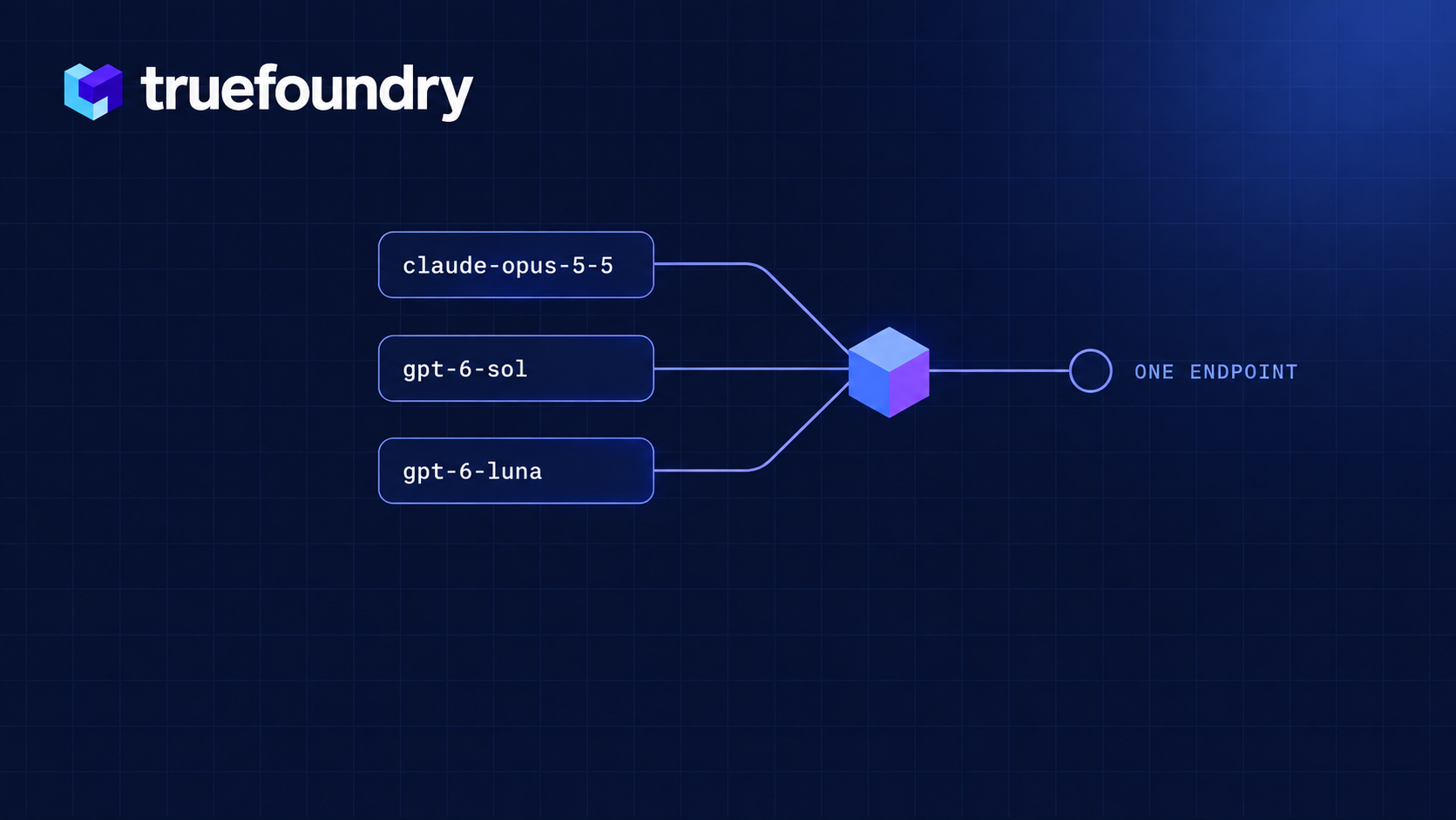
Our AI Gateway routes across 1,600-plus models with intelligent provider selection and automatic failover. That means the multi-model access Portkey and Bifrost provide is already built in. It also gives teams centralized visibility into requests, costs, latency, errors, and model usage.
The governance layer goes further across three surfaces:
For context, Gartner’s 2025 Market Guide for AI Gateways lists AI gateways as a control layer for governance, observability, and cost risk reduction. TrueFoundry has also stated that its AI Gateway handles more than 10 billion requests monthly and adds roughly 3 to 5 milliseconds of latency.
If you want to see governance in action on your own traffic, book a demo. Bring the workload you are evaluating Bifrost vs Portkey for. The session can test routing, model access, guardrails, MCP tool control, cost limits, and audit visibility against production-like requests.
Book a demo to see how TrueFoundry governs models, MCP tools, agents, and costs inside your cloud.
TrueFoundry AI Gateway bietet eine Latenz von ~3—4 ms, verarbeitet mehr als 350 RPS auf einer vCPU, skaliert problemlos horizontal und ist produktionsbereit, während LiteLM unter einer hohen Latenz leidet, mit moderaten RPS zu kämpfen hat, keine integrierte Skalierung hat und sich am besten für leichte Workloads oder Prototyp-Workloads eignet.





Die neuesten Nachrichten, Artikel und Ressourcen werden in Ihren Posteingang gesendet
.png)
.png)
.png)
.png)
.png)
.webp)
.webp)

.webp)
.webp)
.webp)


