November 5, 2026
|
5 min read


Blazingly fast way to build, track and deploy your models!
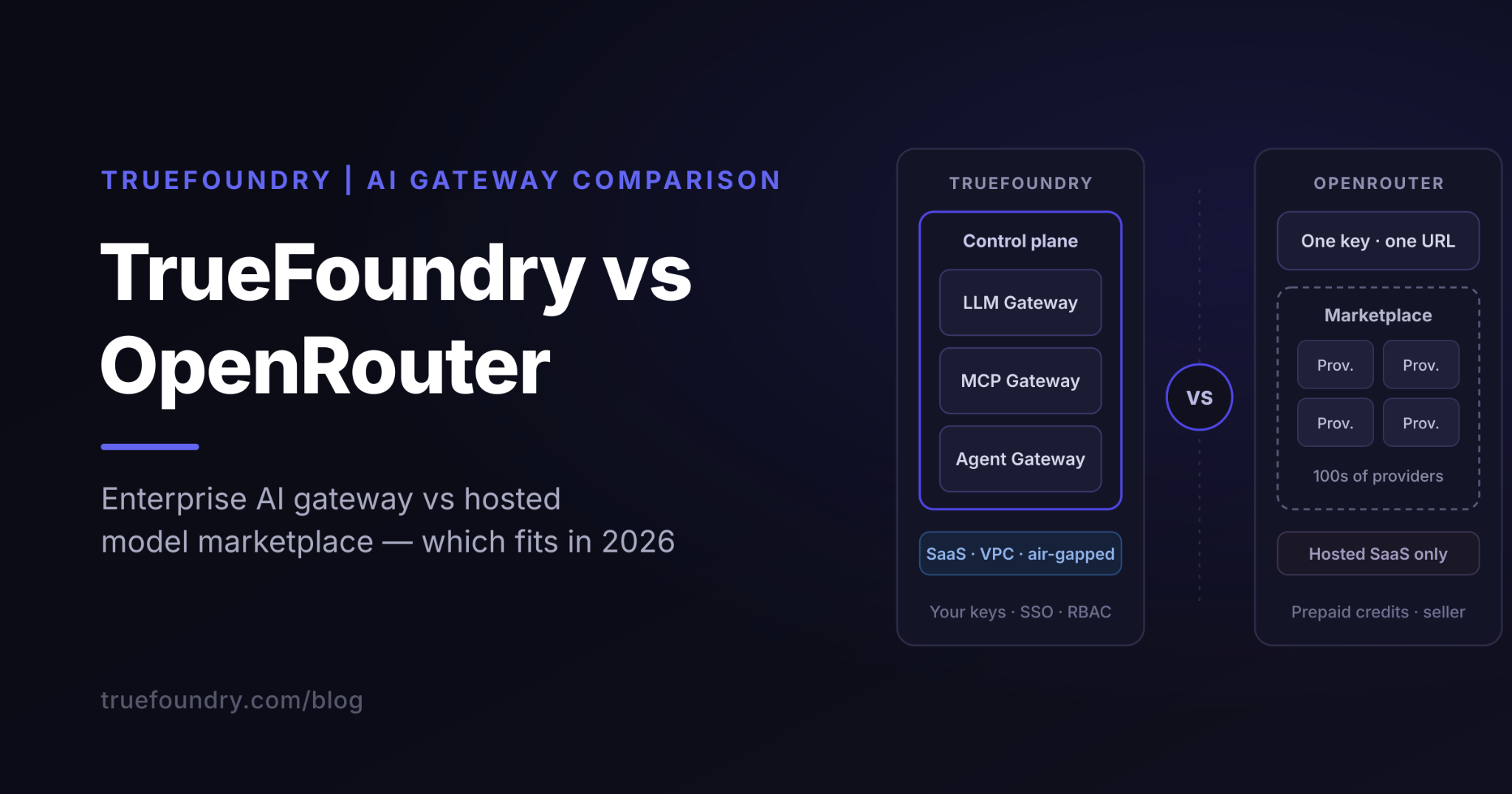
If you have shortlisted TrueFoundry vs OpenRouter, you have probably noticed that both expose an OpenAI-compatible endpoint, both route to hundreds of models, and both let a developer swap providers by changing a model string. That is where the similarity ends. OpenRouter is a hosted model marketplace with a router in front of it. TrueFoundry is an AI gateway built as a control plane for an organisation's model, tool and agent traffic, deployable anywhere from managed SaaS to an air-gapped data centre.
This post is written for the people who have to make that call: platform engineers deciding what sits in front of every team's AI traffic, AI engineers who want one key for every model, and security leaders asking where the prompts go. We compare what each product is, who it is built for, and which kinds of traffic it governs, using each vendor's public documentation. Later posts in this series go deeper on deployment, identity, tenancy, cost, governance, security, observability, pricing and risk.
If you are already evaluating gateways for a production rollout, you can book a TrueFoundry demo or read on for the full comparison.
TrueFoundry AI Gateway is a unified proxy layer that governs three kinds of AI traffic under one control plane. The LLM Gateway puts 2,500+ LLMs behind a single OpenAI-compatible endpoint and covers chat, streaming, embeddings, image, audio, rerank, realtime and batch. The MCP Gateway registers your own MCP servers and applies role-based access control down to individual tools, with an inbound/outbound authentication split and guardrail hooks on tool calls. The Agent Gateway and Harness run governed agents with their own identities, sandboxing, skills and human-in-the-loop approvals, built on the MIT-licensed TrueForge agent harness (LLM Gateway docs, MCP Gateway docs, Agent Harness docs).
We built the gateway out of a Kubernetes-native ML platform, and that lineage shows in the architecture. The gateway plane is stateless and holds its configuration in memory, so authentication, RBAC, rate limits and budgets are checked without a database call in the request path. The result is roughly 3–4 ms of added latency and 350+ requests per second on a single vCPU. The same product ships in four deployment modes: fully managed SaaS, SaaS with traces stored in your own bucket, hybrid with the gateway plane in your VPC, and fully self-hosted including air-gapped environments (modes of deployment).
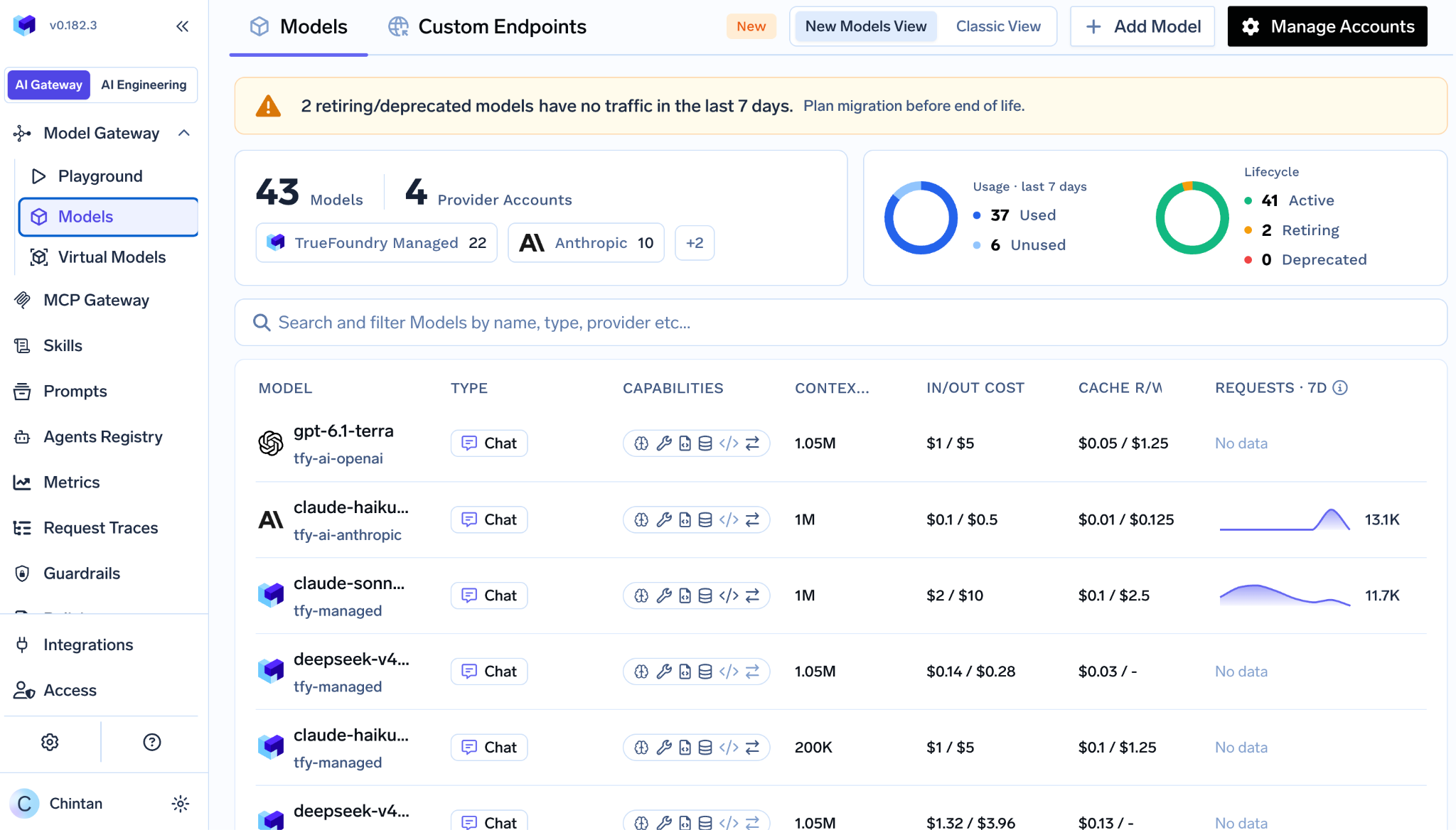
Two design choices matter for the comparison. First, there is no proprietary inference SDK: you keep the OpenAI, Anthropic, Azure OpenAI, Amazon Bedrock, or Vertex AI you already use and point it at the gateway, and cost tracking and limits work across all of them (native SDK support). Second, the gateway governs AI traffic and only AI traffic; it is not a general-purpose API gateway and does not claim to be.
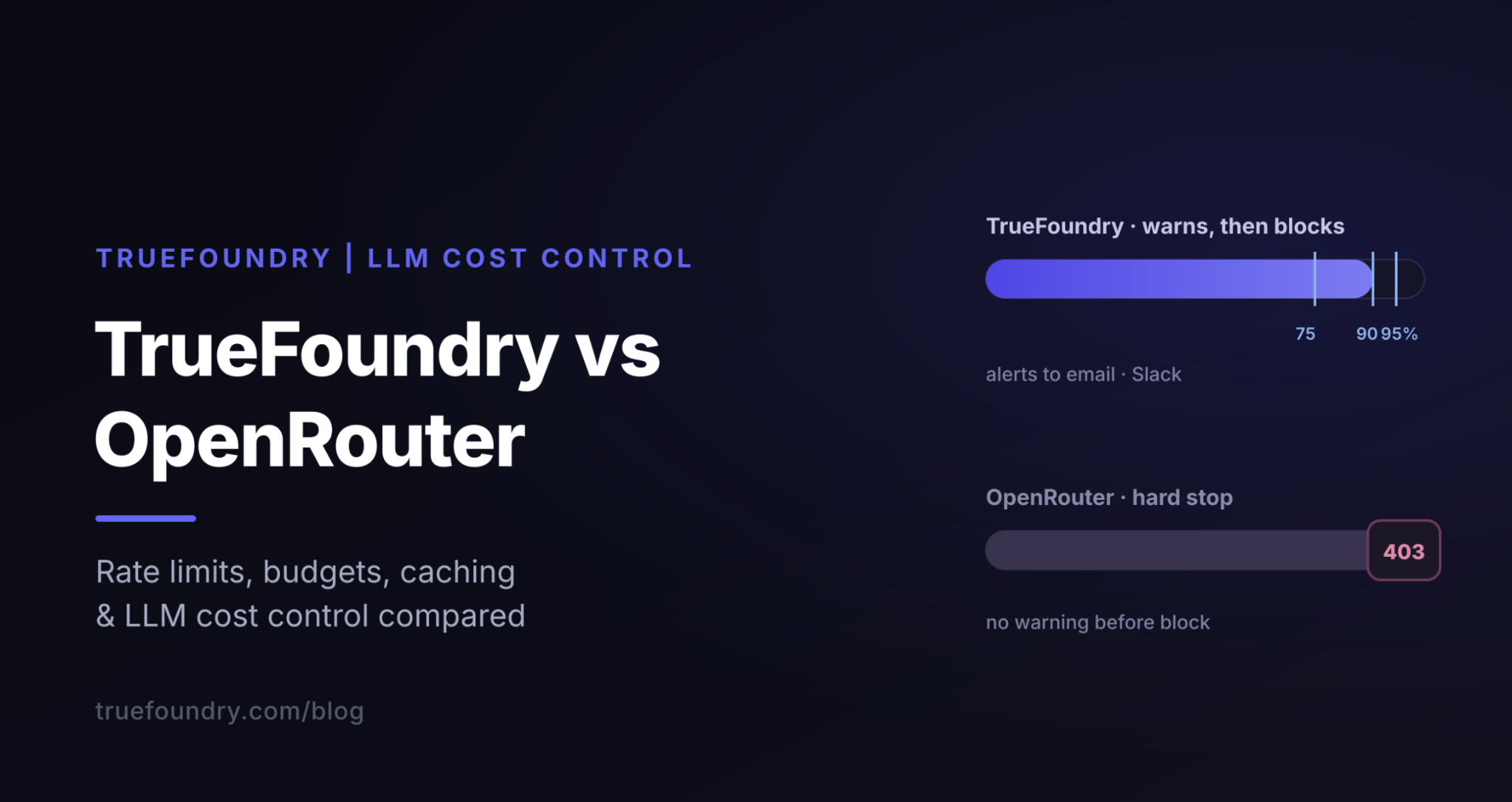
Enterprise controls come with the platform rather than as a separate tier of product: SSO over SAML and OIDC, SCIM provisioning, virtual accounts and agent identities for non-human callers, per-team budgets with warn and enforce modes, and SOC 2 Type II, GDPR and HIPAA documentation for our managed infrastructure (security and compliance).
Best for: platform teams that need one governed control point for model, tool and agent traffic across many teams, especially where prompts must stay inside a VPC or an air-gapped boundary and where a security review will ask for SSO, workload identity and first-party compliance paperwork.
OpenRouter is a hosted, OpenAI-compatible HTTP API that routes inference requests to hundreds of third-party model providers through a single endpoint and a single credential, billing the caller for model usage by default. It accepts three request formats (Chat Completions, Responses and Anthropic Messages) and covers chat, batch, embeddings, rerank, image and video generation, TTS and STT.
The thing to understand about OpenRouter is that it is a two-sided marketplace as much as a router. It recruits providers to sell inference through it, allocates traffic by uptime and performance ranking, holds prepaid credits on the buyer's side and consolidates billing across providers. It sits in the payment path in both directions, not just the request path. That is why its price-weighted provider routing is so good: OpenRouter is the seller, so its price table is the price.
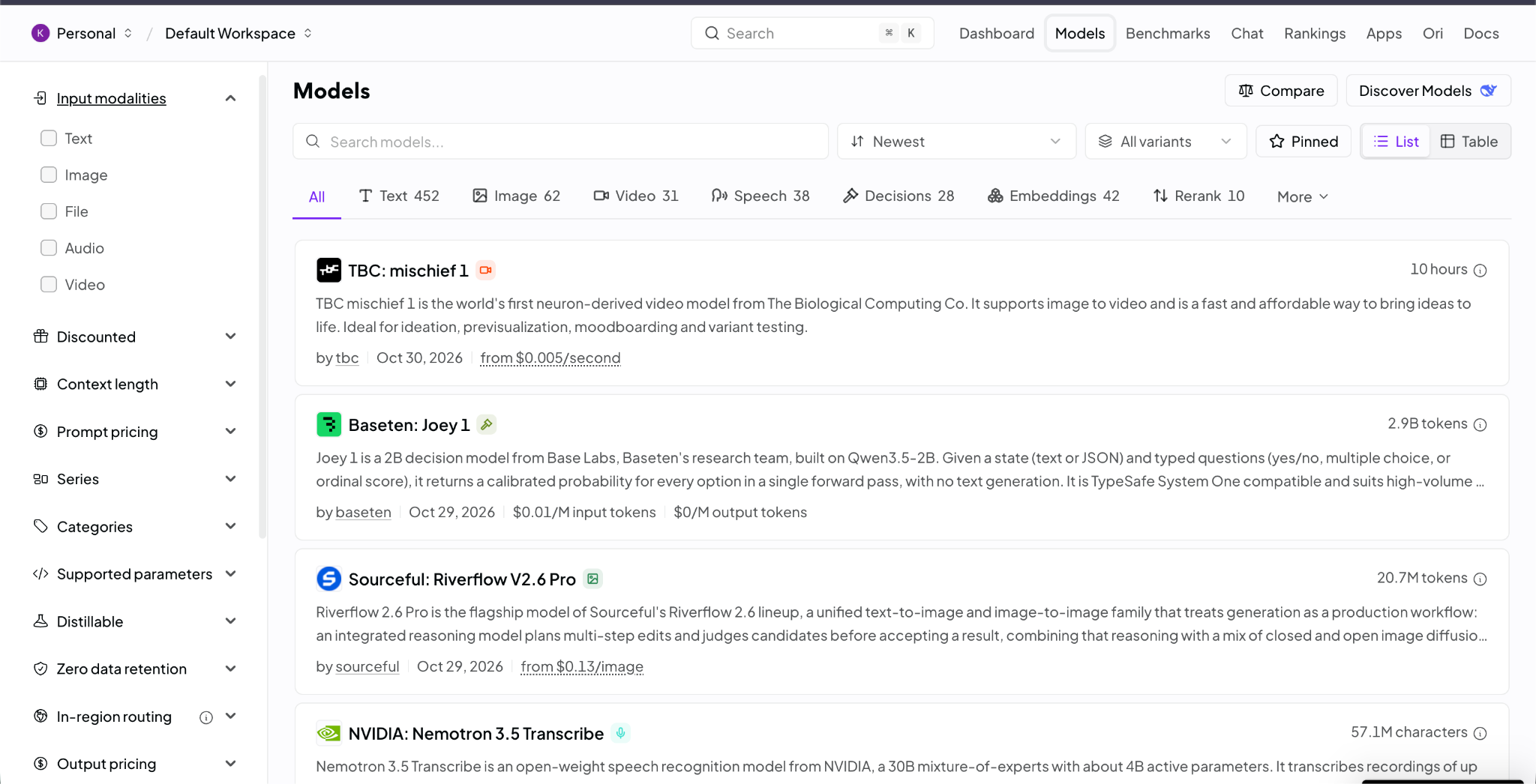
OpenRouter has been broadening from a router into a platform. Server Tools let a model call web search, web fetch, image generation and sandboxed shell or bash execution inside a request, with the containers scoped per account and workspace. Private Models, an Enterprise feature, routes to a customer's own hosted endpoint. The Ori harness and eval CLI sit alongside the API. OpenRouter started life as Window, a Chrome extension for using several models at once, and the product still optimises for the same thing: developer convenience across many models.
Its genuine strengths deserve stating plainly. Onboarding is a key and a base URL with no procurement step. Prompts are not logged by default. Every guardrail (budgets, zero-data-retention routing, allowlists, prompt-injection filtering, PII redaction) is free at every tier. And an OAuth PKCE flow lets a third-party app obtain a key that spends from the end user's own credits without running an auth backend.
Best for: individual developers and small teams who want access to every model today with one key, do not want to hold provider accounts, and are not subject to a data-boundary requirement. Enterprise features such as SSO, SCIM, in-region routing and a signed DPA exist but sit behind a sales-only tier.
The table below compares the two products on archetype and scope. TrueFoundry capabilities are from our product documentation; OpenRouter capabilities reflect its publicly documented functionality at the time of writing.
The table tells you what each product does. These four differences tell you why the choice is rarely a toss-up.
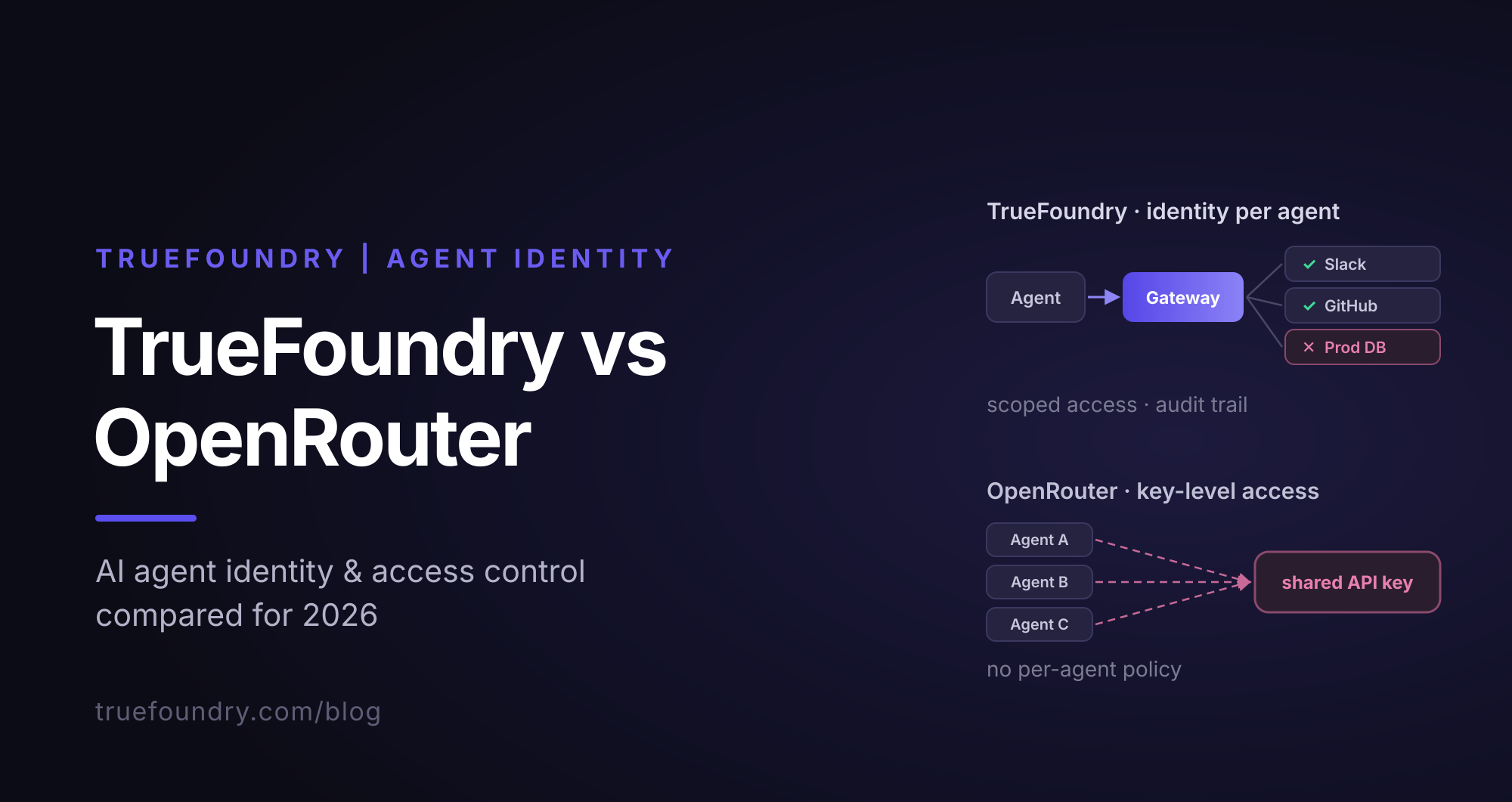
Most comparisons of OpenRouter competitors stop at model routing, but model calls are now a minority of the traffic in an agentic system. Tool calls and agent runs are the rest, and only one of these two products governs them. TrueFoundry's MCP Gateway registers your MCP servers, decides which users and agents may call which individual tools, separates who is calling the gateway from whose credentials reach the downstream server, and runs guardrails on tool calls before and after they execute. OpenRouter does not sit in front of your tools at all: it executes its own server tools and exposes its own catalogue as an MCP server, with no per-tool grants and no consent step.
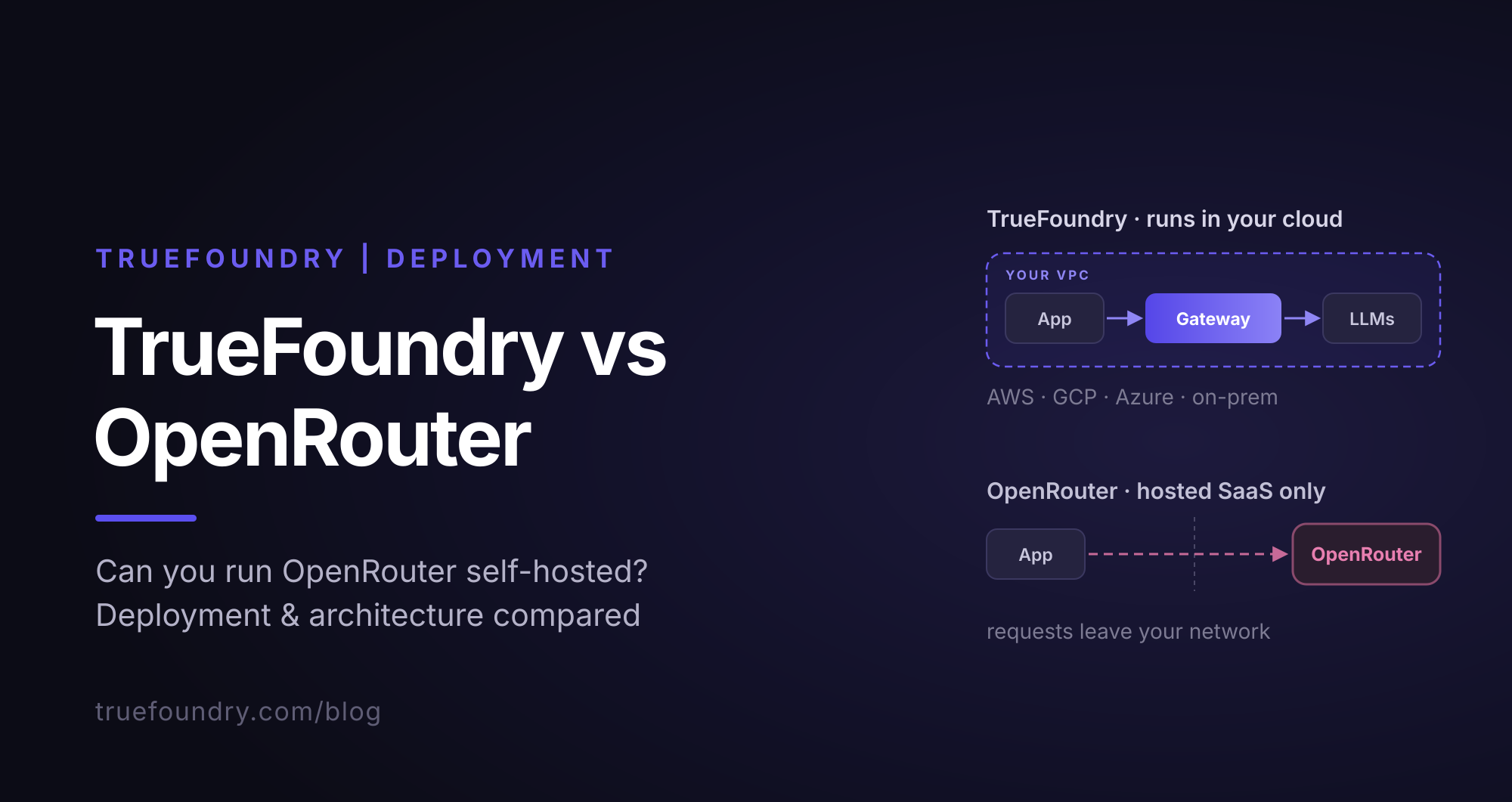
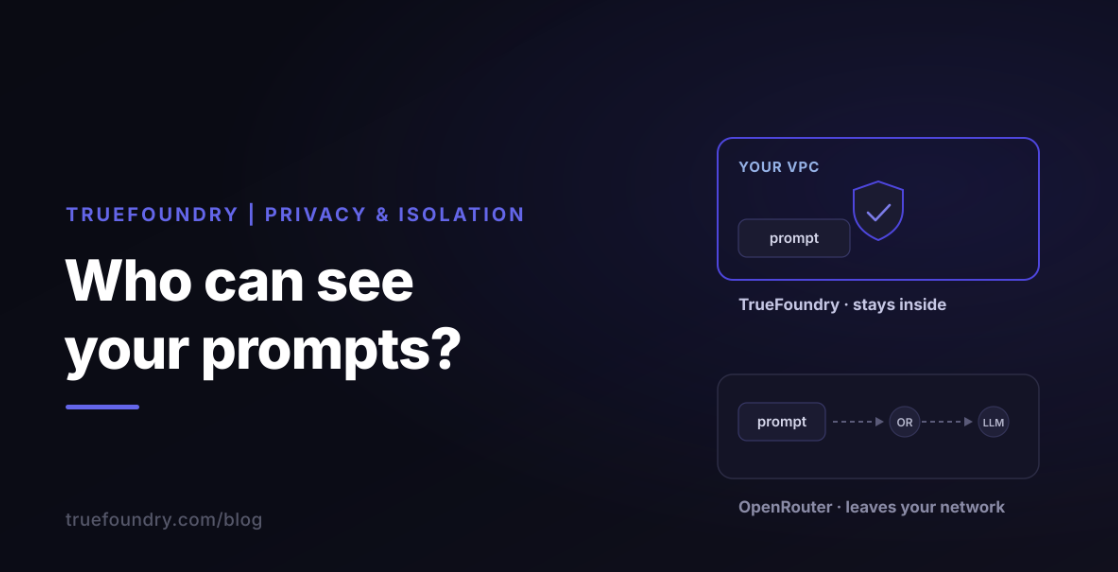
With OpenRouter, prompts always leave your network, and they cross two boundaries: yours to OpenRouter, and OpenRouter to whichever provider serves the request. In-region routing constrains the jurisdiction, zero-data-retention routing constrains what providers keep, and neither changes whether the data leaves. With TrueFoundry, that is a deployment choice. In hybrid mode the gateway plane runs in your VPC and prompts never leave it; in fully self-hosted mode the only egress is user emails and request counts to our licensing server. If your requirement reads “no prompt data leaves our boundary”, this is the row that settles the comparison.
An LLM router can sit in the request path, or in the request path and the payment path. OpenRouter does both: it is the seller of inference, holds your prepaid credits and takes a 5.5% fee on credit purchases, with no per-token markup. That is what makes one key for hundreds of providers possible without you holding a single provider account, and it is also why pricing changes land on your bill without your involvement. TrueFoundry never touches the model bill. You bring your own provider keys, hold your own negotiated contracts, and pay us a tiered licence on requests and seats.
OpenRouter is bought by the AI engineer: quickstart, key, base URL, done. TrueFoundry is bought in two ways depending on deployment mode. At the SaaS tiers it is adopted like a SaaS router, by the AI and platform engineer who repoints a base URL and gets 2,500+ models. At the self-hosted Enterprise tier it is bought like infrastructure, by the platform team with the CISO's sign-off. That is why teams evaluating OpenRouter for enterprise use tend to find the conversation changes the moment identity, data boundary or tool governance enters the requirements: the product that was perfect for one engineer is being asked to do a platform team's job.
OpenRouter is the right call in more situations than a gateway vendor usually admits:
TrueFoundry is the right call when the question is organisational rather than individual:
For a wider look at the field beyond these two, our guide to OpenRouter alternatives covers the self-hosted and enterprise options side by side.
Yes, and many organisations do, in one direction. A team can start on OpenRouter to prototype across models, then move its production traffic behind TrueFoundry as the organisation standardises; the OpenAI-compatible endpoint on both sides makes that a base-URL change. The reverse does not work, because OpenRouter does not sit in front of your tool and agent traffic and cannot be placed inside your network. If you expect to need either within the next year, starting on TrueFoundry SaaS avoids a migration later.
TrueFoundry vs OpenRouter is not really a feature-by-feature contest; it is a choice between two archetypes. OpenRouter is a very good model marketplace: one key, hundreds of providers, price-aware routing, free guardrails and nothing to run. TrueFoundry is an AI control plane: model, tool and agent traffic governed under one set of identities, budgets and policies, deployable anywhere from SaaS to air-gapped, bought by the platform team and signed off by the CISO. If you are standardising your organisation's AI traffic for the next two years, the gap widens the moment a data boundary, an identity provider or an MCP server enters the requirements.
If you are evaluating AI gateways for a production enterprise deployment, book a demo to see how TrueFoundry governs model, tool and agent traffic inside your own VPC, or explore the TrueFoundry AI Gateway to start on the free tier today.
TrueFoundry AI Gateway delivers ~3–4 ms latency, handles 350+ RPS on 1 vCPU, scales horizontally with ease, and is production-ready, while LiteLLM suffers from high latency, struggles beyond moderate RPS, lacks built-in scaling, and is best for light or prototype workloads.




For an organisation, yes; for an individual developer, often not. TrueFoundry governs model, tool and agent traffic under one control plane, runs anywhere from SaaS to air-gapped, and ships SSO, SCIM, workload identity and compliance documentation below the Enterprise wall. OpenRouter wins on zero-friction access to hundreds of providers with no infrastructure and no procurement, which is exactly what a solo developer wants.
It can be, with limits. SSO, SCIM, EU/US in-region routing and a signed DPA are available on OpenRouter's Enterprise tier, but prompts always transit OpenRouter and the providers it routes to, roles stop at Admin and Member, there is no non-human identity, and your own MCP tools cannot be governed. Enterprises with a data-boundary, workload-identity or tool-governance requirement should verify those gaps before committing.
OpenRouter is a hosted, OpenAI-compatible API that routes requests to hundreds of model providers through one endpoint and one credential, and bills you for usage from prepaid credits. It is both a router and a marketplace: it recruits providers, ranks them on price and uptime, and takes a fee on credit purchases rather than a per-token markup.
Yes. TrueFoundry runs as managed SaaS, in hybrid mode with the gateway plane in your VPC, or fully self-hosted including air-gapped environments, on one control plane. In hybrid and self-hosted modes, prompt and response traffic never leaves your network.
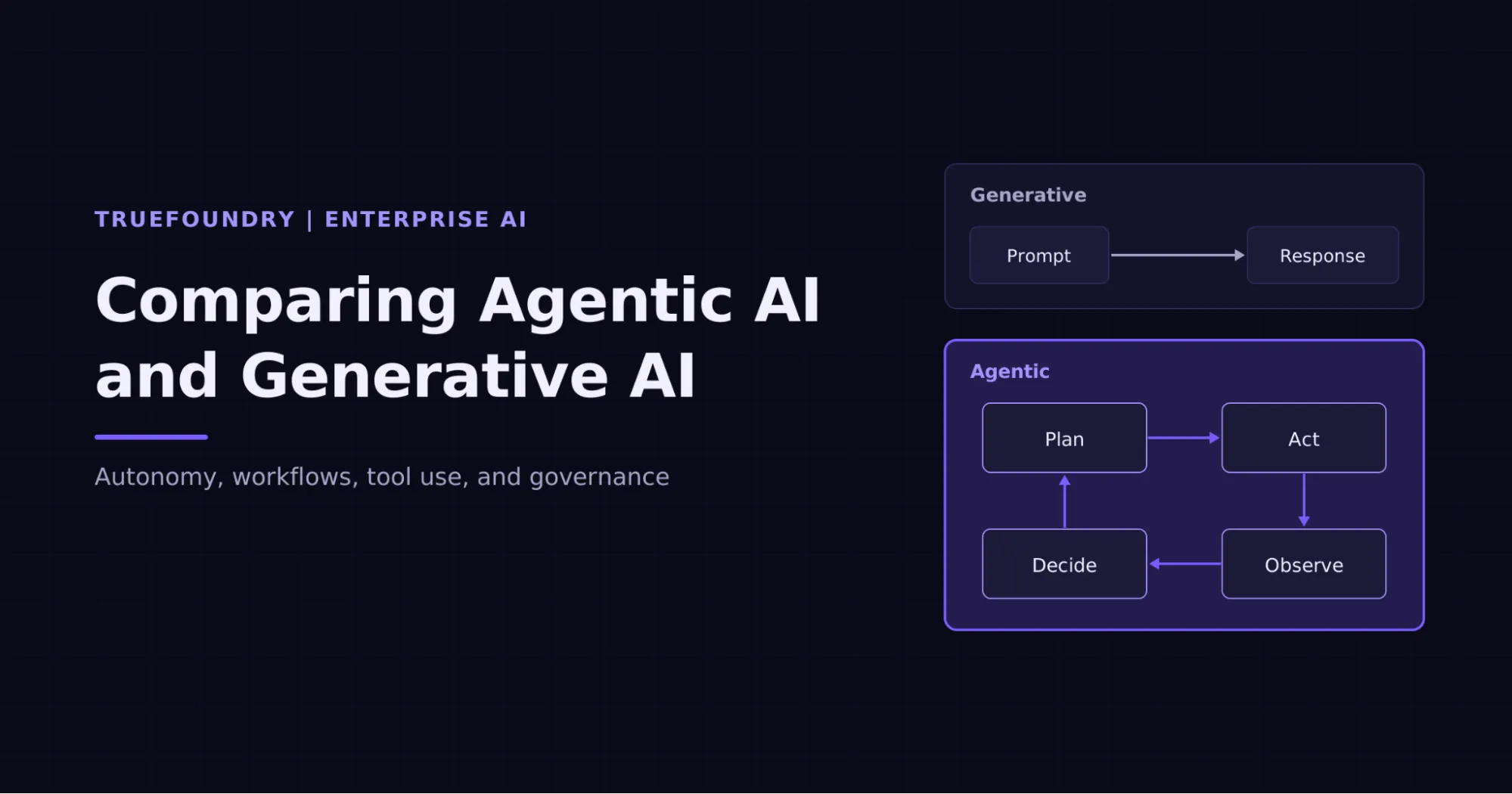
Yes. The platform includes an MCP Gateway with tool-level access control and pre/post-tool guardrails, an Agent Gateway with agent identities, and an agent harness, so agents built on LangGraph, CrewAI, AutoGen or custom frameworks can be governed centrally.
2,500+ LLMs through a single OpenAI-compatible API, with roughly 3–4 ms of added latency and 350+ requests per second on one vCPU. You switch models by changing the model name in the request, keeping the same URL and credentials.



The latest news, articles, and resources sent to your inbox