November 3, 2026
|
5 min read


Blazingly fast way to build, track and deploy your models!
The best AI agent identity tools give every autonomous agent its own verifiable identity, authenticate it on each request, and authorize what it can do under least-privilege policy — with delegation, lifecycle controls and audit. They fall into two complementary groups: identity-and-enforcement platforms that issue and enforce agent identity in the request path, and non-human-identity (NHI) security tools that discover and manage the posture of agent identities.
In one line: these are the platforms that replace shared API keys with governed, per-agent identity for agentic IAM.
How to read this list: if you need to enforce identity in the request path (authenticate the agent and authorize each action before it reaches a tool or model), you want an identity-and-enforcement platform. If you need to discover and secure the sprawl of non-human identities you already have, you want an NHI-security tool. Many enterprises use one of each.
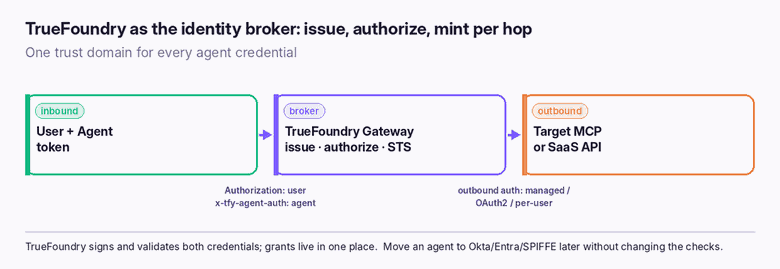
TrueFoundry is an enterprise AI gateway and control plane that treats every agent as a first-class identity and enforces it in the request path. Each agent is registered with its own identity, authenticated on every call, and authorized against least-privilege policy — with on-behalf-of delegation, an MCP registry, SSO/SCIM and full audit — deployable as SaaS, in your VPC, on-prem or fully air-gapped.
What sets it apart in this list is scope: it governs agent identity alongside the models agents call and the MCP servers and tools they reach, from one plane. For teams that want identity, authorization and model/MCP governance in a single enforceable choke point, it is the most complete option.
Mechanically, every request carries the user’s token plus the agent’s TrueFoundry-signed token (Authorization + x-tfy-agent-authorization); the gateway resolves the (user, agent) pair, enforces RBAC plus optional Cedar policy, and performs RFC 8693 on-behalf-of delegation that can only narrow access down the chain. Agents are provisioned, certified, drift-monitored and killed from the registry — and outbound credentials to each tool stay in the gateway, never in the agent
Top Features:
Best for: enterprises that want one control plane governing agent identity, authorization, models and MCP. See the agent governance key concepts and the identity-broker pattern.
Okta, a leader in workforce and customer identity, has extended its Identity Security Fabric toward non-human and agent identities — issuing identities to agents, governing their access, and bringing agent authentication into the same IdP enterprises already use for people. For organizations standardized on Okta, extending that governance to agents is a natural path.
Best for: Okta-centric enterprises that want to extend their existing identity provider to cover agents. (TrueFoundry integrates with Okta for agent identity — see TrueFoundry with Okta.)
Microsoft Entra Agent ID brings AI agents into the Entra directory as first-class identities, so agents can be governed with the same directory, conditional-access and lifecycle tooling Microsoft shops use for users and workloads. It is the obvious fit for estates built on Microsoft — especially agents from Copilot Studio and Microsoft Foundry.
Best for: Microsoft/Entra-centric organizations. (TrueFoundry governs Entra-issued agents reaching MCP servers — relevant when agents span beyond the Microsoft estate.)
Astrix Security is a non-human identity security platform. Rather than sitting in the request path, it discovers the NHIs and AI agents already in your environment, flags over-privilege and anomalies, and helps manage their lifecycle — the posture-and-risk side of agent identity.
Best for: security teams that need visibility into, and control over, NHI/agent risk across existing systems. Pairs well with an enforcement platform.
Oasis Security is a non-human identity management platform built for the scale of service accounts, workloads and now agentic access. It centralizes discovery, governance and lifecycle for non-human identities, with a growing focus on agentic access management.
Best for: enterprises wanting a dedicated plane to govern the full population of non-human identities, agents included.
The honest answer for most enterprises: pair an enforcement control plane (so agents authenticate and are authorized per action) with an NHI-security tool (so you can see and clean up what you already have). They solve different halves of agentic IAM.
TrueFoundry AI Gateway delivers ~3–4 ms latency, handles 350+ RPS on 1 vCPU, scales horizontally with ease, and is production-ready, while LiteLLM suffers from high latency, struggles beyond moderate RPS, lacks built-in scaling, and is best for light or prototype workloads.




AI agent identity tools give autonomous agents their own verifiable identities and govern their access — authenticating each agent, authorizing its actions under least privilege, and auditing what it does. They replace shared API keys and borrowed human credentials with per-agent, governable identity.
It depends on whether you need enforcement or posture. For enforcing agent identity and least-privilege access in the request path — alongside model and MCP governance — TrueFoundry is the most complete. For extending an existing identity provider, Okta or Microsoft Entra Agent ID; for securing existing NHI sprawl, Astrix or Oasis.
Yes. Agents are autonomous, ephemeral and act on others’ behalf, so human-shaped IAM leaves gaps around attribution, least privilege, delegation and lifecycle. Agent identity tools address those specifically, treating each agent as a first-class non-human identity.
An identity-and-enforcement platform issues and enforces agent identity in the request path (authentication and authorization before an action runs). An NHI-security tool discovers and secures the non-human identities you already have, focusing on posture, over-privilege and lifecycle. Many enterprises use both.



The latest news, articles, and resources sent to your inbox