November 3, 2026
|
5 min read


Blazingly fast way to build, track and deploy your models!
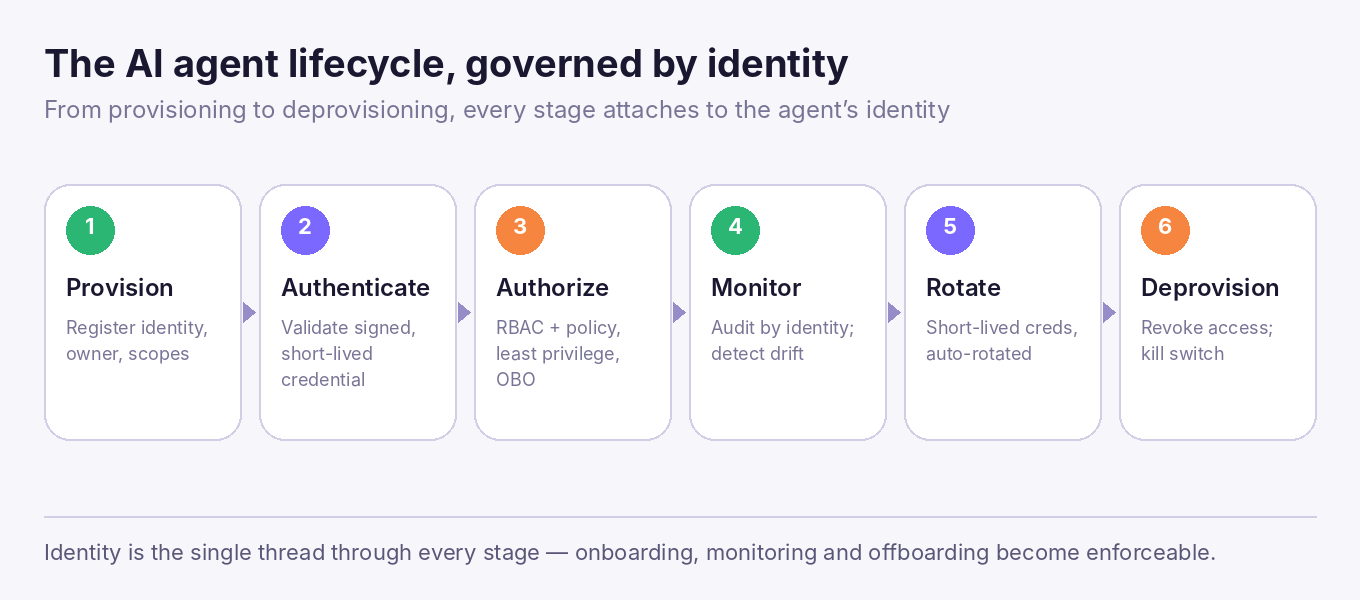
AI agent lifecycle management is the practice of governing an AI agent’s identity and access across its entire life — from provisioning a unique identity with least-privilege scopes, through authenticated and authorized operation, to clean deprovisioning that revokes credentials and retires the identity — so no agent is ever over-privileged, unattributed, or left running after it should be gone.
In one line: treat each agent like a managed employee — onboard it with an identity, govern it while it works, and offboard it cleanly. Identity is the thread through every stage.
Agents are created and retired far faster than human accounts, and without lifecycle discipline the mess compounds:
Making identity the organizing principle fixes this: if every agent has a registered identity, every lifecycle stage has something concrete to attach to. It’s the operational backbone of AI agent governance.
You can try to manage agents by network rules, keys or app config — but those are proxies. Identity is the only thread that runs cleanly through every stage: you provision an identity, authenticate an identity, authorize an identity, audit by identity, and deprovision an identity. Anchor the lifecycle on the agent’s identity and onboarding, monitoring and offboarding all become concrete, enforceable steps instead of best-effort intentions. This is the same per-agent identity principle behind non-human identity for every agent.
Lifecycle management needs a single source of truth: a registry of every agent, its owner, purpose, scopes, credentials and status. The registry is what makes it possible to answer “which agents exist, who owns them, and what can they do?” — and to drive provisioning and deprovisioning from one place. We cover this in depth in what is an AI agent registry.
These risks map directly to the broader agentic AI security risks.
TrueFoundry anchors the whole lifecycle on agent identity through its agent registry — the single inventory of every agent, its owner and its authority.
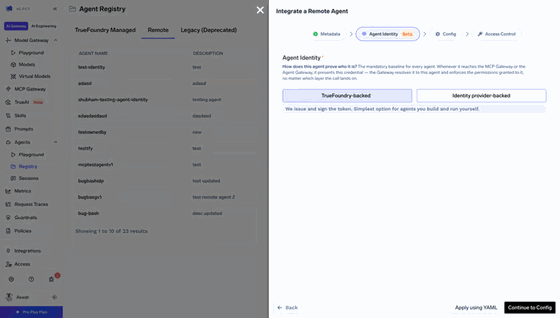
At provisioning, each agent is registered with its owner, business purpose, defined authority (the tools, data domains and actions it may use, and the principals it may act for) and a review cadence. In operation, it is authenticated and authorized at the gateway on every request. For ongoing governance, TrueFoundry adds four lifecycle controls drawn straight from how it models agent governance:
Credentials are kept short-lived and rotated, with per-hop scoped tokens so a leaked credential is useful only briefly. At deprovisioning, revoking the identity cleanly removes the agent’s access everywhere — no orphans. All of this deploys as SaaS, in your VPC, on-prem or air-gapped.
TrueFoundry AI Gateway delivers ~3–4 ms latency, handles 350+ RPS on 1 vCPU, scales horizontally with ease, and is production-ready, while LiteLLM suffers from high latency, struggles beyond moderate RPS, lacks built-in scaling, and is best for light or prototype workloads.




It is the practice of governing an AI agent’s identity and access across its whole life — provisioning a unique identity with least-privilege scopes, authenticating and authorizing it in operation, monitoring and rotating credentials, and deprovisioning it cleanly when retired — so agents never become orphaned or over-privileged.
Identity is the single thread that runs through every lifecycle stage. Anchoring provisioning, authorization, audit and deprovisioning on each agent’s identity turns lifecycle management into concrete, enforceable steps and prevents orphaned, unattributed or over-privileged agents.
An orphaned agent is one that is no longer used or owned but still holds valid credentials and access. It is a standing, unattended attack surface. Lifecycle management prevents orphans by deprovisioning agents on schedule and on owner-offboarding events, driven from an agent registry.
Keep agent credentials short-lived and rotate them automatically rather than on a fixed long interval. Short lifespans mean a leaked credential is useful only briefly, which is far safer than long-lived keys that must be manually rotated.
An agent registry is the single source of truth for every agent — its owner, purpose, scopes, credentials and status. It lets you answer which agents exist and what they can do, and it drives provisioning and deprovisioning from one place, which is what makes clean onboarding and offboarding possible.



The latest news, articles, and resources sent to your inbox