October 14, 2026
|
5 min read


Obtenha acesso instantâneo a um ambiente TrueFoundry ao vivo. Implante modelos, direcione o tráfego de LLM e explore a plataforma completa — seu sandbox estará pronto em segundos, sem necessidade de cartão de crédito.



Published: October 14, 2026
.png)
Blazingly fast way to build, track and deploy your models!
DSPy is a framework from Stanford for building LM systems by programming them rather than prompting them. Instead of hand-tuning prompt strings, you declare the shape of a task — a signature like question -> answer — and compose those into modules (ChainOfThought, ReAct, custom dspy.Module classes). Then DSPy’s optimizers tune the actual prompts and few-shot demonstrations against a metric you define, treating the prompt as a learnable parameter.
This is an effective design, and one which has a cost profile that teams often underestimate. Since optimization entails calling your program to execute the process iteratively on a dataset (creation, evaluation, selection), DSPy is capable of converting small chunks of code into thousands of LM calls. This framework does tasks that you would be performing on your own manually, however, through burning tokens.
This is precisely what an ideal workload for a gateway would be like.
DSPy routes every LM request through LiteLLM, which means it speaks the OpenAI-compatible protocol. To send that traffic through the TrueFoundry AI Gateway, you name the model with the openai/ prefix and point api_base at your gateway URL.
import dspy

lm = dspy.LM(
    model="openai/anthropic-account/claude-4",  # openai/ prefix + TrueFoundry model name
    api_key="your-truefoundry-api-key",
    api_base="{GATEWAY_BASE_URL}",
)
dspy.configure(lm=lm)
That is the entire integration. Every signature, module, and optimizer you write from here calls the gateway underneath — no other code changes. You can also set it once via environment variables:
export OPENAI_API_KEY="your-truefoundry-api-key"
export OPENAI_BASE_URL="{GATEWAY_BASE_URL}"
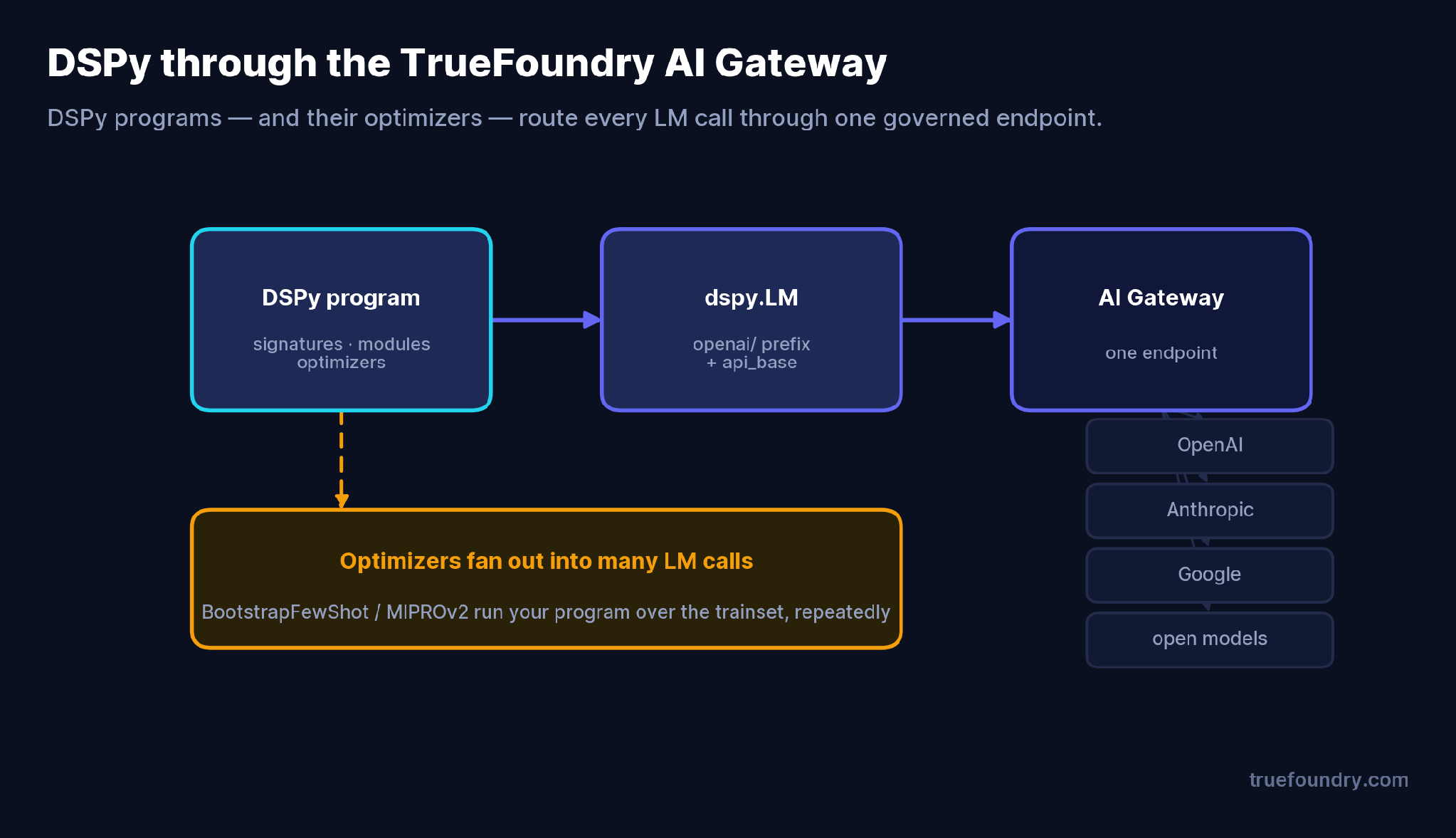
Your DSPy code talks to dspy.LM; dspy.LM talks to the gateway; the gateway talks to whichever provider you named. Swapping openai/anthropic-account/claude-4 for an OpenAI or Gemini model is a string change, because the gateway normalizes them all.
Here is the number that matters. A single ChainOfThought prediction is one or two LM calls. An optimizer is a different animal.
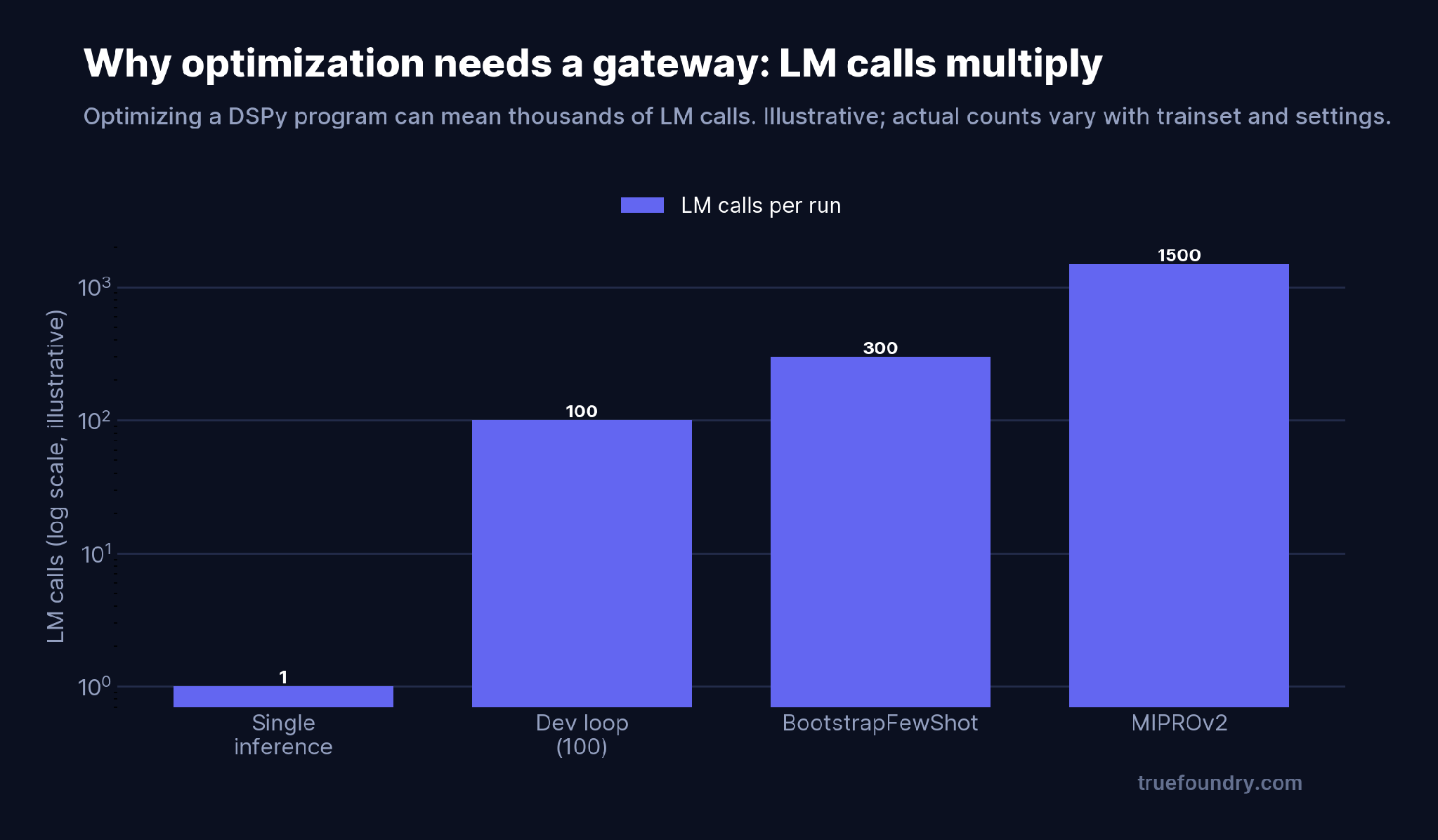
When you call optimizer.compile(), DSPy runs your program over the training set many times — bootstrapping demonstrations, evaluating candidates, searching for the best configuration. A BootstrapFewShot run can be hundreds of calls; MIPROv2 can be thousands. Run that a few times while you iterate on your metric and you have generated serious, bursty, hard-to-predict spend — the kind that blows through a provider rate limit at the worst moment and shows up on the invoice with no breakdown of which experiment caused it.
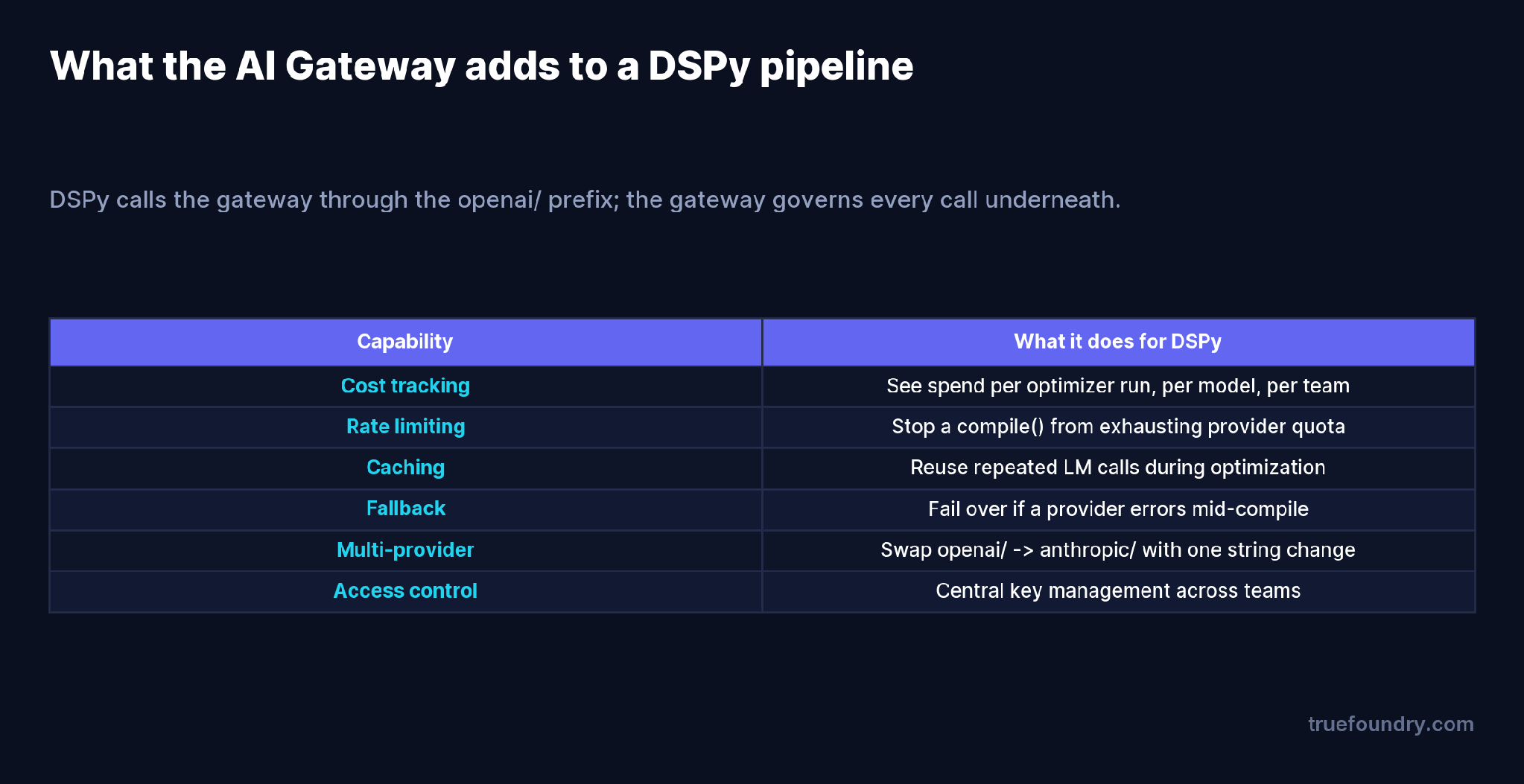
Calling the model directly, you have no guardrails on any of this. Through the gateway, you do:
They optimize against a raw provider key. The first big compile() either trips a rate limit or produces a surprise bill with no attribution. Route it through a gateway before you scale optimization.
They forget caching during iteration. Re-running optimization while tuning a metric repeats many identical calls. Without a cache you pay for every one.
They hardcode the provider. DSPy’s whole value is comparing configurations — but if the model is baked into every module, comparing providers means code edits. The openai/ prefix plus a gateway makes it a string.
They don’t separate dev from prod spend. Optimization runs are experiments; inference is production. Without per-run cost attribution they blur into one line nobody can explain.
Two steps. Install DSPy (pip install -U dspy), then grab your gateway base URL and model name from the unified code snippet in the TrueFoundry playground.
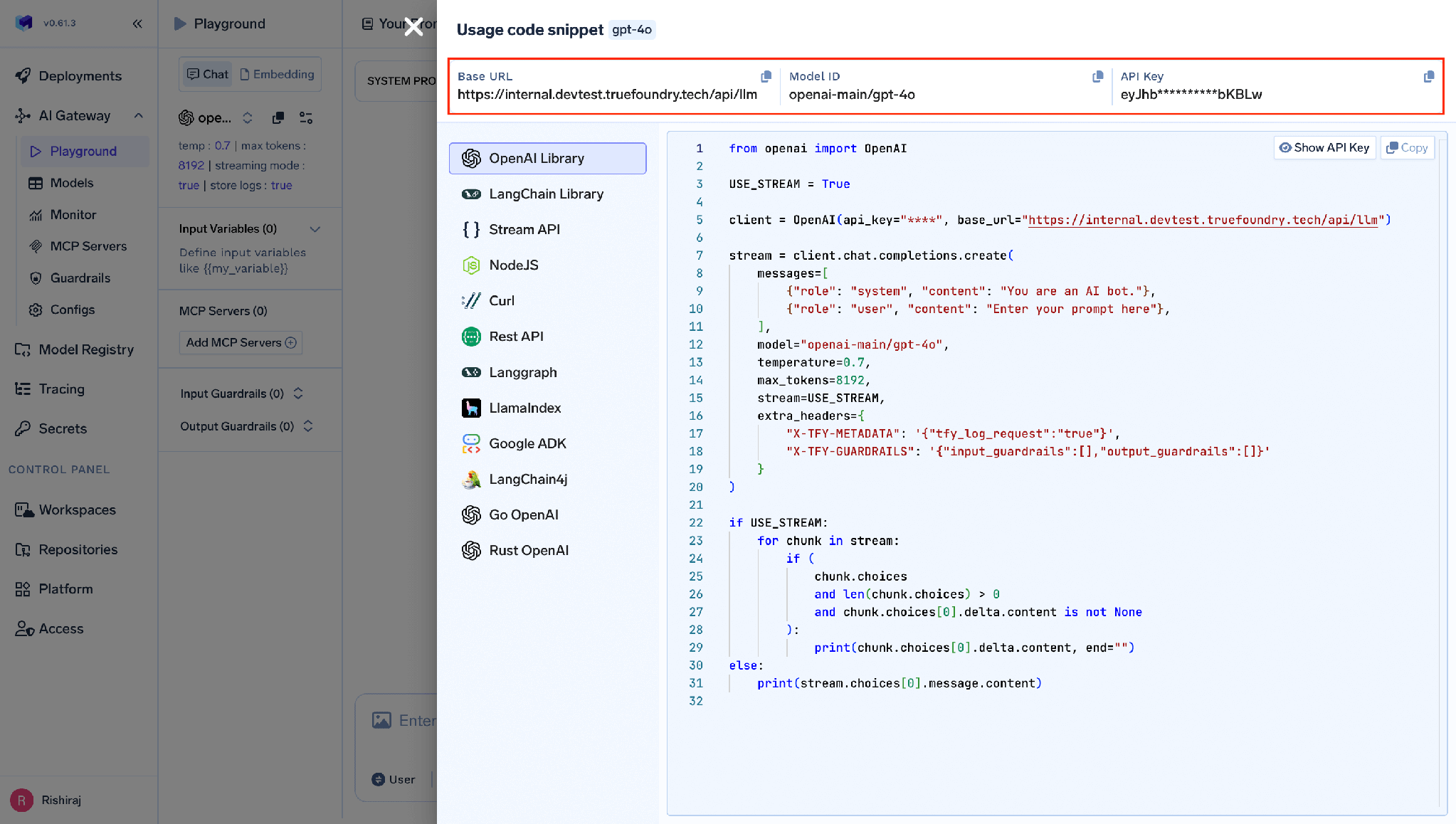
Configure the LM as shown above, then write ordinary DSPy. A signature and module:
class GenerateAnswer(dspy.Signature):
    """Answer questions with short factoid answers."""
    question = dspy.InputField()
    answer = dspy.OutputField(desc="often between 1 and 5 words")

generate_answer = dspy.ChainOfThought(GenerateAnswer)
pred = generate_answer(question="What is the capital of Brazil?")
print(pred.answer)
And an optimizer run — the part that benefits most from the gateway:
from dspy.evaluate import Evaluate

def validate_answer(example, pred, trace=None):
    return example.answer.lower() in pred.answer.lower()

optimizer = dspy.BootstrapFewShot(metric=validate_answer)
optimized = optimizer.compile(qa_module, trainset=trainset)
Every call that compile() makes is now metered, rate-limited, cached, and fallback-protected by the gateway — with zero changes to the DSPy code itself.
A team is tuning a RAG module. Each MIPROv2 run makes roughly 1,500 LM calls, averaging 3,000 input and 400 output tokens per call. They plan 20 runs while iterating on the metric.
On a mid-tier model (say Claude Sonnet 5.5 at $2 / $10 per million), one run is about (1,500 × 3,000 × $2 + 1,500 × 400 × $10) / 1e6 ≈ $15 in input-plus-output — call it $15 per run, or $300 across 20 runs. Route the same optimization at a cheaper model for the bootstrapping phase and the number drops sharply — but you only know that, and can prove the quality trade-off, because the gateway tracked cost per run and per model.
Without that attribution, the $300 is a single unexplained line. With it, optimization becomes a budgeted, measurable part of development — and the decision to re-optimize on a cheaper model is backed by numbers, not vibes.
DSPy changes how you build with LLMs — prompts become parameters, and a compiler does the tuning. The hidden cost of that elegance is traffic: optimizers make far more LM calls than the code suggests, and that spend is bursty, unpredictable, and easy to lose track of.
Pointing DSPy at the TrueFoundry AI Gateway is a two-line change that turns all of it into a governed, measured path — cost per optimization run, rate limits that protect your quota, caching that cuts repeated calls, and fallback that keeps a long compile alive. You keep DSPy’s programming model and gain the operational control production needs.
TrueFoundry AI Gateway delivers ~3–4 ms latency, handles 350+ RPS on 1 vCPU, scales horizontally with ease, and is production-ready, while LiteLLM suffers from high latency, struggles beyond moderate RPS, lacks built-in scaling, and is best for light or prototype workloads.



DSPy is a framework for building LM systems by programming them instead of hand-writing prompts. You define signatures and modules, then use optimizers to tune the prompts and few-shot examples against a metric.
Use the openai/ prefix in the model name and set api_base to your gateway URL in dspy.LM(...), then dspy.configure(lm=lm). DSPy routes through LiteLLM, so any OpenAI-compatible gateway works.
Because optimization generates large, bursty LM traffic. The gateway adds cost tracking, rate limiting, caching, and fallback across every call, and lets you switch models with a one-string change.
No. Only the LM configuration changes. Your signatures, modules, and optimizers are untouched.
It depends on the optimizer, trainset size, and model. A MIPROv2 run can be thousands of LM calls. The gateway meters each run so you can see and budget the exact cost per sweep, per model, and per team.
Yes. TrueFoundry’s data plane runs in your VPC or on-prem, so DSPy’s prompts and optimization data stay in your environment.



As últimas notícias, artigos e recursos enviados para sua caixa de entrada
.png)


.png)
.png)
.png)
.png)
.png)