Obtenha acesso instantâneo a um ambiente TrueFoundry ao vivo. Implante modelos, direcione o tráfego de LLM e explore a plataforma completa — seu sandbox estará pronto em segundos, sem necessidade de cartão de crédito.
9,9
Do Harness de Agentes à Inteligência de Sistema: O que a Engenharia de Grafos muda na IA em produção
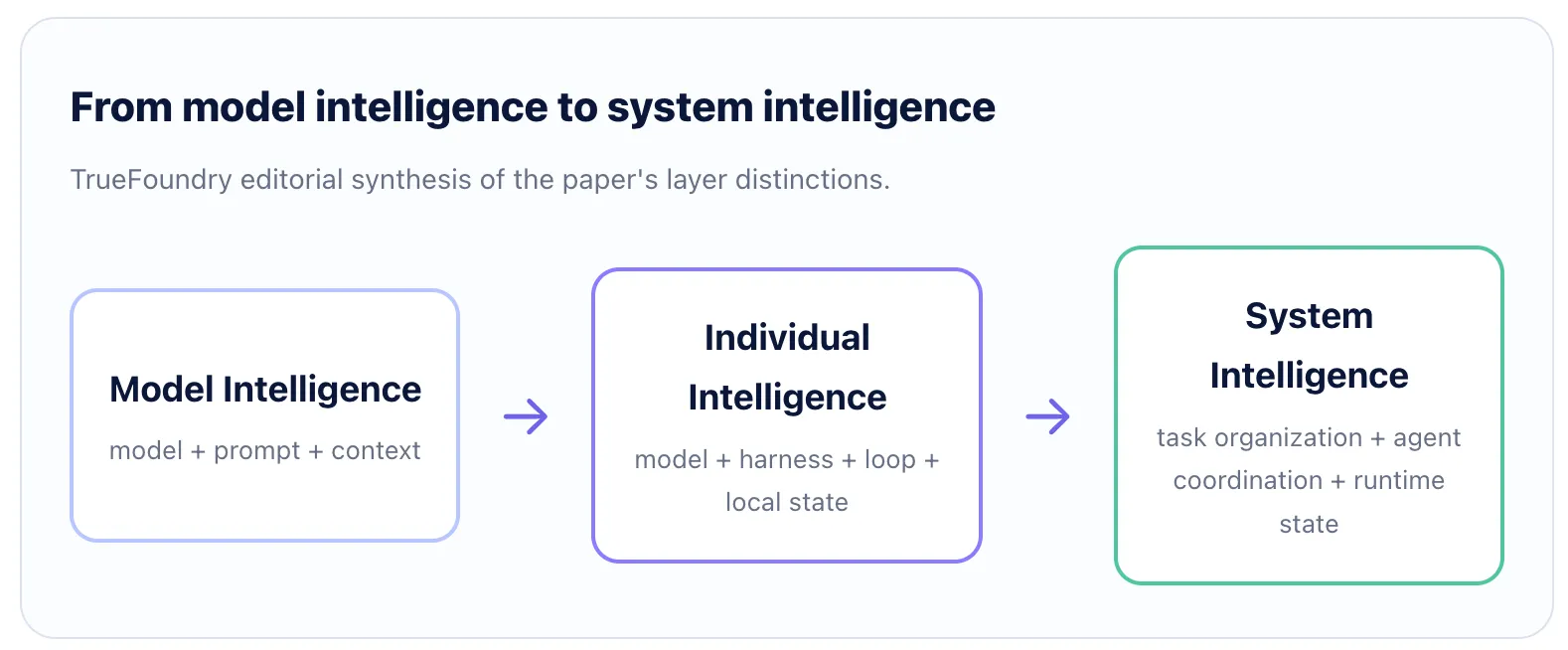
Uma nova pesquisa que propõe a Engenharia de Grafos como um paradigma emergente oferece uma hierarquia útil para desenvolvedores de agentes: o prompt e o contexto moldam uma chamada de modelo; um harness e um loop transformam esse modelo em um agente persistente; a organização em nível de grafo coordena múltiplos agentes, estruturas de trabalho e estados de runtime em um sistema.
Graph Engineering Article Extract
Source note. This article is a TrueFoundry interpretation of Graph Engineering in the Era of LLM Agents: From Individual Intelligence to System Intelligence (arXiv:2608.21156, August 21, 2026). The paper introduces its own terminology and research framing. The product mapping to TrueForge and TrueFoundry is ours; the paper does not evaluate or endorse TrueFoundry products.
The paper's most useful production insight appears before its graph taxonomy. It reduces an individual agent to a compact systems equation:
That formula matters because it moves the engineering unit away from the model call. A model can reason and generate. An agent must keep resources available across calls, invoke tools, preserve state, interact with an environment, accept feedback, pause, resume, and keep operating as the task changes.
The production principle: the harness turns model capability into durable individual execution; graph engineering begins when the problem becomes how multiple units of execution, responsibility, and state should be organized as one system.
Key Takeaways - Graph Engineering
Key Takeaways
The agent harness is a first-class systems layer. The paper treats Harness Engineering as the runtime around the model: tools, memory, skills, execution environments, state, verification, and supporting mechanisms.
Harness and loop are different engineering objects. The harness determines which durable capabilities exist and how they are exposed; the loop determines how they are repeatedly invoked and adapted during execution.
Graph Engineering starts above the individual agent. Its three core concerns are Task Organization, Agent Coordination, and Runtime State Management.
TrueForge maps naturally to the individual-agent runtime. It runs the model/tool loop with MCP, context controls, sandboxing, approvals, subagents, sessions, and events.
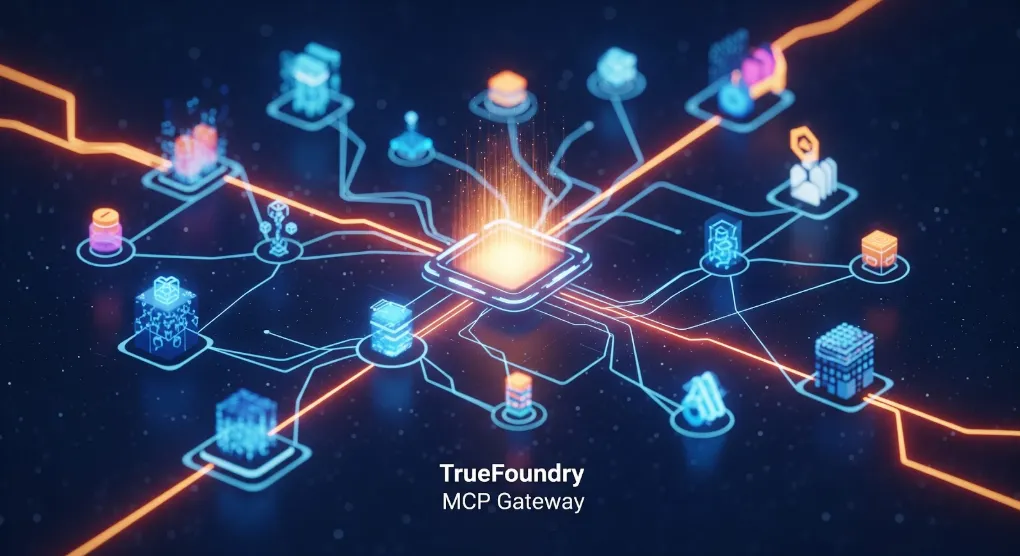
TrueFoundry Gateways map to shared system boundaries. AI Gateway governs routed model traffic; MCP Gateway governs routed tool/data traffic; Agent Gateway provides shared agent registry/control surfaces. None of them replaces the application's graph orchestrator.
A "graph-native agent operating system" remains a research direction. Some of its proposed services resemble today's harness and gateway primitives, but it would be inaccurate to claim that current products already implement the paper's future architecture.
1. O artigo torna o harness um objeto de engenharia, não um código de integração
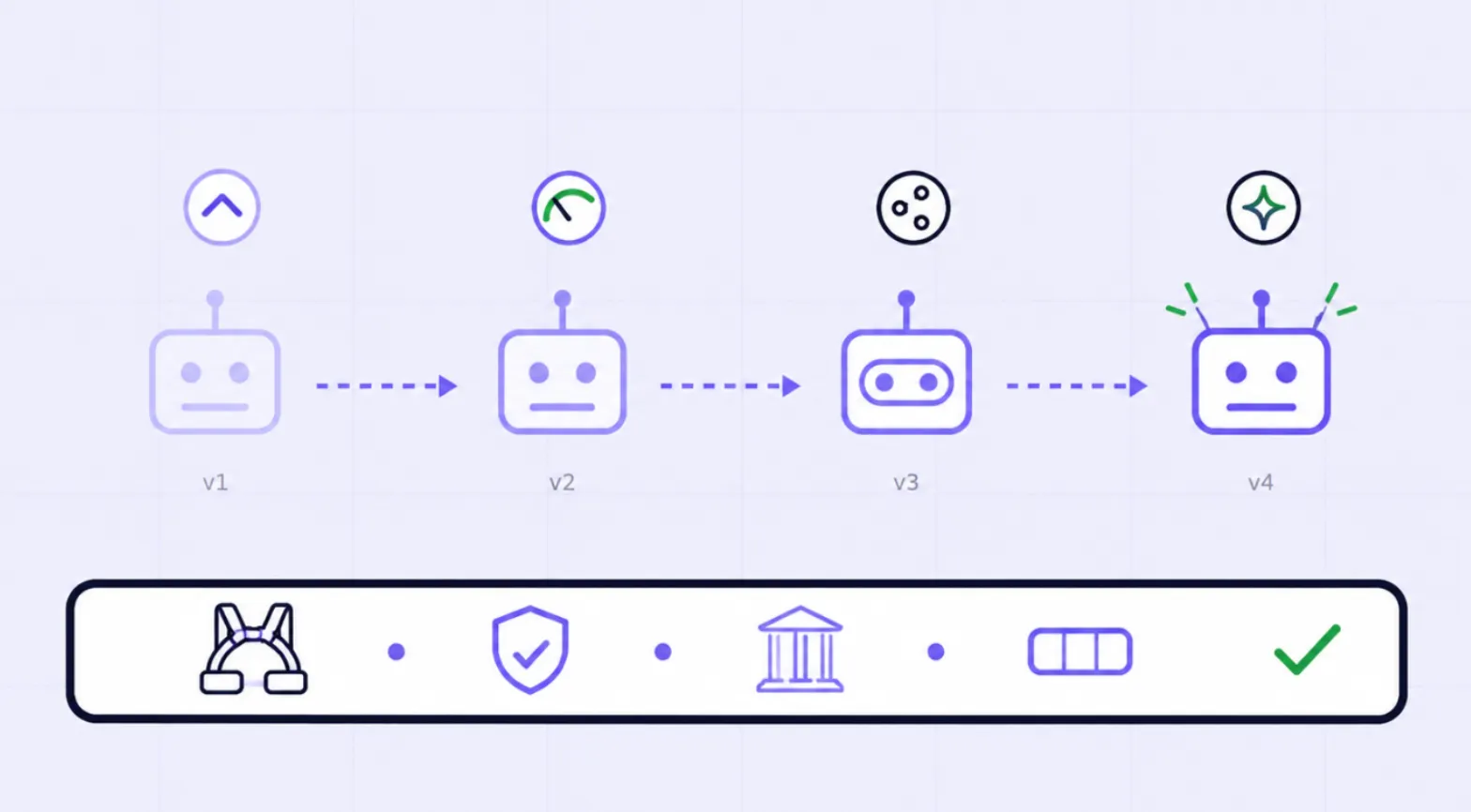
A pesquisa coloca a Engenharia de Prompt, Engenharia de Contexto, Engenharia de Harness, Engenharia de Loop e Engenharia de Grafos em camadas diferentes, em vez de tratá-las como rótulos concorrentes. O prompt e o contexto operam mais próximos da inferência. A Engenharia de Harness estende o modelo com capacidades persistentes e executáveis entre chamadas. A Engenharia de Loop organiza a interação repetida com essas capacidades. A Engenharia de Grafos aborda a organização em nível de sistema.
Essa separação é útil porque o termo "framework de agente" frequentemente agrupa preocupações muito diferentes em um único lugar. Um esquema de ferramenta, um armazenamento de sessão, um sandbox, um ponto de verificação de aprovação e um loop de repetição não são a mesma coisa, mesmo que um SDK os exponha por meio de uma única API.
A seção de Engenharia de Harness do artigo agrupa quatro áreas:
What actions and external capabilities the agent can reach
Memory management
Persistent memory, consolidation, retrieval, update, reconstruction and recovery
What information and experience survive beyond one model call
Skill composition
Reusable procedural capabilities, skill libraries, maintenance and evolution
How successful procedures become named, reusable runtime assets
Runtime orchestration
Configuration, security, verification, execution environments and optimization
How the surrounding runtime turns capabilities into a governable agent
O ponto importante é o escopo. A Engenharia de Harness não é simplesmente "dar ferramentas ao LLM". Ela diz respeito ao runtime persistente no qual essas ferramentas, memórias, habilidades, limites de execução e controles permanecem utilizáveis entre as chamadas.
2. O TrueForge mapeia-se claramente para o runtime de agente individual do artigo
É aqui que aTrueForge possui um mapeamento incomumente direto para o vocabulário do artigo. A documentação atual do TrueForge o descreve como um harness de agente de código aberto — a camada de runtime em torno de um LLM que executa o loop de execução e conecta ferramentas MCP, habilidades, sandboxing, aprovações, subagentes, gerenciamento de contexto e estado de sessão persistente.
O mapeamento não é meramente retórico. A documentação do servidor TrueForge afirma que o servidor planeja um turno, chama o modelo, executa ferramentas, transmite etapas, pausa para aprovação humana em ações sensíveis, mantém o contexto enxuto para tarefas longas e persiste sessões entre reconexões e reinicializações. Seu SDK torna Agente, Sessão, Turno, Evento e Delta objetos de runtime explícitos.
TrueFoundry AI Gateway delivers ~3–4 ms latency, handles 350+ RPS on 1 vCPU, scales horizontally with ease, and is production-ready, while LiteLLM suffers from high latency, struggles beyond moderate RPS, lacks built-in scaling, and is best for light or prototype workloads.







.webp)

.png)
.png)
.png)
.png)
.png)
.png)