


What are foundation models and what are their types?

Building and training a separate AI model for every task can require substantial data, computing resources, and development time. Modern AI development increasingly uses broadly capable models as a starting point for multiple applications instead.
This shift has changed how teams build systems for language, vision, multimodal interaction, and generative artificial intelligence. Understanding what foundation models are helps explain why the same underlying model can support many different downstream applications.
This article explains how foundation models work, their main categories and examples, how they differ from related concepts such as LLMs and generative AI, and the benefits and challenges of using them.
What are foundation models?
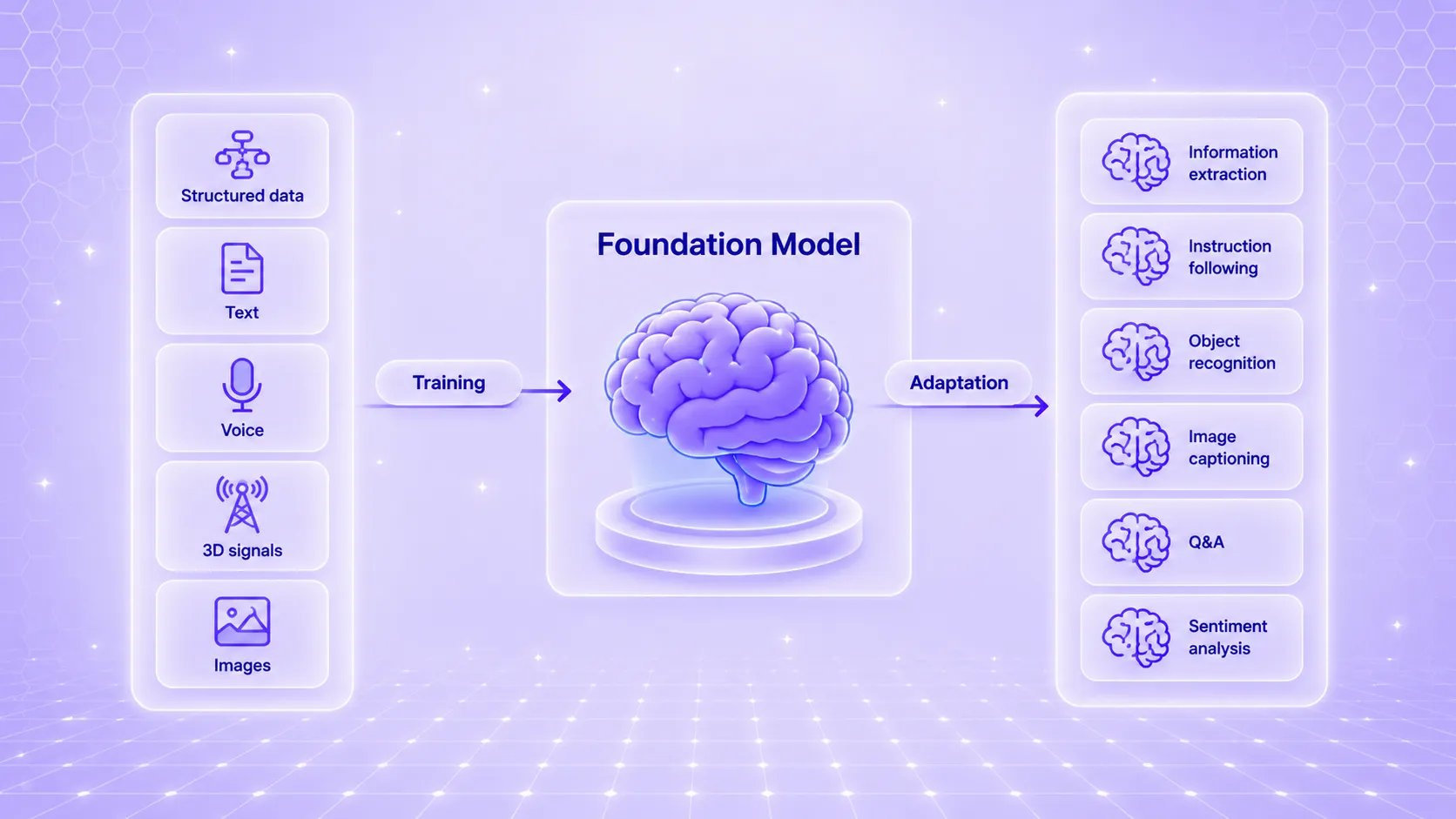
Foundation models are AI models trained on broad datasets at scale so they can be adapted for a wide range of downstream tasks and applications.
Rather than being developed for only one narrowly defined task, a foundation model learns general patterns during pretraining that can provide a reusable starting point for different applications. Depending on the model, teams may adapt or use it through techniques such as prompting, fine-tuning, or other application-specific methods.
Foundation models can work with different modalities. A language-focused model like GPT-4 can generate text, summarize documents, answer complex questions, and assist with coding across various natural language processing tasks.
How do foundation models work?
Developing a foundation model involves a connected series of decisions. Teams first determine what kinds of data and modalities the model needs to handle. Those requirements influence the model architecture and training approach. After pretraining, the model is evaluated and can then be adapted for downstream applications.
Data gathering
Everything starts with data. Depending on what the model needs to learn, developers may use text, images, audio, video, code, or a mixture of several data types. Foundation models are typically pretrained on broad datasets at scale so they can learn patterns and representations that transfer across tasks.
But bigger isn't always better. Duplicated, low-quality, biased, or inappropriate data can affect what the model learns and how it behaves later.
Choosing the modality
The model's intended modalities determine the kinds of data it needs to process. Some foundation models focus on one type of data, such as text or images. Others are multimodal, meaning they can work across two or more modalities, such as text, images, audio, or video.
For example, a multimodal model could look at an image and answer questions about it, or analyze a video while following instructions provided in text.
Defining the model architecture
The architecture determines how the model processes information and learns from its training data.
Transformers are widely used in modern language and multimodal models, although other architectures can be useful for specific types of tasks. The choice of architecture also affects training requirements, model capabilities, and how quickly the model can respond.
Training
This is where the model actually starts learning from the data. During pretraining, the model processes large amounts of data and adjusts its parameters to minimize a training objective. For example, a language model may learn by predicting tokens based on the surrounding or preceding context.
Over time, the model learns statistical representation and relationships within the modalities represented in its training data. Training a large foundation model can require a substantial amount of computing power, storage, and electricity.
Evaluation
Finishing training doesn't mean the model is ready to use.
Teams evaluate the model to understand where it performs well and where it struggles. Evaluations may look at accuracy, reasoning, safety, robustness, bias, and how the model handles unexpected inputs.
The results can lead to additional training, fine-tuning, safety controls, or other changes before the model is deployed.
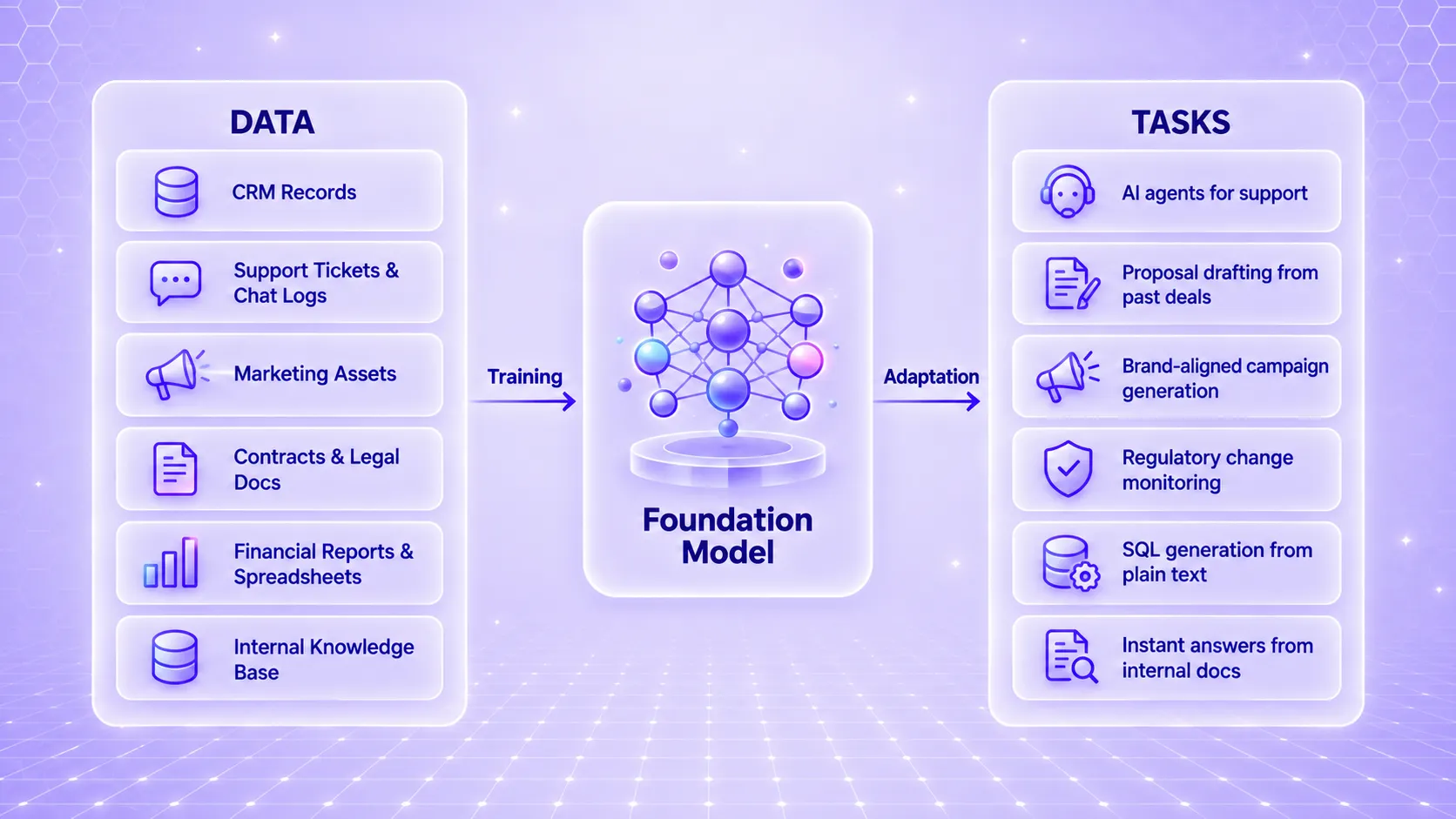
After pretraining, a foundation model can be adapted for downstream applications in several ways. Teams may use prompting, fine-tuning, adapters, or other techniques to specialize the model for a particular task or domain. In some applications, the pretrained model can also be used directly without changing its parameters.
What are the types of Foundation Models?
There isn't one fixed way to classify foundation models. Foundation models can be grouped by modality, domain, architecture, or capability, so the categories below are not mutually exclusive.
Here are some of the common categories.
Large language models
Large language models (LLMs) are designed primarily to understand and generate language.
They can write and summarise text, answer questions, translate languages, generate code, and power conversational applications.
However, the two terms aren’t interchangeable. LLM describes the type of model, while foundation model describes its broader role.
Multimodal models
Multimodal foundation models can work with more than one type of information.
For example, a model might accept a text prompt and an image together, analyze a video, or combine audio and text to understand a user's request.
This makes them useful for applications where information doesn't come in just one format.
Generative Adversarial Networks
Generative adversarial networks (GANs) use two neural networks that work against each other. GANs are a generative modeling approach rather than inherently a category of foundation model. A GAN-based model fits the broader foundation model concept only when it is trained broadly enough to provide a reusable base for multiple downstream tasks. GANs have historically been important for applications such as image generation and synthetic data, although other generative architectures are also widely used today.
Computer vision models
Computer vision foundation models are trained to understand visual information. They can be adapted for tasks such as image classification, object detection, image segmentation, and visual search.
Instead of creating a completely new model for every visual task, developers can start with a pretrained vision model and adapt it to their requirements.
What is the difference between a foundation model and an LLM?
A foundation model is a broader category, while an LLM is a type of model focused on language.
Foundation models can work with text, images, audio, video, or several of these formats. LLMs, as the name suggests, are primarily concerned with understanding and generating language.
The confusion is understandable because many AI models people use today fall into both categories. A model can be an LLM while also serving as the foundation for chatbots, coding assistants, search tools, and other applications.
Put simply, “foundation model” describes a model's broad, reusable role, while “LLM” describes a language-focused class of models.
What is the difference between Generative AI and Foundation Models?
Generative AI and foundation models are closely related, but they don't describe the same thing. Generative AI refers to AI systems designed to generate new content such as text, images, audio, video, or code.
A foundation model refers to the underlying model that can be adapted for different applications. A foundation model can power a generative AI application, but generating content isn't its only possible use. The same model could potentially be adapted for classification, analysis, search, prediction, or other tasks.
The easiest way to understand the distinction is to separate the two concepts. Generative AI describes a content-generation capability or system.
A foundation model describes a broadly pretrained model that can support multiple downstream applications.
What are the examples of foundation models?
Several major AI companies now develop foundation model families that are used across a range of applications.
- Google: Google's Gemini family includes multimodal foundation models with capabilities across modalities such as text, images, audio, and video. They are used for conversational AI, productivity features, and other applications.
- OpenAI: OpenAI's GPT models provide general-purpose capabilities for language, reasoning, coding, and multimodal interactions.
- Meta: Meta's Llama family includes models that developers can use and adapt for chatbots, coding tools, research, and enterprise AI.
- Anthropic: Anthropic's Claude models are designed for tasks such as writing, analysis, coding, and conversational AI.
- Mistral AI: Mistral AI offers a range of language and multimodal models, including smaller models designed for applications where efficiency and deployment flexibility matter.
These model families aren't identical. They differ in capabilities, supported inputs and outputs, licensing, deployment options, performance, and cost.
That means the right choice depends less on simply picking the biggest model and more on what you actually want to build.
What are the benefits of foundation models?
Foundation models have changed AI development by allowing teams to build on existing capabilities instead of starting from zero.
- Versatility and generalization: A single pretrained model can be adapted for different tasks. The same underlying capabilities can support chatbots, coding tools, content applications, search, and analysis.
- Efficiency through transfer learning: Developers can adapt an existing model instead of training a new one from scratch.. Fine-tuning and other adaptation methods can reduce the data, time, and computing resources needed for development.
- Democratization of AI capabilities: Foundation models give more developers and organizations access to advanced AI capabilities without requiring them to build and train a large model themselves. This lowers the barrier to experimenting with AI and creating new applications.
What are the challenges and risks of foundation models?
The flexibility of foundation models comes with its own set of challenges. A model that performs well in one application may not behave the same way in another, particularly when the stakes are high.
Bias and fairness
Foundation models can learn biases and imbalances present in their training data, which may affect downstream outputs and applications. Teams can evaluate performance across representative datasets and user groups, apply appropriate filtering or post-training techniques, and continue monitoring deployed applications for problematic behavior.
Hallucinations and reliability
Generative foundation models can produce outputs that appear plausible but contain incorrect or unsupported information. This is commonly called a hallucination. The issue becomes more serious when a model is used for tasks where inaccurate information could have real-world consequences.
Techniques such as retrieval-augmented generation (RAG), evaluation, guardrails, and human review can help reduce these risks, although they can't eliminate them.
Data privacy and security
Privacy risks can arise both from data used to train or adapt a foundation model and from sensitive information submitted to the model after deployment.
Organisations need to understand how their data is collected, processed, stored, and used. Security risks can include unauthorized model access, sensitive-data leakage, adversarial inputs, or vulnerabilities introduced when models are connected to external tools, APIs, and private data sources.
Computational cost
Training requires significant computing power, storage, and electricity. Once a model is deployed, serving a large number of users can also increase inference costs. Smaller models, quantisation, efficient hardware, and other optimisation techniques can help reduce these expenses..
Transparency and accountability
The internal representations and decision processes of large foundation models can be difficult to interpret, making it challenging to explain why a particular output was produced.
Because a single foundation model may support many downstream applications, weaknesses in the base model can also affect multiple systems. Teams should therefore evaluate both the underlying model and each application built on top of it.
Conclusion
Understanding what foundation models are is useful because they underpin many modern AI applications. Instead of building a separate model for every task, developers can adapt a broadly trained model to meet different requirements.
That flexibility is a major reason foundation models have become so important. At the same time, their scale brings challenges around reliability, privacy, cost, bias, and accountability. Choosing and deploying one therefore involves looking beyond what the model can do and considering how it will actually be used.
When teams use language foundation models in production, they also need infrastructure for deployment, inference, monitoring, scaling, governance, and cost management. LLMOps provides an operational layer for managing these requirements across the model lifecycle.
TrueFoundry's enterprise LLMOps platform supports model serving, fine-tuning, observability, resource management, and governed access to LLMs, helping organizations transition foundation models from initial prototypes to scalable production systems.
Ready to scale your foundation models in production?
TrueFoundry simplifies model serving, fine-tuning, and governance within your secure cloud infrastructure. Book a Demo to see how you can deploy and manage enterprise LLMs effortlessly.

Govern, Deploy and Trace AI in Your Own Infrastructure





