


What Are AI Hallucinations and Why Do They Occur?


An AI system can produce an answer that sounds completely convincing and still be wrong. It may invent a research paper, cite a legal case that does not exist, suggest a software library that was never released, or confidently provide an incorrect answer to a user's question.
These outputs are called AI hallucinations. They occur when an AI system generates information that is false, fabricated, or unsupported by reliable evidence. In business applications, factual errors or false information can affect customers, employees, decisions, or downstream systems.
This article covers what AI hallucinations are, why they occur, what forms they take, and how to reduce and detect them in production AI systems.
What are AI hallucinations?
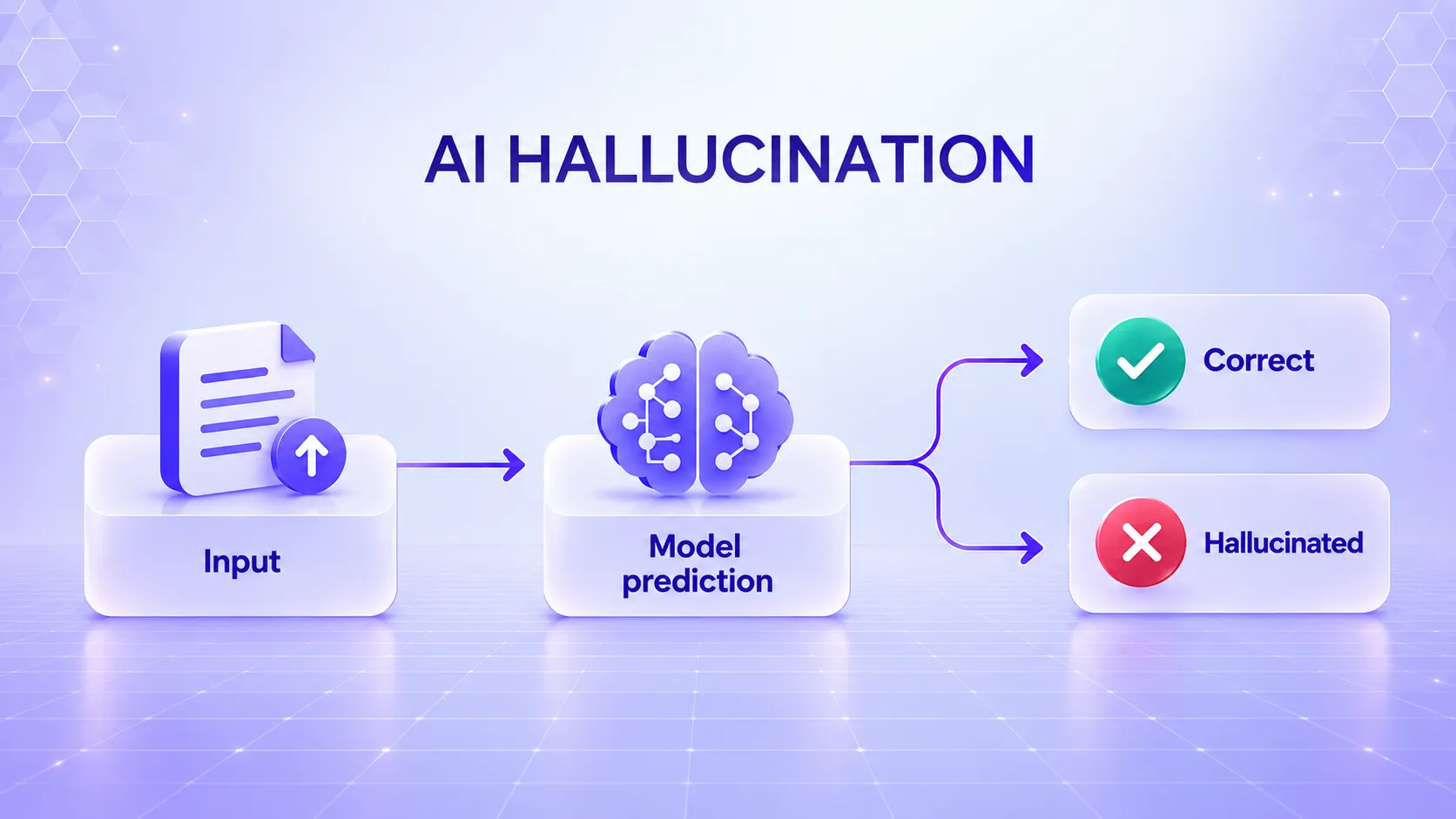
AI hallucinations are false, fabricated, or unsupported outputs generated by an AI system that appear credible or are presented as accurate.
For example, a large language model (LLM) may be asked to summarize a research paper and provide its citation. If the paper does not exist but the model creates a realistic title, author, journal, and publication date, the response is a hallucination.
This happens because generative models generate outputs based on patterns learned from the AI model's training data rather than automatically checking each statement against a trusted source.
Hallucinations can occur in text, images, code, audio, and other AI-generated outputs. The way they appear and the causes of AI hallucinations can differ by model, application, and task.
Why do AI hallucinations occur?
There are several reasons why artificial intelligence (AI) systems hallucinate. Hallucinations can result from limitations in the model and training data, vague prompts, or a lack of reliable data sources available at generation time.
How do language models generate answers?
Large language models generate text by predicting what tokens are likely to come next based on patterns learned during training, rather than following a fixed reasoning process that verifies every claim.
This allows LLMs to produce remarkably fluent responses, but fluency is not the same as factual accuracy. If the model lacks reliable information or cannot determine the answer from its learned patterns, it may still generate a response that appears reasonable but contains factual inaccuracies.
For example, a user asking about an obscure historical event may receive a detailed explanation even when reliable information about that event is limited. The model can combine learned patterns into a plausible answer without having evidence to support the event.
This distinction helps explain why a fluent response is not actually a factual one. Language generation and factual verification are different tasks.
Can training data gaps cause hallucinations?
Yes. Models learn from large collections of data, but those datasets can be incomplete, outdated, inconsistent, or have limited coverage of certain topics.
This can become a problem when a model is asked about niche subjects or information that changes frequently, particularly when the model relies on outdated information. For example, a model may have learned information about an older version of a software library without having information about a recent update.
Data quality also matters. Incorrect or contradictory information in training data can make it harder for a model to produce reliable outputs.
Can the model architecture contribute to hallucinations?
Model architecture and the statistical nature of language generation can also contribute to hallucinations.
An AI model does not retrieve facts from its parameters in the same way a database retrieves verified records. It learns patterns and relationships from its training data and uses those patterns to generate outputs rather than retrieving verified records from curated knowledge bases.
As a result, the model can generate a statement that is coherent and credible but not supported by evidence.
A larger or more capable model can perform better on many tasks, but model capability alone does not guarantee factual accuracy.
Can poor prompts increase hallucinations?
The way a question is written can affect the quality of an AI response.
Consider the vague prompt: "Tell me about the latest AI regulations.”
The prompt does not specify a country, industry, regulator, or timeframe. The model may make assumptions about these missing details and produce an answer that does not match the context.
Clear prompt engineering can provide useful instructions, context, constraints, and expected output format. This can reduce ambiguity, although better prompting cannot eliminate hallucinations on its own.
Why does lack of grounding matter?
A model may not have access to the information required to answer a question accurately.
This is common when an application needs current information, private company data, enterprise data, internal documentation, or information from a specific database.
When the required information is not present in the model’s learned knowledge, an AI application may connect the model to external sources. Retrieval-augmented generation (RAG) is one approach that retrieves relevant information from external sources and gives it to the model as context before generating a response. These RAG systems can use documentation, databases, and other trusted sources to provide relevant context.
Grounding the model with relevant external information can reduce hallucinations, especially if the application depends on recent or confidential data.
What types of AI Hallucinations can occur?
AI hallucinations can take various forms depending on the type of AI system and the nature of the output or interpretation that the model produces.
Text and language hallucinations
Text-based hallucinations include invented facts, fabricated citations, factual inaccuracies, incorrect explanations, false quotations, and unsupported claims.
They can be difficult to notice when the response is detailed, coherent, and confidently presented. A user may assume that a well-structured answer has also been fact-checked when it has not.
Image and vision hallucinations
Image generation models can create objects or visual details that do not correspond to reality. They may also produce inconsistent shapes, features, or relationships between objects.
Computer vision systems can produce inaccurate interpretations, such as misclassifying an object or incorrectly identifying a visual feature.
Code hallucinations
AI coding systems can generate functions, APIs, packages, or configuration options that look legitimate but do not exist, resulting in factual errors in generated technical documentation or code.
They can also generate technical details, such as API parameters, that look valid but do not exist. AI-generated code still needs to be tested and reviewed before it can be used in a production application.
Multimodal hallucinations
Multimodal hallucinations occur when an AI system produces an incorrect interpretation based on multiple types of input, such as text, images, audio, and video.
A system may misunderstand one input or make a false connection between different inputs, increasing hallucination risk when several modalities are processed together. These hallucinations can be harder to identify because the final response may combine information from several modalities.
Where do AI hallucinations appear in the real world?
Hallucinations become more concerning when AI outputs are used in AI workflows where end users may rely on them as trustworthy information.
Fabricated citations
AI systems can generate realistic-looking references to papers, websites, articles, and other sources that do not exist, including fabricated legal citations and academic references.
This can create problems in research, journalism, education, and professional work because a user may cite or rely on the fabricated source without checking the original.
Invented facts and events
An AI system can generate incorrect statistics, company information, historical events, product specifications, or even entirely fictional people.
The risk increases when the subject is obscure, and the reliable information is limited.
Legal research
Legal work has provided the clearest examples of the risks involved, particularly when AI-generated legal advice is used without verification. AI-generated legal research has, in some cases, included case citations to cases that did not exist or inaccurately described real case law.
The lesson is not that AI has no place in legal workflows. Rather, high-stakes AI outputs need to be checked against authoritative sources before they are relied upon.
Scientific research
AI can produce incorrect references, misinterpret research findings, or generate unsupported scientific explanations.
Researchers can use AI for tasks such as summarization and literature discovery, but important claims in scientific writing still need to be checked against the original papers, datasets, and other reliable sources.
Customer support
Consider an AI chatbot used for customer service. A customer may ask whether a product qualifies for a refund. An AI assistant could confidently provide the wrong policy if it does not have access to the company's current support documentation.
For this type of workflow, grounding the response in current company documentation can reduce the risk of delivering obsolete or faulty policy information.
How can AI hallucinations be reduced?
There is no single solution that guarantees an AI system will never hallucinate. Reliable systems usually combine several techniques depending on the application and the risk involved.
Can better training data reduce hallucinations?
High-quality and representative training data can improve model performance and reduce some types of errors.
However, training is not a practical way to keep every model updated with constantly changing information. A model trained months ago cannot automatically know what changed yesterday.
For current or private information, retrieval and grounding are often more useful.
How does RAG help reduce hallucinations?
Retrieval-augmented generation (RAG) connects an AI model to an external knowledge source.
When a user asks a question, the application retrieves relevant information from sources such as documentation, databases, or curated knowledge bases. The retrieved content is then provided to the model so it can use that information when generating its response.
RAG does not automatically eliminate hallucinations. Poor retrieval can still give the model incomplete or irrelevant context. This is why both retrieval quality and response quality need to be evaluated.
Build reliable RAG applications with TrueFoundry

Can prompt engineering help?
Clear instructions can tell an AI system what information to use, how to respond when information is missing, and how to use provided sources or context.
For example, an application can instruct the model to say that it does not have enough information rather than inventing an answer.
Prompting is useful, but it should be treated as one layer of a larger reliability strategy.
Why is human review still important?
Human oversight becomes more important as the potential impact of an incorrect answer increases, particularly when serious consequences or financial and reputational risks are possible.
A customer-support response may need a different level of review from an AI-generated recommendation used in a financial or healthcare workflow. Teams can define approval processes for outputs or actions that carry higher risk.
Can fine-tuning prevent hallucinations?
Fine-tuning can improve a model’s performance on a particular task or follow a specific format. It can also make a model more suitable for a particular domain.
However, fine-tuning does not turn an LLM into a continuously updated knowledge base. If an application needs current information, retrieval and external grounding may still be required.
Does lowering temperature stop hallucinations?
Changing generation parameters such as temperature can affect how varied the model's responses are, but it does not make the model a fact-checker.
Lower temperature may make outputs more predictable in some applications, but a predictable incorrect answer is still incorrect. Parameter tuning should therefore complement, rather than replace, techniques such as retrieval and evaluation when they are appropriate for the application.
How can teams detect AI hallucinations?
Reducing hallucinations is only part of building a reliable AI application. Teams also need ways to identify incorrect or fabricated responses.
Evaluating model outputs
Teams can create evaluation datasets containing representative questions and expected answers or outcomes. These datasets can then be used to test changes to the model, prompts, retrieval systems, and application logic.
Golden datasets, regression tests, factuality checks, and human evaluations can help teams determine whether outputs remain accurate and reliable after changes.
Verifying retrieved information
In a RAG application, the final response depends partly on the information retrieved from the underlying knowledge source.
If the wrong document is retrieved, the model may generate an incorrect response even when the model itself is capable of answering the question correctly.
Teams therefore need to evaluate both retrieval quality and the quality of the model’s generated response.
Monitoring AI applications in production
Once an AI application is running in production, teams need visibility into how it performs and responds to users.
AI observability can help teams monitor factors such as model performance, latency, retrieval behaviour, failures, and output quality. This makes it easier to identify problems that traditional infrastructure monitoring may not reveal.
These practices can form part of LLMOps, where teams manage models, prompts, evaluations, deployments, monitoring, and governance throughout the AI lifecycle.
AI hallucinations in practice
AI hallucinations make reliability a challenge, as plausible-sounding outputs are not always accurate or supported by evidence. For production AI applications, reliability means grounding responses, evaluating and observing outputs, and monitoring system behavior.
Grounding, RAG, better prompting, fine-tuning, evaluation, human oversight, and AI observability can all help reduce the frequency and impact of hallucinations. For production AI, the goal is not simply to generate better answers. It is to build systems where those answers can be grounded, evaluated, and monitored.

Govern, Deploy and Trace AI in Your Own Infrastructure





