



October 1, 2026
|
5 min read


Published: August 21, 2026
Blazingly fast way to build, track and deploy your models!
The easiest AI demo ends with text. Production systems rarely do. They need a ticket object, a routing decision, a list of entities, an API payload, a tool call, or UI state that another program can consume without guessing what the model meant.
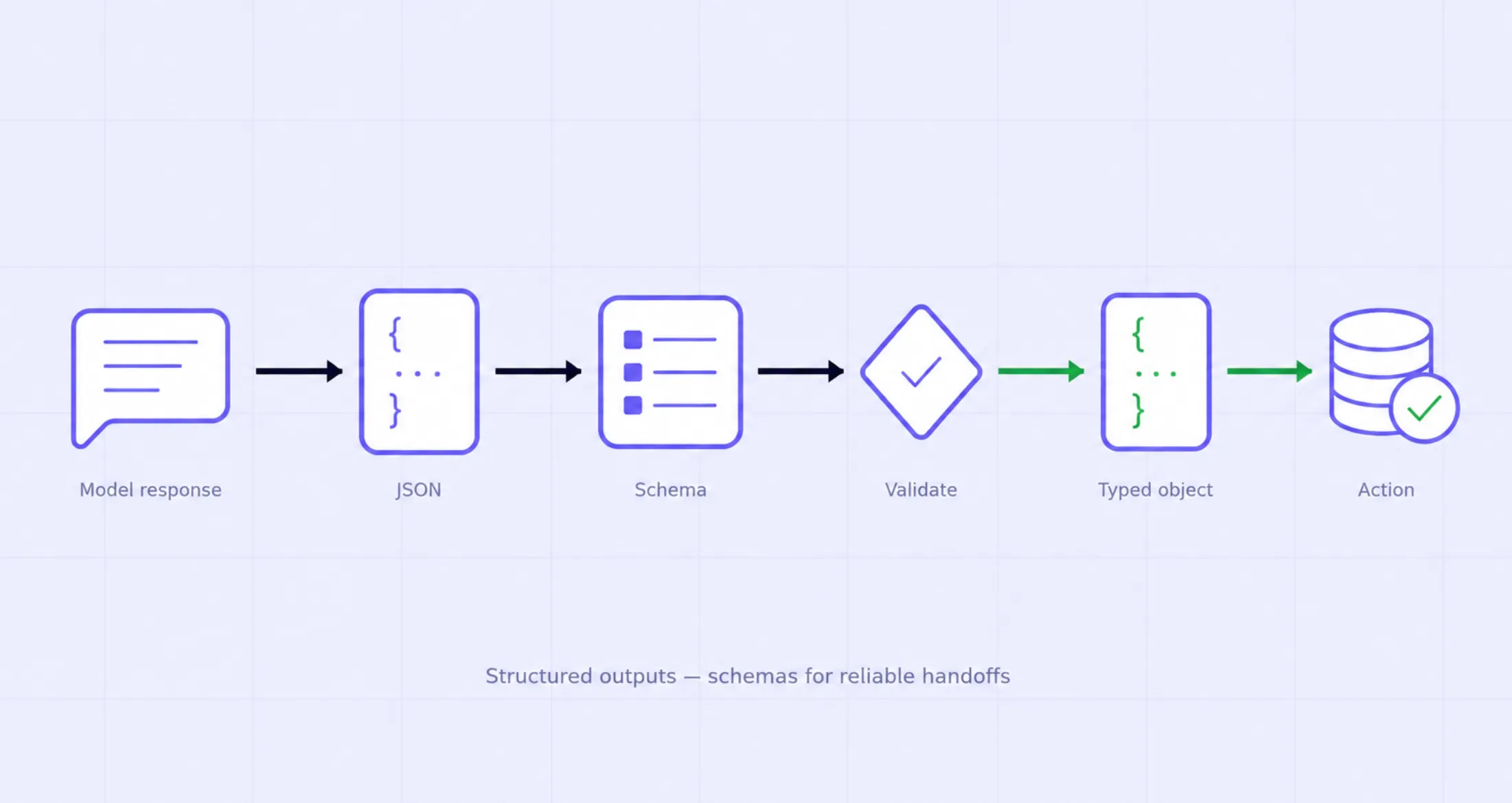
That is why structured outputs are more than a formatting trick. They are one boundary where a probabilistic model meets deterministic software. JSON mode can make syntax predictable. A schema can constrain shape. Pydantic or equivalent application validation can enforce types and local invariants. Business validators check facts and domain rules the schema cannot know. Authorization decides whether a structurally valid object may cause an external action.
free-form text
   ↓
valid JSON
   ↓
schema-conforming object
   ↓
business-valid object
   ↓
authorized action
Each level addresses a different failure mode. Free-form text is expressive but expensive for software to interpret reliably. JSON mode makes parsing predictable. Strict structured-output paths can constrain an object to a declared schema. Application validation checks rules the schema either cannot express or should not be trusted to decide alone—credit limits, resource ownership, deployment environment, whether a customer ID exists, or whether a timestamp is fresh enough for the workflow. Authorization is separate again: a valid request can still be forbidden.
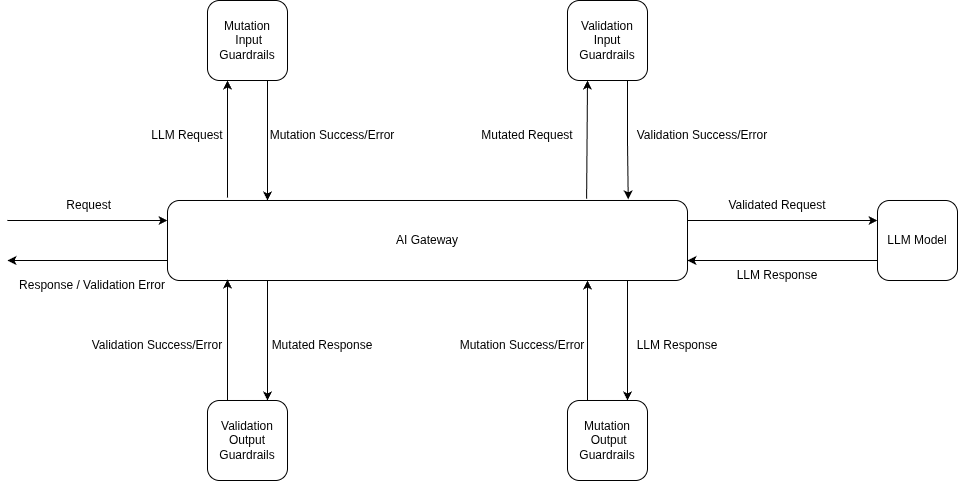
Use JSON mode when you need machine-readable JSON but the exact shape is flexible. TrueFoundry's current Chat Completions documentation describes json_object as valid JSON without structure constraints. That is useful for lightweight extraction, but it should not be confused with a stable API contract.
Use a strict schema when downstream software depends on a stable machine contract and the selected model/provider path supports the schema you need. Required fields, enums, nested structures, arrays, and additionalProperties rules can make the interface substantially more testable.
But “JSON Schema support” is not one universal capability. OpenAI's native Structured Outputs, for example, can constrain successful, non-refused, non-truncated responses to a supplied schema. Other providers support different subsets or semantics. TrueFoundry can bridge unsupported native paths by converting a response schema into a required tool call, but its own provider guidance documents provider-specific constraints—for example, some Anthropic paths do not accept numeric/string constraint keywords such as minimum/maximum or Pydantic's ge/le. A portable API surface is therefore not the same thing as a perfectly portable schema vocabulary.
Even perfect structural adherence can be wrong. A model can emit a syntactically valid date that falls outside the permitted booking window, an order ID with the right type but the wrong tenant, or a refund amount that exceeds policy. Deterministic validators should handle rules that can be expressed deterministically before another model is asked to judge them.
Also distinguish provider conformance from application validation. If a provider or gateway returns a schema-conforming object, your application may still need Pydantic, Zod, a JSON Schema validator, database lookups, policy checks, and postconditions before trusting the object.
Tool calls take the same typed-contract idea into a higher-consequence setting: the object selects an operation and supplies arguments. Schema design therefore becomes part of security design. Narrow enums, explicit required fields, bounded objects, and minimal argument surfaces reduce what the model is able to propose—but authorization and policy must still decide what the caller is actually allowed to do.
TrueFoundry AI Gateway delivers ~3–4 ms latency, handles 350+ RPS on 1 vCPU, scales horizontally with ease, and is production-ready, while LiteLLM suffers from high latency, struggles beyond moderate RPS, lacks built-in scaling, and is best for light or prototype workloads.



.png)


.png)
.png)
.png)

.png)
.png)
.png)
.png)
.png)
.png)
.png)





