


October 1, 2026
|
5 min read


Published: July 4, 2026
Blazingly fast way to build, track and deploy your models!
Getting an LLM agent to work in a demo is satisfying. Getting it to work reliably in production for real users, at scale, day after day is a different discipline entirely.
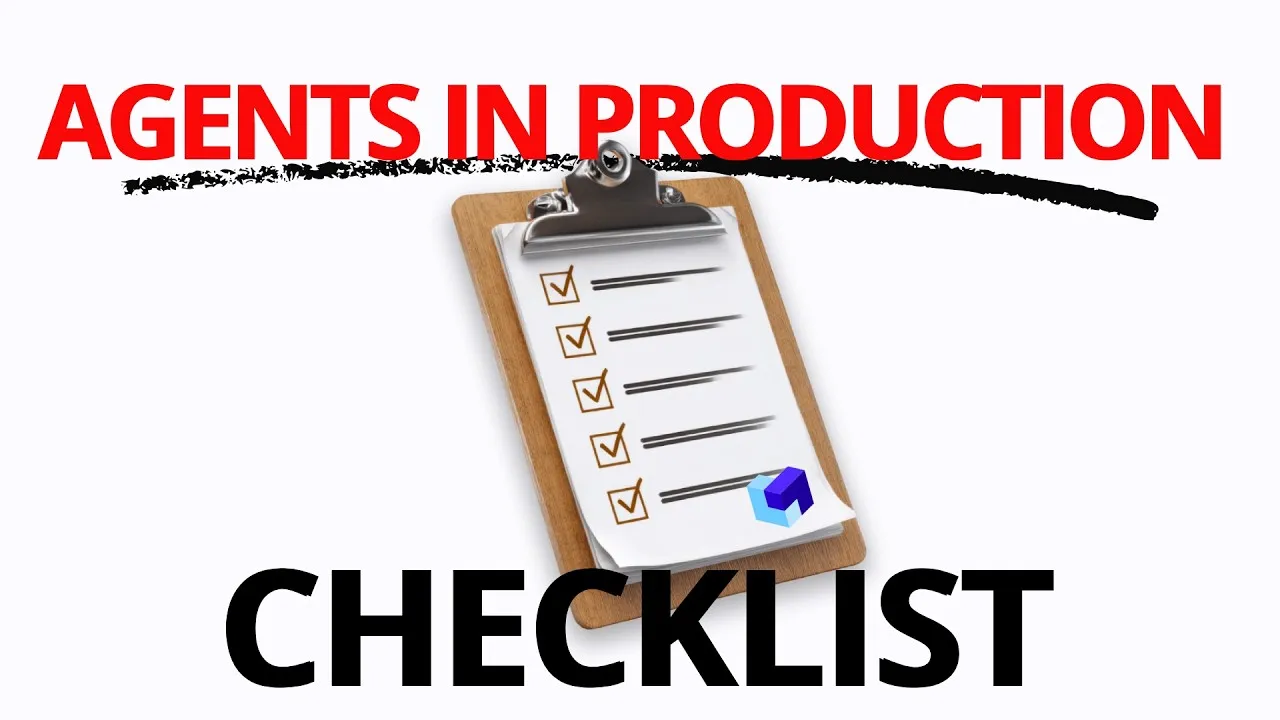
In a recent video, developer educator Sam explored exactly this gap. He laid out a seven-part framework for teams serious about moving beyond the proof of concept. The final three principles he covers, tools and MCP servers, monitoring and tracing, and agent evals, are where most production deployments quietly fall apart. But they sit on top of four foundations that need to be solid first.

This post expands that framework into a complete guide. If you're an engineering team, a CTO, or a founder moving an agentic AI system toward real users, these are the seven things you can't shortcut.
The failure pattern is almost always the same. An agent performs brilliantly in a notebook - one user, controlled inputs, a patient evaluator. Then it meets the real world: concurrent sessions, inconsistent inputs, tool outages, compliance requirements, and users who behave nothing like the test cases.
The models aren't the problem. Today's frontier LLMs are genuinely capable. The problem is the operational layer — everything that wraps around the model. This is what LLMOps is: the discipline of running LLM-based systems in production with the same rigor you'd bring to any critical piece of software. Most teams building LLM agents in production learn its importance the hard way.
Here are the seven pillars.
Prompts are the most fragile part of any LLM system — and most teams treat them like Post-it notes.
In prototypes, prompts live in Python strings inside Jupyter notebooks. Nobody tracks when they changed, what the previous version was, or whether a tweak last Tuesday is why the agent started behaving differently this week. That's fine for experimentation. In production, it's a ticking clock.
When a prompt changes — even subtly — it can silently alter agent behavior in ways that don't show up immediately. A character removed from a system prompt. An instruction reworded. A few-shot example swapped. Each of these is a potential regression with no audit trail.
Prompt management is the bedrock of any serious LLMOps practice. Every other layer of the stack depends on having stable, auditable inputs to the model.
Multi-step agents are stateful. Managing that state cleanly across turns, tool calls, and sessions is one of the hardest unsolved problems in production agentic AI — and one of the least discussed.
An agent in production needs to maintain context within a conversation, across the steps of a multi-tool task, and sometimes even across sessions for returning users. Get any of these wrong and you get agents that forget critical context mid-task, bleed information between users, or arrive at wrong conclusions because they're reasoning over stale state.
The memory question isn't just technical — it's architectural. What lives in the context window? What gets summarized? What persists to a vector store? What gets discarded entirely? There are no universal answers, but there needs to be a deliberate answer for your use case.
Memory management is often treated as an afterthought. In production, it's the difference between an agent that feels coherent and trustworthy and one that feels erratic.
If you're building for one user, skip this section. If you're building for a team, a company, or any multi-tenant use case — and most serious LLM agents in production are — this is non-negotiable from day one.
Multi-user environments introduce a cascade of concerns that don't exist in prototypes: who can invoke which agents, what data can each user access, how are costs attributed, and what's the audit trail when something goes wrong? LLM agents often operate with elevated permissions — they query databases, call external APIs, write to storage. Without proper governance, even a well-intentioned agent becomes a security and compliance liability.
Retrofitting access control onto an agent architecture that wasn't designed for it is expensive and error-prone. Build it in at the start.
In a prototype you call one model. In production you're managing a portfolio: different providers, different model sizes, different latency/cost/capability tradeoffs — and you need intelligent routing between them. This kind of AI agent orchestration — directing the right task to the right model at the right cost — is what separates a production-grade system from a prototype.
An AI gateway is the traffic controller for all your LLM calls. It centralizes API key management, enforces rate limits, routes requests based on cost or task type, provides fallback handling when a provider has an outage, and gives you a single observability surface across every model call in the organization.
Without a gateway, you end up with shadow AI — teams spinning up their own model connections with their own keys, their own costs, and no visibility into what's being called. At scale, this is both a governance failure and a cost problem.
This is one of the three principles Sam covers in detail in the video — and the one he gives the most time to.
Tools are how your agent acts in the world. In the modern agentic ecosystem, MCP (Model Context Protocol) servers have become the standard interface for exposing tools to agents — a structured, discoverable way for an agent to interact with external systems: databases, APIs, code execution environments, search engines, and more.
But tools are also the most common source of silent production failures. An agent that calls a broken tool doesn't fail cleanly. It often spirals — retrying, generating plausible-sounding output based on an error it misread as success, or triggering downstream actions on garbage data. These failures are insidious because they look like agent reasoning failures when the real problem is a broken integration.
Sam's point is direct: every tool needs tests, and authentication needs to be centralized. These aren't nice-to-haves. They're the minimum bar for production.
The best production teams treat tools as first-class services with their own operational lifecycle. If you don't know whether your tools are healthy, you don't know whether your agent is healthy.
Sam's sixth principle — and the one that unlocks everything that comes after it.
Standard APM and logging tools weren't designed for the execution patterns that LLM agents produce. A single agent task might involve a dozen LLM calls, five tool invocations, branching logic, retries, and sub-agent delegation — all non-deterministic, all potentially long-running. A Datadog trace or a CloudWatch log can tell you the response time. It can't tell you why the agent reached the wrong conclusion at step four.
LLM tracing solves this. It follows a complete agent run end-to-end, capturing every prompt sent, every response received, every tool call made, and every branching decision — stitched together into a single inspectable execution graph. Without LLM tracing, debugging a production failure is like reconstructing a conversation from memory.
LLM observability is the broader practice: not just the ability to trace individual runs, but the ability to monitor agent behavior in aggregate — catching cost anomalies, quality regressions, latency outliers, and unusual tool call patterns before users notice them.
Sam frames this as knowing "what's working and what's going wrong." That's the minimum. Done properly, LLM observability also tells you why things are working and why things go wrong — which is the input you need for continuous improvement.
モニタリングこそが エージェント評価 を可能にします。見えないものを評価することはできません。

サムの7番目で最後の原則であり、これで一連のプロセスが完結します。
エージェント評価 によって、本番環境のLLMエージェントが、あなたが行う変更ごとに実際に改善しているのか、悪化しているのかが分かります。
従来のMLでは、評価は比較的明確です。保持されたテストセット、定義されたメトリクス、明確な答えがあります。しかし、エージェントAIではより困難です。出力は長文で多段階にわたります。正確性はしばしば主観的です。エージェントはライブツールと連携するため、評価を実行するだけでも現実世界に副作用をもたらす可能性があります。また、エージェントは非決定論的であるため、同じ入力でも実行ごとに異なる出力を生成する可能性があります。
これらの課題のどれも、 エージェント評価をスキップする言い訳にはなりません。サムの主張は断固たるものです。ユーザーに届く前にリグレッションを捕捉する評価レイヤーなしには、責任を持ってエージェントの変更(新しいプロンプトバージョン、モデルのアップグレード、ツールの変更)をリリースすることはできません。エージェント評価がなければ、あなたは推測しているに過ぎません。
サムが強調する重要な洞察は、エージェント評価は を基盤とすべきだ、ということです。 あなたのLLMの可観測性とトレーシングインフラストラクチャを基盤とすべきだ、ということです。最良の評価ケースは合成されたものではなく、トレースデータから注釈付けされ、キュレーションされた実際のプロダクション実行です。これが、モニタリングが最初に来る理由です。
エージェント評価 はフィードバックエンジンです。LLMオブザーバビリティは「何が起こったか」を教えてくれます。エージェント評価は「十分だったか」を教えてくれます。これらを組み合わせることで、本番環境のLLMエージェントを中断することなく継続的に改善できます。
これらの原則は、選択肢から選ぶチェックリストではありません。これらはシステムであり、その順序が重要です。
プロンプト管理は安定した LLMOps 基盤を提供します。状態とメモリ管理により、エージェントは時間とともに一貫性を保ちます。マルチユーザーアーキテクチャにより、実際のエンドユーザーに安全に公開できます。AIゲートウェイと AIエージェントオーケストレーション レイヤーは、モデルポートフォリオ全体を制御できるようにします。ツールとMCPサーバーにより、エージェントは現実世界で確実に動作できます。モニタリングと LLM observability は、実行時に実際に何が起こっているかを理解するための可視性を提供します。そして エージェント評価 はフィードバックループを閉じ、本番環境のトレースデータを体系的な品質改善へと変えます。
サムのビデオは最後の3つに焦点を当てています。なぜなら、これらはチームが急いでリリースしようとするときに最も見落としがちなものだからです。最初の4つは、デフォルトである程度対処される傾向があります — あなたは ある程度の プロンプトの規律を、 一部の 認証、 一部の モデル管理。しかし、モニタリング、LLMトレース、エージェント評価は、意図的に後回しにされ、その後見直されることのない要素です。まさにその時、本番環境でのインシデントは避けられなくなります。
成功を収めるチームは、 本番環境でのLLMエージェント を扱う上で、どのエージェントフレームワークを使用しているか、どのクラウドを利用しているか、どのようなユースケースを構築しているかに関わらず、7つの要素すべてを真剣に捉えているチームです。
TrueFoundryは、この課題のためにゼロから構築されたエンタープライズAIプラットフォームです。それは、 本番環境でのLLMエージェント を概念実証から運用段階へ移行させるためのものであり、完全な LLMOps スタックとエンタープライズガバナンスをあらゆる層に組み込んでいます。
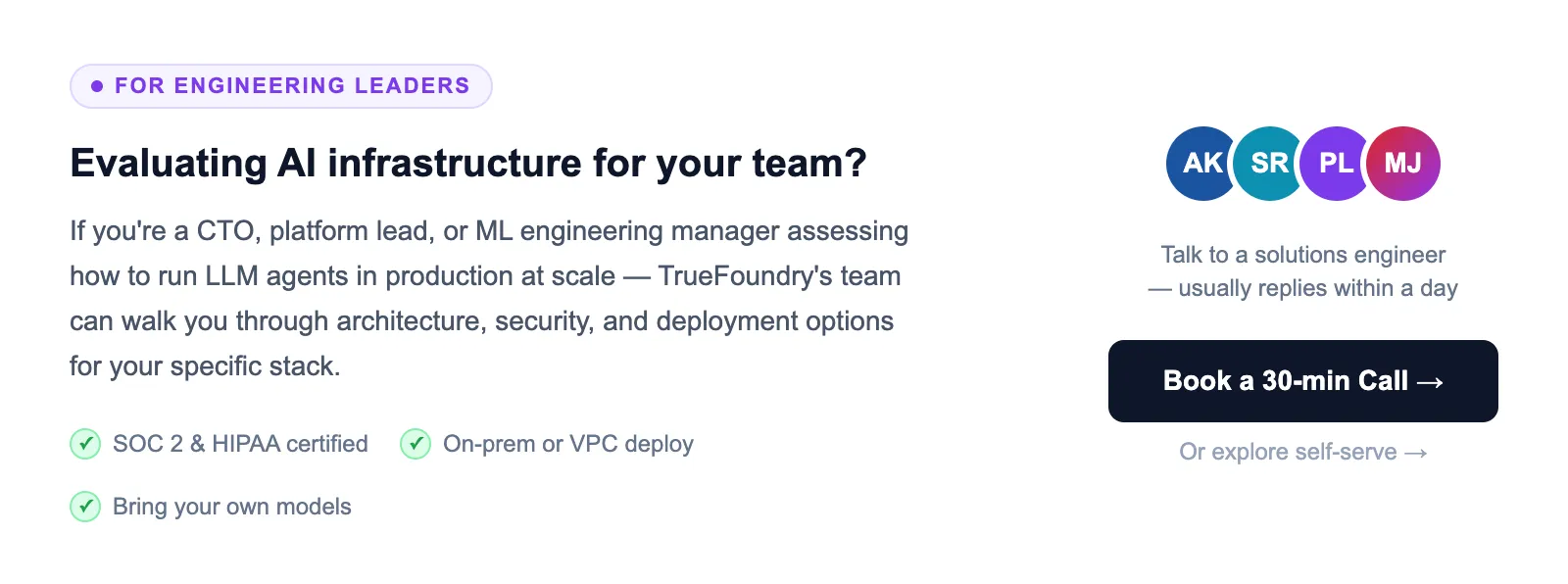
TrueFoundryは7つの要素すべてをカバーしています。
TrueFoundryを利用している顧客は、GPUクラスター利用率が80%向上し、AIエージェントによる価値創出までの時間が3倍高速化し、インフラコストを35~50%削減したと報告しています。
サムは動画の最後にTrueFoundryについて言及しています。「独自のモデルやキーを接続してすぐに使い始めることができ、何かをチームで本番環境に導入するのを容易にします。」
TrueFoundry AI Gateway delivers ~3–4 ms latency, handles 350+ RPS on 1 vCPU, scales horizontally with ease, and is production-ready, while LiteLLM suffers from high latency, struggles beyond moderate RPS, lacks built-in scaling, and is best for light or prototype workloads.



LLMOps(大規模言語モデル運用)とは、LLMを活用したアプリケーションを本番環境で開発、デプロイ、監視、改善するために必要な一連のプラクティス、ツール、インフラストラクチャのことです。MLOpsを拡張した概念であり、生成AI特有の性質である非決定性、プロンプトへの依存性、多段階推論、ツール利用といった課題に対応します。プロンプト管理やモデルルーティングから、LLMの可観測性(オブザーバビリティ)、エージェントの評価に至るまで、幅広い領域をカバーしています。
主な原因として、バージョン管理なしでプロンプトが変更されたことによる予期せぬ不具合の発生、状態管理のミスによるエージェントの混乱やコンテキストの喪失、LLMの可観測性の欠如による障害診断の困難さ、テストされていないツール統合による連鎖的なエラー、そしてエージェント評価の欠如によりユーザーからの指摘があるまで品質低下に誰も気づけないといった点が挙げられます。
LLMオブザーバビリティとは、LLM(大規模言語モデル)やエージェントが実行時にどのような動作をしているかを可視化する手法です。個別の実行レベル(LLMトレーシング:プロンプト、レスポンス、ツール呼び出し、レイテンシ、トークン数)と、集計レベル(ダッシュボード、異常検知、コスト監視)の両面から把握します。これは、本番環境での障害デバッグや、体系的な品質改善を推進するための運用基盤となります。
LLMトレーシングとは、マルチステップのエージェント実行に特化した分散トレーシングの一種です。エージェントタスクの実行グラフ全体(すべてのLLM呼び出し、ツール呼び出し、分岐判断など)を網羅し、それらすべてを検証可能なトレースとして統合します。これにより、非決定的なマルチステップAIシステムで発生した本番環境の障害に対し、根本原因の分析が可能になります。
Agent evals are systematic processes for measuring the quality and reliability of AI agent outputs across prompt versions, model changes, and tool updates. Unlike traditional unit tests, agent evals must handle non-deterministic outputs, multi-step completion, and subjective quality criteria. Best practice combines automated metrics, LLM-as-judge scoring, and human review, ideally drawing test cases from real production traces.
MCP(Model Context Protocol)は、LLMエージェントに対してツールや外部連携機能を構造化された発見可能な形式で提供するためのオープンスタンダードです。MCPサーバーは、エージェントが呼び出し可能なツール群(データベースクエリ、API呼び出し、Web検索、コード実行など)をホストします。本番環境において、MCPサーバーは他のマイクロサービスと同様に、デプロイ、バージョン管理、テスト、監視が行われるべきです。また、MCPツールの認証は個々のツール実装に分散させるのではなく、一元管理する必要があります。
TrueFoundryは、Kubernetesネイティブなエンタープライズ向けAIプラットフォームです。プロンプト管理やマルチテナント対応のアクセス制御から、AIゲートウェイ、MCPサーバーのデプロイ、LLMトレーシング、評価インフラまで、LLMOpsの全スタックを網羅しています。エージェント型AIシステムを概念実証(PoC)から本番環境へと移行させるチーム向けに設計されており、エンタープライズレベルのガバナンス機能が標準で備わっています。
.png)
.png)
.png)
.png)
.png)
.png)
.png)
.png)
.png)
.png)
.png)





