


October 1, 2026
|
5 min read


Published: August 24, 2026
Blazingly fast way to build, track and deploy your models!
LiteLLMは、無料で利用でき、コミュニティによって維持されているオープンソースのプロキシです。インフラストラクチャを完全に制御したい、強力なDevOpsの専門知識を持つチームに最適で、エンタープライズSLAや専用サポートなしでセルフホスティングの複雑さに対応できるチーム向けです。
LiteLLM AI Gatewayは、OpenAI互換の形式を使用して100以上のLLM APIを呼び出すための統一されたインターフェースを提供する、オープンソースのPython SDKおよびプロキシサーバーです。このプロジェクトは、OpenAI、Anthropic、Azure、Vertex AI、Bedrockなど、さまざまなLLMプロバイダー間でのLLM呼び出しを標準化するためのシンプルなラッパーライブラリとして始まりました。
ホスト型インフラストラクチャとエンタープライズサポートを提供するマネージドAIゲートウェイとは異なり、LiteLLM AI Gatewayは根本的に異なるモデルで動作します。オープンソースコードをダウンロードし、自身のインフラストラクチャにデプロイし、自身で保守します。LiteLLM AI Gateway自体によって課される従量課金、ログ制限、リクエストクォータはありません。
しかし、この「無料」のアプローチには、多くのチームが評価時に過小評価しがちな隠れたコストが伴います。
LiteLLMの料金設定の哲学はシンプルです。ソフトウェアは無料(MITライセンス)ですが、運用上の負担はすべてユーザーが負うことになります。
1. LiteLLM ソフトウェアライセンス
プロキシサーバーソフトウェア自体は0ドルです。フォーク、変更、商用利用がライセンス料なしで可能です。このため、チームはインフラストラクチャ費用をより広範な LLMライセンス、特に、ソフトウェア、サポート、ガバナンスを1つの契約にまとめているオープンソースゲートウェイと商用AIプラットフォームのどちらを選択するかを決定する際に顕著です。
2. インフラストラクチャ費用
サーバー、データベース、監視ツール、ロードバランシング、およびすべてのサポートインフラストラクチャの費用を支払います。中程度のトラフィックを処理する本番環境のデプロイメントの場合、一般的なインフラストラクチャ費用は、トラフィック量、冗長性の要件、およびクラウドプロバイダーによって月額200ドルから500ドルです。
3. LLMプロバイダー費用
LLMプロバイダー(OpenAI、Anthropicなど)には、標準のAPI料金で直接支払います。LiteLLMは、マークアップや取引手数料を追加しません。
2024年、LiteLLMは追加機能とサポートを求めるチーム向けに、商用エンタープライズサービスを導入しました。
LiteLLMを検討しているほとんどのチームは、これらのエンタープライズ向けプランではなく、無料のオープンソース版を検討しています。
エンジニアリングチームがLiteLLMの価格を評価する際、総所有コスト(TCO)を考慮せずに0ドルの価格に注目しがちです。本番環境で発生する隠れたコストは以下の通りです。
LiteLLMゲートウェイを本番環境で稼働させるには、以下のための専門的なエンジニアリング時間が必要です。
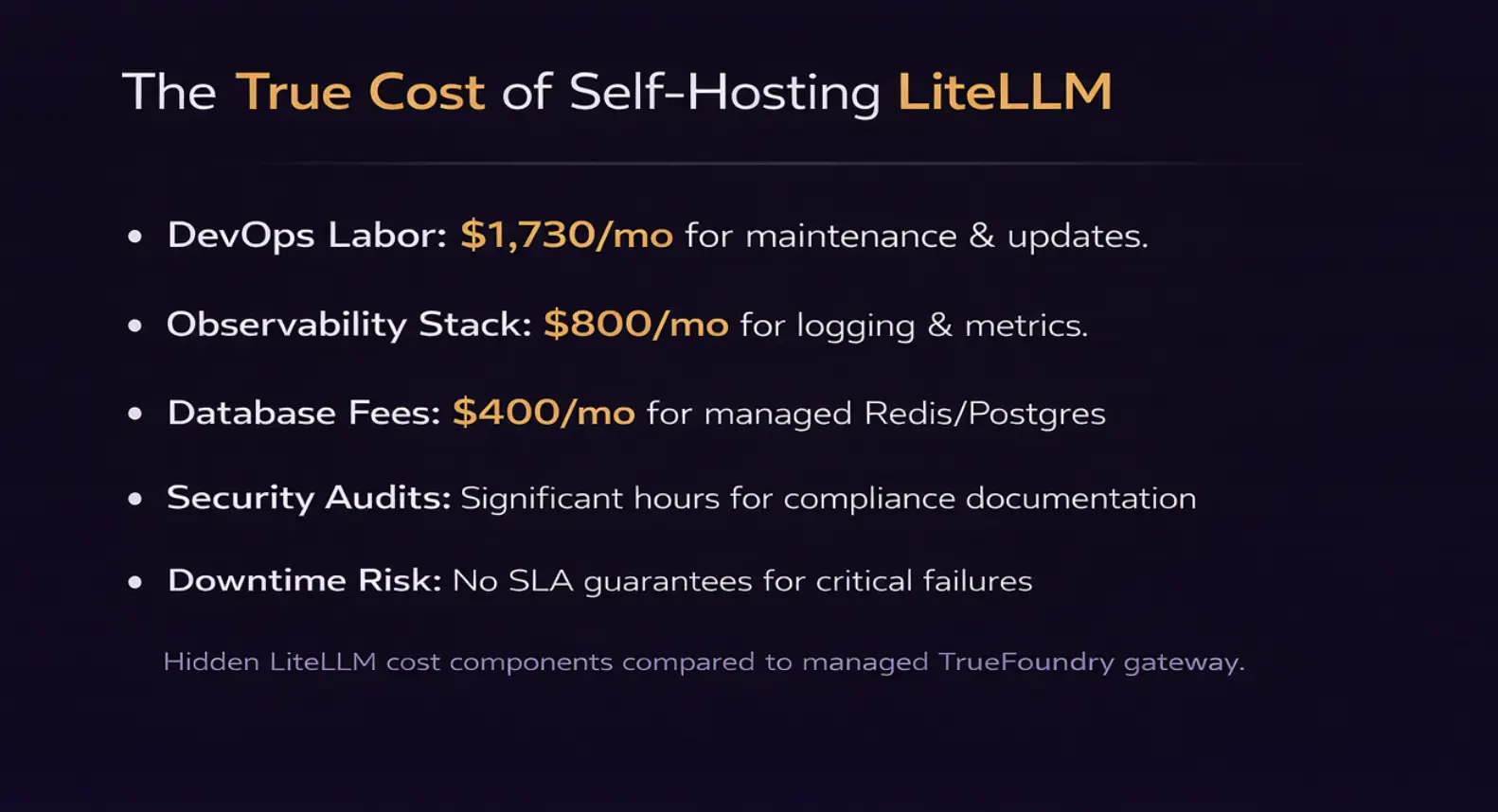
年俸15万ドルのシニアDevOpsエンジニアの場合、毎月20時間のメンテナンスは月あたり約1,730ドルの人件費に相当します。
オープンソース版のLiteLLMゲートウェイの機能には、そのままでは本番環境レベルの可観測性は含まれていません。以下の統合が必要です。
このオブザーバビリティスタックのセットアップと維持には、インフラコストとして月額200ドルから800ドルが追加でかかり、さらに設定とチューニングのためのエンジニアリング時間も必要です。
LiteLLMプロキシには、以下の目的でデータベース(通常はPostgreSQLまたはRedis)が必要です。
本番環境のLLMデプロイメントには、バックアップ、レプリケーション、高可用性を備えたマネージドデータベースサービスが必要です。規模に応じて月額100ドルから400ドルを見込んでください。
ベンダーがセキュリティアップデートを管理しない場合、チームは以下の責任を負います。
コンプライアンス要件を持つ企業にとって、ベンダー提供のセキュリティ認証やSLAがないことは、監査上の大きな問題を引き起こします。
LiteLLM AIはコミュニティによって維持されており、次のことを意味します:
スタートアップや小規模チームにとっては、このコミュニティ主導のモデルはうまく機能するかもしれません。しかし、何百万ものユーザーにサービスを提供するミッションクリティカルなAIアプリケーションを運用する企業にとって、専用サポートがないことは大きなリスクとなります。
価格: ソフトウェアライセンス料は0ドル | インフラストラクチャ: 通常月額200ドル~500ドル
こんな方におすすめ: DevOpsの能力が高く、インフラを完全に制御したい、セルフホスティングの複雑さにも対応できるチーム。
オープンソース版には、100以上のLLMプロバイダーへの統合APIアクセス、仮想キー管理、キー/ユーザーごとの予算追跡、ロードバランシングとフォールバックルーティング、レート制限 (RPM/TPM)、Langfuse、LangSmith、OpenTelemetryロギングとの連携が含まれます。
お客様が管理するもの:
TCOの具体例:
AWS上でLiteLLM Gatewayを本番稼働させている中規模チーム(月間100万~500万リクエストの中程度のトラフィック)の場合、一般的な月額費用は以下のようになります。
これには、初期セットアップ時間(2~4週間)やインシデント対応費用は含まれません。
価格: $250/月 | デプロイ: クラウドまたはセルフホスト
こんな方におすすめ: エンタープライズ機能が必要だが、インフラ管理は自社で行いたいチーム
Enterprise Basicでは、Prometheusメトリクスとカスタムコールバック、コンテンツフィルタリングのためのLLMガードレール、APIセキュリティのためのJWT認証、SSO統合 (Okta、Azure AD)、コンプライアンスのための監査ログが追加されます。
引き続きお客様が管理するもの:
The $250/month fee covers software licensing and access to LiteLLM gateway features, but you still handle all operational aspects. Total TCO is $250 + infrastructure costs ($300-$700) + DevOps time ($1,730) = approximately $2,280-$2,680/month.
Price: $30,000 annually ($2,500/month) | Deployment: Cloud or self-hosted
Best For: Large organizations with substantial token usage who need advanced compliance features and priority support
Enterprise Premium includes all Enterprise Basic features plus priority support with faster response times, dedicated account management, custom feature development, and assistance with compliance certifications (SOC 2, HIPAA).
What You Still Manage:
Total TCO is $2,500 + infrastructure costs ($300-$700) + reduced DevOps time (10-15 hrs, approximately $865-$1,300) = approximately $3,665-$4,500/month.
Here's how LiteLLM pricing compares to managed AI gateway alternatives across pricing models and operational burden:
Key Insight: LiteLLM's TCO remains relatively flat because labor costs dominate. At low volumes (<500K requests/month), LiteLLM AI is actually more expensive than managed alternatives when you account for DevOps time. LiteLLM only becomes cost-competitive at very high scales (>50M requests/month) where the $2,500-$3,500 monthly TCO is significantly less than enterprise pricing from managed vendors.
LiteLLM gateway self-hosted model is ideal for specific use cases where operational control justifies the DevOps burden:
If your team already runs complex infrastructure (Kubernetes, observability stacks, CI/CD pipelines) and has dedicated platform teams, the incremental cost of managing LiteLLM AI gateway is relatively low. Your DevOps team can integrate LiteLLM into existing infrastructure-as-code workflows without significant overhead.
Ideal Profile:
For teams with strict data residency requirements, air-gapped environments, or regulatory constraints that prohibit third-party SaaS vendors, self-hosting is often the only option. LiteLLM AI provides a production-ready proxy that you can deploy entirely within your controlled environment.
Use Cases:
If you're building an AI application platform that serves other businesses (B2B2C model), you may want to manage the gateway infrastructure yourself to:
Self-hosting LiteLLM gateway gives you complete control to modify the proxy code for your specific platform requirements.
At extremely high request volumes, the fixed costs of DevOps labor become a smaller percentage of total spend. A $3,500/month TCO for infrastructure and maintenance is attractive when managed vendor pricing reaches $20,000-$50,000/month at equivalent scale.
Breakeven Analysis:
If your use case is straightforward (basic load balancing, simple fallback routing, minimal observability), LiteLLM gateway features in the open source set may suffice. Teams that don't require semantic caching, prompt registries, advanced RBAC, or compliance certifications can avoid paying for enterprise features they won't use.
Despite the $0 software license, many enterprises and high-growth startups choose managed AI gateways over LiteLLM for several reasons:
Deploying and configuring LiteLLM for production takes 2-4 weeks of engineering time. For startups racing to launch new AI features or enterprises with aggressive roadmaps, this setup time represents opportunity cost. Managed gateways like TrueFoundry or Portkey offer instant deployment with production-grade infrastructure in minutes, not weeks.
Example Scenario: A fintech startup is launching an AI-powered financial advisor chatbot. Delaying launch by 3 weeks to set up LiteLLM infrastructure means lost revenue, competitive disadvantage, and missed investor milestones. The team opts for TrueFoundry's managed gateway to launch in 2 days instead of 3 weeks.
Every hour your DevOps team spends managing LiteLLM infrastructure is an hour not spent building product features that differentiate your business. For most companies, the AI gateway is critical infrastructure but not a competitive advantage in itself.
Opportunity Cost Calculation:
Community-maintained open source projects don't provide uptime SLAs or legally binding support commitments. If a critical bug in LiteLLM causes your production AI application to fail, you're dependent on GitHub issues and community response times.
Risk Scenario: Your AI customer support chatbot (serving 100K users daily) goes down due to a LiteLLM proxy bug. Without vendor SLA commitments, you have no recourse for damages, no guaranteed fix timeline, and no dedicated support engineer to investigate. Your reputation and customer trust suffer.
Managed vendors provide 99.9% uptime SLAs with financial penalties if they fail to meet commitments.
LiteLLM focuses on basic proxy functionality (unified API, load balancing, rate limiting). It lacks advanced capabilities that modern AI applications need:
For teams building sophisticated agentic AI applications, these missing features force additional engineering work or push teams toward managed platforms.
During SOC 2, ISO 27001, or HIPAA audits, self-hosted infrastructure creates documentation overhead. You must demonstrate:
Managed vendors provide pre-certified infrastructure and audit support, reducing compliance burden significantly.
TrueFoundry offers a fully managed AI gateway that eliminates LiteLLM's operational burden while providing enterprise-grade features for agentic AI applications.
1. Zero Infrastructure Management
TrueFoundry handles all server provisioning, scaling, monitoring, security patches, and incident response. Your team deploys AI applications in minutes without touching Kubernetes, databases, or Docker containers.
2. Built for Agentic AI with MCP
TrueFoundry natively supports Model Context Protocol (MCP), enabling sophisticated agentic workflows where AI models interact with external tools, databases, and APIs. This is critical for modern AI applications that go beyond simple chat interfaces.
3. Better Cost Structure for Growth
While LiteLLM's TCO remains flat at $2,000-$3,500/month regardless of usage, TrueFoundry offers:
4. Enterprise Governance from Day One
Unlike LiteLLM which requires Enterprise Premium ($30K/year) for compliance features, TrueFoundry Pro ($499/month) includes:
5. VPCおよびオンプレミスデプロイ データレジデンシー要件を持つ企業向けに、TrueFoundryはエンタープライズティア(Portkeyと同様)でVPCおよびオンプレミスデプロイを提供します。これにより、基盤となるインフラストラクチャの管理は不要です。運用負担なしに、セルフホスティングの制御上のメリットが得られます。
シナリオ1:急成長中のAIスタートアップ
AIコーディングアシスタントを構築しているシリーズAのスタートアップは、迅速な立ち上げ、予測不能な規模でのスケーリング、そしてインフラ管理ではなく製品差別化へのエンジニアリングリソースの集中を必要としています。TrueFoundryのマネージドプラットフォームは、組み込みの可観測性、ガードレール、エージェントワークフロー向けのMCPサポートにより、2日間でゼロから本番環境への移行を可能にします。
シナリオ2:コンプライアンス要件を持つ企業
AIを活用した臨床意思決定支援を構築しているヘルスケア企業は、HIPAA準拠、監査ログ、保証された稼働時間SLAを必要としています。LiteLLMをセルフホストすると、監査のオーバーヘッドとサポートのリスクが大幅に増加します。TrueFoundryは、BBA(事業提携契約)と専任のコンプライアンスサポートを備えた事前認証済みインフラストラクチャを提供します。
シナリオ3:マルチモデルエージェントアプリケーション
フィンテック企業は、複数のモデル(会話にはGPT-4、分析にはClaude、マルチモーダルにはGemini、特殊なタスクにはオープンソースモデル)を使用するAI金融アドバイザーを構築しており、ツール呼び出しのオーケストレーション、会話コンテキストの維持、セマンティックキャッシュの実装を必要としています。LiteLLMは基本的なロードバランシングを提供しますが、MCPサポートとセマンティックキャッシュが不足しています。TrueFoundryの専用エージェントAIプラットフォームは、その複雑さをネイティブに処理します。
LiteLLMの価格設定と「無料のオープンソース」という約束は魅力的ですが、現実はより複雑です。ソフトウェアライセンス費用は0ドルですが、本番環境でのデプロイにおける総所有コスト(インフラ、人件費、監視、サポート)は通常、月額2,000ドルから3,500ドルの範囲です。このため、LiteLLMは、低~中程度のリクエスト量(月間500万リクエスト未満)では、マネージドサービスよりも高価になります。
LiteLLMは、データレジデンシー、エアギャップ環境、または高度にカスタマイズされたプラットフォーム要件のために完全なインフラ制御を必要とする、強力なDevOps専門知識を持つチームに適しています。また、固定DevOpsコストが総支出に占める割合が小さくなる大規模なスケール(月間5,000万リクエスト超)でも費用対効果が高くなります。
しかし、2026年にAIゲートウェイを評価するほとんどのチームにとって、LiteLLMをセルフホストする運用負担は、ライセンス費用削減のメリットを上回ります。主なデメリットは次のとおりです。
TrueFoundryは、運用上の負担をなくし、最新のAIアプリケーション向けに優れた機能を提供するマネージドな代替手段を提供します。エージェントワークフロー向けのネイティブMCPサポート、セマンティックキャッシュ、包括的な可観測性、およびProティア(月額499ドル)のエンタープライズガバナンス機能を備え、TrueFoundryはインフラ管理よりもAI製品の構築に注力するチームにとって、より優れた価値を提供します。
チームに専任のプラットフォームエンジニアがいて、自己ホスティングを必要とする厳格に規制された環境で運用している、または月間5,000万リクエストを超えるトラフィックを処理している場合は、LiteLLMを検討する価値があります。それ以外の場合、TrueFoundryのようなマネージドプラットフォームは、より迅速なデプロイ、一般的な規模でのTCOの削減、およびLiteLLMが提供しないエンタープライズ機能を提供します。
適切な選択は、チームの強みによって異なります。インフラ運用が中核的な能力であり競争上の優位性であるならば、LiteLLMを自己ホストしてください。AI製品開発があなたの焦点であるならば、マネージドプラットフォームを選択し、ビジネスを差別化する機能にエンジニアリング時間を投資してください。
ソフトウェアライセンスは無料ですが、総所有コストにはインフラストラクチャ(月額200~500ドル)、DevOps人件費(月額1,500~2,000ドル)、監視ツール(月額200~800ドル)、およびインシデント対応費用が含まれます。本番環境でのデプロイにおける実際のTCOは通常、月額2,000~3,500ドルに及び、これは低~中程度のリクエスト量におけるマネージドな代替手段よりも高額です。
はい、LiteLLMはロードバランシング、データベースレプリケーション、水平スケーリングを用いてインフラストラクチャを適切に設計すれば、高リクエスト量を処理するためにスケールできます。ただし、キャパシティプランニング、パフォーマンスチューニング、インシデント対応のすべては、お客様の責任となります。マネージドベンダーがこの複雑さを処理します。
いいえ、LiteLLMは現在、MCPをネイティブにサポートしていません。基本的なルーティングと可観測性を備えたLLMプロバイダーへのリクエストのプロキシに重点を置いています。高度なエージェントAIワークフローには、ネイティブMCPサポートを備えたTrueFoundryのようなプラットフォームが必要です。
LiteLLMのオープンソースコードは監査可能であり、これは徹底的なコードレビューを実施できるチームにとってセキュリティ上の利点です。ただし、脆弱性パッチ適用、依存関係の更新、アクセス制御、シークレット管理、監査ログ記録など、すべてのセキュリティ運用はお客様の責任となります。マネージドベンダーは、SOC 2認定インフラストラクチャ、専任のセキュリティチーム、および自動パッチ管理を提供し、セキュリティ運用上の負担を大幅に軽減します。
GitHubのイシューを介したコミュニティの対応に依存することになります。修正の保証されたタイムライン、専任のサポートエンジニア、SLAのコミットメントはありません。ミッションクリティカルなアプリケーションにとって、このサポートリスクは許容できない場合があります。LiteLLM Enterprise Premium(年間3万ドル)は優先サポートを提供しますが、それでもインフラストラクチャの管理はお客様が行う必要があります。マネージドベンダーは、保証された応答時間で24時間年中無休のサポートを提供します。
はい、ただし移行の複雑さは、LiteLLMをどの程度深くカスタマイズしたかによって異なります。標準機能(統合API、基本的なルーティング)を使用している場合、TrueFoundryやPortkeyはOpenAI互換APIを提供しているため、それらへの移行は簡単です。LiteLLMのコードを大幅に修正したり、カスタム統合を構築したりしている場合、移行にはより多くのエンジニアリング作業が必要です。マネージドプラットフォームから始めることで、将来の移行リスクを軽減できます。
TrueFoundry AI Gateway delivers ~3–4 ms latency, handles 350+ RPS on 1 vCPU, scales horizontally with ease, and is production-ready, while LiteLLM suffers from high latency, struggles beyond moderate RPS, lacks built-in scaling, and is best for light or prototype workloads.



.png)
.png)
.png)
.png)
.png)
.png)
.png)
.png)
.png)
.png)
.png)





